A HubSpot AEO vs Botify comparison helps answer one simple question: Do you need visibility or depth? HubSpot AEO is designed to show how your brand appears in AI-generated answers. Botify is designed to help teams understand and improve the technical side of search.
So the choice is less about which tool is better overall and more about what you need right now. HubSpot AEO makes AEO work easier. Botify is better for teams that need full-site SEO analysis.
In this HubSpot AEO vs Botify comparison, we’ll review both and compare them head-on to help you choose.
Disclaimer: This content contains some affiliate links for which we will earn a commission (at no additional cost to you). This is to ensure that we can keep creating free content for you.
HubSpot AEO vs Botify: The Summary Box
| HubSpot AEO | Botify |
 |  |
| HubSpot AEO helps brands monitor and improve how they appear in AI answers. It is built into HubSpot’s marketing software and combines brand visibility tracking, prompt suggestions, and content actions. | Botify is an AI search optimization platform built for broader search performance, not just AEO. It combines data, intelligence, and action to help teams improve visibility across AI search, SEO, and technical workflows. |
HubSpot AEO
- HubSpot AEO helps brands monitor and improve how they appear in AI answers. It is built into HubSpot’s marketing software and combines brand visibility tracking, prompt suggestions, and content actions.
Botify
- Botify is an AI search optimization platform built for broader search performance, not just AEO. It combines data, intelligence, and action to help teams improve visibility across AI search, SEO, and technical workflows.
HubSpot AEO vs Botify: Product Ratings
| HubSpot AEO | Botify | |
| Overall | ||
| Support | ||
| Features | ||
| User-Friendliness | ||
| Value for Money |
HubSpot AEO
- Overall:
- Support:
- Features:
- User-Friendliness:
- Value for Money:
Botify
- Overall:
- Support:
- Features:
- User-Friendliness:
- Value for Money:
Pros and Cons: HubSpot AEO
| Pros | Cons |
| Easy to use | Limited technical depth |
| AEO-focused insights | New tool; still evolving |
| Actionable recommendations | |
| Strong prompt tracking | |
| Quick setup |
Pros
- Easy to use
- AEO-focused insights
- Actionable recommendations
- Strong prompt tracking
- Quick setup
Cons
- Limited technical depth
- New tool; still evolving
Pros and Cons: Botify
| Pros | Cons |
| Deep technical SEO | Steep learning curve |
| Enterprise-level insights | Requires SEO expertise |
| Offers both AEO and SEO | Complex setup |
| Strong data integration |
Pros
- Deep technical SEO
- Enterprise-level insights
- Offers both AEO and SEO
- Strong data integration
Cons
- Steep learning curve
- Requires SEO expertise
- Complex setup
Pricing Details: HubSpot AEO
| Plan | Cost (Per Month) |
| HubSpot AEO | $50 |
| HubSpot Marketing Hub Professional (AEO Included) | Starts at $800 |
| HubSpot Marketing Hub Enterprise (AEO Included) | Starts at $3,600 |
- HubSpot AEO (Standalone) $50
- HubSpot Marketing Hub Professional Starts at $800
- HubSpot Marketing Hub Enterprise Starts at $3,600
Pricing Details: Botify
| Plan | Cost (Per Month) |
| Botify | Custom pricing |
- Botify Custom pricing
Verdict: For most teams, HubSpot AEO is the better fit for AEO work, and Botify is the better fit for technical SEO. HubSpot keeps the focus on AI answer visibility, while Botify goes wider with search intelligence, crawl data, and technical optimization at scale.
HubSpot AEO vs Botify: Who Is It For?
| HubSpot | Botify |
| Small marketing teams | Enterprise marketing teams |
| Existing HubSpot users | Technical SEO teams |
| Growth-focused startups | Businesses with a complex site structure |
| Teams that want to boost AEO | Those who want an AEO + SEO tool |
HubSpot
- Small marketing teams
- Existing HubSpot users
- Growth-focused startups
- Teams that want to boost AEO
Profound
- Enterprise marketing teams
- Technical SEO teams
- Businesses with a complex site structure
- Those who want an AEO + SEO tool
HubSpot AEO vs Botify: Features Comparison
| HubSpot | Botify | ||
| AI Visibility Tracking | Visibility tracking across AI models | ||
| AI visibility score | |||
| Prompt Tracking and Suggestions | Prompt tracking | ||
| Topic discovery | |||
| Citation and Source Analysis | Citation tracking against Competitors | ||
| Source analysis | |||
| Competitor mention tracking | |||
| Competitor Analysis | AI Share of Voice | ||
| Gap identification | |||
| AI insights to boost visibility | |||
| Actionable Recommendations | Plain-language suggestions | ||
| Built-in content actions |
HubSpot
- AI Visibility Tracking
- Visibility tracking across AI models
- AI visibility score
- Prompt Tracking and Suggestions
- Prompt tracking
- Topic discovery
- Citation and Source Analysis
- Citation tracking against Competitors
- Source analysis
- Competitor Analysis
- Competitor mention tracking
- AI Share of Voice
- Gap identification
- Actionable Recommendations
- AI insights to boost visibility
- Plain-language suggestions
- Built-in content actions
Botify
- AI Visibility Tracking
- Visibility tracking across AI models
- AI visibility score
- Prompt Tracking and Suggestions
- Prompt tracking
- Topic discovery
- Citation and Source Analysis
- Citation tracking against Competitors
- Source analysis
- Competitor Analysis
- Competitor mention tracking
- AI Share of Voice
- Gap identification
- Actionable Recommendations
- AI insights to boost visibility
- Plain-language suggestions
- Built-in content actions
Verdict: If your main goal is AI visibility, HubSpot AEO is the better pick. It is built to track and improve how your brand shows up in AI results. Botify is better suited to teams that need crawl data, log data, and deeper technical SEO support.
Table of Contents
Detailed Review: HubSpot AEO
In this section of our HubSpot AEO vs Botify comparison, we’ll look at the former’s key features.
AI Visibility Tracking and Sentiment Analysis
Brand visibility and sentiment analysis is one of the most useful parts of HubSpot AEO. It shows how often your brand appears in AI answers and how those mentions are framed.
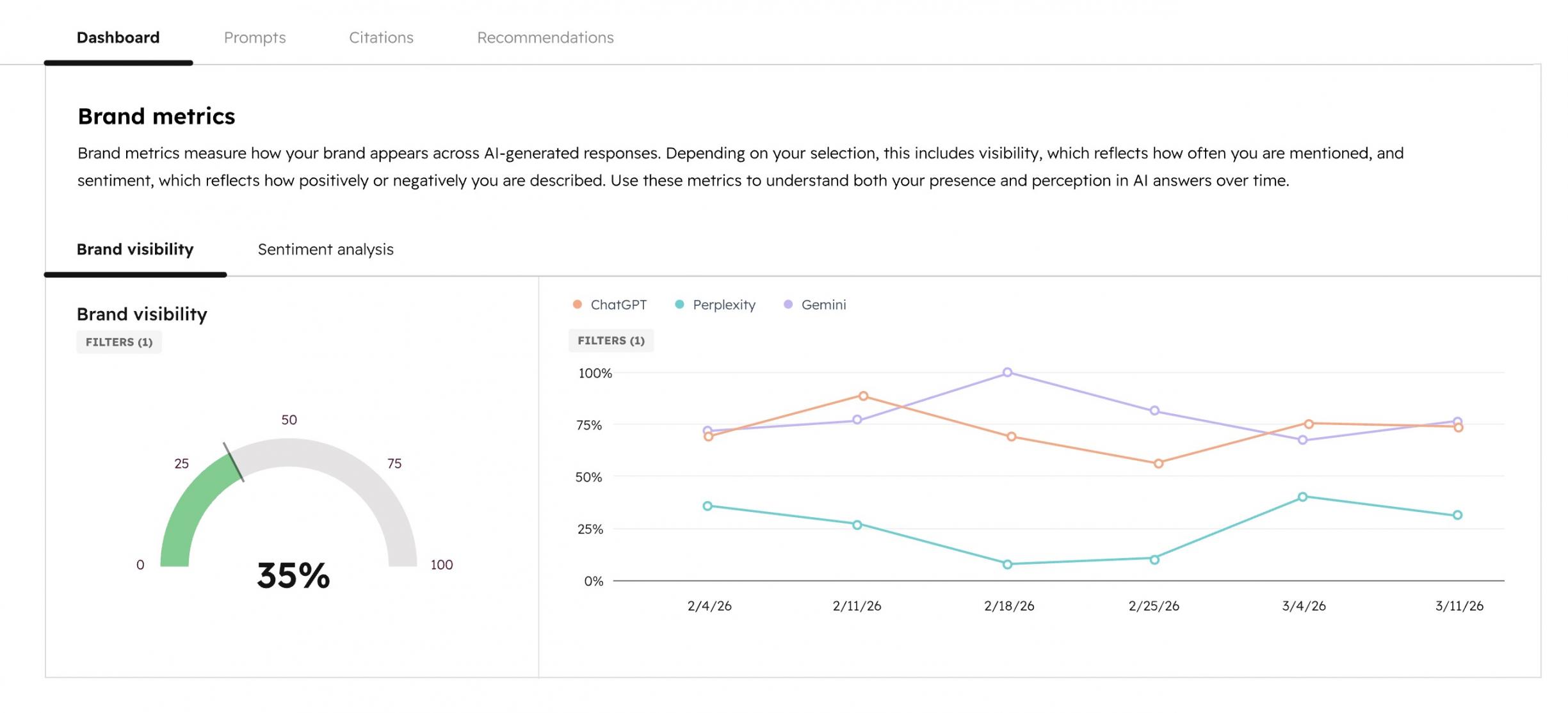
Image via HubSpot
That matters because AI search visibility is not the only thing that matters. You also need to know whether the mention is helping or hurting your brand.
In a HubSpot AEO vs Botify comparison, HubSpot feels more direct and easier to read. It gives you a fast view of brand presence and sentiment without making you dig through too much data. Botify can also help track AI visibility, AI citations, and related search signals, but it is built more like a broader enterprise AI SEO platform.
So the main takeaway is this: HubSpot is the better fit when you want a simple view of brand visibility and sentiment. Botify is stronger when you need broader SEO intelligence around that same visibility.
Prompt Tracking and Suggestions
This feature helps you see which prompts are driving visibility and which ones deserve more attention. That matters because AI search is still messy, and you need a way to narrow down the queries that really matter for your brand.
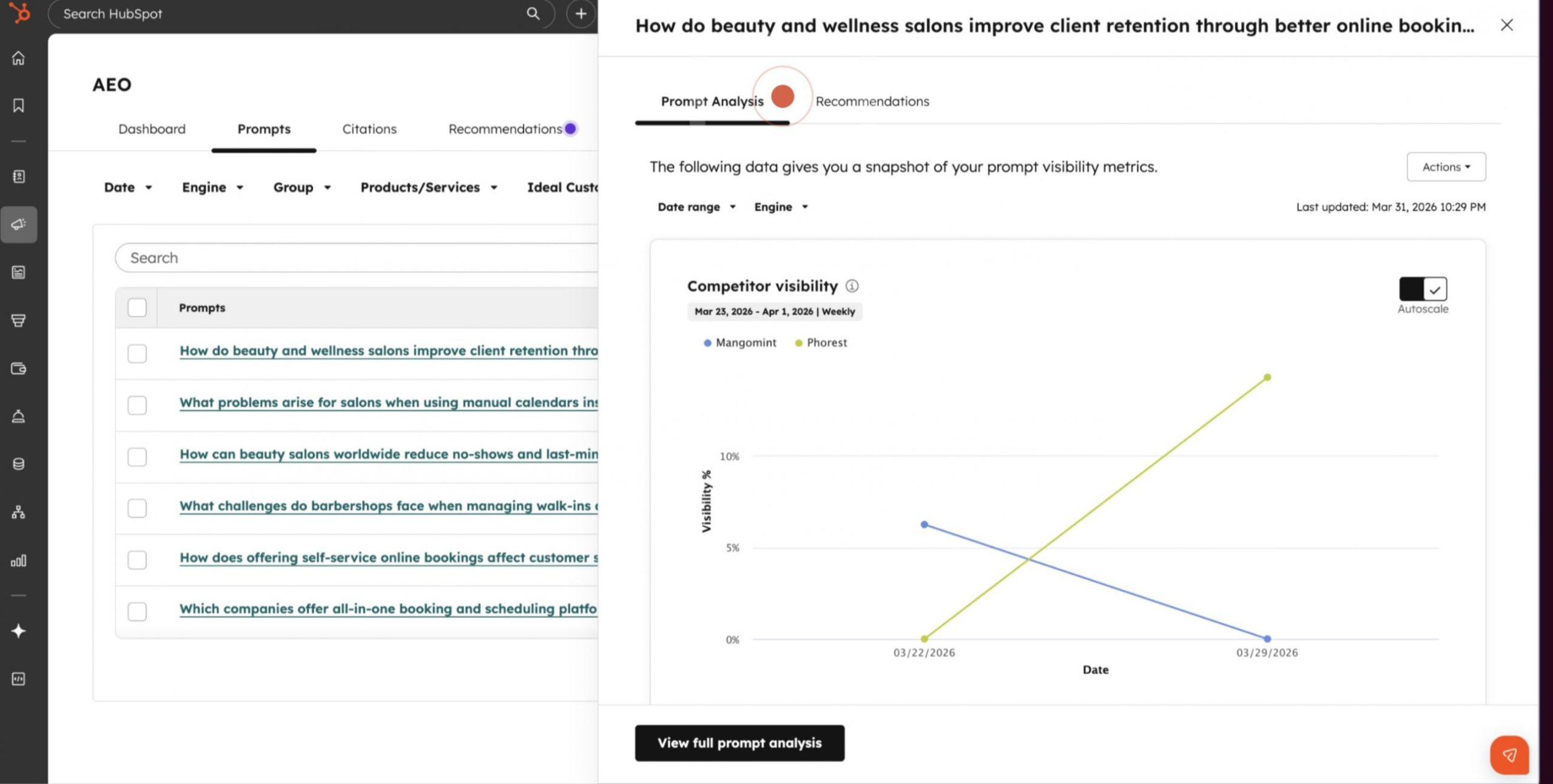
Image via HubSpot
When comparing HubSpot AEO vs Botify, HubSpot is the simpler option for prompt discovery and guidance. It is designed to help you act quickly. It helps teams spot useful prompts and understand where they stand without getting buried in technical layers.
Botify also brings AI search visibility into the picture, but it leans more toward broader SEO analysis and site-level signals than prompt-level guidance.
So the takeaway is that HubSpot is the better pick when you want simple prompt guidance and faster action. Botify is more powerful in the wider SEO sense, but HubSpot is easier for prompt tracking.
Citation and Source Analysis
Citation and source analysis is one of the more useful parts of HubSpot AEO. It helps you see what sources are being pulled into AI answers and which content types are getting attention. That gives you a better sense of what AI platforms trust when they generate responses.
One area where HubSpot AEO shines is its citation analysis, which lets you compare your performance against competitors.
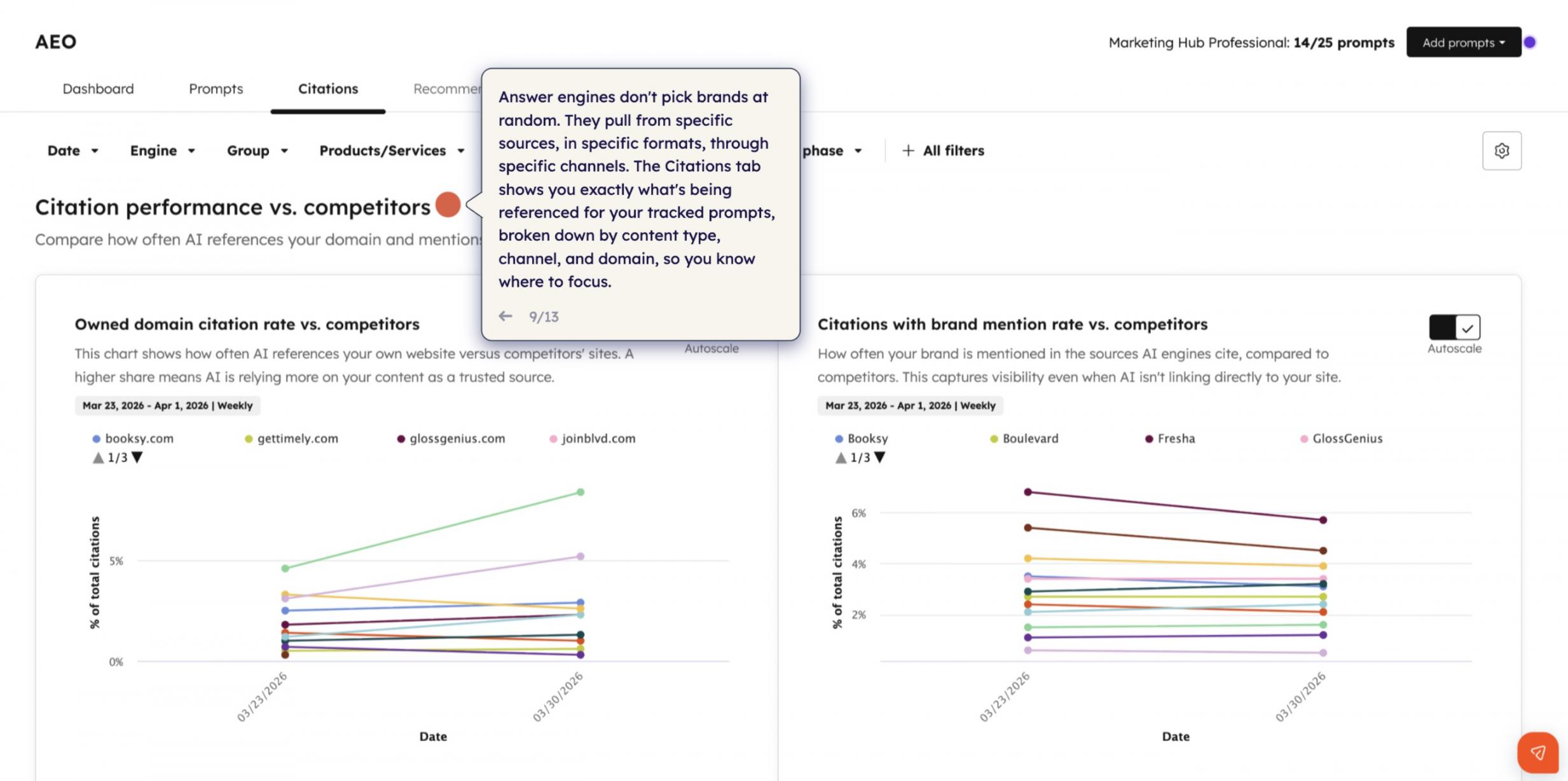
Image via HubSpot
This is very useful as you don’t need to check each competitor’s performance separately.
When you compare HubSpot AEO vs Botify, you’ll see that HubSpot is more focused on visibility signals you can use quickly.
While both AEO tools can help you understand source patterns, Botify is built for a broader and more complex analysis.
To summarize, HubSpot is the easier choice if you want a clear view of citation patterns without too much complexity. Botify gives you more depth, but HubSpot keeps the insight easier to use.
Competitor Benchmarking and Share of Voice
Competitor benchmarking in HubSpot AEO is built around a simple idea. It shows how your brand compares with others in AI-generated answers.
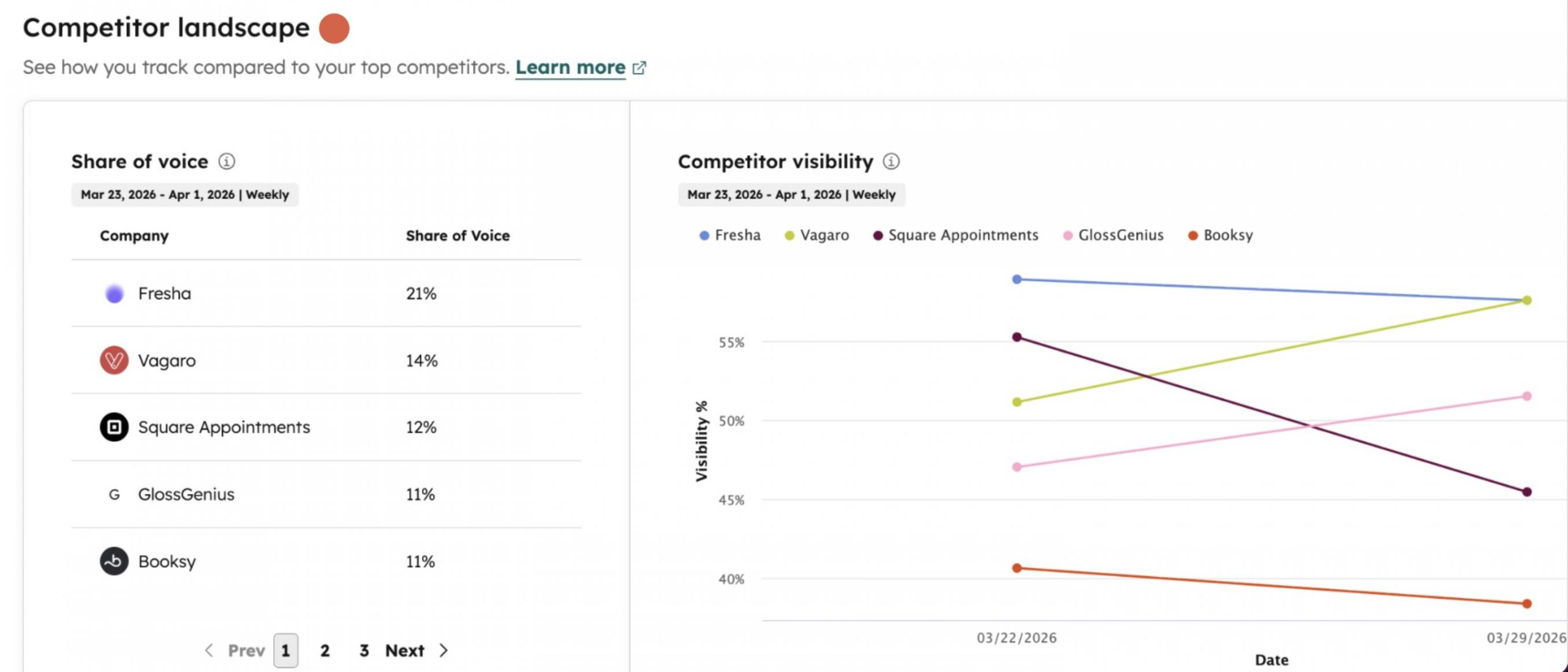
Image via HubSpot
You can quickly see who is getting mentioned more often and where you are losing visibility. That makes it easy to spot visibility gaps and act on them.
During our HubSpot AEO vs Botify comparison, we found that Botify also offers competitor insights, but in a very different way. Its analysis is more closely tied to search performance, rankings, and technical SEO data. It helps you understand why competitors may be outperforming you, but it is not focused on brand visibility inside AI tools.
The key takeaway is that answer engine optimization tools solve different problems. HubSpot focuses on AEO (answer engine optimization) and brand visibility, while Botify focuses on technical SEO performance tracking. For competitor benchmarking in AI search, HubSpot is the more relevant choice.
Actionable Recommendations
HubSpot AEO’s actionable recommendations are designed to help teams act on the data right away. It does not stop at showing brand visibility or sentiment. It tries to guide you toward the next step, which could be content changes, topic coverage, or stronger authority signals.
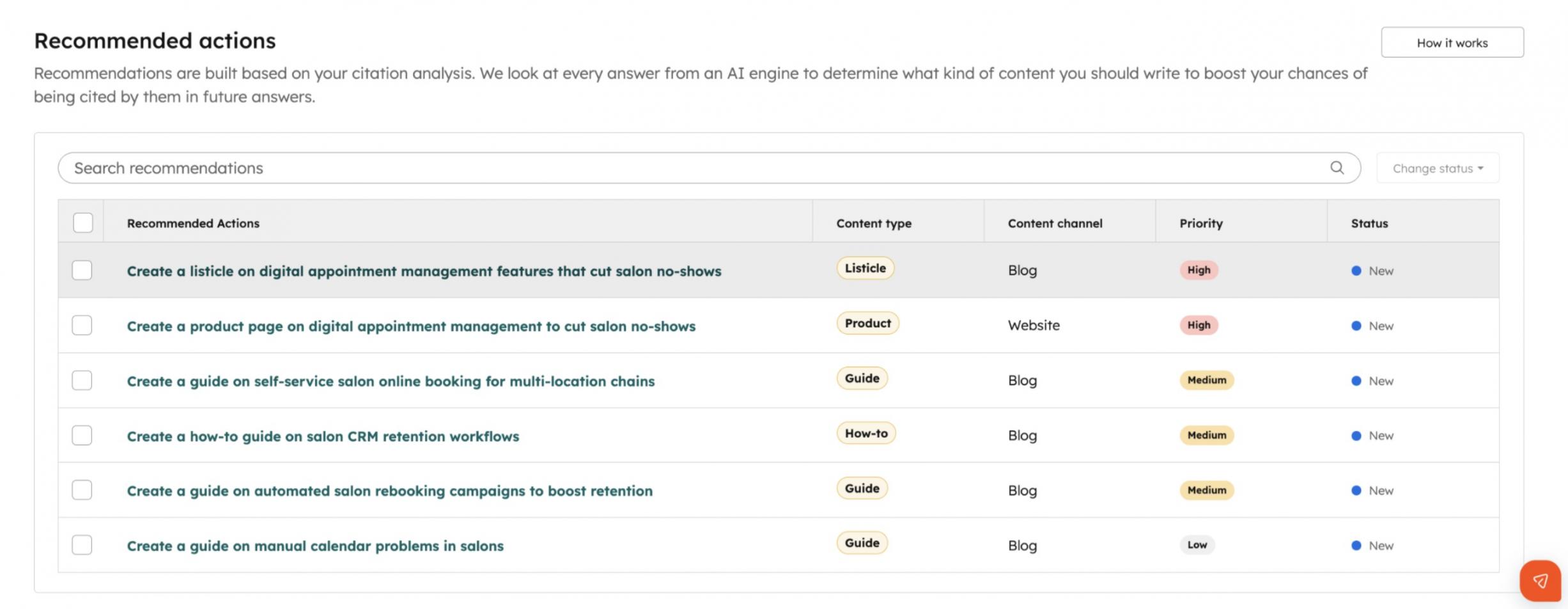
Image via HubSpot
When comparing HubSpot AEO vs Botify, you’ll again see a clear difference in focus. Botify can recommend fixes, too, but those recommendations are usually based on crawl data, indexing issues, and SEO performance. HubSpot stays closer to the AEO side of the problem.
The main takeaway is that HubSpot gives cleaner action points for AI visibility work.
Detailed Review: Botify
Now, we’ll review Botify’s key features for this HubSpot AEO vs Botify comparison.
AI Search Visibility Tracking
Botify’s AI search visibility tracking helps you keep an eye on your presence in AI-generated results and AI engines. It gives teams a broader view of how search visibility is changing as AI becomes a bigger part of discovery.
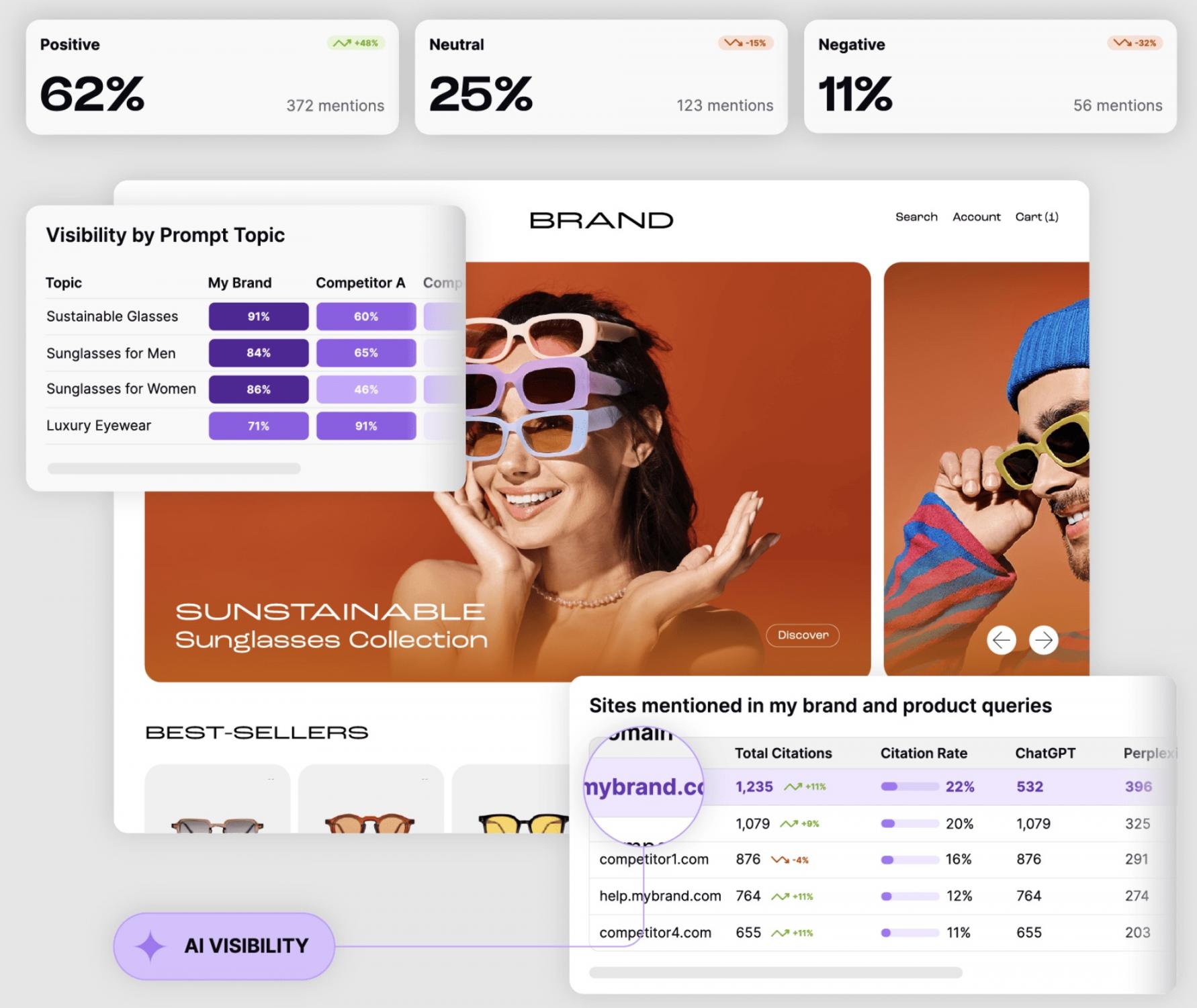
Image via Botify
If you look at HubSpot AEO vs Botify, HubSpot is more centered on brand visibility in AI search. Botify is built around a wider technical SEO system. So the tool is more powerful overall, but less focused on AEO.
The takeaway is that Botify offers this feature, but HubSpot is the better fit for teams that want AI visibility without the extra technical overhead.
First-Party Data and Search Intelligence
Botify helps you connect the dots between crawl activity, log data, and search performance. It shows how bots are moving through your site and where search visibility may be getting lost.
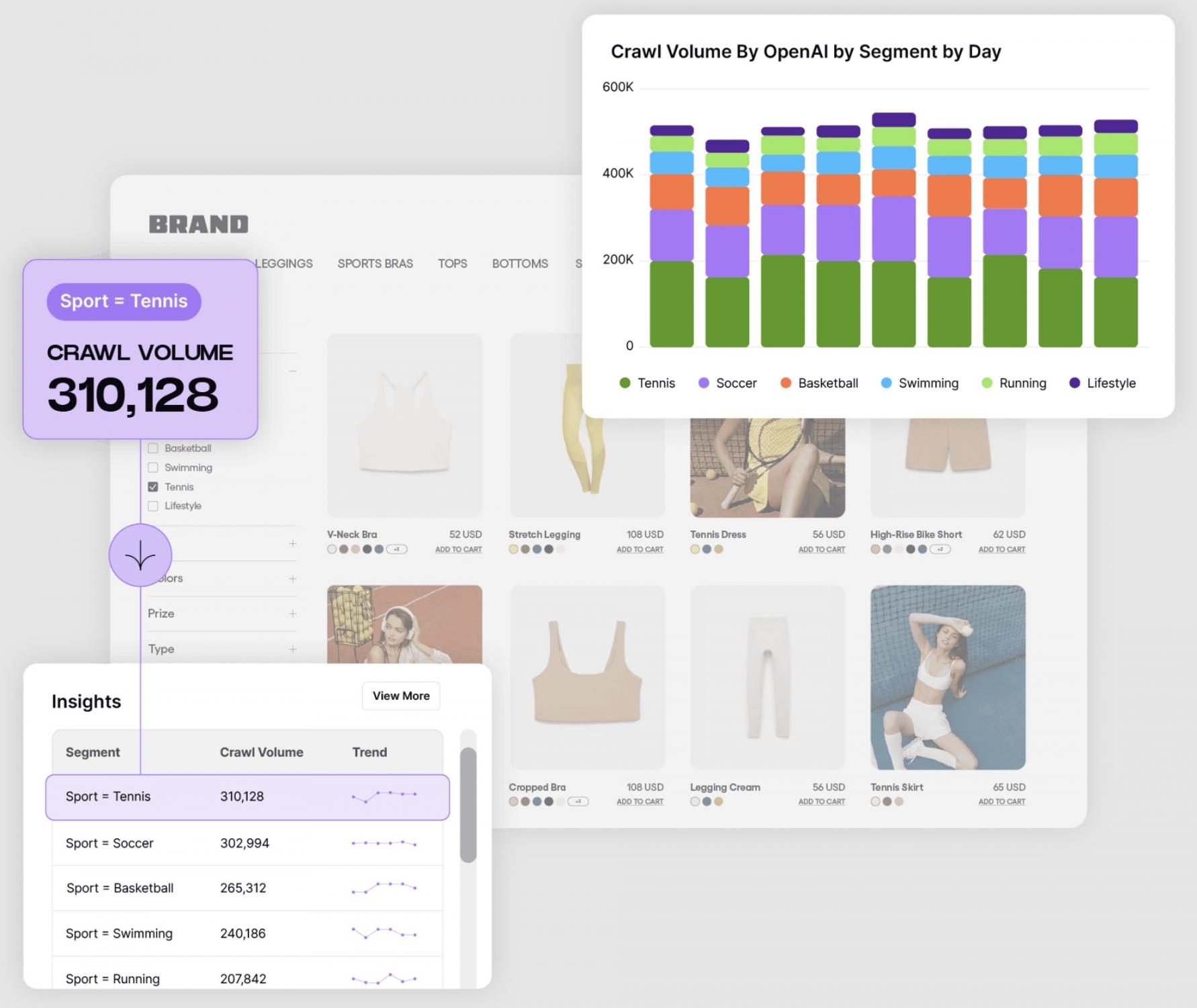
Image via Botify
When comparing HubSpot AEO vs Botify, HubSpot stays more focused on AI answer visibility and brand-level insights. Botify goes wider and deeper, which makes it better for SEO teams that want to diagnose site issues, not just monitor mentions.
The main takeaway is that Botify gives you stronger search intelligence for technical work. HubSpot AEO is still the better choice for AEO-focused teams.
Unified Search Analytics Dashboard
Botify’s unified search analytics dashboard is built to help teams see search performance in one place. It brings together visibility, crawl, and performance data so you do not have to jump between SEO and AI visibility tools.
This can save time and make it easier to understand what is helping or hurting search growth.
In the HubSpot AEO vs Botify comparison, this is another example of the two tools' different focus. HubSpot keeps things centered on AEO and brand visibility. Botify goes wider, giving you more context across the full search stack, which is useful for technical teams.
The gist is that Botify offers a full SEO analytics dashboard, while HubSpot AEO focuses on AI search visibility analytics.
AI-Driven Insights and Automation
Botify’s AI-driven insights and automation help turn search data into action. It tells SEO teams what to fix and prioritize, and what to automate.
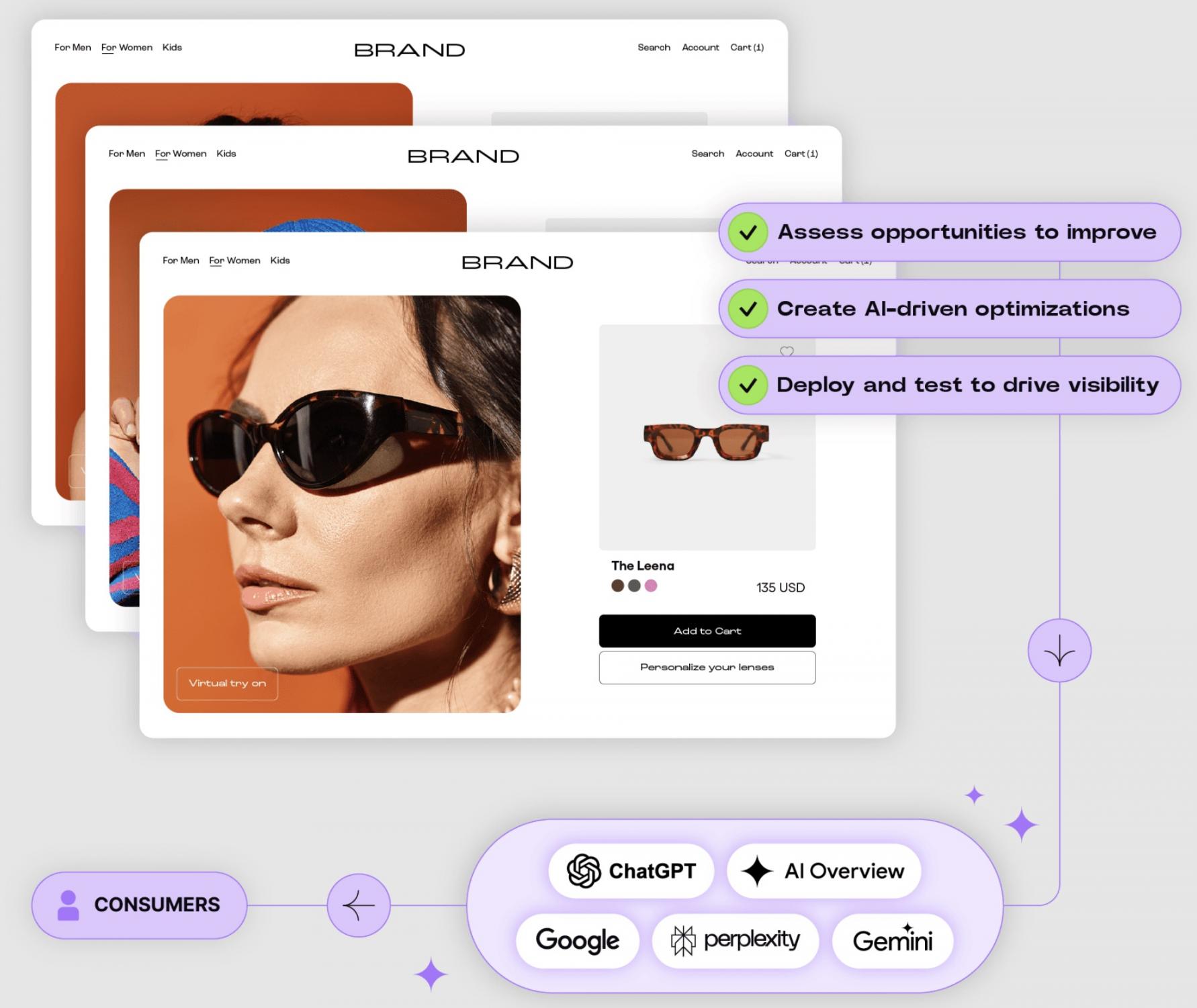
Image via Botify
A simple HubSpot AEO vs Botify comparison clearly shows the difference. HubSpot gives more direct recommendations for AI visibility work. Botify goes further by connecting insights to technical SEO workflows and site improvements.
Overall, Botify is meant for technical SEO teams, and HubSpot AEO is better for those who want to improve AI search visibility.
Deep Technical SEO Capabilities
Botify’s deep technical SEO capabilities help teams identify the issues behind poor search performance.
It can show how search bots move through your site, where pages are being missed, and where technical problems may be blocking visibility. That makes it useful for big sites where small issues can create bigger problems fast.
When comparing HubSpot AEO vs Botify, the difference is easy to see. HubSpot AEO is not an SEO-focused tool and does not offer this.
The key takeaway is that Botify wins on technical SEO depth. HubSpot is still the better choice for AEO tracking.
HubSpot AEO Pricing Plans
HubSpot AEO is available as a standalone product for $50 per month. It’s also included in the Professional and Enterprise plans of the HubSpot Marketing Hub, which cost $800 and $3,600 per month.
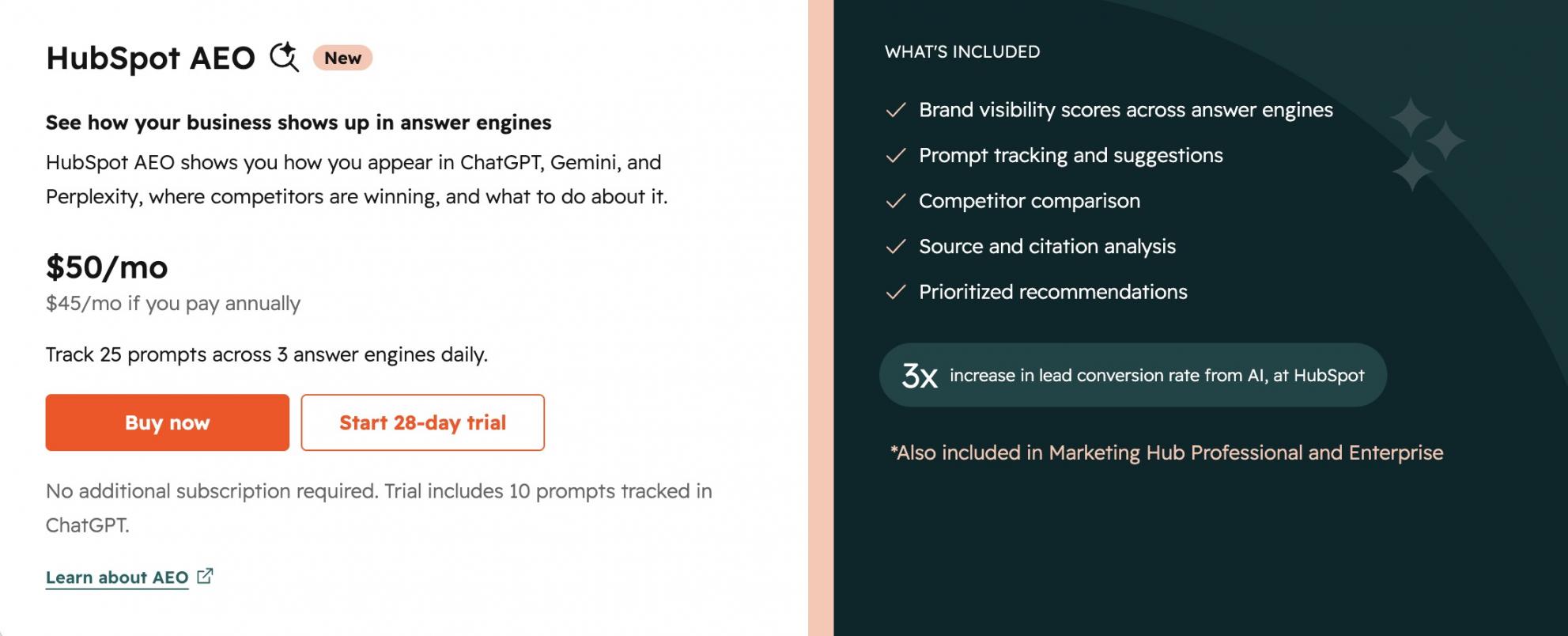
Image via HubSpot
So, whether you have a small team with a tight budget or a large one that’s already using Marketing Hub, you can access HubSpot AEO.
Botify’s Pricing Plans
Botify is typically built for enterprise AEO (answer engine optimization) needs. It offers custom pricing plans based on each client’s specific needs.
Given the depth of AEO and SEO features that it offers, don’t expect very affordable prices.
FAQ
Q1. What is HubSpot AEO?
A. HubSpot AEO helps you see if AI systems are mentioning your brand and how often. It also gives simple suggestions so you know what to do next.
Q2. How is HubSpot AEO different from Botify?
A. HubSpot AEO vs Botify is really about focus. HubSpot is built for tracking AI visibility, while Botify is built for deeper SEO work behind the scenes.
Q3. Who should choose HubSpot AEO over Botify?
A. Choose HubSpot AEO if you want to see how your brand shows up in AI answers and tips to improve your AI search visibility. It goes beyond providing raw AI visibility data and gives actionable suggestions in plain language that you can use right away.
Q4.Who should choose Botify over HubSpot AEO?
A. Botify is the stronger choice for technical SEO teams that care about crawl behavior, indexation, and automation. It is built for complex websites and deeper operational SEO work, not just brand-level AEO tracking.
Q5. HubSpot AEO vs Botify: Which offers more value for money?
A. If you judge value by ease of starting and lower cost, HubSpot AEO wins. If you judge value by depth and enterprise capabilities, Botify may be worth more for teams that can actually use its technical stack.
HubSpot AEO vs Botify: Final Verdict
If you want a tool that is built around AI search and brand visibility, HubSpot AEO is the stronger pick. Botify has greater technical depth, but HubSpot is easier to use and more directly tied to AEO work.
That is why HubSpot is the better fit for most teams comparing HubSpot AEO vs Botify. Sign up for HubSpot AEO and see where your brand shows up in AI answers.
Disclaimer: This content contains some affiliate links for which we will earn a commission (at no additional cost to you). This is to ensure that we can keep creating free content for you.

About the Author


CEO/Founder @ Attrock
Gaurav Sharma is the Founder and CEO of Attrock, a results-driven digital marketing company. Grew an agency from 5-figure to 7-figure revenue in just two years | 10X leads | 2.8X conversions | 300K organic monthly traffic | 5K keywords on page 1. He also contributes to top publications like HuffPost, Adweek, Business2Community, TechCrunch, and more.
Featured In
Related Posts