HubSpot AEO and traditional SEO tools solve different visibility problems. Traditional SEO tools help webpages rank in Google and drive organic traffic. HubSpot's AEO tools measure how AI platforms like ChatGPT describe your brand. Most businesses need both because search visibility now happens in search results and AI-generated answers.
The short answer to the HubSpot AEO vs traditional SEO tools debate is that you need both. HubSpot AEO (answer engine optimization) gets your brand cited inside AI answers. Traditional SEO tools rank your website pages in Google SERP.
AEO and SEO tools fix different layers of the same visibility problem. So, the smart move isn't to pick one, but to use both for specific purposes.
This guide answers that head-on. I'll define AEO, show how HubSpot's AEO differs from traditional SEO tools, and flag where each one wins.
The shift toward AI answers is real, and it's moving fast. Many people now use AI platforms to quickly get answers.
The data backs it up. According to Pew Research, 34% of US adults used ChatGPT in 2025, roughly double the share in 2023. According to a 2025 Statista projection, US AI search users are expected to reach 36 million by 2028.
So, now’s the time to join the AEO race, and this article will help.
Disclaimer: This content contains some affiliate links for which we will earn a commission (at no additional cost to you). This is to ensure that we can keep creating free content for you.
Table of Contents
What Is Answer Engine Optimization (AEO)?
Answer engine optimization (AEO) is the practice of structuring content so that AI answer engines cite your brand as the source. It targets AI answers, not blue-link rankings.
The goal is simple: You want to be cited in the answer a model reads out, not the tenth link nobody clicks.
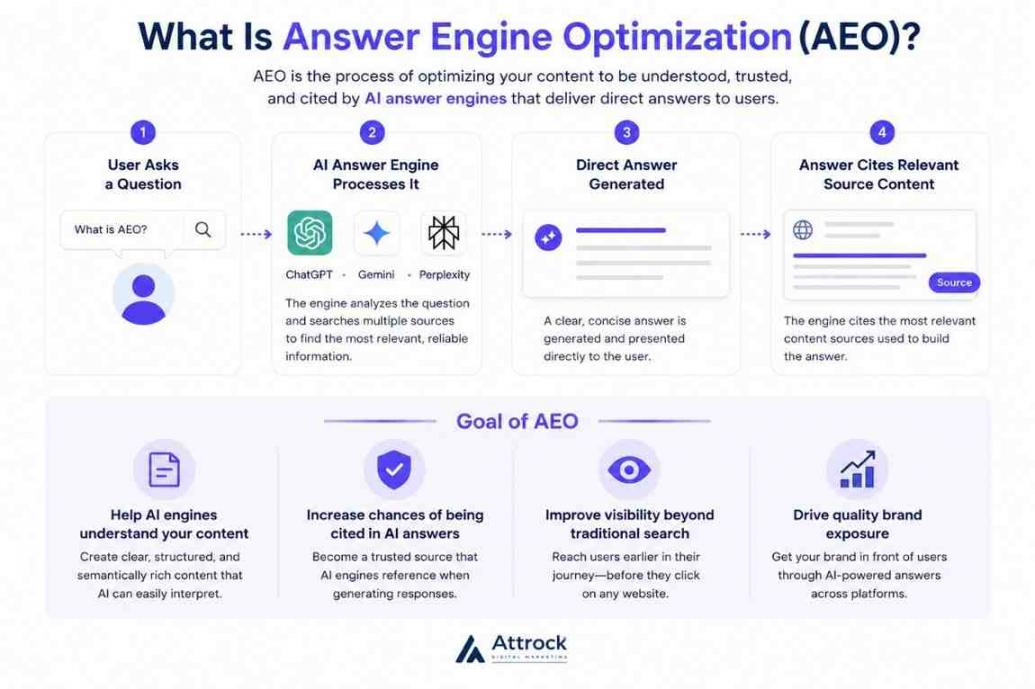
AEO is a close cousin of SEO, not a replacement. Both reward clear, credible, well-structured content. They just aim it at different places.
SEO aims to rank content on search engine results pages. AEO aims to get you a citation in the answers your buyer reads inside ChatGPT, Perplexity, or the Google AI Overviews.
A few signals do most of the work. Think plain definitions, structured data, and citable claims that a model can lift without losing the meaning.
Get those right, and your brand shows up in the answer, with a citation. That's the core of AI search optimization: write so machines can quote you cleanly.
SEO vs AEO vs GEO: The Quick Distinction
SEO, AEO, and GEO aren't competitors, but form three layers of the same visibility stack, each aimed at a different channel.
Here's a quick comparison:
| Approach | What it Optimizes | Where You Win |
|---|---|---|
| SEO | Ranking pages in search results | Google's blue links and SERP features |
| AEO | Getting cited in AI-generated answers | AI Overviews and answer engines |
| GEO | Getting cited inside LLM chat answers | ChatGPT, Gemini, and Perplexity replies |
In practice, people use AEO and GEO interchangeably, since both target AI answers. The point holds for all three. None replaces the others, and you cover them from a single content base.
AEO is the practice of optimizing content so AI answers and answer engines cite your brand as the source. It targets sentiment, citations, and share of voice inside AI responses, not keyword rankings.
How Do Traditional SEO Tools Work and Where Do They Still Win?
Traditional SEO tools measure how your pages perform in traditional search. They help you rank on search engine results pages (SERP) and get organic traffic to your website.
Four signals do the heavy lifting: keyword rankings, organic traffic, backlinks, and technical health. That data tells you what to publish, what to fix, and what's already winning.
The category is mature and deep. A handful of SEO platforms have dominated for years. These include:
| Traditional SEO tool | What it's best known for |
|---|---|
| Semrush | All-in-one keyword and competitor research |
| Ahrefs | Backlink index and rank tracking |
| Moz | Domain authority and on-page SEO |
| Screaming Frog | Technical site crawls and audits |
I lean on this layer every day. It identifies ranking gaps and technical issues before they cost traffic.
Here's the shift worth naming. Most of these platforms now bolt on AI-visibility tracking, because their users want to know where they stand in AI answers.
But the core job hasn't changed, and these tools are not obsolete. People still use Google. According to data from Exploding Topics, Google got over 101.2 billion monthly visitors in May 2026.
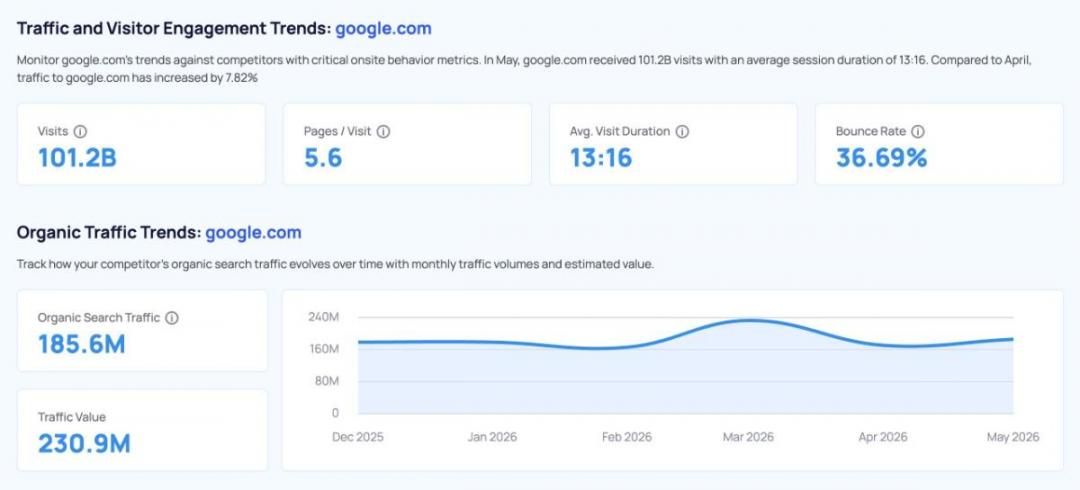
Image via Exploding Topics
So traditional SEO tools keep winning the page-ranking and click-driving layer. What they don't track is how your brand or content is cited in AI answers. That gap is where AEO comes in.
They measure and improve keyword rankings, organic traffic, backlinks, and technical health. They help get clicks from Google, even as AI answers take a growing share of research.
What Is HubSpot AEO and How Does It Work?
HubSpot AEO (Answer Engine Optimization) is a tool that tracks how your brand appears in AI-generated answers. It also suggests what you can do to get cited in more AI answers.
You can use HubSpot AEO to:
- See your brand visibility score showing how often you appear in AI answers
- Track specific prompts (the questions your buyers are asking AI) relevant to your business
- Run a citation analysis to see which pages and domains are being referenced in AI answers
- Get prioritized recommendations like create this page, fix this gap, and reach out to this site
Here’s what the dashboard looks like:
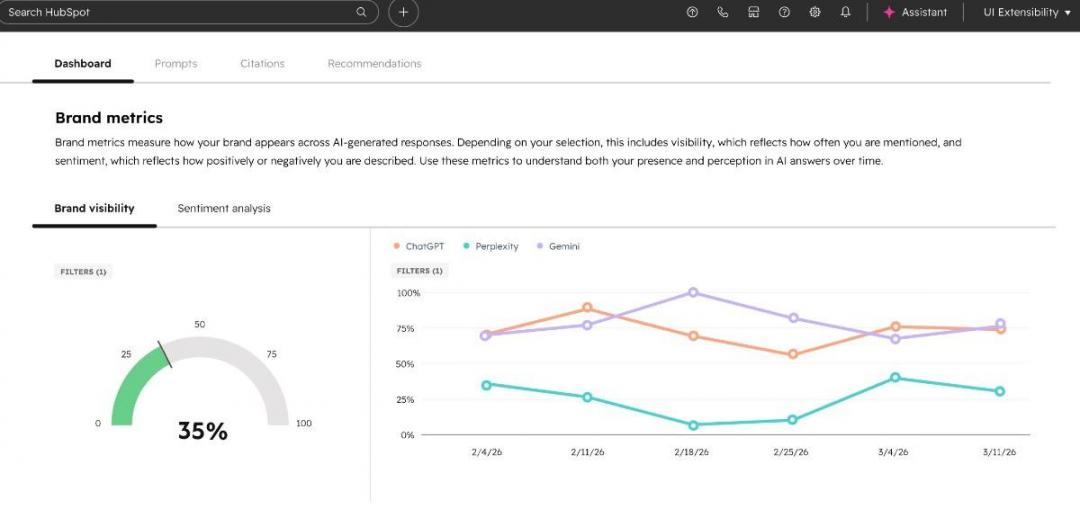
Image via HubSpot
So, how does it differ from traditional SEO tools?
While traditional SEO tools focus on Google rankings, HubSpot AEO focuses on AI answers.
What makes HubSpot AEO different from generic AEO trackers is its CRM integration. It already knows your customers and suggests prompts based on your buyer segments, rather than generic industry templates.
When it identifies a gap, you can create a blog post, update a page, or publish a LinkedIn post directly from the platform. No tool-switching is required.
HubSpot AEO is available as a standalone tool for $50/month, with a free 28-day trial. If you're already on Marketing Hub Professional or Enterprise, it's included at no extra cost. This makes it one of the most accessible AEO tools for existing HubSpot customers.
HubSpot AEO helps you check your brand's visibility in AI search. Unlike traditional SEO tools that focus on SERP rankings, it improves AI visibility.
HubSpot AEO vs Traditional SEO Tools: How Do They Compare?
HubSpot AEO helps you improve your visibility in AI answers, while traditional SEO tools help improve SEO rankings. So, the honest answer to the HubSpot AEO vs traditional SEO tools comparison is that you need both.
The overlap is the content underneath. A well-structured, well-cited page can earn both a good Google ranking and an AI citation.
That's why I treat answer engine optimization vs traditional SEO as a stack, not a choice.
Here's how the two compare across the dimensions that matter most.
| Dimension | HubSpot AEO | Traditional SEO Tools |
|---|---|---|
| Primary goal | Get the brand cited inside AI-generated answers | Rank pages in Google's results and drive clicks |
| What they measure | Share of voice in AI answers, citations, brand mentions, sentiment | Keyword rankings, organic traffic, backlinks |
| Optimization target | LLM retrieval and answer synthesis (ChatGPT, Perplexity, and Gemini) | Google's crawler and ranking algorithm |
| Core tactics | Entity clarity, structured data, citable claims, cross-source authority | Keywords, on-page, backlinks, technical SEO |
| Measurement cadence | Prompt-based monitoring of AI answers | Continuous rank tracking |
| Where results show | AI Overviews, chat answers, answer engines | SERP positions |
You can see the clear differences between HubSpot AEO and traditional SEO tools.
Where do HubSpot AEO and traditional SEO tools overlap?
They share the content layer. The same structured, credible page that ranks in Google SERP can also feed AI answers. So, your optimization work compounds across both AEO and SEO even though each is measured separately.
HubSpot AEO focuses on AI visibility, while traditional SEO tools focus on search visibility. The difference is where the results appear. The overlap is that both rely on clear, trustworthy, and well-structured content.
HubSpot AEO vs Traditional SEO Tools: Which One Should You Choose?
The honest answer? You probably need both AEO and SEO tools, just for different reasons.
Traditional SEO tools were built for a world where ranking on Google was the whole game. That world hasn't disappeared, but it's gotten a lot more complicated.
Buyers now research products across Google and AI platforms. Your SEO tool tracks one, and HubSpot AEO tracks the other. If you're only running one, you've got a blind spot.
The best move is to use HubSpot AEO along with your SEO tool. Let your SEO platform handle keyword rankings, site audits, and backlinks. Let HubSpot AEO handle your AI visibility score, prompt tracking, and content recommendations for AI search.
Here’s a simple graphic to help you make a decision:
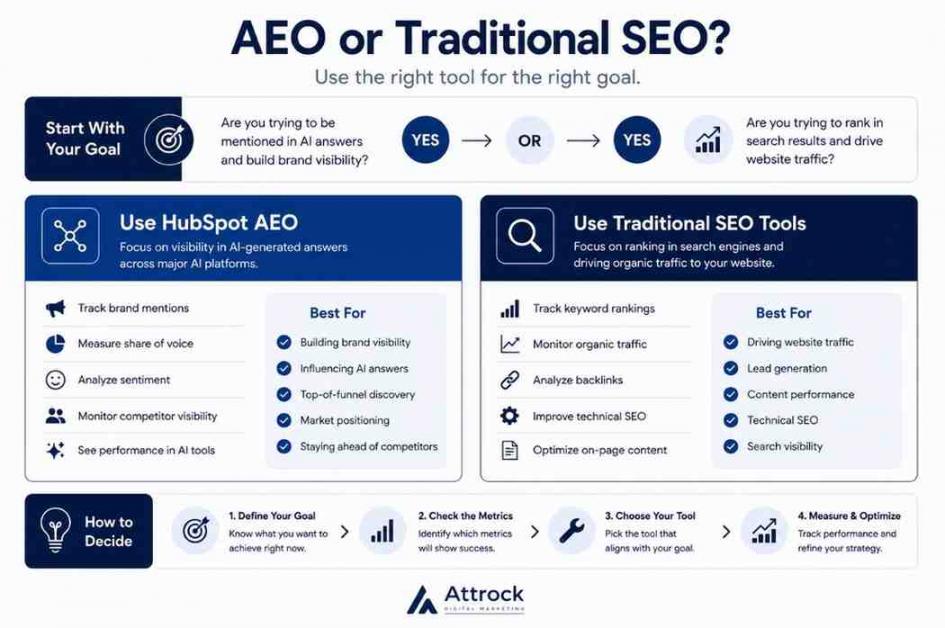
Lean on traditional SEO tools when your traffic and conversions still come mostly from Google's blue links, and you need keyword, backlink, and technical depth. Add AEO tools if your buyers use AI platforms for research, and you need to see and influence how AI answers describe your brand.
What is the Future of Search: AEO or SEO?
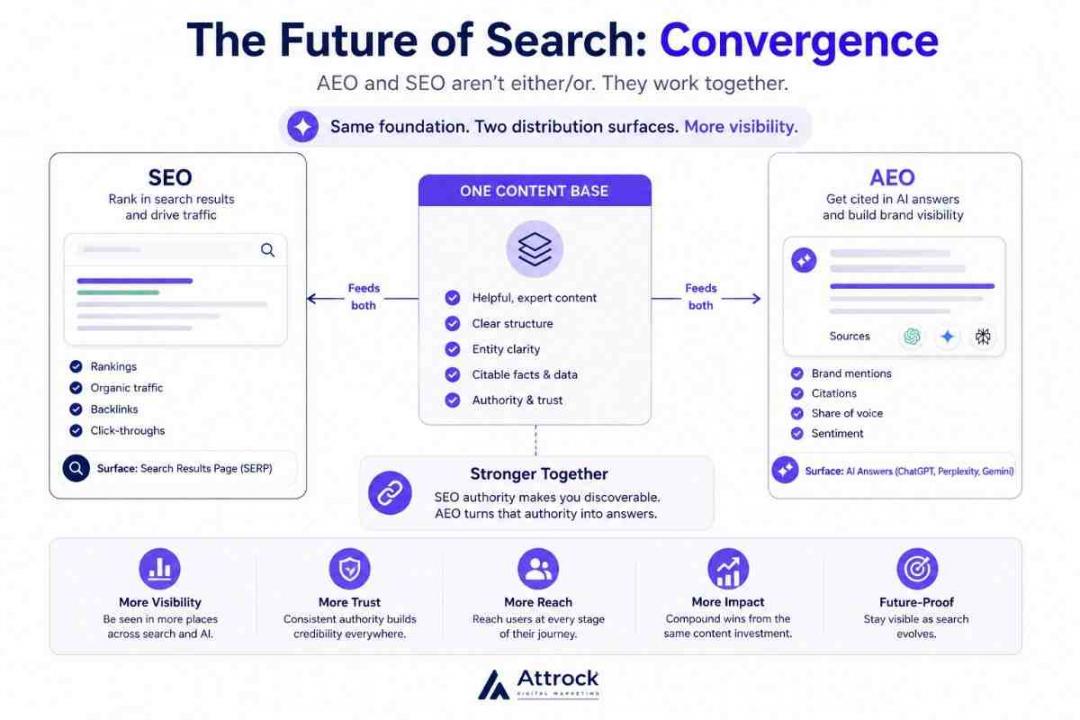
The future of search isn't AEO replacing SEO: it's convergence. The winners stack AEO on top of SEO and feed both from one content base. Same pages, same authority, two surfaces: the results page and the AI answer.
When I ran an AEO audit for a SaaS client, one pattern jumped out. The pages already ranking in organic search were the ones most cited in AI answers.
The foundation carried over, so I didn't need to rebuild the content. I made it more quotable and entity-clear, and the existing authority did the rest.
That's the pattern I keep seeing. Strong SEO gives AEO something to cite, and strong AEO turns that authority into answer-level visibility.
So don't pick a side in the HubSpot AEO vs traditional SEO tools question. Build one credible content base.
Measure rankings with your SEO tools, and measure AI perception with a tool like the HubSpot AEO. That's how you stay visible as search splits into links and answers.
Because they draw on the same content foundation. A credible, well-structured page earns both search rankings and AI citations, so the smartest strategy is to build once and distribute across search results and AI answers.
FAQ
Q1. What is answer engine optimization (AEO)?
A. AEO is the practice of structuring content so AI answer engines cite your brand. It optimizes for sentiment, citations, and share of voice inside tools like ChatGPT, Perplexity, and Gemini, not keyword rankings.
Q2. What's the difference between SEO, AEO, and GEO?
A. SEO ranks your pages in search results. AEO wins answer features and AI Overviews. GEO gets you cited inside LLM answers. People use AEO and GEO interchangeably, and all three stack on one content base.
Q3. Is the HubSpot AEO tool free?
A. You can try 25 prompts for free. After that, you can use it by paying $50 per month.
Q4. Can AEO replace traditional SEO tools?
A. No, they measure different things. SEO tools track rankings, traffic, and backlinks, while AEO tools track how AI answers describe you. Most teams run both, since the same content feeds rankings and AI citations.
Q5. What does the HubSpot AEO measure?
A. HubSpot AEO helps businesses understand their AI visibility. It tracks brand mentions, sentiment, and share of voice and assigns a brand visibility score.
Q6. Which AI engines do AEO tools track?
A. Different AEO tools offer different capabilities. The HubSpot AEO tool tracks AI visibility across ChatGPT, Gemini, and Perplexity. Enterprise platforms like Profound track 10 or more AI systems, adding Google AI Mode, Copilot, Meta AI, and others.
Q7. What are the best AEO tools for AI visibility in 2026?
A. For most marketing teams, HubSpot AEO is the best starting point for AI visibility in 2026. At $50/month or included with Marketing Hub Professional, it provides brand visibility tracking, prompt monitoring, citation analysis, and prioritized recommendations. Its CRM integration lets it recommend the right prompts for your specific buyers, not generic industry questions.
Q8. Do I need separate tools for SEO and AEO?
A. Yes, you should use specialized tools for SEO and AEO. Some platforms combine both, but many teams pair a dedicated SEO tool with an AEO tool like HubSpot AEO.
Q9. How is AEO measured compared with traditional SEO?
A. Traditional SEO uses rankings, organic traffic, and backlinks. AEO uses share of voice in AI answers, brand sentiment, and citation frequency. SEO tracks the results page; AEO tracks how AI models describe you when nobody clicks.
HubSpot AEO vs Traditional SEO Tools: What’s the Verdict?
In the HubSpot AEO vs traditional SEO tools decision, the answer isn't either-or. They're complementary layers of the same visibility problem.
Your SEO tools help get organic traffic from search engines. AEO tools like HubSpot AEO shape how AI answers describe your brand. The same content can help you win both the SEO and AEO game.
So start where it's cheapest to learn. You can sign up for HubSpot AEO to see how AI engines represent your brand today.
Keep your SEO tools doing what they do best, and stack the two as AI search grows.
Want help building an AI-visibility strategy on a strong SEO base? Explore Attrock's SEO services, and drop your questions in the comments. I'll answer them.
Disclaimer: This content contains some affiliate links for which we will earn a commission (at no additional cost to you). This is to ensure that we can keep creating free content for you.