Ranking in AI search results requires creating content that AI systems can extract, verify, and cite in their responses.
Visibility now depends on appearing in AI-generated summaries, and that’s where answer engine optimization (AEO) tools help you stay relevant.
They monitor how often your brand appears in AI-generated responses and which prompts trigger them. This way, you can optimize content for conversational queries.
As Google AI overviews show up on traditional search engine results pages, many informational queries now deliver answers directly on the page.
So, users don’t always have to click a link to get the information, as AI already provides a summary.
We’ve spent years helping clients navigate these shifts. Each site we’ve handled has grown organic traffic, domain authority, and high-quality backlinks despite major algorithm updates.
In this guide, we’re combining Google’s recommendations with our hands-on experience to show you how to rank in AI search results.
You’ll also see how tools like HubSpot AEO can help you claim your spot in AI summaries.
Disclaimer: This content contains some affiliate links for which we will earn a commission (at no additional cost to you). This is to ensure that we can keep creating free content for you.
Table of Contents
What Is AI Search and Why It Matters for Your Brand
AI search refers to a technology that uses artificial intelligence to generate direct answers to queries.
Unlike traditional search, which delivers a list of web pages, AI search understands human language and provides a more personalized user experience.
These AI-generated answers can appear as Google AI overviews or responses from platforms like ChatGPT.
Instead of competing for clicks in SERPs, you now have to position your website to appear in AI-generated summaries and recommendations.
AI search results can include content from websites appearing on the first page of Google.
For instance, a Google AI overview cites Chess.com as one of its sources for “How to play chess.” That same website ranks number one for the query on Google’s search results pages.
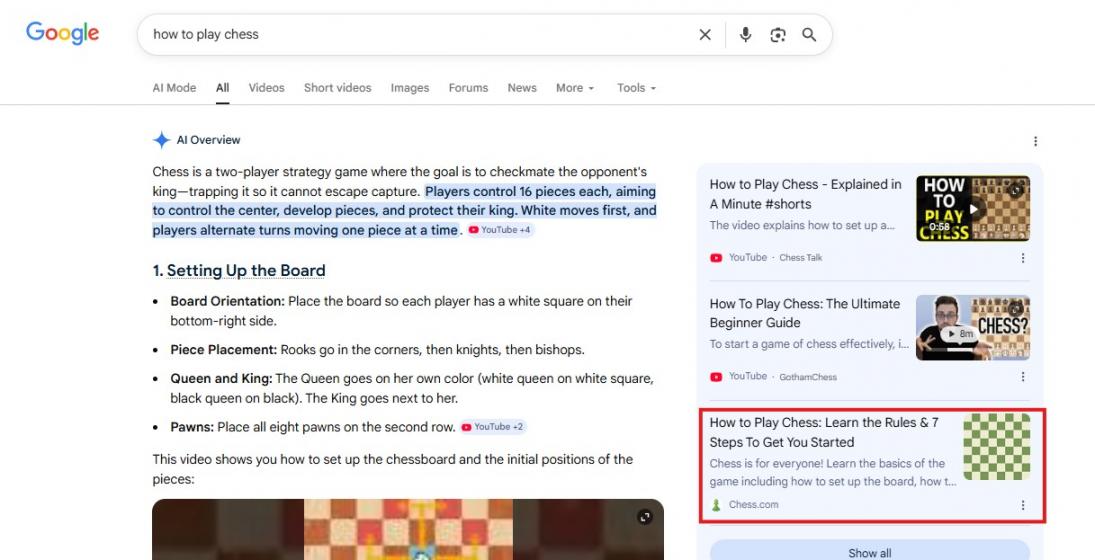
Image via Google
At the same time, AI models can cite sources that are not even ranking high on Google if their content is more relevant to the specific query.
This creates a different kind of opportunity. Your website doesn’t have to be number one in Google search results. However, your content should be helpful enough to be cited in Google’s AI summaries.
For brands, this has three major implications:
- Brand Visibility: Your brand can appear in AI-generated answers, even if users don’t visit your site. This is becoming more common as 61% of consumers reported using conversational AI tools like Gemini to shop online.
- Perceived Credibility: Being cited in a Google AI overview or other AI-powered results acts as an endorsement. In recent research by Omnicom Media Group, 20% of consumers rely exclusively on AI overviews in their buying journey.
- Higher Purchase Consideration: AI provides immediate answers to informational queries like “what is” and “how to.” If your brand is mentioned, you influence decisions before users ever compare options or visit competitors.
However, you can’t track AI overview visibility with traditional SEO tools. Google Search Console doesn’t tell you whether AI is citing your brand or recommending your competitors.
That’s why you need tools like HubSpot AEO to monitor AI search visibility and identify which queries trigger AI overviews.
So, while you’re focused on getting backlinks and keyword targeting, you still need to understand how to rank in AI search results.
In summary, artificial intelligence shifts the goal from ranking on Google to being the trusted source that AI cites.
How AI Search Engines Choose What to Cite
When learning how to rank in AI search results, your content needs to be trusted, easily extractable, and up to date.
AI search focuses on these three main factors to evaluate whether a piece of content can support an answer.
1. Earned Authority
AI engines prioritize content connected to sources they already recognize as credible.
This includes your own domain authority and how your brand appears across other authoritative sites.
A positive brand mention or citation in a guest post, podcast, YouTube video, or forums like Reddit serves as social proof and strengthens brand trust.
These sources are frequently referenced in AI training data and ongoing indexing. This means associations with them can increase your likelihood of being cited in AI search results.
2. Structure, Readability, and Relevance
Even highly authoritative content won’t be cited if AI systems can’t easily extract a clear answer from it.
AI-powered search results contain content that is:
- Structured with descriptive headings that match user queries
- Written in direct, answer-first language
- Organized into bullet points, summaries, and scannable sections
- Aligned tightly with search intent and informational searches
This is where many pages fail to rank in AI search results. They contain valuable content, but it’s either buried in long paragraphs or lacks proper organization.
3. Recency and Content Freshness
AI search engines prefer information that reflects the most current understanding of a topic. This is especially important for fast-changing areas like AI, marketing, and technology.
Fresh content tells AI platforms that your page includes:
- Recent updates
- New data, statistics, or examples
- Current search trends and evolving user queries
Outdated content is less likely to appear in AI overview citations, even if it previously performed well in traditional search rankings.
Regular updates help maintain relevance and improve your chances of being selected for AI-generated answers.
When learning how to rank in AI search results, you must ensure that your content is backed by third-party credibility. AI also prioritizes information that is easy to read and kept up to date.
How to Rank in AI Search Results: 6 Proven Strategies
Your content must answer the full scope of a query when learning how to rank in AI search results. This implies that you must go beyond ranking for the main keyword.
Let’s show you how HubSpot tools can help you map, structure, and scale that coverage efficiently.
1. Create Helpful, People-First Content
Your content must help users, not just attract clicks, if you want to rank in AI search results.
Even in traditional search engine optimization, you need non-commodity posts to rank high. Such content solves problems and adds original value.
So, if your page reads like every other piece of content on the internet, Google and AI platforms view it as generic.
Assuming you want to create content on SEO tips, commodity content would be a rehashed list of standard advice like “use keywords” and “fix meta tags.”
However, non-commodity content would be your own data showing the strategies you used. For example, showing how you grew a client’s traffic to 120k per month.
Helpful content adds something new, whether it’s real-world experience or original research. It also fully answers the query instead of forcing users to keep searching.
HubSpot’s Content Hub can support this process by helping you plan, create, and refine content at scale.
With its Breeze AI, you can generate outlines, draft blog posts, and repurpose content into emails or social media posts.
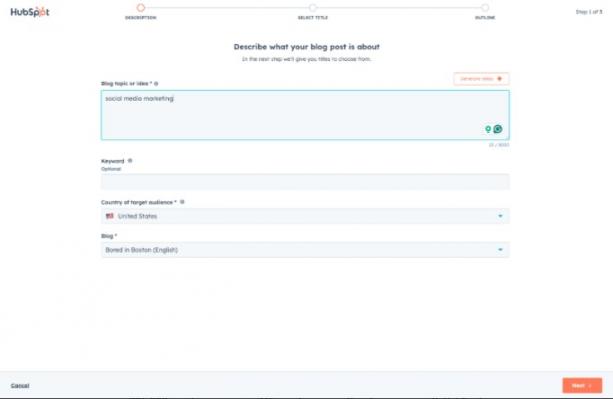
Image via HubSpot
While AI content writing tools speed up production, the real value comes from adding your expertise to make the content useful.
Use this quick audit checklist to ensure your content is helpful:
- Does this content add original insights, examples, or data?
- Does it fully answer the user’s question without gaps?
- Does it go beyond what’s already ranking in search results?
- Is it written from real experience or informed expertise?
- Does it provide key takeaways instead of general advice?
- Would someone bookmark or share this after reading?
You can also evaluate quality using the Who, How, and Why framework:
- Who created it? Is there an author or brand with relevant expertise or credibility?
- How was it created? Was it thoughtfully developed or mass-produced and generic?
- Why was it created? Is the goal to help users, or just to rank and convert traffic?
If your content passes these checks, it’s more likely to rank in AI search results. That’s because it’s in line with the Google page experience update on E-E-A-T (Experience, Expertise, Authoritativeness, and Trustworthiness).
2. Build Topical Authority with Query Fan-Out
Understanding how to rank in AI search results is essential to ensure your content covers every related sub-question within a keyword. This is known as query fan-out.
AI search engines use this technique to break a search query into multiple, smaller related queries.
It anticipates follow-up questions and tries to cover all necessary aspects of that query, providing as much information as possible.
For instance, a query like “best laptop for content writers” can prompt the AI system to research:
- Which brands make the best laptops for writers?
- What features to look for in a writing laptop?
- How much to spend on a laptop for writing?
A 2025 study shows that 51.2% of websites that appear in AI overviews rank for the main query in organic search and at least one fan-out query.
Hence, pages that rank across fan-out queries are more likely to be cited. AI systems prefer sources that demonstrate depth across a topic.
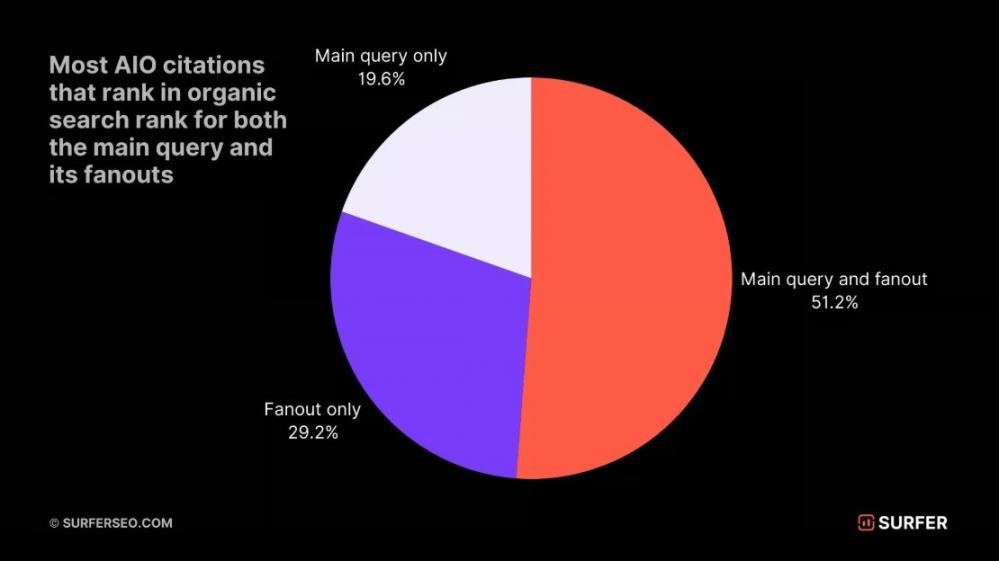
Image via Surfer SEO
This is where you need to restructure your content strategy template to rank in AI search results. Traditional SEO focuses on one main keyword per post, along with supporting keywords.
However, you can use that keyword to build a topic cluster. It’s a group of related content centered around a main theme or topic.
If your main page focuses on lead generation, it can provide general information. The supporting pages can then cover topics like social media lead generation and B2B SaaS lead generation strategies.
While you can use a query fan-out generator to get multiple sub-queries, the HubSpot SEO tool helps you get topic suggestions.
You can group keywords into core topics and supporting subtopics based on your expertise.
As you create content around each subtopic, you strengthen your topical authority.
It gives you more opportunities to rank in AI search results across multiple query variations.
3. Earn Brand Mentions and Citations
Your website should be consistently associated with topics that are relevant to its niche. This way, others can cite it in their own posts or social media content.
For instance, when we discuss SEO matters, we mention brands like Semrush and Ahrefs.
Not only do they offer SEO tools, but they also provide valuable content on search engine optimization.
In fact, many websites link to their content because they trust the data or recommendations there.
According to Ahrefs’ study, the way your brand is mentioned across the internet is a top determinant for appearing in AI overviews.
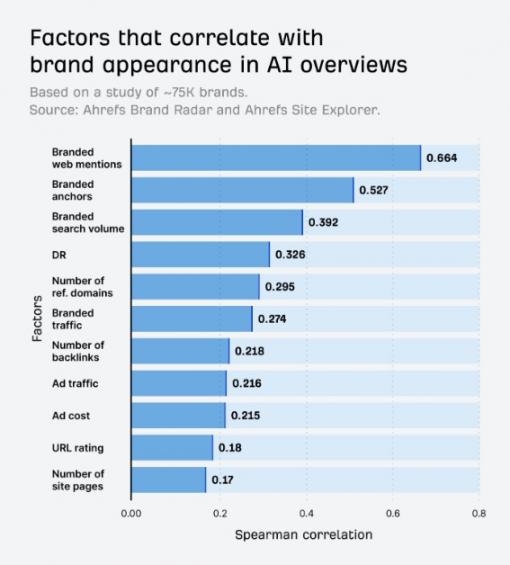
Image via Ahrefs
Below is a list of tactics you can use to get brand mentions and citations:
- Earn Mentions on Authoritative Sites: Contribute knowledge, data, guest posts, or expert insights to reputable blogs and publications in your niche. These mentions serve as external validation signals, increasing the likelihood that your content will rank in AI search results.
- Support Claims with Data: AI search engines prefer content with original insights, such as studies you conducted with consumer data. Even if you’re mentioning external research, ensure you link to the original publication.
- Leverage PR Strategies: Standard online PR services include brand mentions in press releases and reputation management. These activities ensure that your brand name appears across diverse reputable channels, providing third-party validation.
- Target Listicle Link Building: AI models source information from list-based posts (e.g., Best tools for X). You can identify sites that rank for your keyword and pitch for inclusion instead of waiting to be found.
4. Deliver an Excellent Page Experience
Knowing how to rank in AI search results involves making your content easy to access, load, and navigate.
Slow load times, intrusive pop-ups, or cluttered layouts make it hard for both users and AI crawlers to engage with your content.
You can improve page experience using these tips:
- Mobile-First Design: Most AI search interactions occur on mobile devices. Hence, make sure your content is responsive and easy to read on smaller screens.
- Clean Layout and Navigation: Use logical headings, short paragraphs, and bullet points. This improves readability and helps AI models extract key information.
- Minimal Distractions: Avoid aggressive popups, autoplay media, and excessive ads that interrupt the user journey. You can time popups to display just before a visitor exits your site.
- Site Security: Google alerts users when a site is unsafe for browsing, leading to immediate user abandonment. AI engines also avoid citing unsecured sites. HTTPS shows your website’s credibility.
- Core Web Vitals: These are Google’s metrics for checking loading performance, interactivity, and visual stability. A fast, stable site is easier for AI crawlers to index, increasing the likelihood that your content will rank in AI search results.
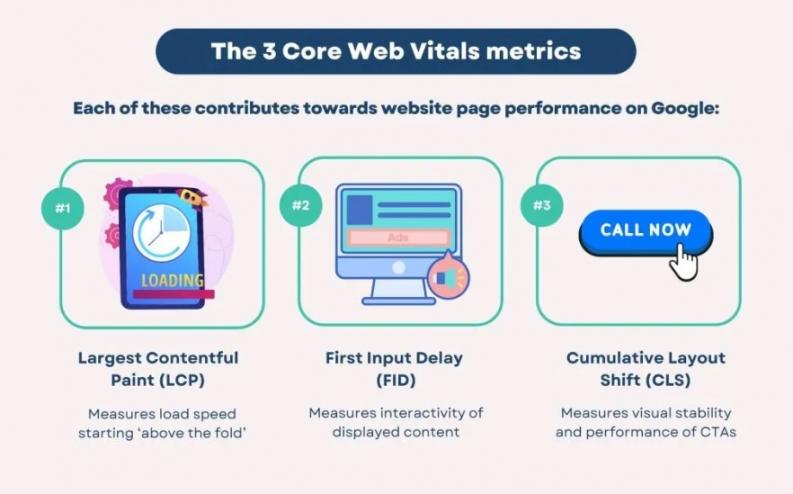
Image via 67 Degrees
Tools like HubSpot’s Content Hub make it easier to maintain these standards. It offers optimized templates, built-in performance monitoring, and mobile-responsive design.
This way, you can create pages that meet both user expectations and requirements for how to rank in AI search results.
5. Use Structured Data That Matches Your Content
Your structured data, also known as schema markup, helps search engines interpret and organize your content into categories.
Google uses this data to display rich search results, such as featured snippets, reviews, pricing, ratings, and products.
However, when planning how to rank in AI search results, your schema must accurately reflect what’s on the page.
Google and AI crawlers rely on it to understand context, but they will ignore or distrust it if it’s misleading.
An example of a misleading schema is using the “Event” schema for a product offer to gain visibility in event search results.
Here are some technical quality guidelines to follow when using structured data:
- Use Accurate and Current Information: Outdated or time-sensitive content reduces the likelihood that your content will rank in AI search results
- Avoid Manipulation Tactics: Fake reviews, misleading claims, or irrelevant markup can disqualify your page from enhanced search results
- Use Supported Formats: JSON-LD is the most widely recommended schema markup format, but Microdata and RDFa also work if implemented properly
- Ensure Pages are Crawlable: Don’t block important pages with txt or noindex tags, or AI crawlers won’t see your structured data
6. Adapt to Changing Search Behavior and User Needs
An important part of how to rank in AI search results is improving your content to suit how people search.
User queries are becoming more conversational, specific, and voice-driven. Instead of short keywords, users now ask full questions in natural language.
Below are a few things you can do to adapt your content to changing user needs:
- Include question-based headings that match how users speak
- Update content as new subtopics and related questions emerge within your niche
- Keep examples, data, and recommendations current so your content remains relevant
- Monitor how users interact with your content to know whether it still satisfies user intent
Most importantly, you need visibility into how AI search engines are presenting your brand.
Using tools like HubSpot AEO, you can track how your business appears in AI search results. It also shows which queries trigger AI-generated answers and where competitor brand mentions show up instead of yours.
This helps you identify gaps and adjust your content marketing strategy based on real AI search performance.
Ultimately, knowing how to rank in AI search results involves demonstrating expertise through topic clusters and third-party mentions. You should also maintain traditional SEO standards, from schema markup to page experience, making it easy for AI to trust your content.
FAQ
Q1. How to rank in AI search results?
A. The following tips are helpful when learning how to rank in AI search results:
- Optimize your content to answer specific questions
- Use structured data markup
- Build authority through credible mentions across the web
- Publish original data
- Maintain a fast and secure site
Q2. How do AI models rank content?
A. AI models pull information from sources they recognize as credible, relevant, and well-structured. Factors like domain authority, clear formatting, direct answers, and trustworthy mentions on online platforms influence which content gets cited in AI responses.
Q3. Is SEO dead or evolving in 2026?
A. SEO isn’t dead; it’s evolving. Search engines still look for quality content, site authority, and technical performance. What changed is that answer engine optimization now runs alongside traditional search engine optimization.
Q4. Will AI replace SEO?
A. No, AI isn’t replacing SEO. It’s responding to the way users search for information and providing quick answers. As AI-generated search results become more common, the goal shifts from ranking on SERPs to being the source AI cites. You still need SEO skills such as content strategy, authority building, and technical optimization to make it happen.
Q5. Can ChatGPT do an SEO audit?
A. ChatGPT can assist with parts of an SEO audit, like reviewing meta descriptions, suggesting keywords, or analyzing content structure. It can’t crawl your site or access live data. You can pair it with dedicated SEO tools like Ahrefs, Semrush, or Google Search Console for a full audit.
Wrapping Up
Learning how to rank in AI search results comes down to creating useful content for humans and AI platforms.
Search will continue to change, but you still need to keep up with SEO and AEO best practices.
So, while your website is ranking for high-intent keywords in your niche, ensure it’s structured to deliver answers to user queries upfront.
Tools like HubSpot AEO can help you track AI visibility, understand where your brand appears, and refine your strategy based on real data.
This makes it easier to adapt, stay relevant, and position your brand for consistent appearance in AI-generated results. Try HubSpot today and see where your brand stands in AI search.
Disclaimer: This content contains some affiliate links for which we will earn a commission (at no additional cost to you). This is to ensure that we can keep creating free content for you.