- Match techniques to deal complexity: Use lighter outreach for simple deals and personalized outreach for complex ones.
- Qualify between follow-ups: Reassess fit, intent, and engagement before sending another message.
- Follow up consistently: Use a planned sequence instead of stopping after one message.
- Keep humans in the loop: Let AI draft outreach, but review it for accuracy and relevance.
- Track performance: Measure reply and meeting rates to see what works
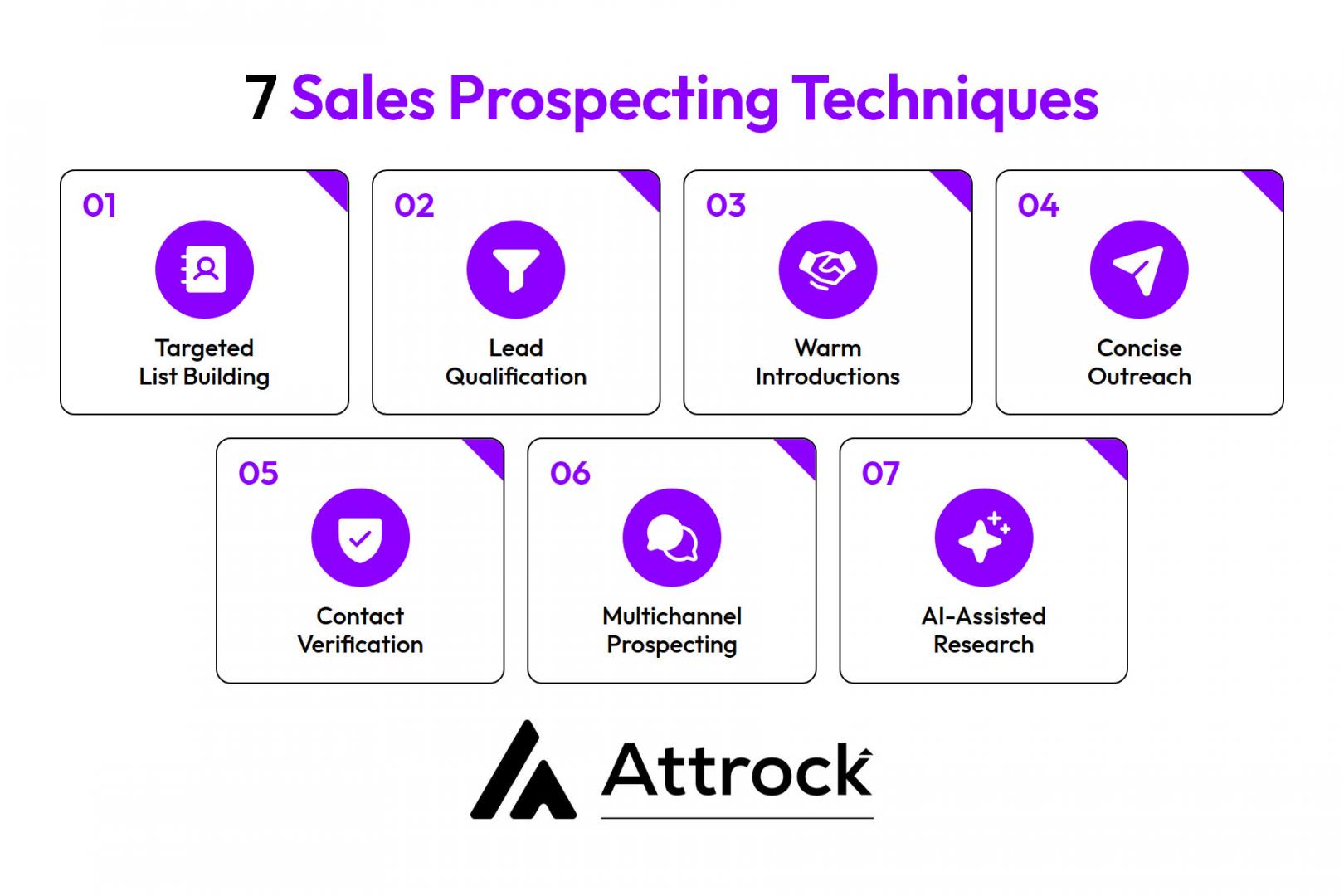
The seven sales prospecting techniques are targeted list building, lead qualification, warm introductions, concise outreach, contact verification, multichannel prospecting, and AI-assisted research.
Most sales reps already know plenty of tactics. The harder part is choosing which ones deserve their limited time.
This guide explains seven practical techniques, the benchmarks to track, and when each method makes the most sense. Start with the bottleneck hurting your pipeline most instead of trying every new tactic at once.
Disclaimer: This content contains some affiliate links for which we will earn a commission (at no additional cost to you). This is to ensure that we can keep creating free content for you.
Table of Contents
What Is Sales Prospecting?
Sales prospecting means finding potential buyers. It also means checking whether they’re a good fit and starting conversations with them.
Prospecting is an early part of the sales process. It helps reps find and qualify buyers before moving them toward a deal. Sales prospecting techniques help reps find potential buyers, check their fit, and start conversations. This helps them spend more time on prospects who are likely to buy.
A lead is a person or business that may need your product or service. They may have shown interest, or your team may have identified them through research.
Your ideal customer profile (ICP) describes the types of accounts you can serve best. It typically covers factors such as industry, company size, and the problems you solve.
A prospect is a potential buyer who fits your target customer criteria. They may be a person or company, and they don't need to have shown interest yet.
An opportunity is a qualified prospect with a potential deal. The sales team has found a real need and is working toward a sale.
Clear sales stages help reps decide which leads need attention. That's important when time is tight. In Salesforce's 2026 State of Sales report, nearly half of sales reps said they lacked enough time for cold outreach.
Ultimately, effective prospecting is about having fewer, better-qualified conversations.
Sales prospecting means finding people who match your ideal customer profile, checking whether they're a good fit, and starting a conversation. The goal is to find potential buyers who may benefit from your product or service and explore whether there's a sales opportunity.
What Are the 7 Best Sales Prospecting Techniques?
Seven sales prospecting techniques can help fill your pipeline: buying-signal research, lead qualification, warm introductions, targeted outreach, multichannel prospecting, buying-committee engagement, and AI-assisted research.
You don't need every technique for every deal. Choose the ones that suit your buyers, deal size, and sales process. Combine them where it makes sense.Some techniques help you find the right buyers. Others help you start conversations and give prospects a reason to respond.
Use the benchmarks as a starting point, not fixed targets. Adjust them based on your market, deal size, and sales cycle.
The Bridge Group's 2025 SDR report surveyed 351 B2B companies. It found a median monthly quota of 10 Stage 0 meetings held per rep. That's a target for meetings that take place, not just meetings booked.
Most companies in the survey were B2B SaaS firms, so use this figure as a reference rather than a target for every sales team.
You need enough techniques to find leads, check their fit, and reach them through the channels they use. These seven give you options to build a process that fits your sales goals. Thirty might make a good reading list, but they're unlikely to become part of your daily routine.
1. Build a Signal-Based Target List
A good prospect list saves time. A poor one can leave you chasing accounts that aren't ready to buy. Instead of relying on job titles alone, look for buying signals. A recent business event gives you a clear reason to reach out and makes your message more relevant.
A buying signal is an action or event that may suggest a need for your product. It doesn't always mean the company is ready to buy.
This could mean new funding, more hiring in your target buyer's team, or a change in leadership.
- Define your ICP: Note your target industry, company size, and main buyer problem. Check each account against these details.
- Choose three signals to monitor: Look for funding announcements, new job postings on company websites, and role changes on LinkedIn.
- Check the signal date: Recent events may give you a stronger reason to reach out. Older signals can still matter if the need remains.
- Start with a focused list: Try 50 accounts that match your ICP rather than collecting 500 contacts without checking their fit.
Build a list around one buying signal. Compare its reply rate with a similar list that doesn't use that signal.
Here's an example of a prospect list filtered by buying signals.
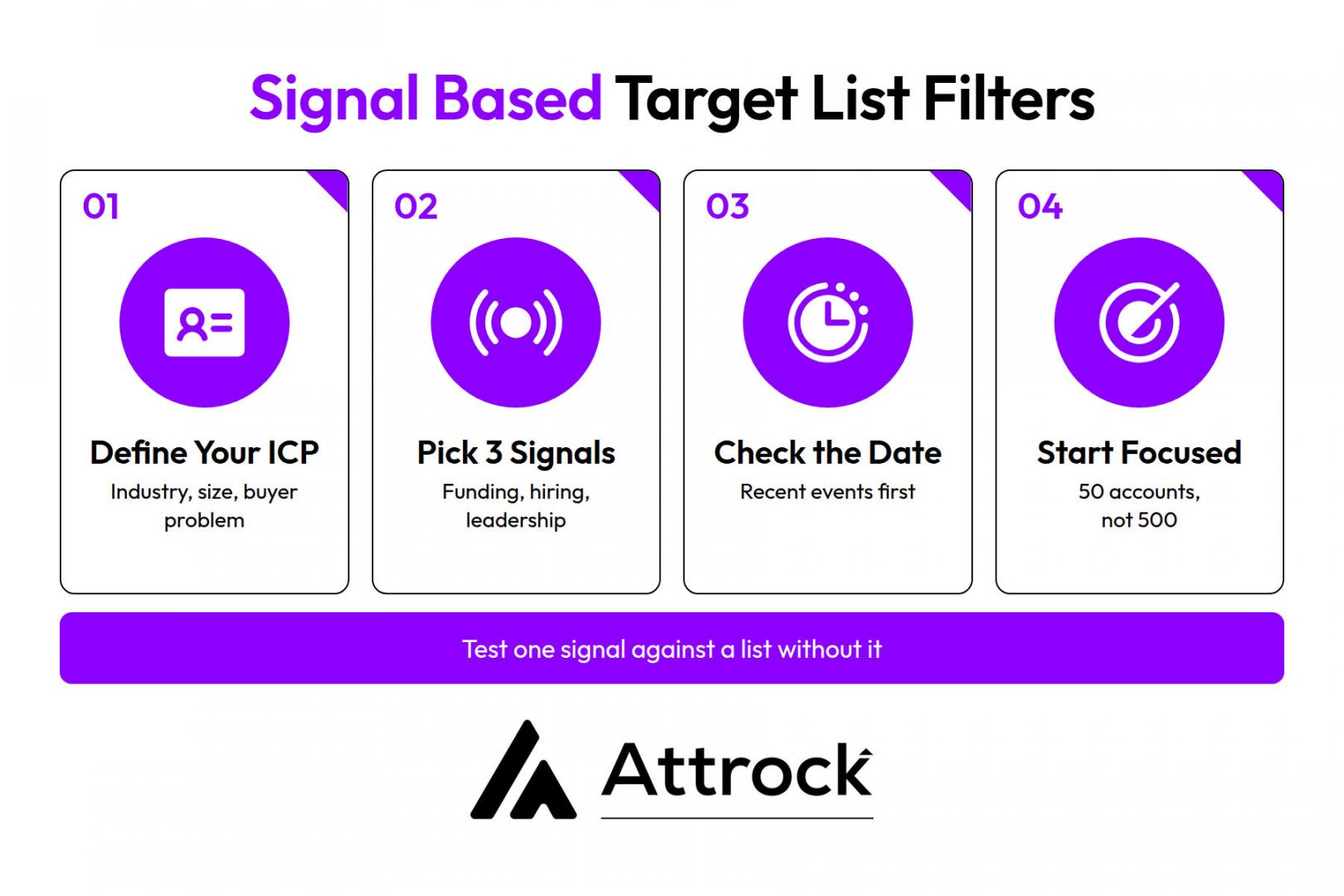
A job title helps you find the right person to contact. A buying signal tells you what may matter to their business right now, giving you a more relevant reason to reach out.
2. Qualify Prospects With Three Simple Checks
Not every lead deserves the same attention. Qualifying prospects helps you focus on accounts that are more likely to need your product. Checking prospects between follow-ups saves time. It also keeps your outreach relevant to potential buyers.
Check three things before reaching out: the person, the company, and the buying need. Drop accounts that clearly don't fit. Research or nurture those that may be a good fit later.
- Right person: Can this contact make or influence the buying decision? If not, find someone closer to the problem you're trying to solve.
- Right company: Does the account match your ICP? Check its industry, size, and business needs before spending more time on it.
- Right project: Is the problem worth solving, and does the company plan to act soon? If the timing isn't right, keep the account on your nurture list.
Start with what you can find in your CRM or through research. If details are missing, ask a few questions during your next conversation. Without these checks, you may spend time following up with buyers who aren't a good fit.
Review ten accounts on your prospect list. Decide which need outreach, more research, or follow-up later.
The example below shows how to use the three checks to decide whether an account is worth pursuing.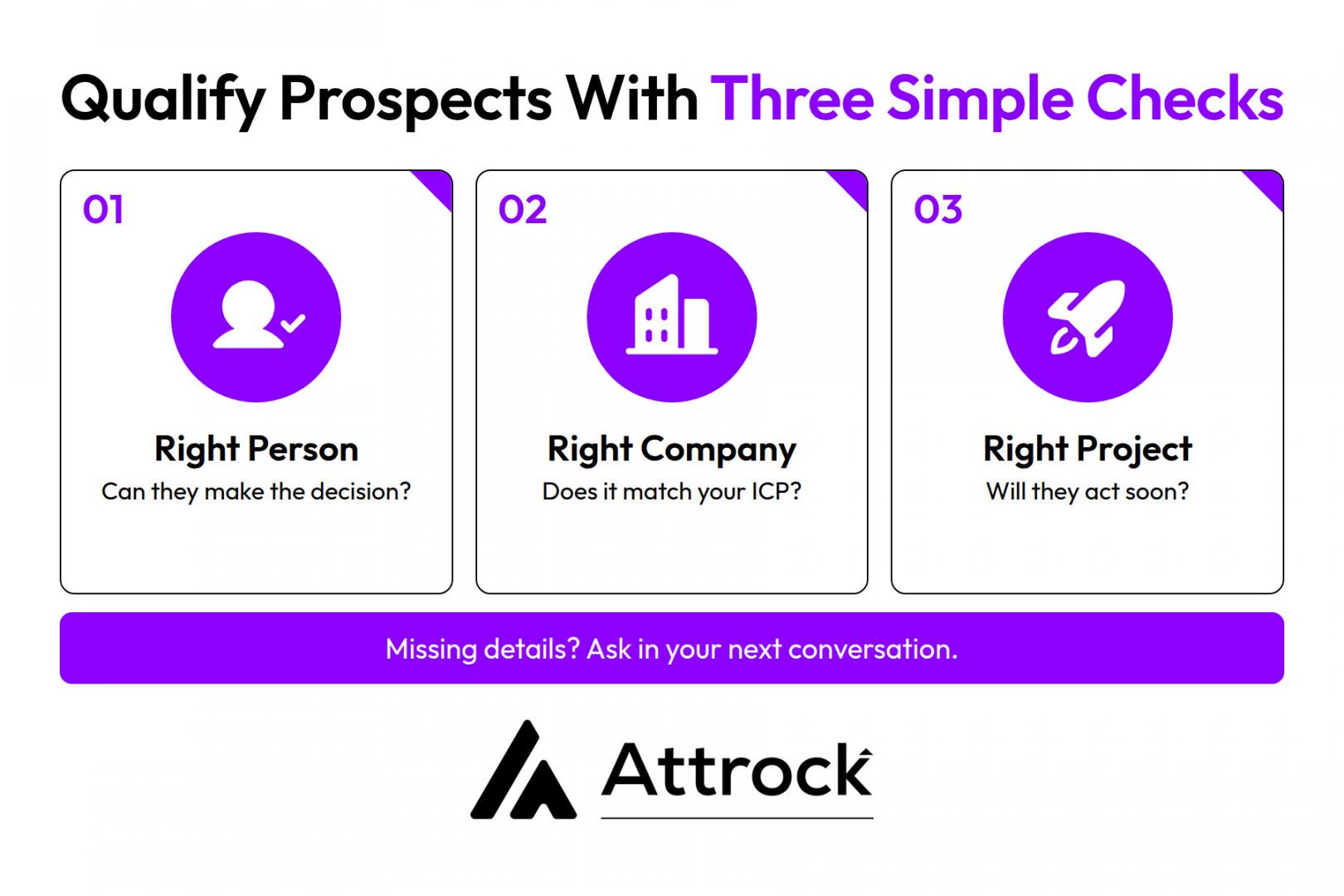
3. Ask Your Network for Warm Introductions
A warm introduction connects you with a potential buyer through someone you both know. An introduction from a trusted contact can make your first message feel less like a cold pitch.
In 6sense's 2025 B2B buyer study, 85% of buyers had prior experience with the vendor they chose. This shows why familiarity matters in B2B sales, though it doesn't measure the impact of referrals.
Here are a few ways to get more introductions:
- Ask for an introduction: Tell your contact who you'd like to meet and why. Give them an easy way to say no.
- Make it easy to share: Write a short note that explains what you do and why the introduction could help.
- Contact former customers and colleagues: They know your work and may recommend you.
- Keep referrers informed: Let them know how the introduction went, even if it didn't lead to a deal.
Here's a message a contact can forward:
“Hi [Prospect], meet [Your Name]. They help companies with [specific problem]. I thought it might be useful for you two to connect.”
Pick three people in your network who know your work. Ask if they can introduce you to someone who might need your help.
You can also explore Attrock's guide to build an effective referral marketing strategy for more ways to encourage recommendations.
Here's an example of a short introduction request you can send to someone in your network.
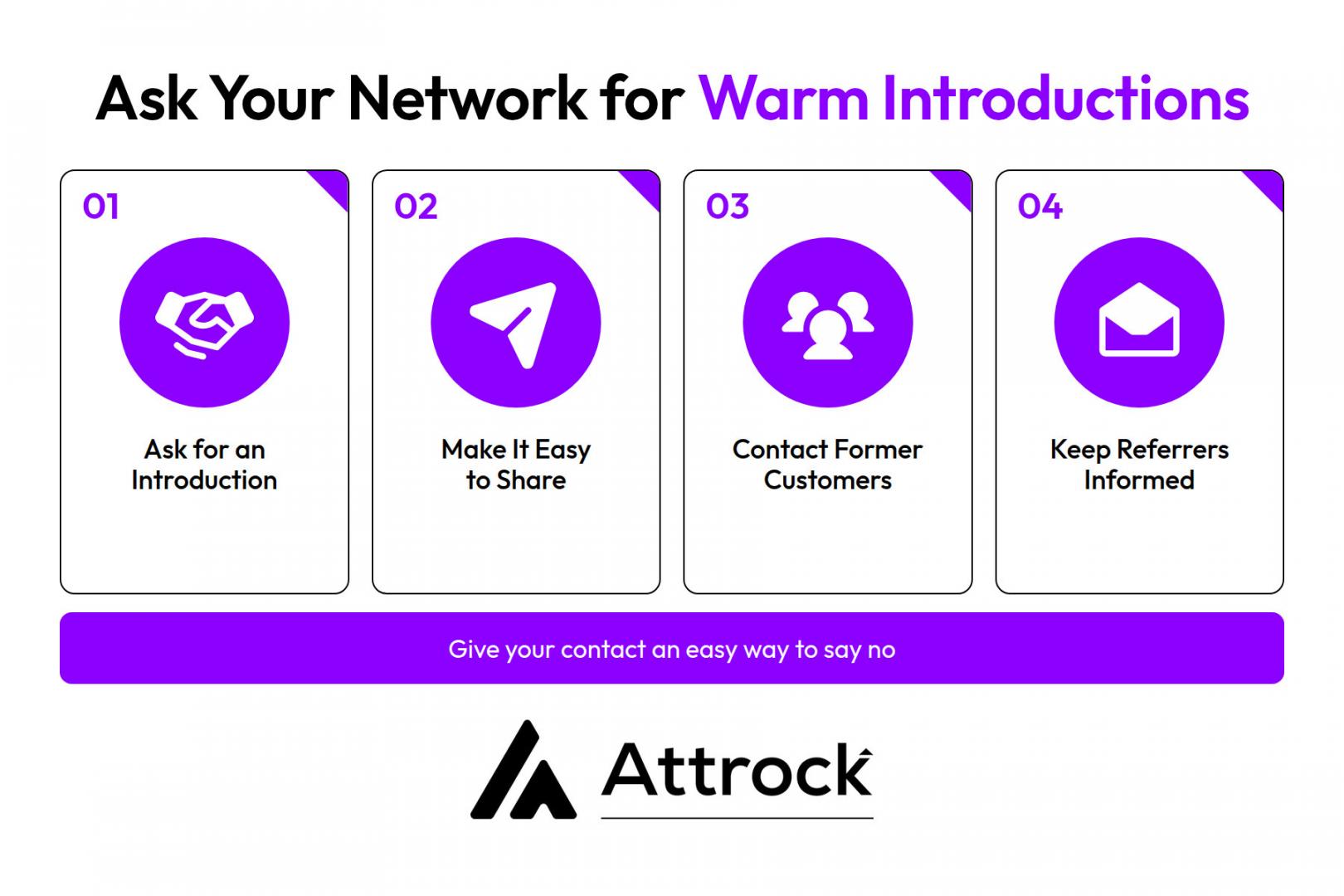
A warm introduction connects you with a potential buyer through someone they already know and trust. This can make your first message feel more credible and give the buyer a reason to respond.
4. Send Short Emails to Small, Verified Lists
Keep cold emails short and relevant. Check your contact list before sending, too. Even a strong message won't get a reply if it goes to an invalid address.
Saleshandy analyzed 30.3 million cold emails in 2026. Campaigns with fewer than 200 prospects had reply rates of 15% to 20%, compared with 8% for lists of 500 to 1,000. Smaller lists may also be easier to target and personalize.
The bounce rate was 1.21% for verified addresses, compared with 2.11% for unverified ones. For addresses classified as bad, it reached 10.58%. Keeping your list clean also helps with email deliverability.
Keep these practices in mind:
- Check your list before sending: Invalid addresses can hurt your sender reputation and affect future delivery.
- Keep first emails under 100 words: Focus on one relevant problem and one clear request. Mention a buying signal when it adds value.
- Increase sending volume gradually: Start with a low daily volume. Increase it slowly while checking bounce rates, spam reports, and delivery errors.
- Follow email rules: In the US, use truthful subject lines, include a valid postal address, and offer an opt-out method. Honor opt-outs within 10 business days. See the FTC's CAN-SPAM guidance.
For your next campaign, start with 100 accounts that match your ICP. Test your message before reaching out to a larger list. Use email tracking to measure replies and positive replies.
Here's an example of a cold email with four parts: a relevant opening, a clear problem, a short value statement, and one request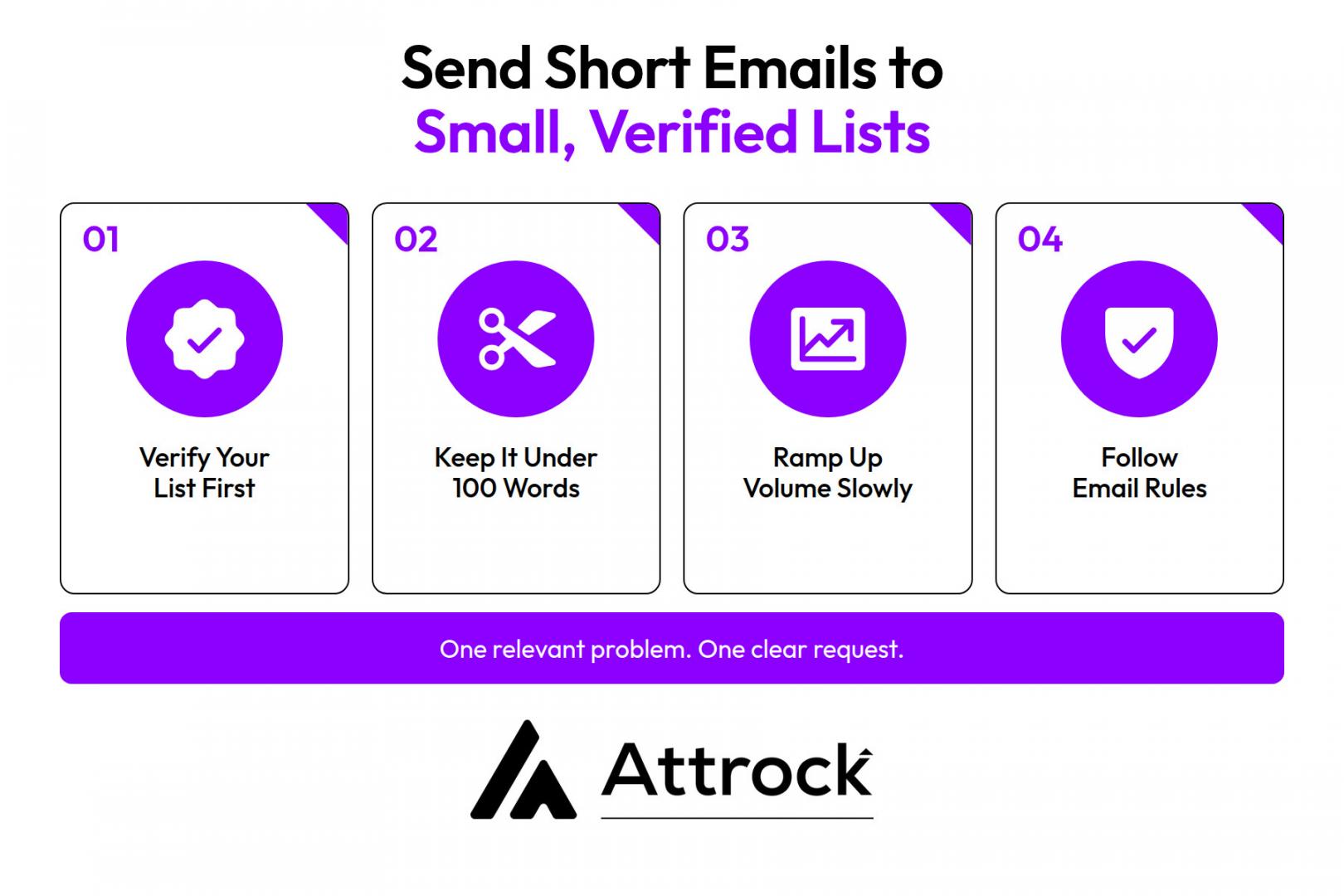
5. Use a Multichannel Follow-Up Sequence
A multichannel sequence uses email, calls, and LinkedIn to reach prospects over time. It gives you more ways to start a conversation without relying on one message.
Saleshandy's 2026 study found that follow-ups generated 57% of positive replies. Email-only sequences had a 0.11% positive reply rate, compared with 0.88% for sequences using email, LinkedIn, and another channel.
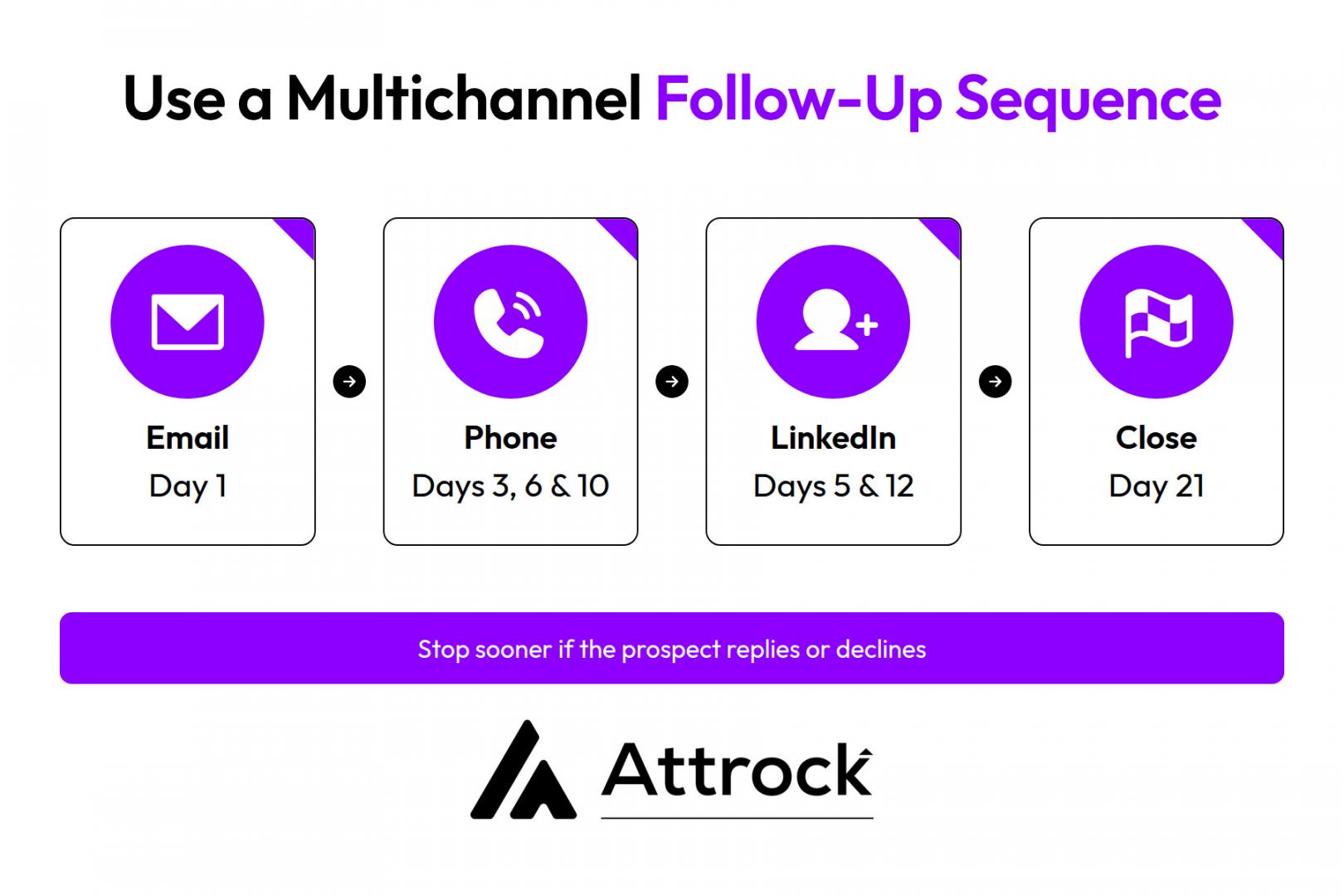
Here's one way to plan your outreach over three weeks:
- Day 1 – Email: Mention a relevant buying signal, explain the problem, and ask one question.
- Days 3, 6, and 10 – Phone: Make up to three call attempts. If you connect, ask about the prospect's needs.
- Days 5 and 12 – LinkedIn: Send a relevant connection request, then follow up if they accept. Don't repeat your email pitch.
- Day 21 – Close: End the sequence if there's no reply. Stop sooner if the prospect responds or declines.
In Cognism's 2025 study of over 204,000 cold calls, 93% of conversations happened within the first three attempts. Expandi's 2026 research also found that three-message LinkedIn sequences had a 9.8% reply rate, compared with 5% for sequences with five or more messages.
A sales engagement platform can help you plan follow-ups and track replies across channels. You can also use small business automation to schedule routine tasks.
Try adding one channel beyond email to your next outreach sequence.
Here's an example of how to spread email, phone, and LinkedIn outreach over three weeks.
6. Multithread the Buying Committee
Relying on one contact can put a deal at risk. In larger B2B deals, several people may shape the final decision. Building ties with them helps you understand their needs and concerns.
The buying committee includes people who use, review, influence, or approve a purchase. Multithreading means building relationships with several people involved in the same buying decision.
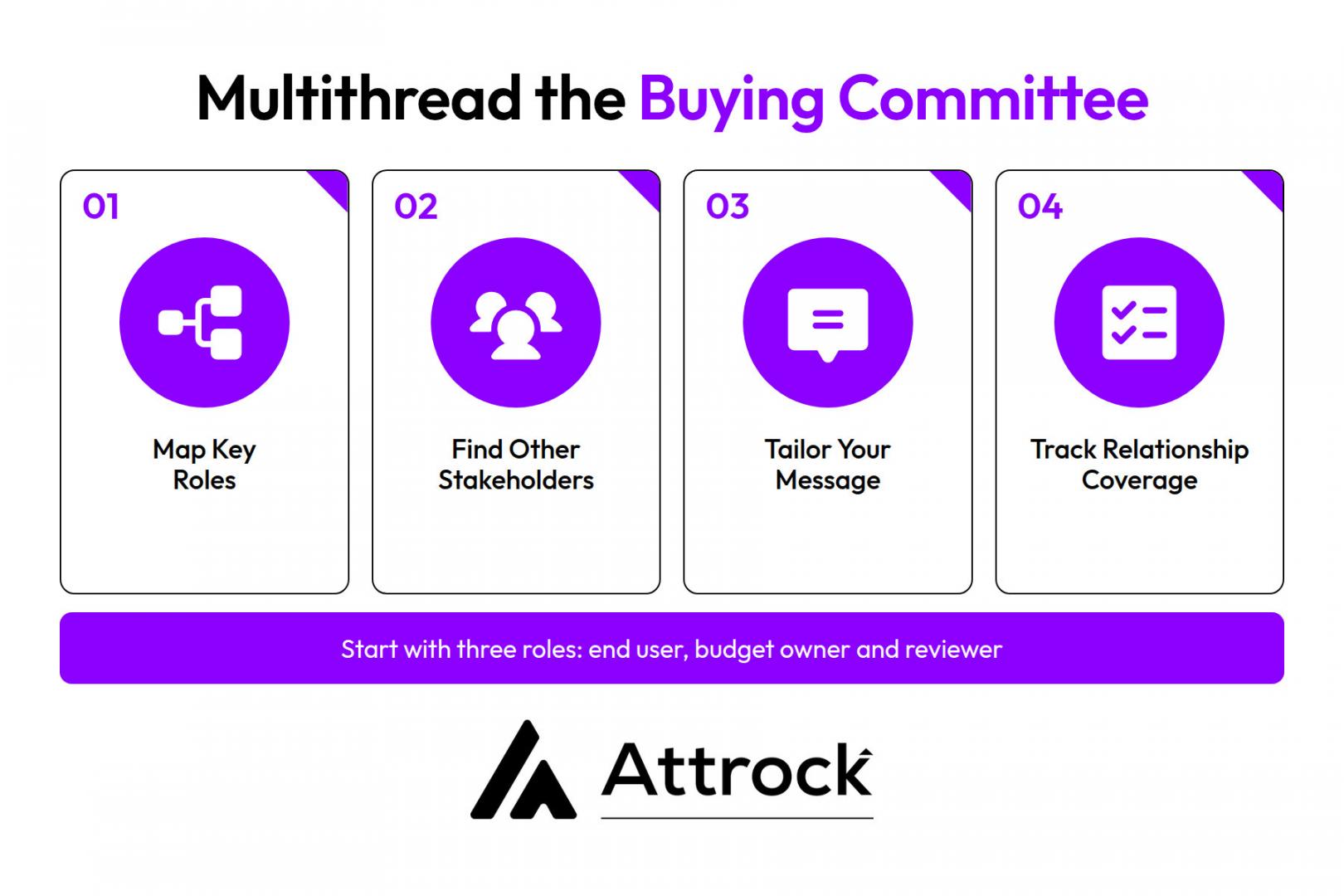
Start with three roles: the person facing the problem, the budget owner, and someone who will review or influence the decision.
Consensus's 2026 B2B Buyer Behavior Report analyzed over 6 million customer interactions on its demo platform. It found that Demoboards shared with seven or more stakeholders were linked to opportunities 36% of the time, compared with 19% for those with no additional stakeholders.
The results show a link between stakeholder involvement and sales opportunities, not proof of more closed deals. They also suggest why it helps to look beyond your first contact.
- Map key roles: Find the end user, budget owner, and technical reviewer or other key influencer.
- Find other stakeholders: Ask your main contact who else needs to be involved. Request an introduction before reaching out.
- Tailor your message: Finance leaders and end users care about different things. Adjust your approach for each group.
- Track relationship coverage: Check which stakeholders you've spoken with and which roles still need attention.
Review your five largest open deals and identify which key contact you're missing.
Multithreading also supports account-based marketing, where teams focus their efforts on high-value accounts and the people involved in each purchase.
Here's an example of a stakeholder map showing which contacts are involved in a deal.
7. Put an AI Agent on Research and Drafting
An AI agent can research accounts, spot buying signals, and draft outreach messages. You can then review the drafts before sending them.
This saves reps from starting every email from scratch. They can spend more time checking prospect fit and adding details AI may miss.
Salesforce's 2026 State of Sales report found that 55% of sales pros use AI for prospecting. Top performers were 1.7 times more likely to use prospecting agents than lower performers, though this doesn't prove AI caused their success.
Expandi studied 118 LinkedIn campaigns across 73 accounts. Within the same accounts, human-written outreach had about 12% higher connection acceptance rates than AI-written outreach. Reply rates were similar.
HubSpot's Prospecting Agent spots buying signals, finds contacts, and drafts personalized emails. It requires an eligible paid plan and uses HubSpot Credits when creating outreach. You can set it to ask for approval before sending.
Keep these practices in mind:
- Use AI for research, not decisions: You still need to decide if a prospect is a good fit and when to reach out.
- Review every message: Choose the review-before-sending option. Check names, claims, and relevance before approving each draft.
- Watch credit usage: Set your own weekly lead target and track how many HubSpot Credits the agent uses.
- Compare results: Test AI-assisted and human-written messages with similar prospects. Track positive replies and meetings, not just total replies.
If you only research a few accounts each week, a spreadsheet and calendar reminders may be enough.
Want to test an agent? Compare options in our guide to AI prospecting tools. Start with a small list and review the results after your outreach sequence ends.
The example below shows how an AI agent moves from prospect research to an email draft and human review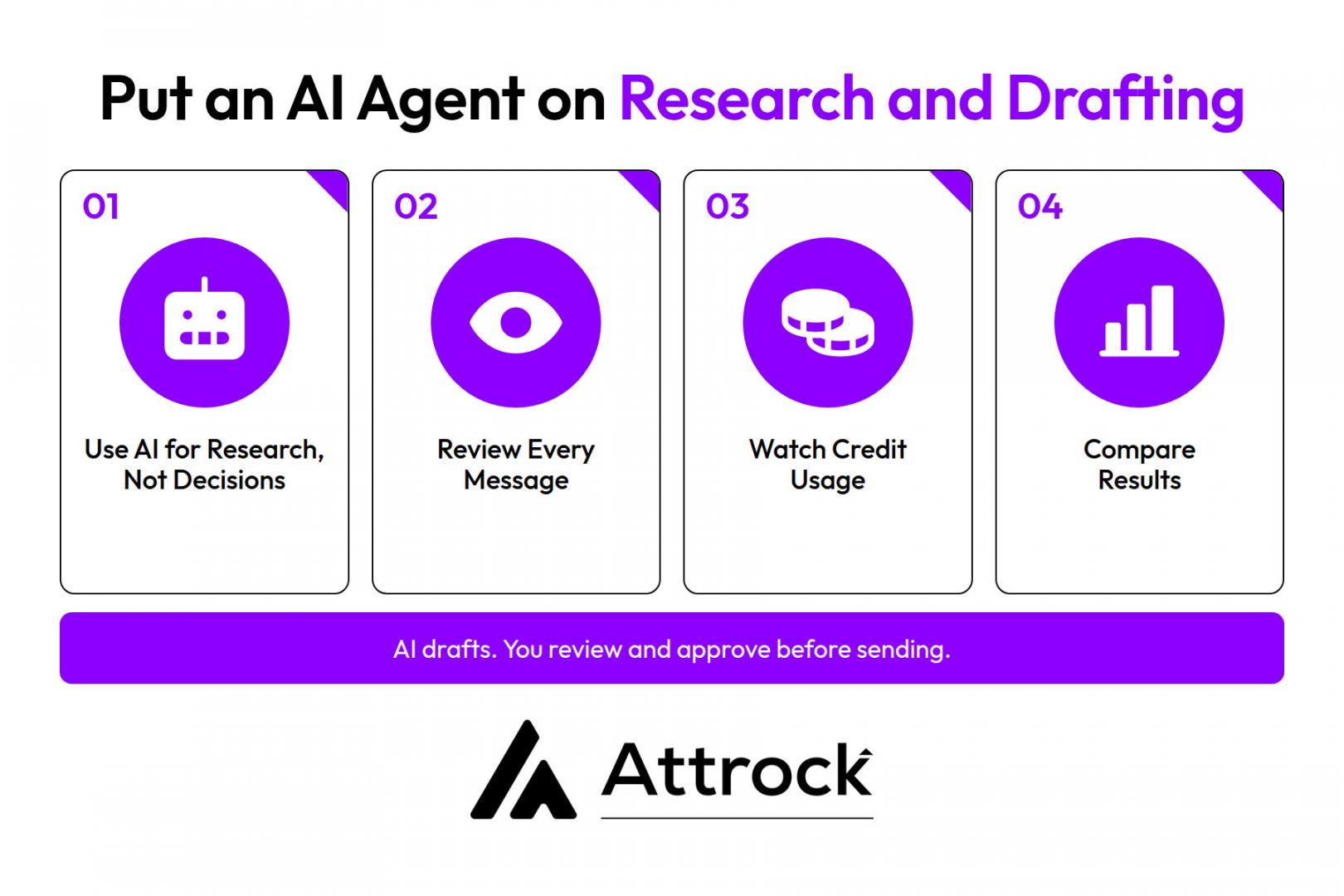
Sales prospecting means finding potential buyers, checking if they match your ideal customer profile, and starting relevant conversations. To build a strong pipeline, create a targeted prospect list, qualify leads, and follow up consistently. Focus on buyers who have a real need for your product or service.
Which Prospecting Techniques Work at Your Deal Size?
Deal size can shape your sales prospecting techniques. Smaller deals often suit short, repeatable outreach. Larger deals may need more research and contact with several stakeholders. The buying process matters, too.
A $3,000 self-serve purchase may need little sales support. A $150,000 deal involving several stakeholders often needs a more personal approach.
Use the table below to choose a starting approach. The deal values are examples, not fixed rules.
| Deal profile | What the buying looks like | Techniques to prioritize | Techniques to skip |
|---|---|---|---|
| Self-serve, under $5k | One buyer, decision within days | Verified lists, short sequences, AI-assisted drafts | Extensive account research, multithreading when only one buyer is involved |
| Mid-market, $5k-$50k | Two or three decision-makers, several weeks | Buying signals, warm introductions, follow-up sequences, AI research | High-volume outreach without clear targeting |
| High Value, $50k+ | Often involve several decision-makers, longer sales cycles, and more approvals | Multithreading, warm introductions, account-based prospecting | Generic mass emails, relying on one contact, unreviewed AI messages |
| Founder-led, any size | The founder handles sales alongside other business tasks | Warm introduction, three qualification checks, focused follow-ups | Too many channels at once, complex workflows before they're needed |
If you handle sales yourself, start with two or three techniques you can manage each week. Add more once you know what's working.
G2's 2026 survey of 1,038 B2B software buyers found that finance involvement in purchase decisions rose from 31% to 46% in one year. This shows why sales teams need to understand who influences a purchase, not just who uses the product.
For complex deals, identify the people involved in the purchase and learn what matters to each one. For simpler deals, keep your outreach focused and easy to manage.
Small sales teams should start with verified contact lists, lead qualification, and focused follow-ups. Keep messages short and relevant. For larger deals involving several stakeholders, add warm introductions and build relationships with the people involved in the purchase.
How Do You Measure Sales Prospecting Performance?
Track six metrics to measure prospecting performance: first meetings held, cold email reply rate, bounce rate, LinkedIn reply rate, daily activities, and calls per conversation.
These numbers show how much outreach you do, whether your messages reach buyers, and how often those efforts lead to conversations.
Tracking numbers is only the first step. Compare your results with past campaigns to see whether they're improving. Then use industry benchmarks to find areas that may need work.
You can use sales productivity tools to track outreach activity, follow-ups, and results in one place.
| Metric | Research Finding | Source |
|---|---|---|
| First meetings held per rep, monthly | Median monthly SDR quota: 10 Stage 0 meetings held | The Bridge Group, 351 B2B companies, 2025 |
| Cold email reply rate | 15–20% for campaigns under 200 prospects; 8% for 500–1,000 | Saleshandy, 30.3M emails, 2026 |
| Bounce rate | 1.21% for verified valid email addresses | Saleshandy, 2026 |
| LinkedIn reply rate | 9.8% for three-message sequences | Expandi, 2,966 campaigns, 2026 |
| Activities per day | 112 median activities; 4.1 average quality conversations | The Bridge Group, 2025 |
| Call attempts to reach a prospect | 93% of recorded conversations occurred within three attempts | Cognism, 204,000+ calls, 2025 |
Here's a simple weekly routine to put these numbers into practice:
- Monday: Build your prospect list using one buying signal.
- Tuesday to Thursday: Set aside time each day for outreach. Use calls, emails, or LinkedIn based on your prospect list.
- Friday: Review outreach activity and replies. Remove poor-fit accounts and set reminders for prospects who may be ready later.
Activity counts show how much outreach you do. Conversations show who responds, while meetings held show whether that interest moves forward. Track all three to find gaps.
Pro Tip: Choose one metric to improve this month. Track the others as usual, then review your progress at the end of the quarter.
Match your prospecting approach to deal size and buying complexity. Use verified lists and short sequences for simpler deals. For complex deals, focus on warm introductions and multithreading. Track meetings held, email and LinkedIn replies, bounce rates, daily activities, and call attempts to see what needs improvement.
Where Should You Start With These Sales Prospecting Techniques?
Start with a prospect list based on buying signals. Check which accounts are a good fit, then choose an outreach method your team can manage. Starting small makes it easier to track results and see what needs to change.
You don't need all seven techniques at once. Start with two that address your biggest prospecting gaps and test them for a month. Compare your reply rates and meetings held with past results. Use the benchmarks in this guide as a reference.
Keep what works. If you still have gaps, test another technique.
For more ways to build a consistent pipeline, explore these lead generation strategies.
Set time aside each week to prospect, review replies, and update your list. Keep the steps that bring useful conversations and change those that don't.
Focus on accounts that match your ideal customer profile instead of reaching out to every lead. Use warm introductions when you can, and make cold outreach relevant to each prospect. Follow up with a clear plan, but know when to stop.
FAQ
Q1. What Are the Best Sales Prospecting Techniques?
A. The best techniques depend on where your prospecting results are falling short. If you're getting replies but few meetings, work on qualification.
If replies are low, review your prospect list before changing your emails. If deals stall near closing, focus on reaching more decision-makers. Start by identifying the weakest part of your process.
Q2. What Are the 5 P's of Prospecting?
A. The five P's of prospecting are purpose, preparation, personalization, perseverance, and practice. They help sales reps set goals, research buyers, tailor messages, follow up, and improve their skills. Other versions use slightly different terms.
Q3. What Is the 3-3-3 Rule in Sales?
A. The 3-3-3 rule is an informal sales guideline. One version suggests three outreach attempts across three channels over three days. Another spaces the attempts three days apart. The separate 3×3 research rule means finding three useful facts about a prospect in three minutes.
Q4. How Many Times Should You Follow Up With a Prospect?
A. Aim for four to six follow-ups over three weeks, then stop. The right number depends on the channel and how prospects respond. Cognism's research found that most phone conversations happen by the third attempt.
Track your attempts instead of relying on instinct. A clear stopping point also prevents follow-ups from becoming excessive.
Q5. What Is the Difference Between Prospecting and Lead Generation?
A. Lead generation focuses on attracting potential customers through inbound and outbound marketing. Prospecting involves sales reps identifying and contacting specific accounts.
Lead generation fills the top of the funnel. Prospecting determines which potential customers deserve direct attention and a sales conversation.
Q6. Do Cold Calls and Cold Emails Have to Follow Compliance Rules?
A. Yes. In the US, CAN-SPAM requires commercial emails to use truthful sender details, include a valid postal address, and offer a way to opt out. Senders must honor opt-outs within 10 business days.
Cold calls and texts may also fall under the TCPA and other telemarketing rules. Canada's CASL and Europe's GDPR add requirements for marketing and personal data. Check local rules before contacting prospects.
Q7. Are the Top 10 Sales Prospecting Techniques a Real List?
A. No. There's no universally accepted list of the top 10 sales prospecting techniques. Different guides recommend different approaches based on their audiences and sales models.
A small startup and a large enterprise team rarely need the same methods. Choose your techniques based on deal size, available resources, and your sales process.
Q8. How Much Time Should a Rep Spend on Prospecting Each Week?
A. Schedule prospecting as a regular task, not just spare-time work. Two focused hours a day is a good starting point. It's a suggestion, not an industry standard.
Consistency matters more than the exact number of hours. You can move a prospecting block when needed, but avoid canceling it regularly.
Conclusion
Effective sales prospecting techniques aren't about contacting as many people as possible. They're about finding the right accounts, understanding their needs, and reaching them with relevant messages.
Start with buying signals and qualify prospects before investing time in outreach. Build relationships across channels and use AI to help with research and drafting. Track reply rates and meetings held to see what's working.
The goal is to build a process your team can follow each week, with less wasted effort and more useful sales conversations.
Need help finding and qualifying the right prospects? Attrock's lead generation services can help you build a stronger pipeline.
Want to keep prospect records and follow-up tasks in one place? Explore HubSpot Starter to manage your pipeline and stay on top of outreach.
Disclaimer: This content contains some affiliate links for which we will earn a commission (at no additional cost to you). This is to ensure that we can keep creating free content for you.