AEO prompt selection is the process of identifying which questions people ask AI engines and making sure your brand appears in the answers. Get it right, and AI starts recommending your brand. Get it wrong, and competitors take that spot instead.
Today, more people are skipping traditional search entirely. SparkToro data shows that about 60% of Google searches end without a single click. AI platforms like ChatGPT, Gemini, and Perplexity are answering questions before your site ever gets a chance to compete.
That means the real question isn't just “How do I rank?” it's “Does my brand show up when someone asks AI for a recommendation in my category?”
Say someone asks, “What's the best email tool for small businesses?” — does your brand appear, or does a competitor take that spot?
These questions are your AEO prompts. Identifying them early and shaping your content around them are key to building lasting visibility in AI search. In this guide, you'll learn how to choose, test, and improve prompts over time.
Disclaimer: This content contains some affiliate links for which we will earn a commission (at no additional cost to you). This is to ensure that we can keep creating free content for you.
Table of Contents
What Is AEO Prompt Selection (and Why It Matters?)
AEO prompt selection is the process of choosing the right prompts to influence how AI systems generate answers about your brand. It plays a key role in answer engine optimization (AEO) and shapes how AI answer engines deliver AI responses.
Unlike traditional SEO, where you optimize for rankings and blue links, AEO prompt selection positions your brand directly within AI responses. It shapes AI responses that confidently cite your brand using verifiable data and E-E-A-T signals.
Here’s why AEO prompt selection matters:
- AI Visibility: Prompts reflect how you appear in AI summaries and answers. If you’re not tracking the right prompts, you won’t know where you’re missing.
- User Intent: AI models answer based on what real users ask. Your tracked prompts must reflect actual user behavior across AI search, not assumptions.
- Gap Identification: Tracking prompts shows where your brand is missing from AI-generated answers. It also helps close gaps that cost you traffic and visibility.
- Business Impact: Structured prompts improve brand mentions and drive measurable outcomes. These include traffic, conversions, and engagement.
AEO prompt selection is how you identify, define, prioritize, and monitor the questions users ask in AI search. It’s the foundation of AI visibility. Without it, you’re optimizing blind.
Key Considerations for AEO Prompt Selection
Not every question your audience asks is worth tracking. Effective AEO prompt selection helps align prompts with user intent, business goals, and measurable outcomes.
1. Start with Intent, Not Keywords
Keyword research tells you what people search. Intent explains why.
AI tools like ChatGPT don’t match keywords. They focus on meaning and context to understand what users want. So chasing keywords alone won’t help you show up in AI answers.
Think about the real question behind the words. Then match your prompts to where the buyer is in their journey:
- Informational prompts (“What is HubSpot AEO?”) target early-stage buyers building awareness
- Transactional prompts (“Best SaaS AEO tool for B2B marketing”) signal high purchase intent
- Navigational prompts (“HubSpot AEO demo”) come from buyers already close to a decision
Having a healthy mix of prompts can help cover the full funnel.
2. Don’t Rely on Guesswork
Manual brainstorming often leads to missed opportunities and weak AI visibility. It's slow, biased, and easy to get wrong.
Modern AEO tools like HubSpot AEO suggest prompts to track based on your industry, competitors, and customer data. They allow you to start with a focused, relevant list rather than a blank page.
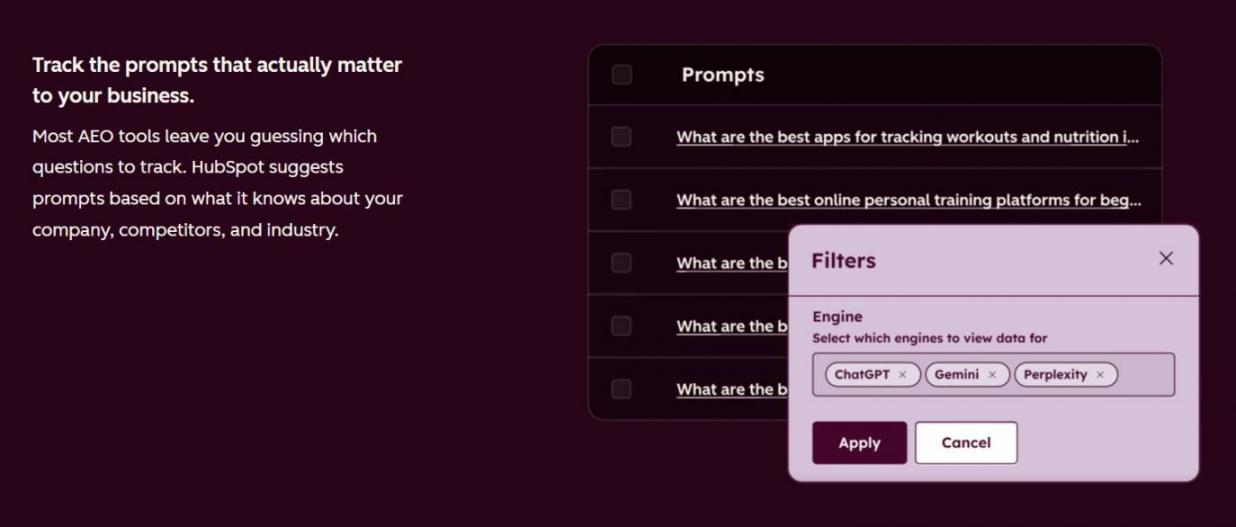
Image via HubSpot
AEO prompt selection works best when it’s driven by user intent, real use cases, and data, not guesswork. The right prompts lead to stronger AI visibility and better outcomes.
3. Map Prompts to Real Use Cases
Think beyond generic prompts and align them with real scenarios. AI answers show up across content creation, product discovery, and customer support scenarios. Some specific prompts that connect to real buyer moments include:
- “How to improve AI search visibility”
- “Best CRM for finance-focused B2B SaaS companies”
- “Data and AI tools that integrate with HubSpot Marketing Hub”
Specific prompts that connect to a clear use case help AI systems generate relevant, branded responses.
4. Prioritize High-Impact Prompts
Not all prompts are equal. Focus on ones with high search demand, clear revenue potential, and, critically, those where competitors are already showing up.
High-impact prompts usually have clear intent and strong business value. For example:
- “How can I reduce cloud storage costs by 20% this quarter?”
- “Best alternatives to Mailchimp under $60/month for small businesses”
- “Which dentist near me accepts MetLife insurance and has appointments this week?”
Tools like HubSpot AEO turn AI visibility data into clear, prioritized actions. For example, they can suggest creating a new page or updating content to close gaps.
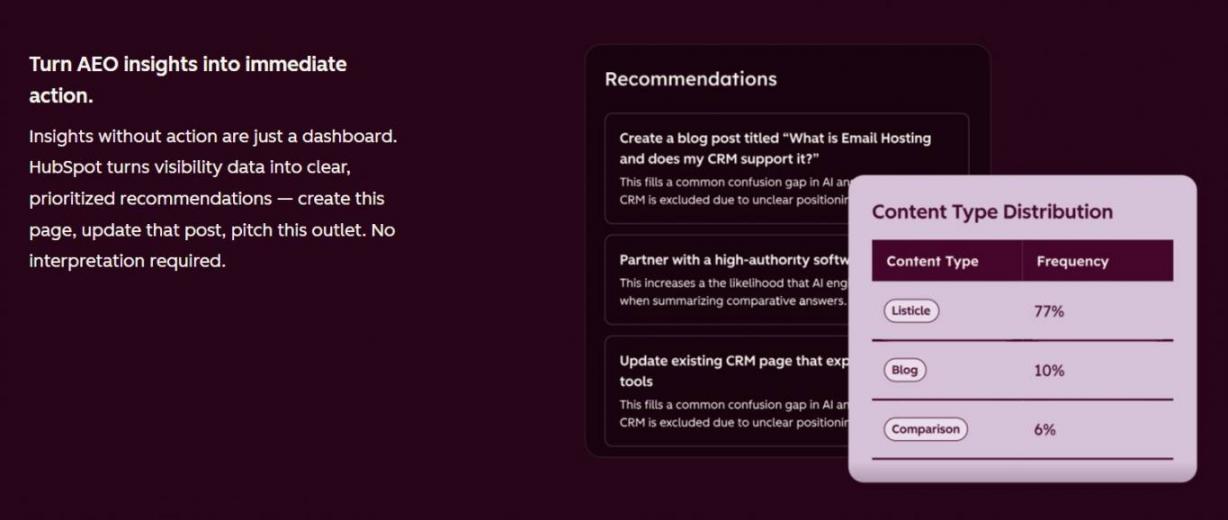
Image via HubSpot
It’s worth tracking high-impact prompts as they influence brand visibility scores and AI summaries across major answer engines.
The AEO Prompt Management Lifecycle
AEO prompt selection doesn’t stop at choosing the right prompts. To build lasting AI visibility, you need a system that helps you manage prompts over time. This is where most teams struggle.
Prompts get scattered across docs, chats, and tools. There’s no clear structure, tracking, or way to improve results. A strong system fixes this. It helps you organize prompts, improve consistency, and turn them into assets you can scale.
Collect and Organize Prompts
Start by gathering prompts from every relevant source. These can include sales call notes, customer support tickets, Google AI overviews, competitor mentions, and AI answer engines.
Look at what questions users are asking on forums, Reddit, and social media. Then, organize your findings. Make it easy to find and reuse prompts by either grouping or tagging each by:
- Buyer Stage: Awareness, consideration, or decision
- AI Engine: ChatGPT, Gemini, Perplexity, or a combination
- Use Case: Product discovery, comparison, support, and content creation
- Topic Cluster: Grouped by product, service, campaign, or theme
This structure makes it easy to filter, assign, and act on prompts later, especially when your AEO strategy or team expands.
A common mistake is collecting too many prompts too fast. More isn’t better. A focused list of 10 to 20 high-intent prompts gives cleaner data and faster wins than a bloated library of 100 prompts nobody reviews.
Start narrow, then expand based on results.
Structure Prompts for Consistent AI Responses
How you write a prompt affects what you get back. Vague, generic prompts return vague, generic AI responses, making performance tracking nearly impossible.
AI engines reward clarity and context, so each prompt must be specific, stable, and repeatable. A few rules that help:
- Be Specific about Context: “Best CRM for small business” is too broad. “Best CRM for small B2B SaaS teams with under 50 users” is trackable. Similar prompts can return very different AI answers, so precision matters.
- Keep Phrasing Consistent: If you change the wording of an individual prompt each time you run it, you’re not tracking the same thing. Lock in the exact phrasing and only update it intentionally, then log the change.
- Version Your Prompts: When a prompt evolves, don’t overwrite it. Keep a record of what the original said, what changed, and when. This lets you tie shifts in AI visibility back to specific prompt changes or content updates.
The goal is a prompt library where every entry is clean, comparable, and easy to hand off to a teammate. If your prompts reflect sloppy structure, your tracking data will be just as messy.
Track Outputs and Measure Performance
Once your prompts are organized and structured, it’s time to run them and record their performance.
Indeed, AEO prompt selection is only effective when you can connect prompts to real outcomes. These include traffic, conversions, and engagement. The core metrics worth tracking are:
- Brand Visibility Score: How often your brand appears across your tracked prompts
- Citation Performance: Which of your pages, blog posts, or third-party mentions are driving AI answers
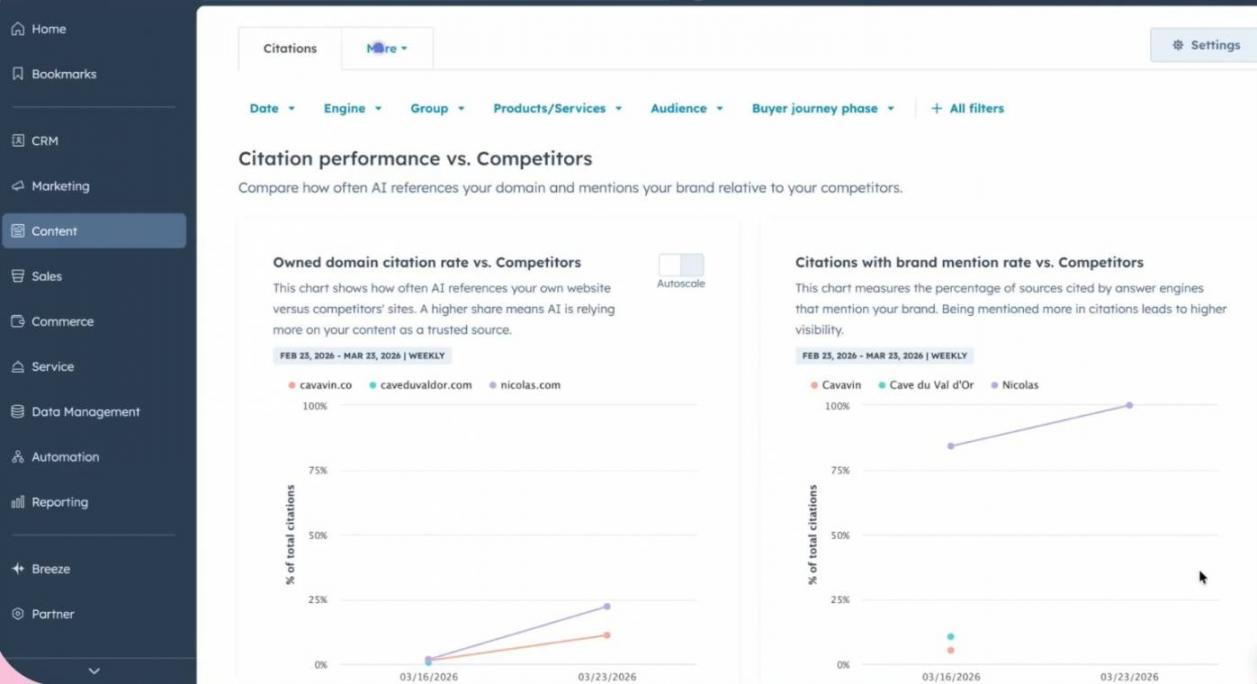
Image via HubSpot
- Share of Voice: Your brand mentions vs competitor mentions across the same prompt set
- Sentiment: How answer engines describe your brand when they do mention you
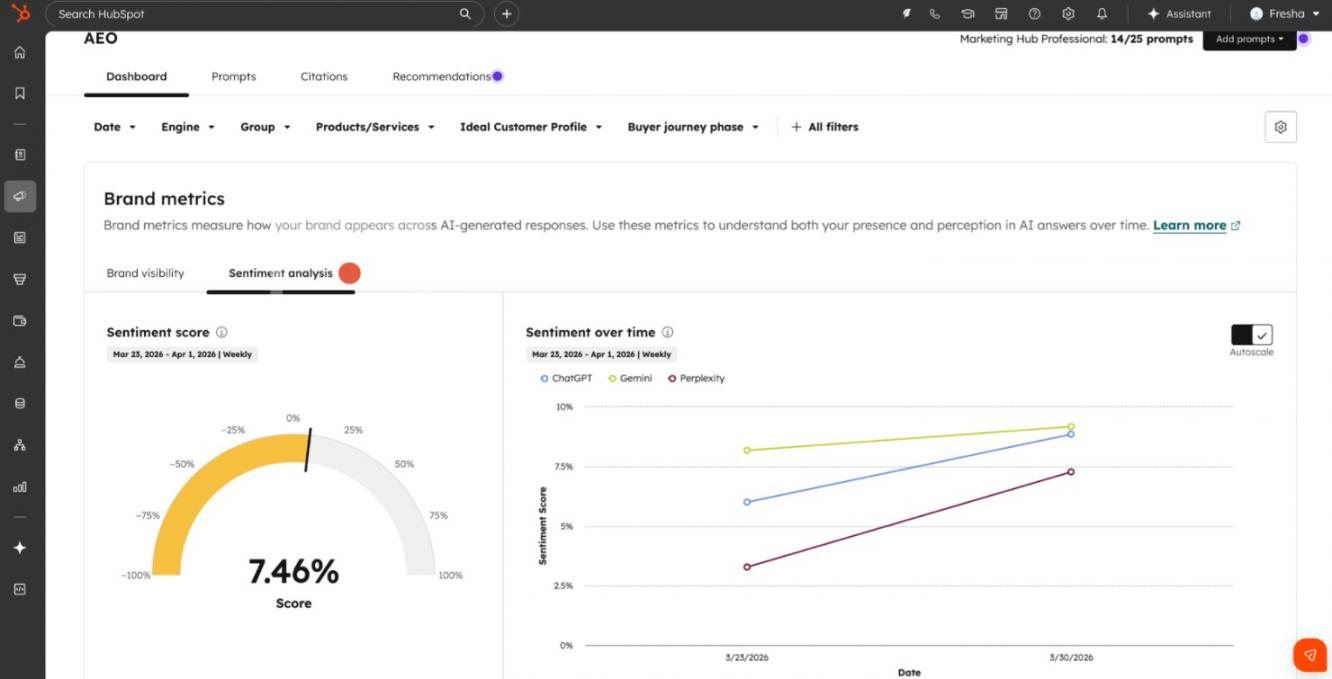
Image via HubSpot
- Downstream Impact: Traffic and conversions arriving from AI search
Citation analysis is especially powerful. It shows you why you appear, which means you can create more of what’s working.
Say a specific blog post keeps earning citations across major answer engines. That’s a signal to expand, update, and build related content around it.
Monitor prompts and success metrics regularly, and track your outcomes — not just the outputs.
Refine Prompts Using Real Results
Tracking without acting is just data collection. The real value of AEO prompt selection comes from closing the loop. Here’s how to go about it:
- Low visibility on a high-intent prompt? Your existing content isn’t authoritative enough. Create new content, optimize existing pages, or earn citations from third-party sites AI crawlers already trust. Tools like Surfer SEO and Clearscope can help identify where your content falls short on depth and authority.
- Solid content that’s still not showing up? The issue may be how the prompt is framed. Try restructuring the prompt itself. New prompts framed around a slightly different angle can unlock AI visibility gaps you didn’t know existed.
- Competitors dominating the same prompt? Analyze what content they have that you don’t. Then build something more specific, verifiable, and stronger on E-E-A-T signals. AI content writing tools like Jasper can speed up that content creation process once you know the gaps you need to fill.
- Negative or weak sentiment in AI responses? Look at what sources AI models are pulling from. Fix gaps in messaging and improve how your brand appears across trusted platforms. Tools like Salesforce can then connect those findings to your broader marketing and content workflows.
AEO prompt selection improves with tracking and iteration. Measure what works, refine what doesn’t, and scale prompts that drive real results.
How HubSpot AEO Brings Structure to Prompt Management
By now, it’s clear that AEO prompt selection is not just about writing better AI prompts. It’s about managing them as structured, trackable assets within your marketing system. And that’s where most teams hit a wall.
Prompts can end up scattered across chat logs, docs, spreadsheets, and SEO tools with no centralized system to manage or evaluate them. Teams also struggle to track AI visibility or connect prompts to real outcomes. This creates gaps in your AEO strategy and makes it hard to scale what works.
HubSpot AEO addresses this by consolidating prompt selection, tracking, and performance into a single platform, so your team can work with clarity and consistency.
Here’s what it looks like in practice:
- AI visibility tracking runs across ChatGPT, Gemini, and Perplexity. You can see how answer engines describe your brand on a single dashboard.
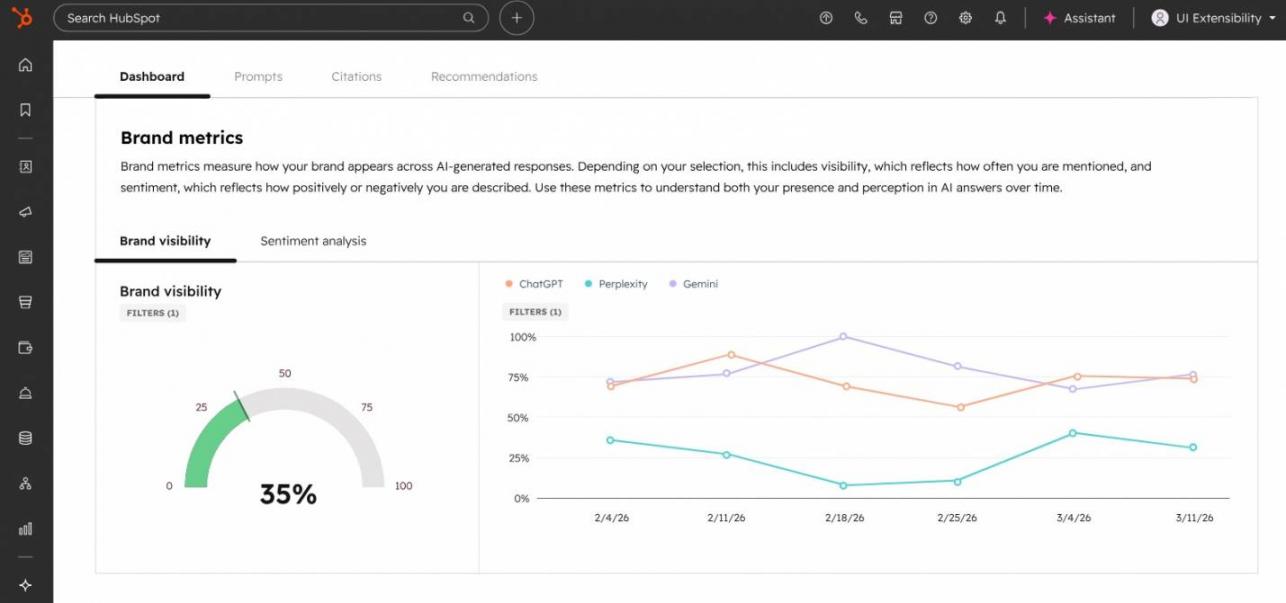
Image via HubSpot
- HubSpot Marketing Hub integration connects prompt performance to campaign and customer data. You can now cite AI search as a revenue driver.
- Prioritized recommendations tell your team exactly what to fix and in what order. These are tied to real business outcomes, not just visibility scores.
- Prompt suggestions are generated automatically from your company profile, competitors, and industry. This cuts out manual brainstorming.
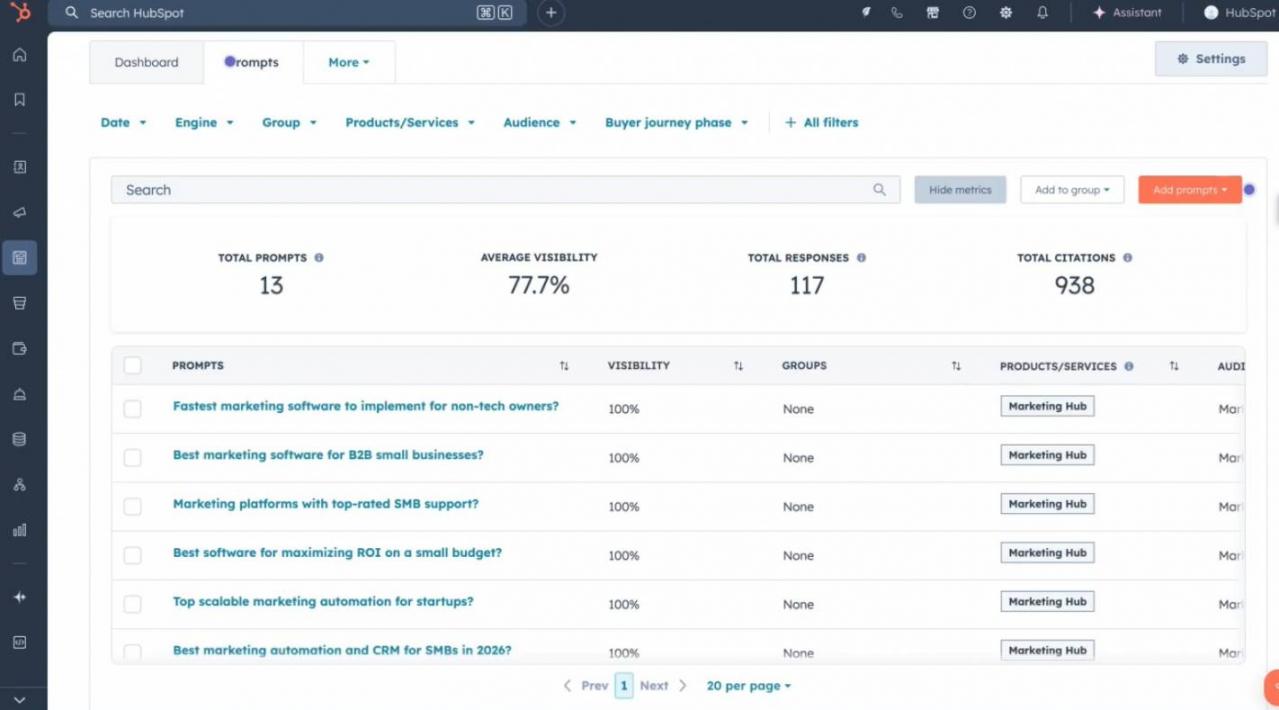
Image via HubSpot
Unlike SEO tools that bolt on AI features, HubSpot AEO is a dedicated AI visibility tool purposely built for answer engine optimization. It gives your team a centralized, data-driven system to manage AI visibility end-to-end, without the fragmentation that kills most AEO strategies.
FAQ
Q1. What is AEO prompt selection?
A. AEO prompt selection is the process of identifying which questions to monitor across AI platforms like ChatGPT, Gemini, and Perplexity. It helps you track and improve how your brand appears in AI answers.
Q2. How is AEO different from traditional SEO?
A. Unlike traditional SEO, AEO targets AI-generated answers, not blue links. It focuses on how AI models describe your brand, not just where you rank.
Q3. How often should I review my tracked prompts?
A. A monthly review or once every two weeks works well for most teams. Check what improved, and what dropped, and update the prompts based on performance data and changes in user behavior or AI systems.
Q4. Can small teams manage AEO prompt selection?
A. Yes. Small teams can start by tracking prompts manually in a spreadsheet and reviewing what works. As needs grow, tools like HubSpot AEO can help scale and automate the process.
Q5. Does HubSpot AEO work for small businesses?
A. Yes. HubSpot AEO starts at $50/month with a free 28-day trial, with no credit card required. For businesses already using HubSpot Marketing Hub, HubSpot AEO comes included. For businesses on Marketing Hub Professional or Enterprise, HubSpot AEO is included in the plan.
Q6. What makes a good AEO prompt?
A. A good AEO prompt is specific, intent-driven, and repeatable. It reflects a real question your target audience would ask an AI engine. It’s not just a keyword, but a full conversational query tied to a clear buyer stage. The best prompts are precise enough to elicit consistent AI responses, making performance tracking meaningful over time.
Q7. How many prompts should I track?
A. Start with 10 to 20 high-intent prompts rather than trying to cover everything at once. A focused list gives you cleaner data and faster wins than a large library nobody reviews regularly. Once you have baseline visibility data and a clear picture of where competitors are showing up, you can expand from there based on results.
Q8. What's the difference between an AEO prompt and a keyword?
A. A keyword is a short phrase optimized for traditional search rankings, such as “best CRM software.” An AEO prompt is the full conversational question someone would actually ask an AI engine, such as “What's the best CRM for a small B2B SaaS team with under 50 users?”
AEO prompts more closely reflect natural language and buyer intent than keywords, which is why they require a different approach to tracking and optimization.
Master AEO Prompt Selection for Lasting AI Visibility
AI search isn’t slowing down. Buyers are asking AI engines which brands to trust, and AI is already answering.
AEO prompt selection is how you make sure your brand is part of that conversation. But selection alone won’t sustain visibility. You need a system that organizes, tracks, measures, and refines prompts over time.
That’s exactly what HubSpot AEO delivers. By building a structured prompt management workflow, you don’t just keep pace with AI search; you lead.
Start today, and turn every prompt into measurable visibility, stronger trust, and real business growth.
Disclaimer: This content contains some affiliate links for which we will earn a commission (at no additional cost to you). This is to ensure that we can keep creating free content for you.