If you are weighing HubSpot vs Constant Contact, the choice is sharper than a feature list suggests. HubSpot Marketing Hub is the better pick for B2B SaaS, ecommerce, and growth-stage teams that need CRM-tied email and real automation. Constant Contact is the better pick for small businesses, local services, and nonprofits that want fast, focused email and event tools.
That difference shapes setup time and cost at scale. So instead of comparing tick-boxes, I compared HubSpot vs Constant Contact on the jobs each platform actually does well. By the end of this guide, you will know which platform fits your team, audience, and growth plan.
Disclaimer: This content contains some affiliate links for which we will earn a commission (at no additional cost to you). This is to ensure that we can keep creating free content for you.
Table of Contents
HubSpot vs Constant Contact: The Summary Box
| # | HubSpot Marketing Hub | Constant Contact |
|---|---|---|
 |  | |
| What it is | A CRM-first platform with email, automation, and reporting built in. Every send ties to a contact record, so you can track what a campaign does to your pipeline, not just opens | An email focused and events platform that gets small teams sending fast, with a friendly editor and built-in registration |
| Best for | B2B SaaS, agencies, and ecommerce brands that want email working off live sales data | Small businesses, nonprofits, local services, and event-driven teams |
| Wins on | Automation depth, CRM-native email, reporting, and integrations | Entry price, event marketing, a friendly editor, and same-day setup |
| Free option | It offers a free plan | No free plan |
Which Is Better: HubSpot or Constant Contact?
For HubSpot vs Constant Contact, the answer tracks your sales motion: HubSpot Marketing Hub suits teams building email into a CRM-driven growth engine, while Constant Contact suits teams that want simple, low-cost email and event marketing. The deciding factor is whether your email strategy needs to connect directly to sales data.
The two platforms take different approaches. HubSpot Marketing Hub combines email marketing, automation, and CRM data in a single system. It allows campaigns to align with contact records, deal stages, and revenue reporting.
Constant Contact focuses on straightforward email campaigns and event promotion, making it a simpler option for businesses that do not need advanced CRM functionality.
Pricing and ratings below are current as of June 2026. Confirm on each vendor page before you buy.
| Factor | HubSpot Marketing Hub | Constant Contact |
|---|---|---|
| Best for | B2B SaaS, agencies, ecommerce, growth teams | Small business, nonprofits, event-driven orgs |
| Free plan | Yes — free email tool + free CRM | No — 30-day money-back guarantee |
| Starting paid price | $20/seat/mo (Starter list price) | $12/mo (Lite, up to 500 contacts) |
| Marketing automation | Visual, branching workflows with CRM triggers | Pre-built automations, expand on Premium |
| Native CRM | Yes (free, built-in) | No (relies on integrations) |
| Lead scoring + attribution | Yes (Professional and up) | Limited |
| Integrations | 2,000+ apps | 300+ apps |
| Email deliverability | Sender authentication, dedicated IP options, suppression management | Sender authentication and list-hygiene tools |
| G2 rating | 4.4/5 | 4.0/5 |
| Capterra rating | 4.5/5 | 4.3/5 |
Snapshot verdict:: HubSpot leads on breadth, automation, and reporting. Constant Contact leads on entry price and event tooling. Pick by what your sales motion and audience actually need.
How Did I Evaluate HubSpot and Constant Contact?
I evaluated HubSpot vs Constant Contact on six criteria that match what marketers actually buy email tools for: feature depth, real cost as your list grows, automation, deliverability, learning curve, and long-term fit. The scores draw on hands-on use and current platform documentation.
The six criteria I scored against:
- Feature depth: Email builder, segmentation, AI tools, lead scoring, attribution, and ecommerce automation.
- Pricing and total cost: Entry price, contact-based scaling, onboarding fees, and what you pay at 5,000 and 25,000 contacts.
- Automation depth: Single-trigger sends versus branching, CRM-data-driven workflows.
- Deliverability support: Sender reputation tooling, authentication support, and inbox placement.
- Learning curve: Time to first campaign and ongoing admin overhead.
- Long-term fit: How the platform scales as your list, team, and tech stack grow.
Each platform is scored on the same six points, so the trade-offs are easy to compare side by side.
Why this scoring matters: feature lists hide the real differences. Comparing the same six jobs on each platform surfaces the trade-offs you will feel in month three, not month one.
What Is HubSpot Marketing Hub?
HubSpot Marketing Hub is the marketing layer of HubSpot's CRM-first platform, combining email, automation, landing pages, forms, and reporting on top of a free Smart CRM. It targets growth-stage businesses that want email tied to contact data, deal stages, and revenue attribution.
Marketing Hub is distinct from the wider HubSpot Customer Platform (the bundle of Marketing, Sales, Service, Content, and Commerce Hubs). For email-led teams, Marketing Hub is the right product to compare against Constant Contact, not the full suite.
The platform delivers visual marketing automation workflows that trigger from form fills, page views, deal stages, and lead scores. Contacts and deals live in the same database as your sends. This keeps your HubSpot email integration with sales data native, which lets you score leads, route handoffs, and attribute revenue without third-party connectors.
HubSpot also includes Breeze AI for content drafting, workflow automation, and audience segmentation on paid tiers. For B2B SaaS, agencies, and ecommerce brands, that combination supports tighter lead handoffs and cleaner reporting.
Who is HubSpot Marketing Hub designed for? Growth-stage marketing teams that need email, automation, lead scoring, and CRM data running off one source of truth. The free CRM lets smaller teams start without upfront cost and move to paid tiers as they grow.
For broader category context, see my roundup of email marketing tools. HubSpot's free CRM also rewards good CRM best practices from day one.
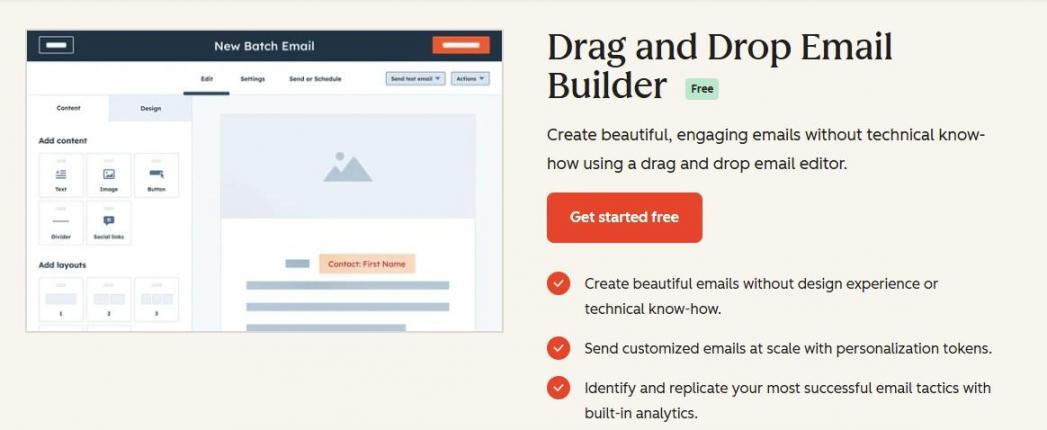
Here's the HubSpot Marketing Hub email builder in action:
What Is Constant Contact?
Constant Contact is a focused email marketing and event platform built for small businesses, nonprofits, local services, and event-driven organizations that need easy, reliable sends without a full marketing suite. Its core strengths are speed of setup, event registration, and a friendly editor.
The platform pairs a strong drag-and-drop builder with a large template library and easy list management. Welcome automations come on Lite. Standard and Premium add more automation paths, segmentation, A/B-style subject testing, and dynamic content.
Constant Contact stands out for event marketing. You can build registration pages, sell tickets, and manage invites inside the same account. That closes a workflow many email tools force you to outsource. The platform also bundles social posting, AI copy assistance, and 300+ integrations across Shopify, Eventbrite, Canva, and similar tools.
In my hands-on testing, most new users can build and send a first campaign quickly, thanks to the templates and guided setup. Branded templates and clean list hygiene take some additional setup. Where the tool stops short: automation paths flatten on Lite and Standard. There is no native CRM, so sales-stage data still lives in another system.
Who is Constant Contact designed for? Small marketing teams, solo founders, nonprofits, and local services that need fast email plus event tools, with a minimal learning curve. Simplicity and predictable monthly costs are the selling points.
If you want the wider field, my list of the best email marketing services covers more options.
Here's the Constant Contact email editor:
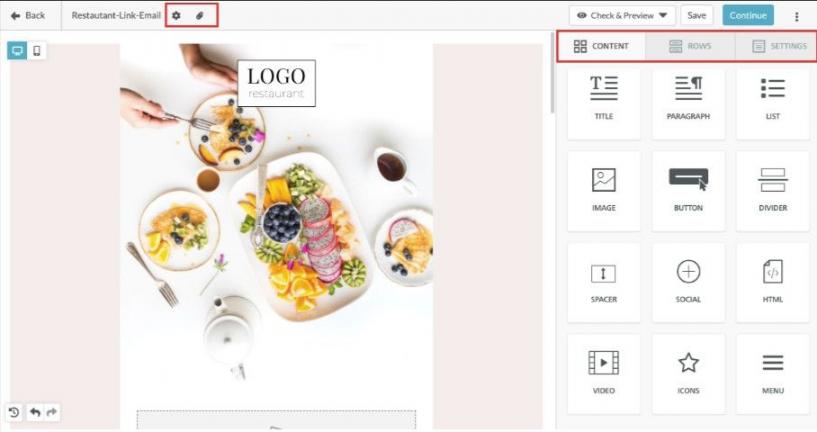
Imgae via Constant Contact
Which Has Better Features: HubSpot or Constant Contact?
HubSpot wins on automation, CRM integration, reporting depth, and integrations, while Constant Contact wins on event marketing, simplicity, and fast campaign setup. The right answer depends on which jobs you need each platform to do.
Both platforms ship the basics well: drag-and-drop email design, broad template libraries, list segmentation, and AI-assisted copy. If you would rather outsource creative, these email design agencies can help. The gap opens once you need automation, lead scoring, attribution, or behavior-based sends.
HubSpot's branching marketing automation triggers on contact properties, page views, deal stages, form fills, and predictive lead scoring. It also handles multi-touch attribution and customer journey analytics on Professional and Enterprise, which Constant Contact does not offer.
Constant Contact keeps automation deliberately simple — welcome series, autoresponders, and an AI campaign builder that handles common drip patterns. Premium adds custom paths, dynamic content, and ecommerce automation, which closes a real gap for Shopify-style stores. The native CRM split is the clearest single difference: HubSpot has one, Constant Contact does not.
If you need a builder for landing page optimization, HubSpot covers it natively, while Constant Contact offers simpler landing pages. Track campaign performance on either platform with these email marketing metrics.
| Feature | HubSpot Marketing Hub | Constant Contact |
|---|---|---|
| Drag-and-drop email builder | Yes | Yes |
| Template library | Yes (extensive) | Yes (extensive) |
| A/B testing | Yes (Professional and up) | Subject-line testing (Standard+) |
| Marketing automation | Branching visual workflows | Pre-built; custom paths on Premium |
| List segmentation | Advanced with CRM data | Basic; advanced on Premium |
| Lead scoring | Yes (Professional and up) | Limited |
| Multi-touch attribution | Yes (Professional and up) | No |
| Customer journey analytics | Yes (Enterprise) | No |
| AI tools | Breeze AI (copy, agents) | AI copy + AI campaign builder |
| Landing page builder | Yes | Yes |
| Signup forms and pop-ups | Yes | Yes |
| Native CRM | Yes (free, built-in) | No (integrations only) |
| Ecommerce automation | Yes (Pro+) | Yes (Premium) |
| Event marketing | Limited | Yes (standout feature) |
| SMS marketing | Add-on | Yes (500 included on Premium) |
| Integrations | 2,000+ apps | 300+ apps |
| Reporting and analytics | Custom reports + attribution | Standard reports, with drill-down on higher tiers |
| Free email sends | 2,000/mo on Free; scales by tier | Based on contacts and sends |
| Onboarding fee | $3,000 (Pro) / $7,000 (Enterprise) | None |
| Phone support | Paid tiers | All plans |
What does the matrix tell you?On HubSpot vs Constant Contact features, HubSpot leads where data depth matters: automation, lead scoring, attribution, and reporting. Constant Contact leads where simplicity and events matter. Match the platform to the jobs you actually need.
How Do HubSpot and Constant Contact Compare on Pricing?
Constant Contact starts at $12 per month on the Lite plan for up to 500 contacts, with Standard at $35 per month and Premium at $80 per month at the same base contact level.
Pricing increases as your contact list and send volume grow, with up to 15% savings for annual billing and up to 30% for nonprofits. It does not offer a free plan, but does include a 30-day money-back guarantee.
HubSpot Marketing Hub Starter starts at $20 per seat per month, with pricing scaling based on seats and contact tiers. It includes a permanent free plan and a built-in free CRM, making it more of an all-in-one system rather than a standalone email tool.
HubSpot’s free tier is a key differentiator, offering a permanent free email tool with up to 2,000 email sends per month alongside access to the free HubSpot CRM. Paid plans scale from Starter at $20 per seat per month (annual billing) to Professional at $890 per month and Enterprise at $3,600 per month. Professional includes a $3,000 onboarding fee, while Enterprise adds a $7,000 onboarding fee.
| Plan | HubSpot Marketing Hub | Plan | Constant Contact |
|---|---|---|---|
| Free | $0 (2,000 sends/mo + free CRM) | — | No free plan (30-day guarantee) |
| Starter | $20/seat/mo (1,000 contacts) | Lite | $12/mo (up to 500 contacts) |
| Professional | $890/mo + $3,000 onboarding (2,000 contacts) | Standard | $35/mo (500 contacts) |
| Enterprise | $3,600/mo + $7,000 onboarding (10,000 contacts) | Premium | $80/mo (500 contacts) |
Treat the list price as the planning number, and confirm current pricing at signup. The cost shape changes as your list grows.
| List size | HubSpot (typical path) | Constant Contact (typical tier) |
|---|---|---|
| 500 contacts | Free or Starter ($20/seat) | Lite $12 / Standard $35 |
| 5,000 contacts | Starter ~$200/mo (est.: 1,000 base + 4,000 added contacts) | Standard ~$110 / Premium ~$200 |
Cost figures for 5,000-plus contacts are modeled from each vendor's contact-based pricing; confirm with the vendor's own calculator before you budget.
The honest read on value comes down to scope. Constant Contact wins the entry price for a basic newsletter program with a small list. HubSpot is the only option here with a $0 starting point and a free CRM included. Its paid tiers buy automation, lead scoring, and attribution that Constant Contact does not offer. For the latest tier details, see the Constant Contact pricing page.
Which is cheaper at scale? On HubSpot vs Constant Contact pricing, Constant Contact has the lower entry price for email-only programs. HubSpot trades a higher list price for the free plan, free CRM, and depth that small Constant Contact tiers cannot match.
Which Has Better Deliverability and Ease of Use?
Constant Contact publicly reports a 97% deliverability rate, though vendor-reported metrics are not always directly comparable across platforms, while HubSpot offers strong sender-authentication and reputation tooling. Both platforms provide the tools needed for strong deliverability when email best practices are followed.
On ease of use, Constant Contact is faster to learn; HubSpot rewards investment with deeper control. Pick by how much complexity your team can absorb. On deliverability, the two platforms compete on tooling rather than a single number. Constant Contact publishes a 97% deliverability rate on its own site, one of the higher published claims in the category, though independent inbox tests often land lower.
HubSpot does not lead with a headline figure; instead it provides DKIM and SPF setup, dedicated IP options on Enterprise, and suppression management, with email health dashboards that flag bounce, complaint, and engagement risks early.
The learning curve is where the two platforms diverge most. Constant Contact is built for speed. A non-technical marketer can launch a first campaign quickly and settle into a steady routine soon after.
HubSpot asks more upfront. The broader platform takes longer to learn, so newer teams should plan for some ramp-up before they are fully productive. Professional and Enterprise rollouts often need a structured onboarding plus internal admin time. The payoff arrives later, when workflows, CRM data, and reporting all run from one account.
Which is easier to launch? Constant Contact for speed and minimal training. HubSpot for control and scale once your team is onboarded. Pick by the complexity you can actually staff.
Who Should Use HubSpot vs Constant Contact?
HubSpot Marketing Hub fits B2B SaaS, agencies, ecommerce brands, and growth-stage teams that need email tied to a CRM. Constant Contact fits small businesses, local services, nonprofits, and event-driven organizations that want simple, predictable email at a low cost. Each platform suits a different type of buyer.
For a scaling B2B SaaS team, HubSpot's CRM-native automation and lead scoring pull ahead. These teams often pair email with broader B2B lead generation programs. Agencies managing multiple clients also gain from HubSpot's reporting and seat structure.
For a 10-person nonprofit running monthly newsletters and an annual gala, Constant Contact is the more practical pick. Event registration is built in, the editor is friendly, and Lite at $12 per month keeps overhead low. On ecommerce, the split is about depth: Constant Contact Premium handles simpler store-level automation, while HubSpot adds deeper ecommerce analytics and attribution on top of its flows.
| Your situation | Better fit | Why |
|---|---|---|
| Scaling B2B SaaS needing CRM + automation | HubSpot Marketing Hub | CRM-native email, lead scoring, attribution |
| Agency running campaigns for multiple clients | HubSpot Marketing Hub | Reporting, seat structure, integrations |
| Small business sending simple newsletters | Constant Contact | Fast setup, low entry price, easy editor |
| Nonprofit or event-driven organization | Constant Contact | Built-in event registration and simplicity |
| Ecommerce brand needing behavior-based flows | HubSpot Marketing Hub | Branching workflows, CRM data, attribution |
| Team starting free, planning to grow | HubSpot Marketing Hub | Free email plus free CRM, clean upgrade path |
| Tight budget, email-only, under 500 contacts | Constant Contact (Lite) | Lowest entry price for basic sends |
Match the platform to your team, your goals, and your tech stack rather than the brand name. For broader B2B coverage, see my list of B2B marketing tools. Ecommerce teams in particular gain from behavior-based ecommerce marketing flows that simple newsletters cannot match.
Who should pick which? Growth and B2B teams lean HubSpot for CRM-tied automation. Many ecommerce brands do too, though a small store with a short list may be perfectly happy on Constant Contact or a lighter tool. Small business, nonprofit, and event-driven teams generally pick Constant Contact. Your sales motion, and your wider B2B digital marketing plan, is the deciding factor.
How Should You Choose Between HubSpot and Constant Contact?
Three variables can guide your HubSpot vs Constant Contact decision toward long-term fit: your growth plans, your automation needs, and your existing tech stack, not feature count. Pick the platform that answers the most of those over the next two years, not just this quarter.
The framework below summarizes the trade-off.
Choose HubSpot or Constant Contact If
By goal:
- All-in-one growth platform with CRM: HubSpot Marketing Hub
- Simple, focused email and events: Constant Contact
By team and sales motion:
- B2B SaaS, sales-led, or agency: HubSpot
- Small team, nonprofit, or solo: Constant Contact
By budget and stack:
- Need a free plan and built-in CRM: HubSpot
- Need the lowest paid entry price: Constant Contact
Before you commit, work through these five questions.
- What will the real cost be at my projected list size in 18 months?
- How much automation depth will I actually use beyond a welcome series?
- Do I need email tied to a CRM and sales pipeline today, or can it wait?
- How much admin and training capacity does my team realistically have?
- What does switching cost me if I outgrow this platform in year two?
If automation, CRM data, and reporting matter to you, HubSpot answers more of those questions. If speed, low cost, and event tools matter most, Constant Contact does. For a deeper framework, see how to choose a CRM for your business.
Fastest decision path? Map your two-year plan first. If you are building toward automation and CRM, start on HubSpot's free tier. If you want simple email now, start Constant Contact's Lite plan.
Who Should Choose Which Platform?
HubSpot is a better fit for teams that plan to scale email into a wider growth engine; Constant Contact is a better fit for teams that want focused, low-cost email and event tools. Both can earn their place when matched to the right buyer.
- Pick HubSpot Marketing Hub if you run a B2B SaaS, agency, or ecommerce brand and want email, automation, lead scoring, and a free CRM on one platform.
- Pick Constant Contact if you run a small business, nonprofit, or event-driven organization and want simple, low-cost email with built-in registration tools.
- Start with HubSpot's free plan if you are not sure yet, since it includes the free CRM and gives you a clean upgrade path as your needs grow.
One-line decision: HubSpot for growth and depth. Constant Contact for simplicity and events. Both work when the tool matches your goals.
FAQ
Q1. Is HubSpot or Constant Contact better for email marketing?
A. HubSpot is better for growth-stage teams that want email tied to a CRM, automation, and attribution. Constant Contact is better for small businesses, nonprofits, and event-driven organizations that want simple, low-cost email and built-in event registration without a steep learning curve.
Q2. What is Constant Contact and who is it built for?
A. Constant Contact is an email marketing and event platform built for small businesses, nonprofits, and local services. It pairs an easy editor and template library with event registration and AI copy assistance, making it a strong pick for teams that want reliable sends without a full marketing suite.
Q3. How much does Constant Contact cost per month?
A. Constant Contact starts at $12 per month for Lite with up to 500 contacts. Standard is around $35 and Premium around $80 at that level. Prices rise with contact count and email volume, and annual prepayment saves up to 15%, or up to 30% for nonprofits.
Q4. Does HubSpot have a free email marketing plan?
A. Yes. HubSpot offers a permanent free plan that includes 2,000 email sends per month and the free HubSpot CRM. It is a real free plan, not a trial, which makes it a strong starting point for small teams that want a CRM-connected email tool with a clean upgrade path.
Q5. Is HubSpot better than Constant Contact for marketing automation?
A. Yes, on depth. HubSpot offers branching workflows that trigger on contact properties, page views, deal stages, and lead scores. Constant Contact offers welcome series, pre-built automations, and an AI campaign builder, which cover the basics well but do not reach HubSpot's multi-step, CRM-driven paths.
Q6. Which has better email deliverability?
A. Both perform well with clean lists. Constant Contact advertises a 97% deliverability rate on its own page. HubSpot offers sender authentication, suppression management, dedicated IP options on Enterprise, and email health dashboards. List hygiene and sender authentication usually affect deliverability more than the platform choice.
Q7. Can I migrate my list from Constant Contact to HubSpot?
A. Yes. You can export your contacts and lists from Constant Contact and import them into HubSpot using its built-in import tools. Plan time to rebuild automations, segments, and templates, since those settings do not transfer between platforms and may need to be redesigned for HubSpot's CRM-driven workflow model.
Q8. What are good alternatives to Constant Contact?
A. Strong alternatives fall into a few groups: all-in-one platforms that pair email with a CRM, ecommerce-focused email tools, and simple budget newsletter senders. For teams that want automation, lead scoring, and a built-in CRM as they scale, HubSpot Marketing Hub is my top pick. Choose based on your budget, the automation depth you need, and whether email must connect to sales data.
What's the Final Verdict on HubSpot vs Constant Contact?
The clear takeaway on HubSpot vs Constant Contact is that they solve different problems. HubSpot Marketing Hub is built for B2B SaaS, agencies, and ecommerce brands that need CRM-connected email and real automation. Constant Contact is built for small businesses, nonprofits, and event-driven teams that need fast, low-cost email and built-in registration tools.
Pick HubSpot when growth, automation depth, and reporting matter. Pick Constant Contact when entry price, simplicity, and events matter. If you are unsure, HubSpot Marketing Hub offers a free plan, so you can test the email tools and the free CRM at no cost before committing to a paid tier.
Ready to try it? Get started with HubSpot's free plan
Disclaimer: This content contains some affiliate links for which we will earn a commission (at no additional cost to you). This is to ensure that we can keep creating free content for you.