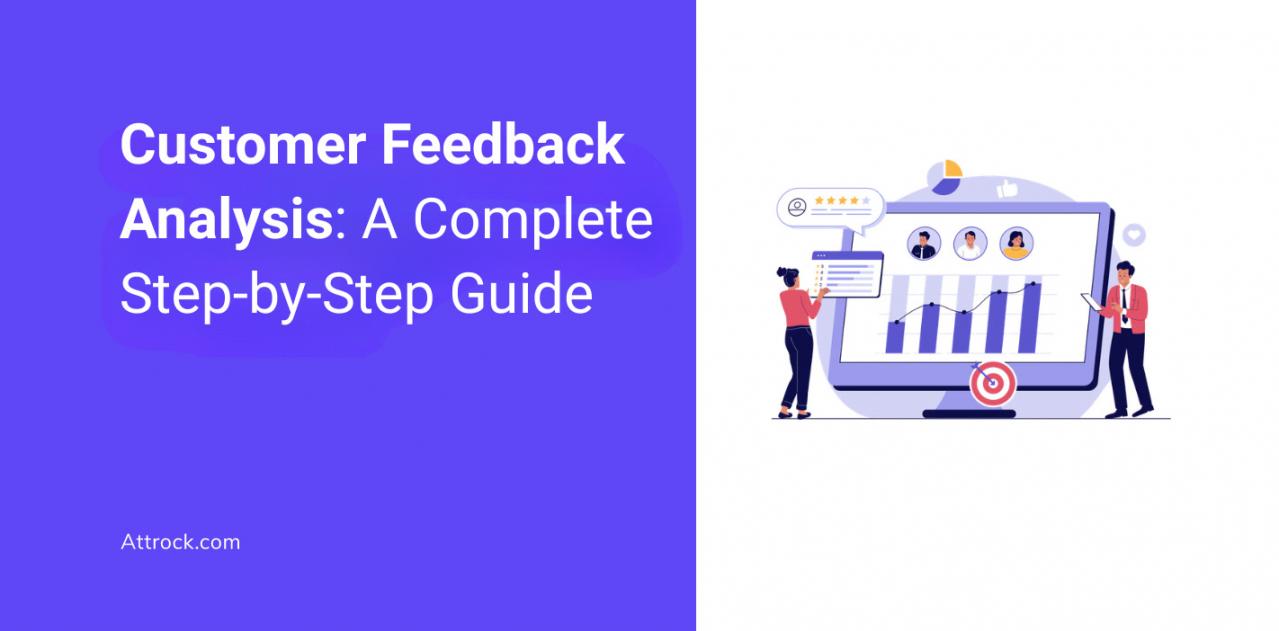
- Customer feedback management is a loop, not a survey: collect, analyze, act, then tell the customer what changed.
- Silent churn is the real risk: most unhappy customers leave without complaining, so acting on feedback is the differentiator.
- Closing the loop is the highest-value step: it's the one most teams skip, and the one customers remember.
- A few metrics carry the weight: NPS, CSAT, and CES each answer a different question.
- AI speeds up analysis, not judgment: it sorts feedback at scale, but humans still decide what to fix.
Customer feedback management is the systematic process of collecting, analyzing, and acting on customer insights into your business. The goal is simple: improve your products, services, and experiences.
It runs as a continuous loop. You ask for input, centralize it, route the insights to the right teams, then follow up with the customer.
Here's the uncomfortable part. Collecting feedback is getting harder, not easier. Fewer than one in three customers now share feedback after an experience. Many unhappy ones just leave without a word.
So the edge no longer comes from gathering the most feedback. It comes from managing what you get and acting on it faster than your rivals.
Disclaimer: This content contains some affiliate links for which we will earn a commission (at no additional cost to you). This is to ensure that we can keep creating free content for you.
Below, I break down the full process, the metrics that matter, the tools, and the habits that close the loop.
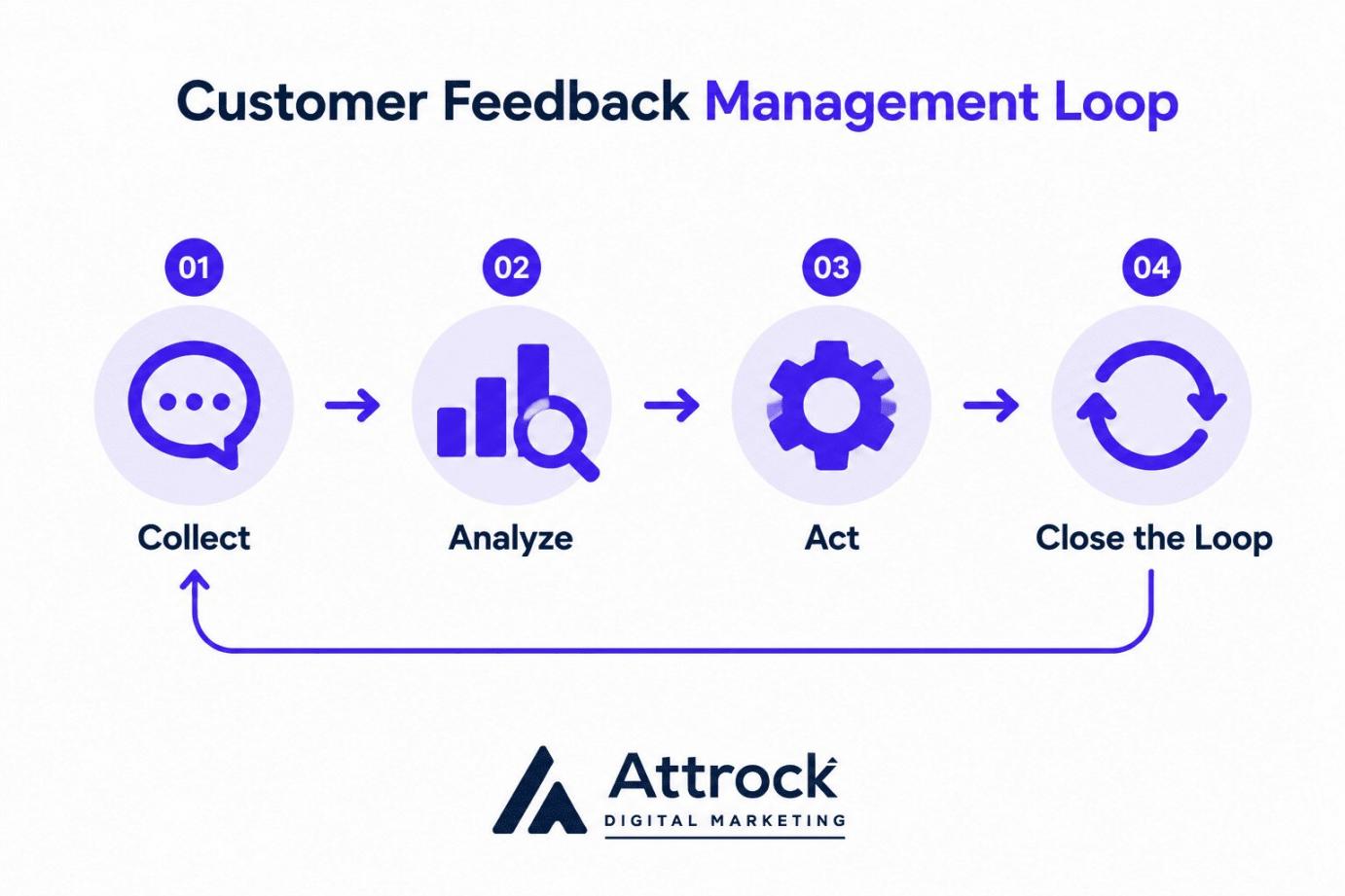
Image via Attrock
Table of Contents
What Is Customer Feedback Management?
Customer feedback management (CFM) is the complete process of collecting customer sentiment, interpreting it, and using that information to improve your business. It turns scattered opinions, complaints, and praise into decisions your teams can use.
Think of it as a system, not a one-off survey. A single survey gives you a snapshot. A customer feedback management system gives you a repeatable loop. It keeps listening, learning, and improving.
By incorporating social listening, businesses can monitor conversations beyond direct surveys and uncover valuable customer insights in real time.
It helps to separate two terms that people mix up. Voice of the Customer (VoC) is the broad practice of capturing what customers think and feel.
CFM is the engine that manages that input and routes it to action. One is the goal, the other is the machinery.
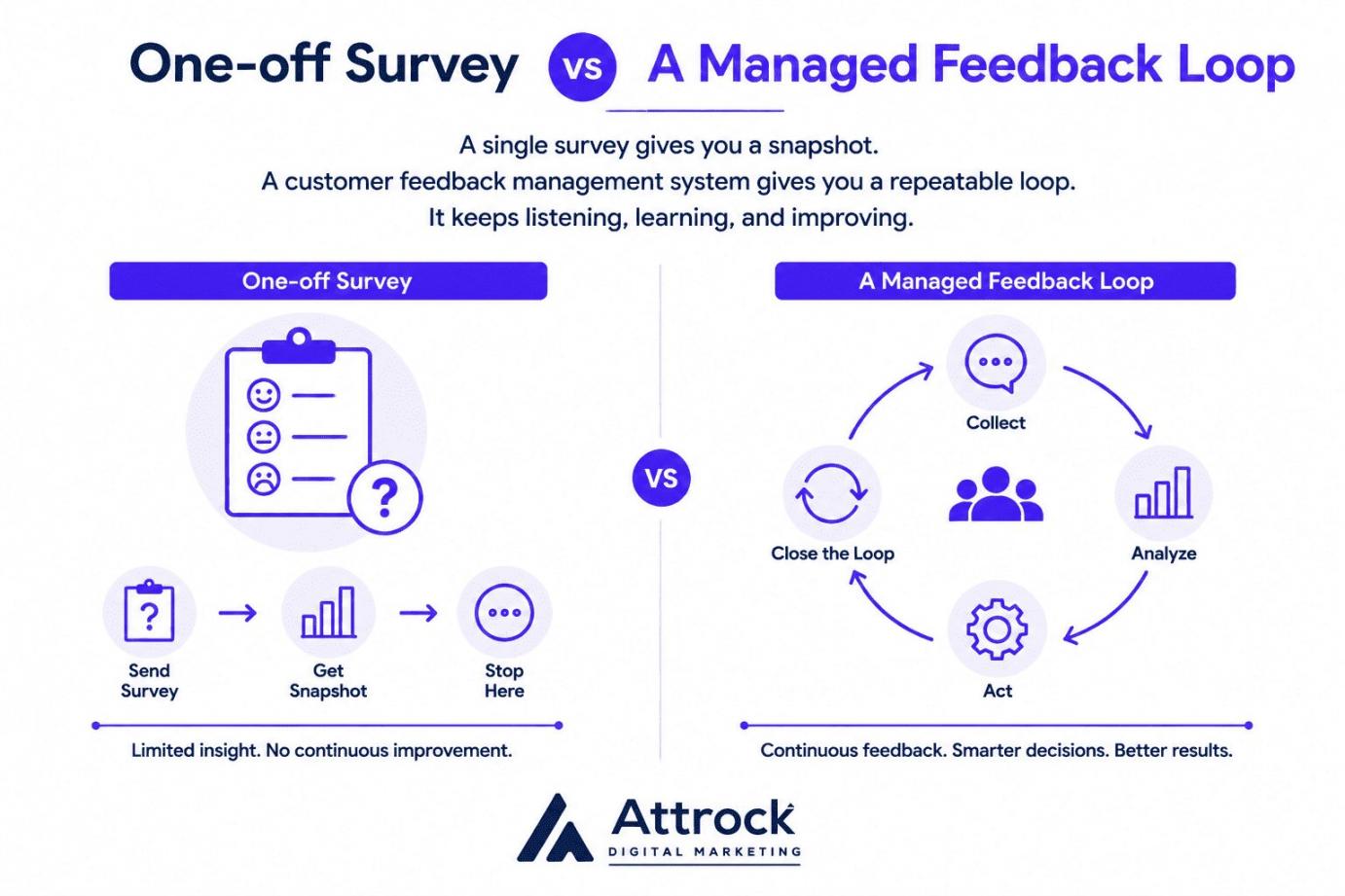
Image via Attrock
Types and Sources of Customer Feedback
Customer feedback comes in three broad forms, and a strong program captures all three. The table below breaks them down.
| Feedback Type | Where It Comes From | Example |
|---|---|---|
| Direct (solicited) | You ask for it | Post-purchase CSAT surveys, NPS polls, user interviews |
| Indirect | You observe it in existing interactions | Support tickets, live chat logs, sales call notes |
| Unsolicited | Customers volunteer it | Online reviews, social media mentions, community posts |
Feedback also splits by format. Quantitative feedback gives you numbers you can trend, such as scores. Qualitative feedback gives you the “why” in the customer's own words.
You need both. The score tells you something changed. The comment tells you what to fix.
Customer feedback management is the process of gathering and studying customer feedback, making improvements based on it, and following up to let customers know how you solved their problems. It captures direct, indirect, and unsolicited input and turns it into business decisions.
Why Does Customer Feedback Management Matter?
Customer feedback management matters because the cost of not listening is rising, and most of it is invisible. Unhappy customers rarely complain anymore. They just spend less or leave.
The numbers are stark. Qualtrics XM Institute's 2026 research found that fewer than one in three consumers now give feedback after an experience. That's an all-time low.
Worse, about 30% with a bad experience say nothing at all. They simply switch brands. That's silent churn, and you can't fix what you never hear.
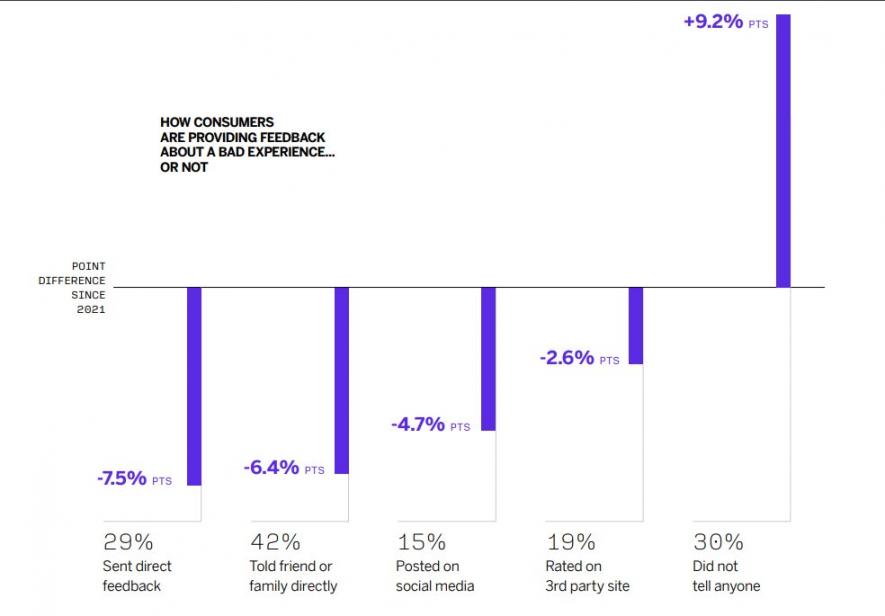
Image via Qualtrics
Acting on feedback is also a growth lever, not just a defense. According to Forrester's 2024 CX research, customer-obsessed companies recorded 41% faster revenue growth and 51% better customer retention. Yet only a small fraction of companies qualify as customer-obsessed.
Experience now carries the same weight as the product. Salesforce research reports that more than a third of customers say that inconveniences in their experience will cause brands to lose them.
Here's the trap to avoid. Collecting feedback you never act on is feedback theater. In my work with growth teams, the winners aren't the ones running the most surveys. They're the ones who close the loop fastest, so customers see their input become change.
Because most unhappy customers leave without complaining, managing and acting on customer experience feedback protects revenue from silent churn and turns it into a growth advantage.
What Is the Customer Feedback Management Process?
The customer feedback management process is a four-step loop: collect, analyze, act, and close the loop. Each step feeds the next. Skip one, and the cycle breaks.
This is the core of managing customer feedback well. Most guides stop at “collect and analyze.” The teams that actually improve treat acting and closing the loop as the main event.
Step 1: Collect Feedback Across Channels
You may begin by gathering feedback at every touchpoint where customers form an opinion. Extract data from surveys, help desk tickets, customer reviews, chats, and social media. Keep surveys short, as people hate filling long forms.
The aim here is to cover as many bases as possible. One channel only shows a fraction of your customers' experience. Hundreds of channels integrated into one platform will give you the complete story.
Step 2: Centralize and Analyze
Next, combine all the sources into a single system to get an overall view. It will help you address the problem of scattered feedback across multiple tools, which is a main concern for most teams. Then, do a deep analysis. Assign tags to each customer feedback product by theme, sentiment, and urgency level.
Identify and combine the ones that occur frequently so a single, strong complaint will not cause disproportionate damage compared to a quiet pattern found across hundreds of customers. The best customer feedback analysis focuses on the highest-impact ones and filters out the rest.
Step 3: Act on the Insights
Now, send the prioritized insights to the team responsible for the solution. This could be the product team, user experience, or customer support. This step is what turns feedback into value.
Having a definite person in charge and a specific timeframe transforms a mere tag in the dashboard into an improvement. When a theme is big enough, it earns a place on the roadmap, with the feedback as evidence.
Step 4: Close the Loop
Closing the loop means telling the customer what you have done with their comment or feedback and then confirming that the problem has been fixed. It is the step that almost everyone skips. It is also the one customers remember.
In practice, closing the loop takes a bit of coordination. You should set clear deadlines for replies based on the seriousness of the customer's issue. For example, a major business client who is angry about a broken feature should never be forced to wait in the same queue as someone submitting a minor suggestion.
Route each item to a named owner with an acknowledgment workflow. Ensure that they reply to customer emails or messages promptly. Use a tool like timetoreply to track and improve response times. It works within your Gmail or Outlook, so you don’t need to switch tools.
If you do this consistently, customers will feel like they are actually being heard instead of sending messages into a black hole. It turns giving feedback into a meaningful conversation that customers will want to keep having with you.
It's four steps in one loop. Collect feedback across channels, centralize and analyze it, act on the priorities, then close the loop.
How to Collect Customer Feedback: Methods and Channels
The best customer feedback collection happens across several channels at once. Every channel surfaces a different truth. A survey tells you how someone feels. A support ticket tells you what broke.
Here are the channels worth running and what each is best for.
| Channel | Best For | Note |
|---|---|---|
| Surveys (NPS, CSAT, CES) | Structured, comparable scores | Keep them short; trigger at key moments |
| In-app & website widgets | In-the-moment reactions | High context, low effort for the user |
| Support tickets & live chat | Friction and bugs | Rich indirect feedback you already collect |
| Reviews & social listening | Public sentiment and reputation | Unsolicited and unfiltered |
| Interviews & focus groups | The deep “why” | Lower volume, higher insight |
| Behavioral & product signals | What customers do, not just say | Pairs well with stated feedback |
A quick reality check on surveys. Response rates stay modest even when you do everything right. According to 2025 benchmark data, most email surveys land in the 20%-30% range.
The fix isn't nagging people harder. It's asking fewer, sharper questions at the right moment.
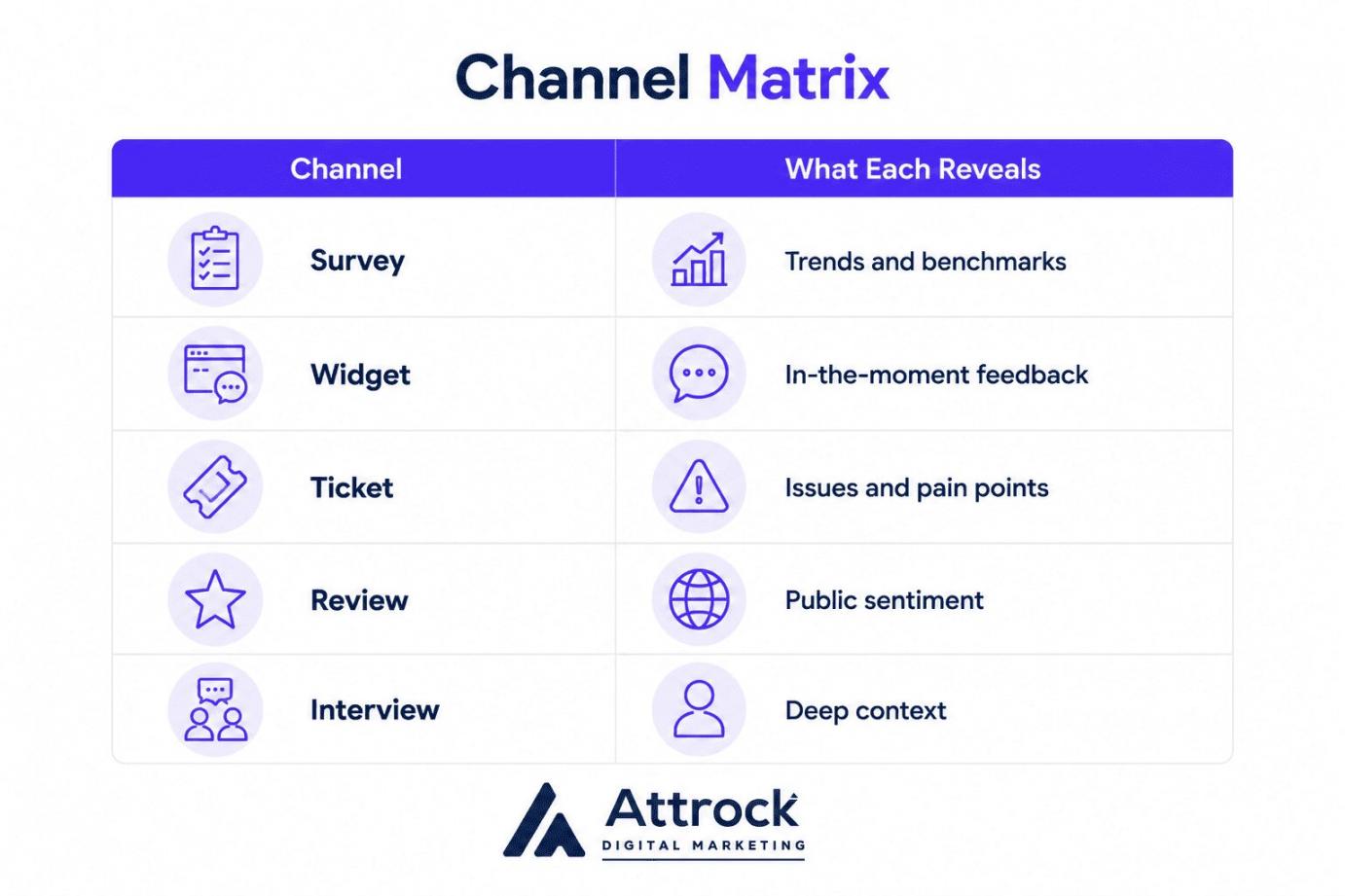
Image via Attrock
Use several channels together, not just one. Surveys give you scores, widgets catch in-the-moment reactions, tickets reveal friction, reviews show public sentiment, and interviews add depth.
How to Measure Customer Feedback: NPS vs. CSAT vs. CES
You can't manage what you don't measure. So most customer feedback management programs run on three core metrics: NPS, CSAT, and CES. Each answers a different question.
| Metric | What It Measures | The Question | Scale/Formula | Best Used When |
|---|---|---|---|---|
| NPS (Net Promoter Score) | Loyalty and advocacy | “How likely are you to recommend this brand?” | 0–10; % promoters minus % detractors | Tracking long-term relationship health |
| CSAT (Customer Satisfaction) | Satisfaction with a moment | “How satisfied were you?” | Often 1–5; % positive responses | Right after a specific interaction |
| CES (Customer Effort Score) | How easy it was | “How easy was it to get this done?” | Usually 1–7; average score | Measuring friction in a task or journey |
A few additional numbers are helpful to complete the picture. Churn rate shows you how many customers have left. A customer health score is a combination of signals that helps identify customers most likely to leave.
For context, according to Retently’s benchmark data, the 2025 global average NPS sits near 32. However, it varies quite a bit by industry. So, it is better not to aim at a single universal “good” number. Instead, monitor your own trend.
Note that relying on just one score can give you the wrong idea. For example, a customer might give you a high satisfaction score just to be polite, even though the process was frustrating and took way too much effort. To get the real story, look at all your scores together and read the actual comments your customers leave.
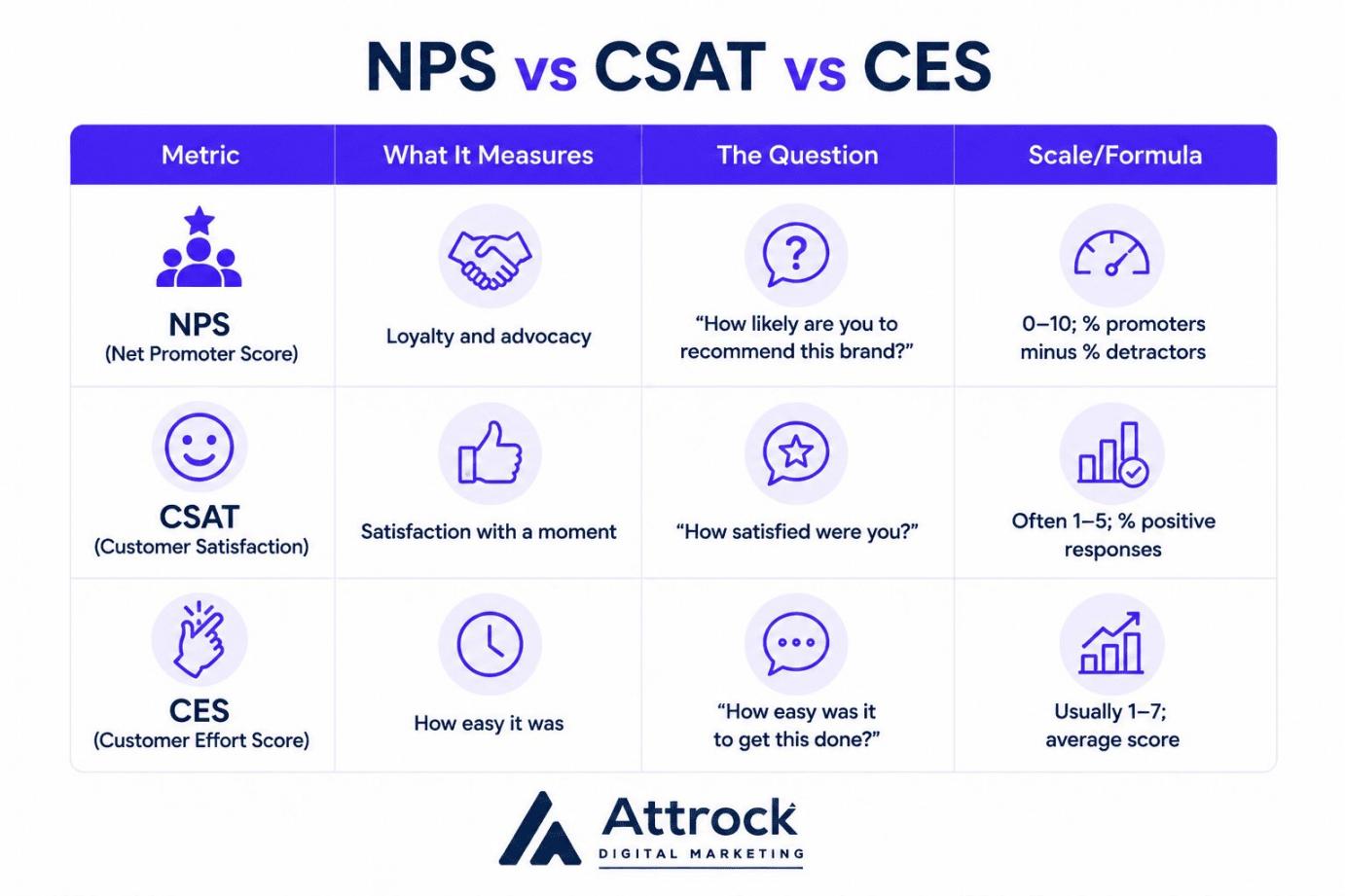
Image via Attrock
Which Metric Should You Use?
- Use NPS When: You want a pulse on loyalty and word-of-mouth over time.
- Use CSAT When: You want fast feedback on a specific interaction.
- Use CES When: You want to find and remove friction in a journey.
Using AI to Manage and Analyze Customer Feedback in 2026
AI has become the engine room of feedback analysis. It reads thousands of open-text comments, sorts them by theme, scores sentiment, and surfaces root causes. It can even flag accounts at risk of churning, helping teams prioritize proactive outreach with the right customer success software.
Adoption is climbing fast. The Qualtrics XM Institute reports that AI usage in customer experience programs rose roughly 20% in a single year. On the service side, Gartner found that 91% of customer service leaders feel pressure to deploy AI in 2026.
Here's where AI earns its place in customer feedback analytics:
- Auto-Categorization: Tags incoming feedback by topic, so themes emerge without manual sorting
- Sentiment Analysis: Scores tone at scale, flagging the comments that need a human now
- Predictive Signals: Spot patterns that tend to precede churn, so you act before the customer leaves
- Smart Routing: Sends each piece of feedback to the right owner automatically
But AI is not set-and-forget. Qualtrics also found that nearly one in five customers who used AI support saw no benefit at all.
So keep humans on the judgment calls. AI can tell you what customers are saying. Your team still decides what's worth fixing.
AI can collect, sort, and analyze feedback at scale, including sentiment and churn prediction. But it works best with humans in the loop, since AI support alone often disappoints customers.
How to Evaluate Customer Feedback Management Software
A customer feedback management system centralizes feedback from all channels, analyzes it, and routes it to the appropriate team.
When you go looking for customer feedback management software, keep an eye out for certain key features. It should be able to gather comments from multiple places, use AI to analyze the data quickly, send issues to the right team members, and connect to your customer database (CRM). It also needs easy-to-read dashboards and enough flexibility to grow along with your business.
The market has grown into clear categories. Rather than rank them, here's how to think about the main groups, with a few names in each:
- All-in-one CX and VoC Platforms: Enterprise-grade capture and deep analytics, such as Qualtrics, Medallia, and InMoment.
- AI-native Feedback Analysis: Tools built to tag and trend large volumes of open-text feedback, such as SentiSum.
- Website and Product UX Feedback: Widgets, heatmaps, and session insight, such as Hotjar and Contentsquare.
- Survey-First Tools: Fast, flexible survey-building for NPS, CSAT, and CES, such as Typeform and SurveyMonkey.
- CRM-Native Feedback: Survey tools that live next to the customer record, where your team already works.
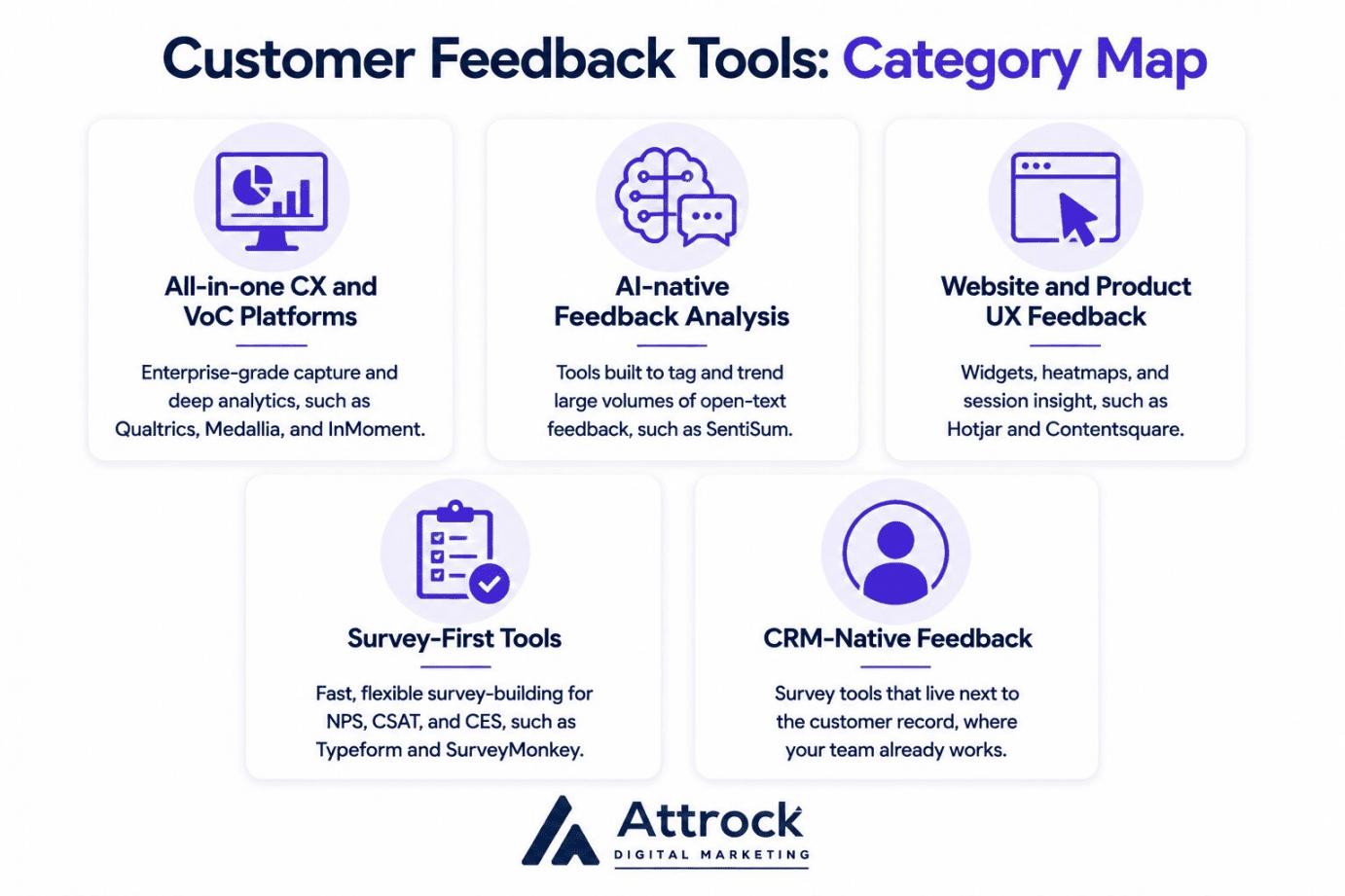
Image via Attrock
That last category fits most growing teams best. If your customer data already lives in a CRM, keep feedback beside it. That removes a lot of friction.
HubSpot's Service Hub is a strong option here. Its Customer Feedback tool ships ready-made NPS, CSAT, and CES surveys. You can send them by email, via chat, or via a web link. Responses route straight to dashboards and the customer record.
If you want your feedback tied directly to your sales and support teams rather than locked away in a separate system, a tool that connects to your existing software is an easy choice.
However, no single tool works for every business. A busy consumer brand might need a massive enterprise feedback platform, while a product development team might prefer a specialized tool that tracks website user behavior. Pick a tool that matches how you talk to customers, the size of your business, and where your team already does their daily work.
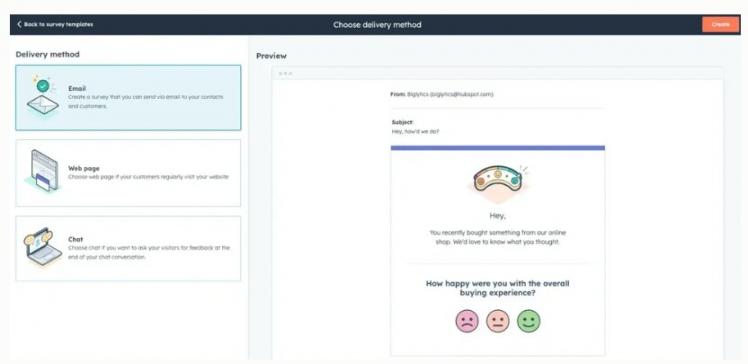
Image via HubSpot
You need a tool that gathers customer opinions from multiple sources, uses AI to analyze them quickly, routes issues to the right team members, and connects directly to your customer database (CRM).
Depending on your business size, you can use large-scale enterprise platforms, specialized website user experience tools, or simply enable the built-in feedback features already included in your current CRM.
What Are Customer Feedback Management Best Practices?
The strongest customer feedback best practices share one theme. They shorten the distance between hearing something and doing something about it. A clear customer feedback management strategy turns that into a habit. Here are the practices that move the needle.
Close the Loop Fast
Speed is what sets you apart. You need to respond, fix the problem, and let the customer know what changed while the experience is still fresh in their mind. Reacting quickly and visibly will do more to turn an unhappy customer into a loyal fan than any minor tweaks you could ever make to your feedback survey.
Keep Feedback Data Private and Governed
Customer feedback is personal data, so treat it that way. Be very careful when collecting and handling personal data, and ensure your retention period complies with regulations such as the GDPR and the CCPA. In addition to deciding who has access to what, you should also do your best to anonymize the data.
Good governance is not just meeting regulations. It's building trust, and most competitors quietly ignore this truth.
Give Customer Feedback Management a Clear Owner
Feedback that belongs to everyone belongs to no one. Decide who the owner is, and then organize the workflow between product, support, and CX. Get the top managers to support you so that the insights have a chance to influence the roadmap.
Without a designated owner, the feedback loop will inevitably stop after the initial burst of enthusiasm for the product launch.
Tailor It: B2B vs. B2C
Your strategy must correspond to the type of business you operate. B2B customer feedback is generally less voluminous but highly critical, and sometimes involves a large number of stakeholders. For B2B, conducting account-level reviews is definitely more effective than conducting mass surveys.
B2C feedback is high-volume and transactional. So automation, in-app prompts, and review monitoring do the heavy lifting.
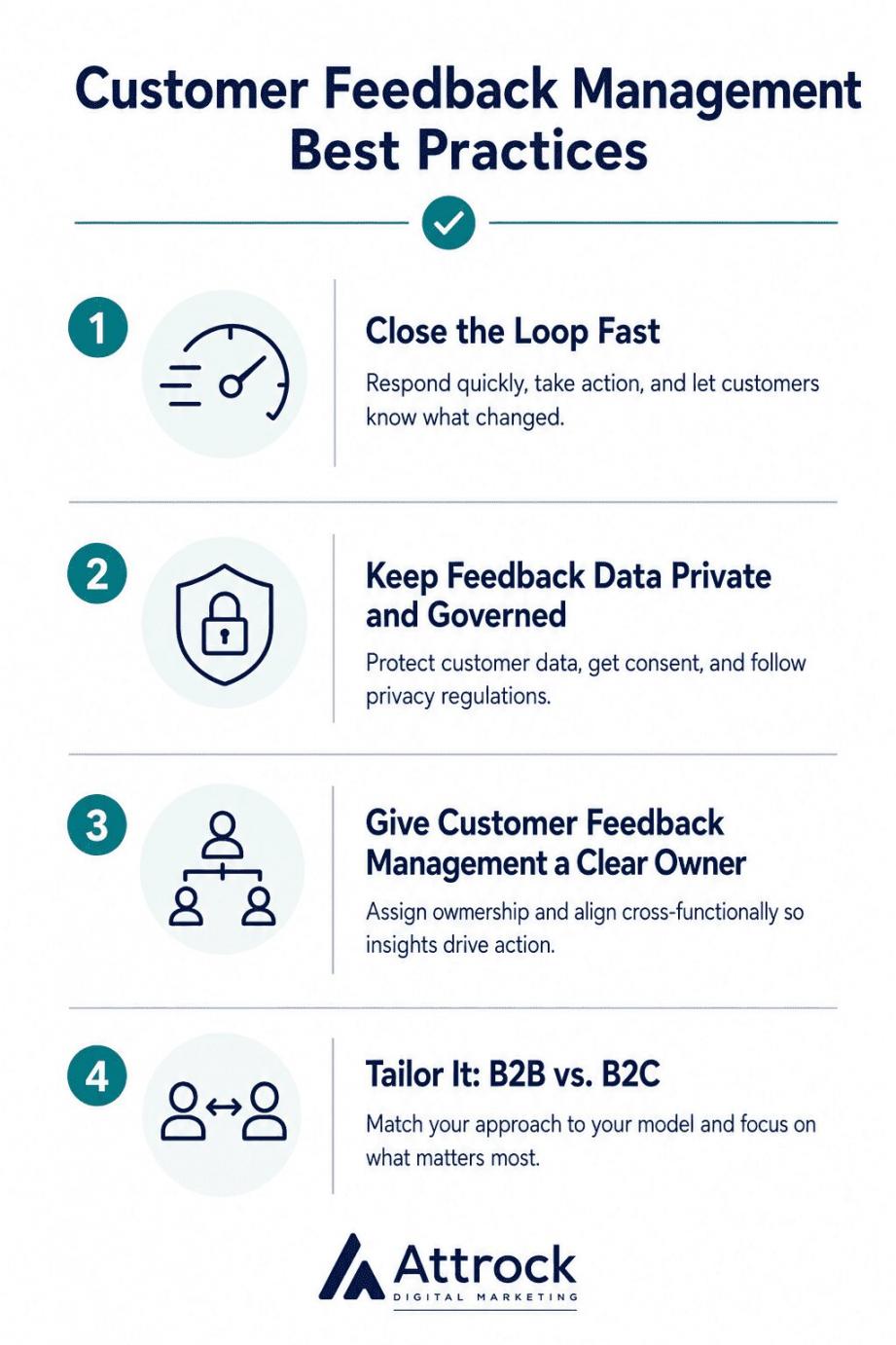
Image via Attrock
Four habits matter most. Close the loop quickly, govern feedback data well, assign a clear owner, and tailor it to B2B or B2C.
FAQ
Q1. What are the 3 C's of customer feedback?
A. The 3 C's are commonly framed as Collect, Categorize, and Close the loop. You collect feedback across channels, categorize it by theme and sentiment, then close the loop by acting and reporting back. It's a simple way to remember the cycle.
Q2. How do you manage customer feedback?
A. Managing customer feedback consists of 4 phases: gather feedback through multiple channels, combine and analyze the feedback, prioritize and implement changes, and finally share the changes with the customer. If you want this cycle to be continuous, you must have a feedback system.
Q3. Why is customer feedback management important?
A. Most dissatisfied customers simply switch to your competitors without complaining. Good feedback management, in fact, uncovers such silent problems. How can it benefit your business? First, it helps prevent revenue loss from customer churn. Secondly, it enables you to turn customer experience into a quantifiable growth driver.
Q4. What is a customer feedback management system?
A. It is a software solution that consolidates customer feedback from sources like surveys, tickets, reviews, chats, etc. This tool also performs sentiment analysis on the collected data and shares the resulting insights with the relevant departments. Essentially, it brings the customer feedback process into the workplace without requiring multiple disconnected spreadsheets.
Q5. What's the difference between NPS, CSAT, and CES?
A. These three metrics measure different parts of the customer experience. NPS tracks long-term loyalty by asking how likely someone is to recommend you. CSAT checks how happy a customer is with a specific moment (such as a support call), and CES measures how easy or hard it was for them to get a task.
Q6. How often should you collect customer feedback?
A. Ongoing collection of feedback via always-on channels like review sites and customer support is advisable. Besides that, you can set survey triggers for specific moments, such as post-purchase. At the same time, over-surveying the same customers is to be avoided, as it reduces response rates and causes fatigue.
Q7. What does closing the feedback loop mean?
A. Closing the loop means reaching back out to a customer after they give you feedback. You let them know you heard them, tell them what you changed to fix the problem, and make sure they are happy with the result. Very few companies actually take this final step, but it is the exact action that turns a complaining customer into a loyal fan.
Q8. How do you analyze customer feedback?
A. You start by categorizing each piece of feedback by theme, sentiment, and urgency. You then weigh the issues based on impact rather than volume. While AI can perform auto-categorization and sentiment scoring, greatly accelerating the process, it is humans who ultimately make the call on which problems are worth solving.
Q9. Can AI accurately categorize customer feedback?
A. AI does a good job of sorting feedback by topics and sentiments and is capable of working with a scale that humans cannot. Still, humans should oversee the process, as AI on its own is often incapable of nuance. Besides, the accuracy of AI-enhanced classification depends on the quality of the training data.
Q10. How do you manage customer feedback across multiple sources?
A. To manage feedback from multiple places, pull everything, such as surveys, support tickets, reviews, and social media, into one central system. Having all your data in one view lets you spot real patterns and fix the biggest problems first, instead of just reacting to whichever channel is shouting the loudest at the moment.
Q11. What is the difference between customer feedback management and Voice of the Customer?
A. Voice of the Customer is the broad process of figuring out what customers are thinking and feeling. Customer feedback management is a series of steps for capturing, managing, and using customer input. VoC represents the target; CFM is the means to reach it.
Q12. How is B2B customer feedback management different from B2C?
A. B2B feedback comes in lower volume from several different people within a single company, meaning personal relationships and direct reviews matter most. In contrast, B2C feedback is a massive wave of quick, individual opinions, which means you have to rely on automated tools and fast online surveys to handle it all.
Conclusion
Effective customer feedback management is about collecting information, giving it serious thought, and solving the problems clients encounter when interacting with your products or services. When you succeed at this, negative reviews will stop being disturbing background noise; they will become clear directions you can use to take your company up a notch.
Start small. Pick one channel and one metric. Build the habit of acting and following up, then expand from there.
HubSpot’s Service Hub offers an excellent customer feedback management tool that can be the perfect springboard for your business. Learn more about it here.
Want help turning that loop into a growth engine? My team at Attrock offers digital marketing consulting to put customer insight to work.
Disclaimer: This content contains some affiliate links for which we will earn a commission (at no additional cost to you). This is to ensure that we can keep creating free content for you.