- Qualify Your Prospects: Start with people who may need your offer and have reason to consider it
- Make One Clear Point: Explain how you can help and ask for one next step
- Show Why It Fits: Use details that connect your offer to the prospect's needs
- Give Follow-Ups a Purpose: Share a useful detail each time you reach out
- Check Your Email Setup: Authenticate your domain, follow sender rules, and keep spam complaints low
Knowing how to write a cold email starts with choosing the right prospect and giving them a reason to reply. Every line should serve a purpose, from the subject line to the final request.
Start with a recipient who may need what you offer. Write a clear subject line, show that you understand their needs, and make one claim you can back up. Then, ask for one simple next step.
What happens after you send the email matters, too. This guide covers the writing process, practical tips, follow-ups, and templates you can adapt. You'll also learn the rules that help your emails reach the inbox.
Disclaimer: This content contains some affiliate links for which we will earn a commission (at no additional cost to you). This is to ensure that we can keep creating free content for you.
Table of Contents
What Is a Cold Email, and Does It Still Work?
A cold email is a one-to-one message to someone you haven't contacted before. It has a clear purpose, such as offering a service or starting a business conversation.
There are two common uses. A cold sales email promotes a product or service, while a job-seeker email asks for advice, a referral, or a chance to connect. This guide covers the first kind, which some teams call a cold call email.
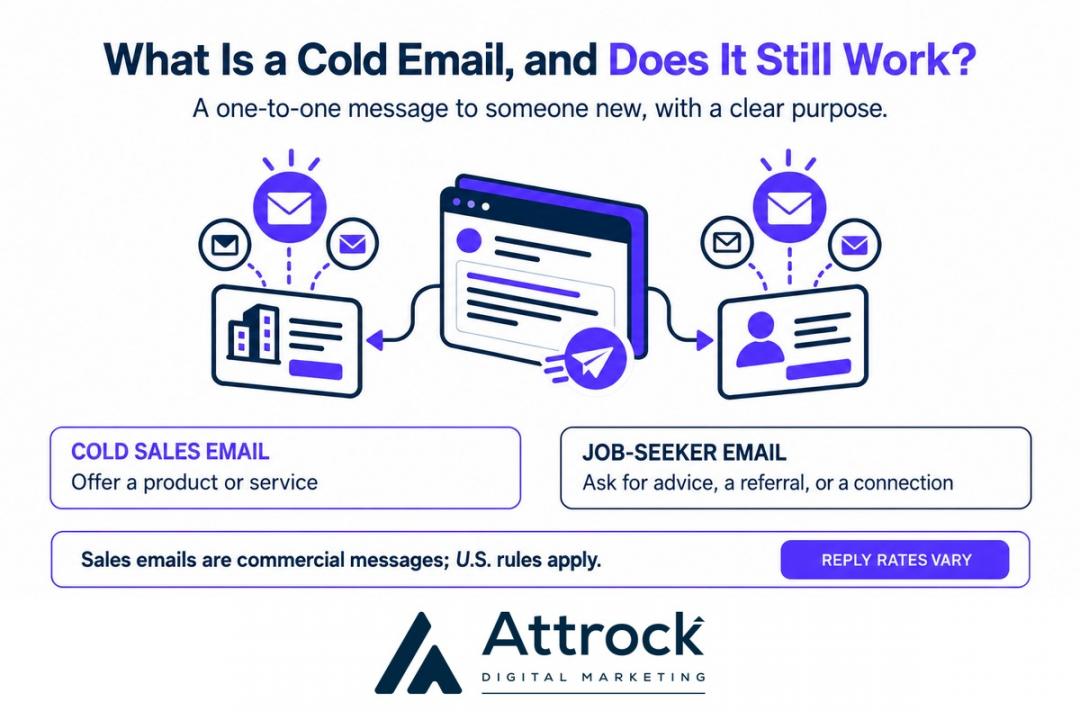
The difference matters. It changes the ask, the length, and the law. A sales email is a commercial message, so US commercial email rules apply.
Cold emailing works, but reply rates vary.
Instantly’s Cold Email Benchmark Report 2026 puts the average reply rate at 3.43%. The platform's top quartile exceeds 5.5%, while its best-performing senders top 10.7%. This threefold gap shows that stronger targeting, problem-focused messaging, and better campaign execution drive higher reply rates.
Here’s another takeaway that matters as you learn how to write a cold email: list size can also be impactful.
Saleshandy’s analysis of 30.31 million cold emails, published in October 2026, found campaigns under 200 prospects had a 15% to 20% reply rate. Campaigns with 500 to 1,000 prospects sat near 8%.
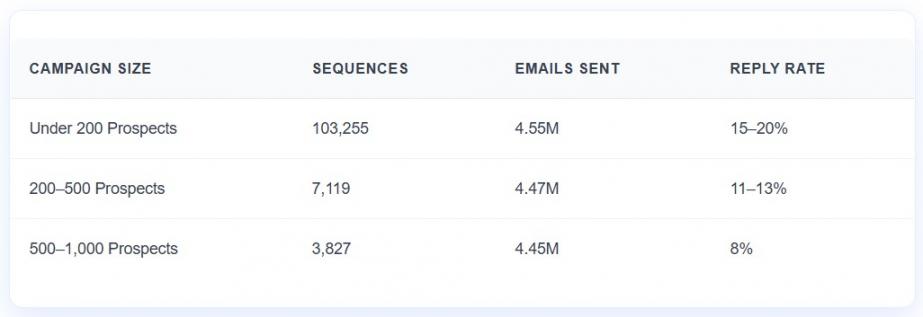
Image via Saleshandy
Smaller campaigns replied more often, but list size may not be the only factor. Targeting, relevance, and the offer quality can also affect results.
A cold email introduces you to someone who doesn't know you. It can get replies, but results depend on who you contact and what you send. Instantly puts the average reply rate at 3.43%. Saleshandy's findings also show that smaller campaigns can get better results. Before sending more emails, check whether you're reaching the right people with an offer they'll care about.
The Anatomy of a Cold Email That Gets Replies
A good cold email has six parts. Each has a clear purpose, and each should earn its place. The sender name helps recipients recognize you. The subject line gives them a reason to open the email, while the opening line shows why you're contacting them.
The main claim gives them a reason to consider your offer. The ask tells them what to do next, and the email signature identifies you. Try to keep the email under 80 words. This is a useful guide, not a strict rule.
Saleshandy found that subject lines with five to seven words had the highest open rates in its October 2026 analysis. Still, a clear subject line matters more than its length.
| Part | What It Should Do | Practical Target | Common Mistake |
|---|---|---|---|
| From line | Help recipients recognize you | Your name and company | Using a no-reply address or an unfamiliar sender name |
| Subject line | Give recipients a reason to open | 5–7 words | Making it sound like an ad |
| Opening line | Show why you're contacting them | 10–20 words | Using generic praise or a copied opener |
| Claim | Explain why your offer matters | One clear, supportable point | Making vague or unproven promises |
| Ask | Make the next step clear | One simple request | Asking for too much time or effort |
| Signature | Show who you are | Name, role, and relevant details | Leaving out key contact information |
The same six parts work for job and internship outreach, too. The main difference is the goal.
Talk about what you've built or learned, then connect it to the recipient's work. You could ask for a short chat or advice on your next step. One specific question is enough.
A cold email needs a from line, subject line, opening, claim, ask, and signature. Focus on one point and make one clear ask. For job outreach, mention your experience or skills and request advice or a short chat.
How to Write a Cold Email in 6 Steps
Knowing how to write a cold email starts before you draft the first line. You need the right prospect, a clear reason to reach out, and one simple goal. Follow these six steps to build an email that's relevant, brief, and easy to answer.
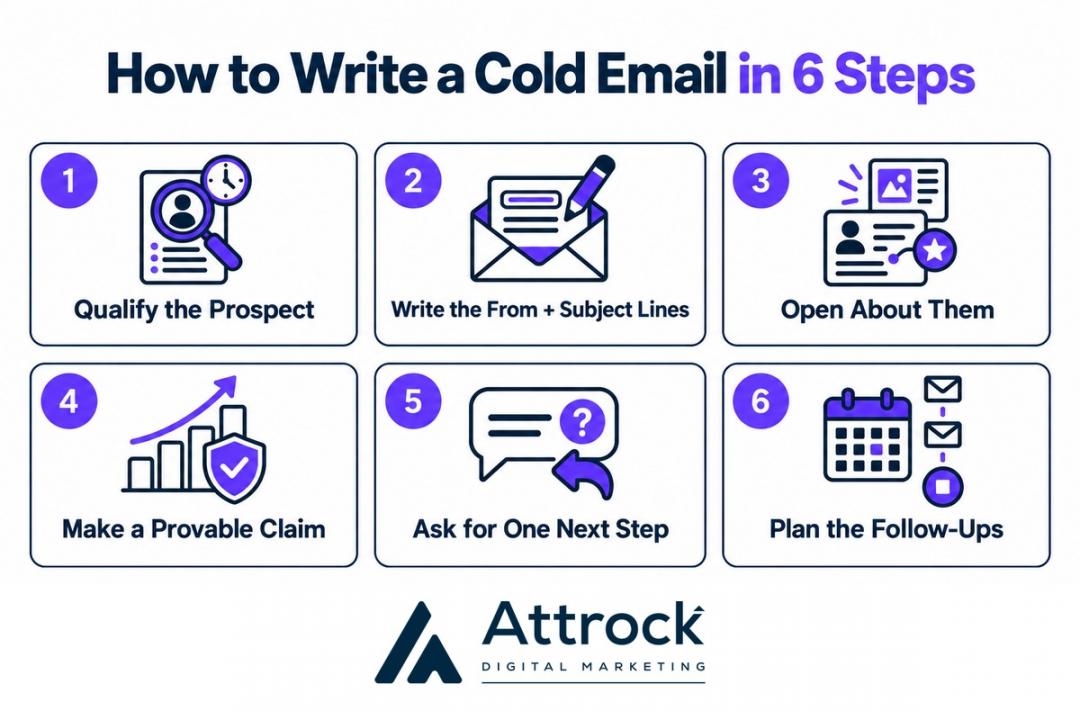
Step 1. Qualify the Prospect Before You Write a Word
Knowing how to write a cold email starts with asking yourself three questions. Does your offer solve a problem for this prospect? Can they make the decision or connect you with the right person? Why contact them now?
If you can't find a good fit, try someone else. A bigger contact list won't help if no one has a reason to respond.
Use these checks to qualify each prospect:
- Problem Fit: Find a need your offer can address
- Authority: Check whether the person can approve your offer or influence the decision
- Timing: Look for a recent event that makes contact relevant
Build your list before drafting your emails.
Step 2. Write the From Line and the Subject Line
Use your real name and a company email domain recipients can verify. Write a subject line that tells them what the email is about. These details help people decide whether to open your message.
Skip subject lines that sound like ads. Big promises might attract attention, but they can also make your email look like another sales pitch.
A better approach:
- Be Clear: “Question About Your Q4 Rollout” beats “Transform Your Rollout.”
- Keep It Short: Saleshandy’s October 2026 analysis found that many top-performing subject lines had just five to seven words.
- Make It Relevant: A first name won't help if the subject line has nothing to do with the recipient.
Write a draft subject line early. Review it again once the email is done.
Step 3. Open About Them, Not About You
Start with a detail that shows why you're contacting this person. One short sentence is often enough. Then explain why you're reaching out.
Skip generic greetings like “Hope you're well” and long introductions about your company. Get to the point without making the reader work to understand your reason for writing.
Here are three ways to open:
- A Recent Event: Mention a product launch, company announcement, or new role
- An Observed Detail: Point to something specific about their product or business
- A Named Connection: Mention a mutual contact only if you have permission to do so
Keep the detail relevant to your offer. A personal fact that has no link to your message can feel intrusive rather than thoughtful.
Step 4. Make One Specific, Provable Claim
Give the prospect one clear reason to care about your offer. Explain what you can help them do, fix, or improve. Keep the claim relevant to the need you identified in Step 1.
Before you send the email, check if you can back up your claim with proof.
Use these checks to keep your message clear:
- Explain the Benefit: Show how your offer could help the prospect
- Make It Relevant: Link your claim to a problem the recipient may have
- Be Realistic: Avoid claims like “guaranteed” or “best” unless you have proof
Use a real customer result or a clear example when you have one. Never invent results to make your pitch sound stronger.
Step 5. Ask for One Low-Friction Next Step
End with one clear request. Make it easy for the prospect to respond without committing to a long meeting or major decision.
Here are three simple ways to ask:
- Ask a Short Question: “Is this still handled in-house?”
- Request a Referral: “Is there someone better placed to discuss this?”
- Offer More Information: “Would a short overview help?”
Ask for one action per email. Don't request a meeting, ask several questions, and offer a demo in the same email.
Before you send, reread the message. Knowing how to write a cold email means cutting extras. That includes repeated points, long intros, company background, and details that don’t support your ask.
Aim for about 80 words or fewer. This isn't a strict limit. If a sentence doesn't help the reader understand your message or reply, remove it.
Step 6. Plan the Follow-Ups Before You Send
Don't assume one email will get a reply. Plan your follow-ups before sending the first message so you know when to reach out again and what you'll say.
Instantly's 2026 platform data credits the first message with 58% of replies and follow-ups with 42%. Saleshandy's analysis makes a stronger case for persistence. Its data establishes that 57% of replies come from follow-up emails.
A follow-up plan can be simple:
- Space Out Emails: Wait three to five business days between messages
- Give Them a Reason to Reply: Share something useful or clarify your first message
- Know When to Stop: Stop if the prospect declines or asks you not to contact them
With email tracking tools, you can see whether recipients open or click your messages. Use those signals as clues, not proof that someone is ready to buy.
Choose a relevant prospect before drafting your email. Use a clear subject line, get to the point quickly, and make one claim you can support. End with a simple ask and plan your follow-ups.
How Much Personalization Is Worth It, and Where Does AI Fit?
The right level of personalization depends on your prospect list, available time, and offer. A large list may need basic company research. But a short list of high-value prospects can justify deeper research.
Use these tiers as planning guides, not proven benchmarks. The time estimates are practical targets, and the list sizes are rough estimates.
| Tier | What You Personalize | Research Time | Where to Look | Suggested List Size |
|---|---|---|---|---|
| Tier 0 | Nothing beyond the name | Under 10 seconds | A CSV column | Any size, but it reads as bulk email |
| Tier 1 | Company details | About 1 minute | Website, careers page, recent news | 200–500 |
| Tier 2 | Role and recent event | 3–5 minutes | Funding news, job posts, product updates | 100–200 |
| Tier 3 | Individual research | 10–15 minutes | Articles, talks, podcasts, public work | 20–50 |
Personalization takes more than using someone's first name. Find a detail that connects your offer to their needs, but don't spend 15 minutes researching every prospect if the deal is small.
AI can speed up that research. Use it to find relevant companies, summarize public information, or spot recent events worth mentioning. Verify the details before including them in your email.
You can also use AI to draft subject lines and opening lines. Review each one before sending. Generic praise, invented details, and vague claims can make your message sound copied.
HubSpot's Prospecting Agent can handle several early outreach tasks.
It researches accounts, finds contacts, and drafts messages using data in Smart CRM. The tool is available on the Starter plan, using HubSpot Credits to run. It consumes 100 credits per lead whenever it generates personalized outreach. This applies to recommended leads and manually enrolled prospects.
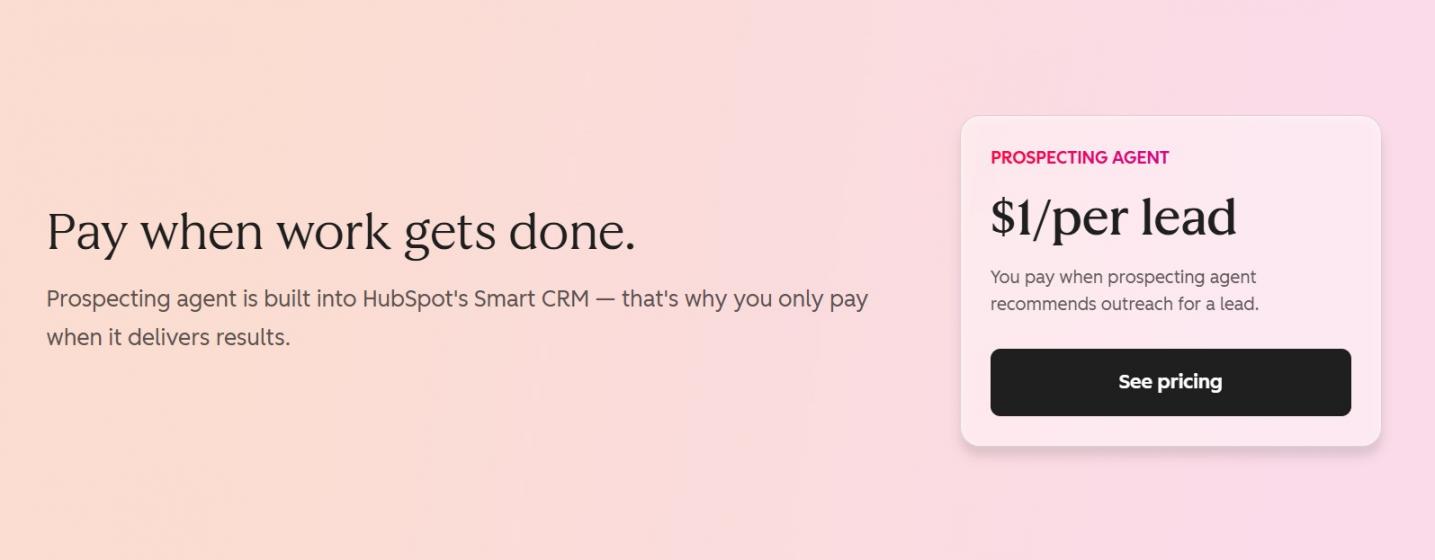
Image via HubSpot
If you're contacting just a few high-value prospects, doing the research yourself may be quicker. Use AI where it saves time, but keep the details that make each message relevant.
Not every prospect needs the same amount of research. For large lists, company news or other relevant details may be enough. Spend more time on promising leads, and use AI to gather information or draft messages. Check the details before you hit send.
Is Cold Emailing Legal? CAN-SPAM, GDPR, and the Gmail Rules
Cold emailing is legal in the US when it follows CAN-SPAM. In the UK and EU, the rules depend on the recipient and the type of business. You must also meet mailbox providers’ requirements to help your messages reach the inbox.
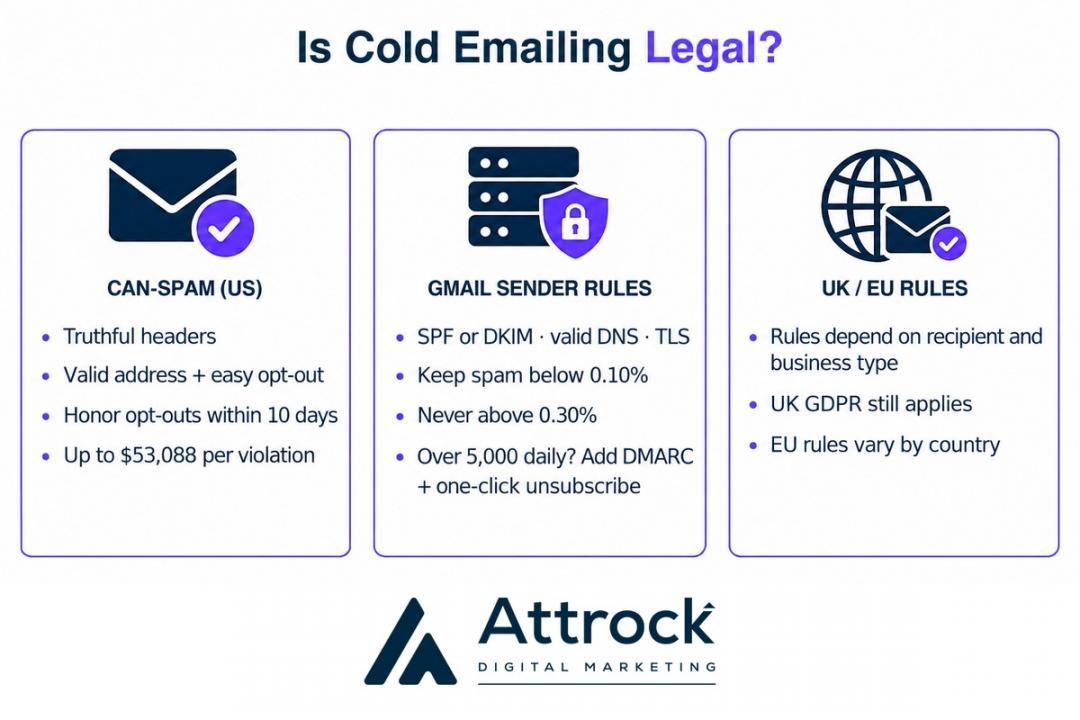
- CAN-SPAM (US): Honest headers and subject lines, clear ad identification, a valid physical address, easy opt‑out, honoring opt‑outs within 10 days, and oversight of third‑party senders. Each violation can cost up to $53,088.
- Gmail Sender Rules: SPF or DKIM authentication, valid DNS records, TLS, spam rate below 0.10% (never above 0.30%). Senders with over 5,000 daily messages must also use DMARC and one‑click unsubscribe.
- UK/EU Rules: The ICO’s B2B guidance explains when businesses can contact corporate subscribers without consent under PECR. UK GDPR still applies, and EU rules vary by country.
| Requirement | Who It Applies To |
|---|---|
| CAN-SPAM compliance | Commercial emails in the US |
| SPF or DKIM, valid DNS, TLS | Senders to Gmail accounts |
| SPF, DKIM, DMARC, and one-click unsubscribe | Senders sending over 5,000 Gmail messages daily |
| Applicable consent and data-protection rules | Senders contacting people in the UK or EU |
No, not automatically. US senders must follow CAN-SPAM, while UK and EU senders must check the rules that apply to their recipients. Mailbox providers also set requirements for authentication and spam rates.
Four Cold Email Templates You Can Adapt
The best approach depends on why you're reaching out. These four examples cover a recent event, a problem you've spotted, a referral, and a stalled conversation. Use them as starting points when learning how to write a cold email, and adjust the details to fit your recipient.
- The trigger event. Use a recent development as your reason for reaching out.
Subject: Question about the Dublin office
Hi Priya,
Saw you’re hiring three support leads in Dublin after the Series B.
Adding a new region usually puts pressure on rotas and first-response times.
Is queue routing still handled manually at your end?
Gaurav
Anatomy: The subject sets the context, while the opening refers to a verifiable event. The claim points to a specific operational issue.
- The observed problem. Point out something you've noticed yourself.
Subject: Your pricing page on mobile
Hi Tom,
I noticed your pricing page's comparison table sits below the fold on mobile. Visitors see the tiers without context.
That makes it harder to compare plans by fit, rather than price.
Would a two-minute screen recording showing what I mean be useful?
Gaurav
Anatomy: The opening line proves someone looked. The claim avoids revenue promises.
- The referral. Name a contact only after getting their permission.
Subject: Maya suggested I write
Hi Dan,
Maya Olsen mentioned you’re rebuilding the onboarding sequence this quarter.
The tricky part is often syncing trial emails with in-product prompts so users don’t get double-messaged.
Already on your list, or worth a note?
Gaurav
Anatomy: The shared contact gives the email context from the start. The rest identifies a specific issue and invites a quick response.
- The re-engagement. Pick up a conversation that went quiet.
Subject: Closing the loop on this
Hi Sana,
You asked about multi-region routing in March, but the timing wasn’t right.
We just updated our routing rules to support per-region SLAs, and the new setup process is much faster.
Still worth a look, or should I close the file?
Gaurav
Anatomy: The opening reminds me of an earlier conversation. The update gives a reason to reconsider, while the question makes it easy to decline.
Pick the closest template and tailor it. That’s how to write a cold email that fits. Open with a relevant detail, then make one ask.
FAQ
Q1. Is Cold Emailing Illegal?
A. Not automatically. In the US, commercial cold emails must follow CAN-SPAM. UK and EU rules depend on the recipient, the type of email, and local data-protection laws. Check the rules that apply before sending.
Q2. Does Cold Emailing Work for Sales?
A. A cold email for sales works best on small, well-qualified lists. Saleshandy’s data shows 15% to 20% replies for campaigns under 200 prospects. Campaigns of 500 to 1,000 sat near 8%.
Q3. Is Cold Email Still Effective in 2026?
A. Yes, but replies aren’t guaranteed. Instantly reports a 3.43% average reply rate. Its top performers pass 10.7%. Saleshandy’s data points to more replies when you follow up.
Q4. What's the Best Opening Line for a Cold Email?
A. Start with one detail you can verify, such as a recent launch or hire. Tie it to your offer in one sentence, but skip generic praise. That's how to write a cold email opener.
Q5. How Long Should a Cold Email Be?
A. Aim for 80 words or fewer, which is enough for one claim and one ask. Cut any sentence that doesn’t help the reader respond.
Q6. How Many Follow-Ups Should a Cold Email Sequence Have?
A. Three or four follow-ups, spaced three to five business days apart, work well. Give each one something new, like a fresh detail or a clearer pitch. Stop if the person declines or opts out.
Q7. How Do I Stop My Cold Emails Landing in Spam?
A. Start by authenticating your domain and enabling TLS. Keep your list relevant and watch your spam rate. Google advises staying below 0.10% and avoiding 0.30% or higher.
Q8. How Do I Write a Cold Email for a Job?
A. Mention something specific about their work and how you’re connected, then ask one clear question. Ask if they’d like your résumé instead of attaching it.
Conclusion
A great cold email depends on who you contact and why. Learning how to write a cold email that earns replies starts with finding prospects who have a reason to hear from you.
Give them a relevant reason to read, make your point, and ask for one clear next step. Before sending, check your email setup and plan how you'll follow up.
Need help finding new accounts? Try HubSpot's Starter Plan. It includes the Prospecting Agent for researching accounts and preparing outreach, running on your plan's included HubSpot Credits.
Prefer to leave email campaigns to specialists? Explore Attrock's email marketing services.
Disclaimer: This content contains some affiliate links for which we will earn a commission (at no additional cost to you). This is to ensure that we can keep creating free content for you.