- Start With Two Channels: Choose one for quick leads and another for long-term growth.
- Build a Simple System: Send every inquiry to one form and CRM, then follow up promptly.
- Prioritize Qualified Leads: Focus on buyers who need your offer, can afford it, and may convert.
- Track Profitability: Measure leads, cost per lead, conversion rate, and response time each week.
- Follow Marketing Rules: Honor opt-outs and obtain written consent before sending marketing text messages.
Small business lead generation helps you find people who may buy your products or services. It is a way to attract potential customers, collect their details, and follow up.
You don't need a large budget or many marketing channels to attract leads. Start with a clear offer and choose the channels your target customers use. Then, track your leads and focus on the methods that bring sales.
Finding enough leads remains a major concern for small business owners. LocaliQ’s 2026 marketing trends report surveyed over 300 owners. It found that 59% expected finding new leads to be difficult.
This guide covers small business lead generation strategies, costs, and a practical 90-day plan. I'll walk you through how to attract more potential customers and turn their interest into sales.
Disclaimer: This content contains some affiliate links for which we will earn a commission (at no additional cost to you). This is to ensure that we can keep creating free content for you.
Table of Contents
What Is Small Business Lead Generation?
Small business lead generation is the process of finding leads or potential customers and getting their contact details. A lead is someone who shows interest in your offer and shares their email or phone number.
Not every person who visits your website or follows you on social media becomes a lead. You need a way to contact them and encourage them to buy.
There are two main types of leads.
- Inbound Leads: Potential customers who discover your business through search engines, social media, reviews, or referrals.
- Outbound Leads: People your business reaches through cold emails, phone calls, or direct messages.
The Federal Reserve Banks’ 2026 report on employer firms shows why lead generation matters. It found that reaching customers and growing sales was the common operational challenge among 57% of firms.
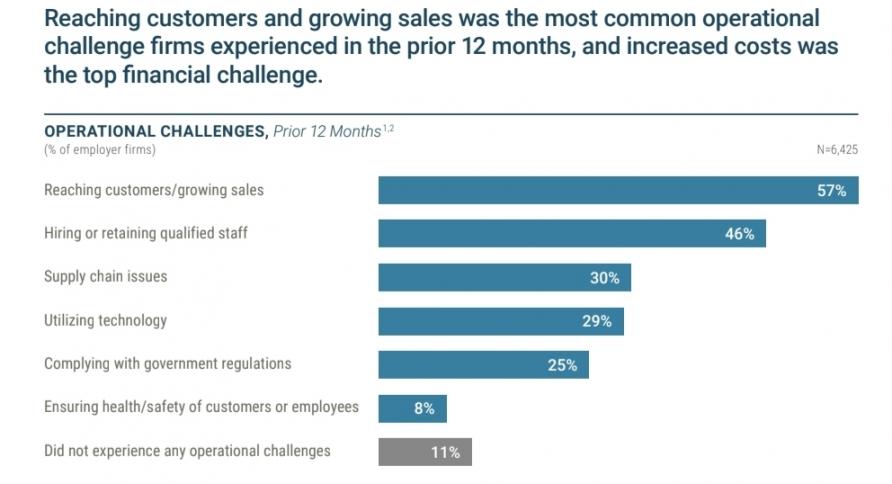
Image via Fed Small Business
A good small business lead generation system gives you a simple way to find potential buyers. You attract people, collect their contact details, and follow up with them. Over time, you can track which methods bring the most customers and sales.
It’s finding likely buyers, getting a way to reach them, and following up to land a sale.
What Does a Small Business Lead Generation System Need?
A small business lead generation system needs five key parts. These include a strong offer, a landing page, a short form, a CRM, and fast follow-up. Together, they help you attract potential customers and turn their interest into sales.
Each part has a specific job. You can start with free lead generation tools and improve your system as your business grows.
| Part | What It Does | Cheapest Way to Start | Sign It’s Broken |
|---|---|---|---|
| Offer | Gives people a reason to contact you. | A free quote, call, or checklist | Visitors leave without making contact. |
| Landing Page | Explains your offer on one focused page. | A free landing page builder | Many visitors leave without filling out the form. |
| Form | Collects contact details and customer requests. | Name, email, and one question | People start but do not finish the form. |
| CRM | Stores lead details and notes in one place. | Free CRM software | Leads get lost in emails and messages. |
| Follow-Up | Starts a conversation with each new lead. | A same-day reply rule | Leads stop responding after one message. |
Once these five parts are in place, you need a way to manage generated leads. Without one, contact details can get lost across emails and social media messages. LocaliQ’s 2026 report found that only 32% of owners used lead management software.
Small businesses also use CRM tools to keep lead details, messages, and follow-up tasks. You can start with free CRM software instead of paying for extra tools. As your business grows, you can upgrade to a plan with more features.
Your landing page should also connect to your CRM for lead management. When someone fills out your form, their details should go straight into your contact list.
For example, HubSpot lets you add forms to landing pages. A form submission can create or update a contact record in its Smart CRM.
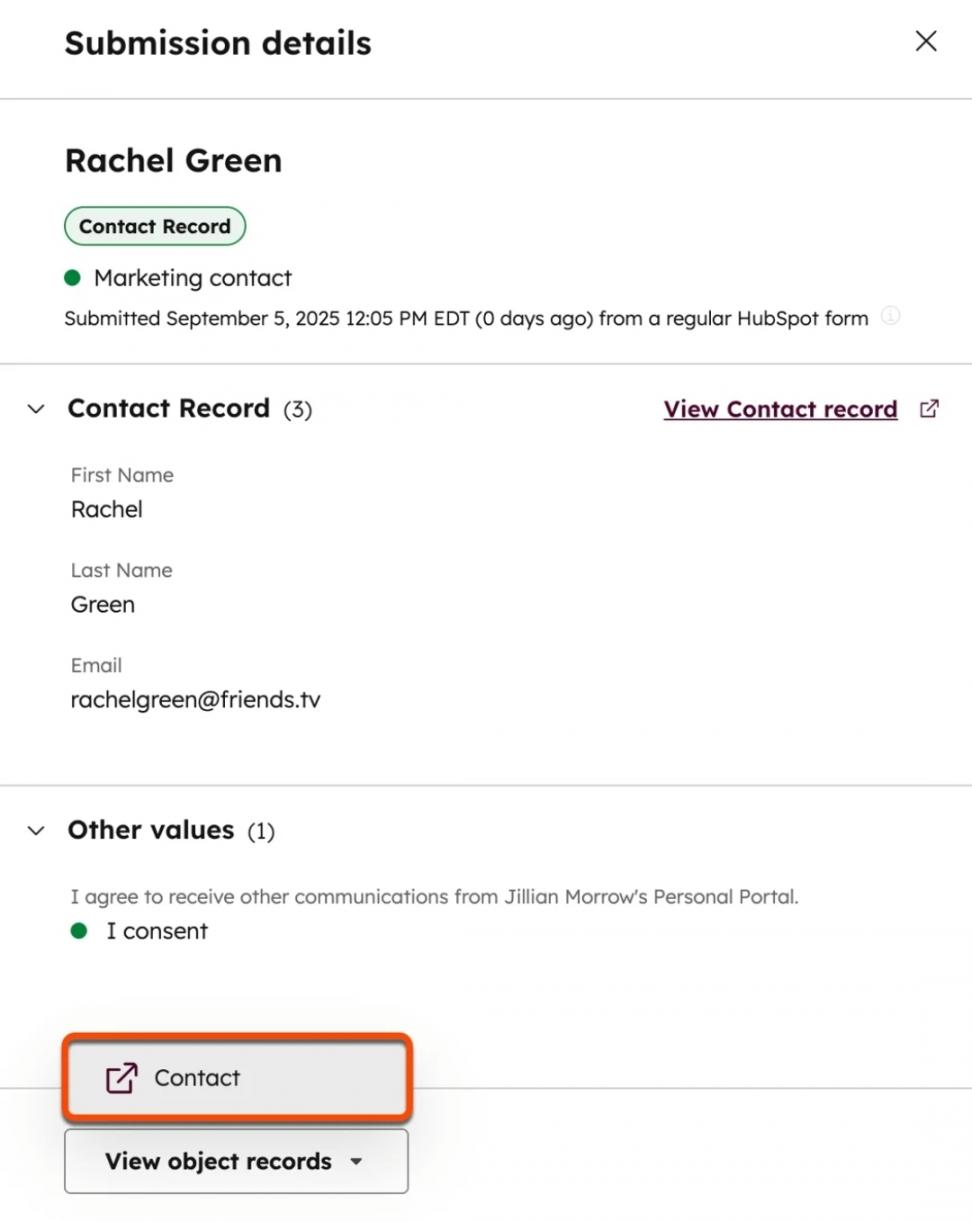
Image via HubSpot
You can use a spreadsheet if you receive only a few leads each week. However, a CRM is useful as your lead list grows. Choose software that fits your budget and current needs.
A good system combines a strong offer, landing page, lead capture form, CRM, and follow-up. Together, these parts help capture interest, organize leads, and turn inquiries into sales.
Which Lead Generation Strategies Work Best for Small Businesses?
The best small business lead generation strategies include local search, referrals, content marketing, paid ads, and direct outreach.
Each strategy attracts potential customers in a different way. Choose two that fit your audience, budget, and available time. You do not need to use all five at once.
Use this table to compare the five options. The costs and timelines are rough guides; the actual results might vary.
| Channel | Best Fit | Cash Cost | Illustrative Time to First Leads |
|---|---|---|---|
| Local search and reviews | Local services and shops | Low | 2-6 weeks |
| Referrals and partners | Businesses with happy, repeat customers | Low | 1-6 weeks |
| Content, social and organic search | Owners who can publish regularly | Low | 1-6 months |
| Paid search and social ads | Offers with clear demand and margin | Medium to high | 1-7 days |
| Direct outreach | B2B services with a defined buyer list | Low to medium | 1-4 weeks |
Three of the small business lead generation strategies, which are organic search, content, and referral marketing, cost more time than money. Paid advertising can bring leads faster, but it requires a larger budget. Choose the strategies that suit your business, then track their results.
Local Search, Reviews and Google Business Profile
Local search helps small businesses or startups appear when nearby customers look for the products or services. Start with a complete Google Business Profile and recent customer reviews. Creating a profile is free, but you must keep your hours, services, and photos updated.
BrightLocal’s 2026 local consumer review survey polled 1,002 US adults. It found that 97% read online reviews, while 47% avoid businesses with fewer than 20 reviews.
The survey also found that 85% are more likely to use businesses after reading positive reviews. Negative reviews deter 77% of consumers.
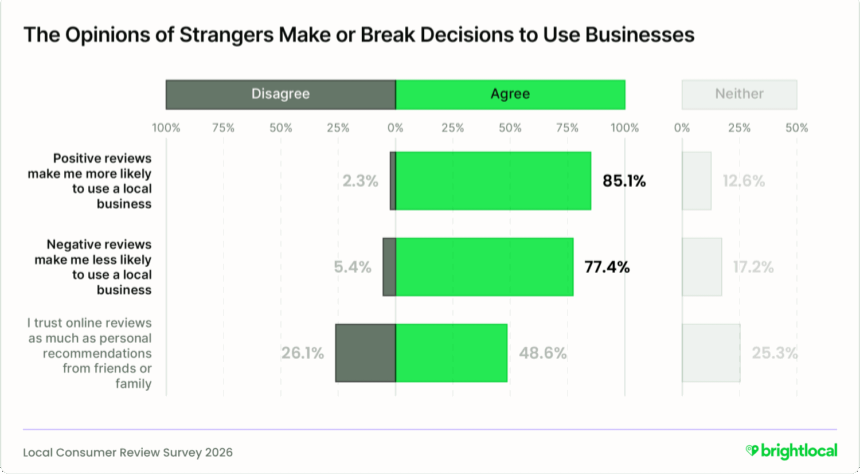
Image via BrightLocal
These findings show how much reviews can affect customer choices. Reviews are among the simplest social proof examples to get. Ask happy customers to leave reviews after a purchase or completed job. Reply to reviews to show customers you value their feedback.
Referrals and Partner Networks
Referrals help you find new customers through people who already trust your business. Ask happy customers for referrals after a successful sale or completed job. Be specific about the type of customer you want to reach.
LocaliQ’s 2026 survey found that 83% of small firms named customer referrals as their best source for getting new leads.
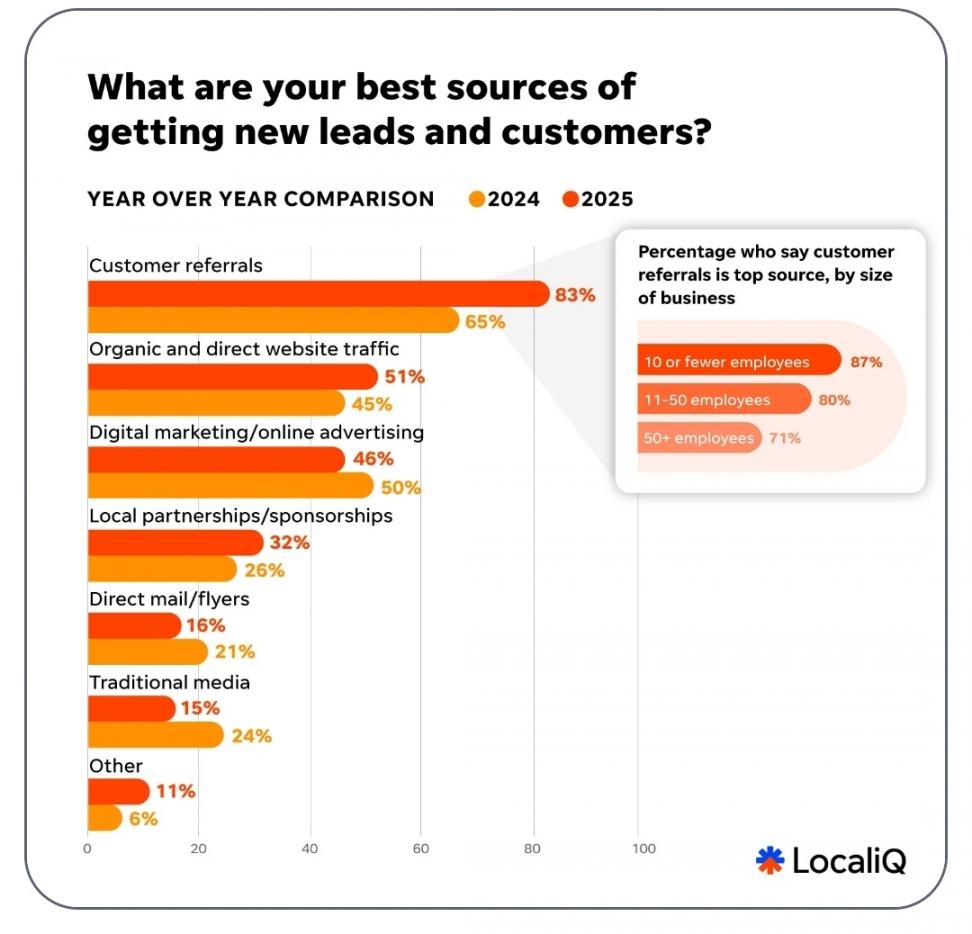
Image via LocaliQ
You can also partner with businesses that serve the same customers but offer different services.
A referral marketing program gives customers a structured way to recommend your business. Track each referral and thank customers who bring in new buyers. With time, referrals can become a steady source of small business lead generation.
Content, Social Media and Organic Search
Organic lead generation for small business starts with answering questions your customers already ask. Share useful content on your social media pages and website.
Focus on solving problems before promoting your products or services. Unlike paid ads, useful content can keep attracting visitors long after publication.
LocaliQ’s 2026 survey found that social media marketing was among the most-used marketing channels by 66% of small businesses in 2025. Another 32% still planned to invest in it.
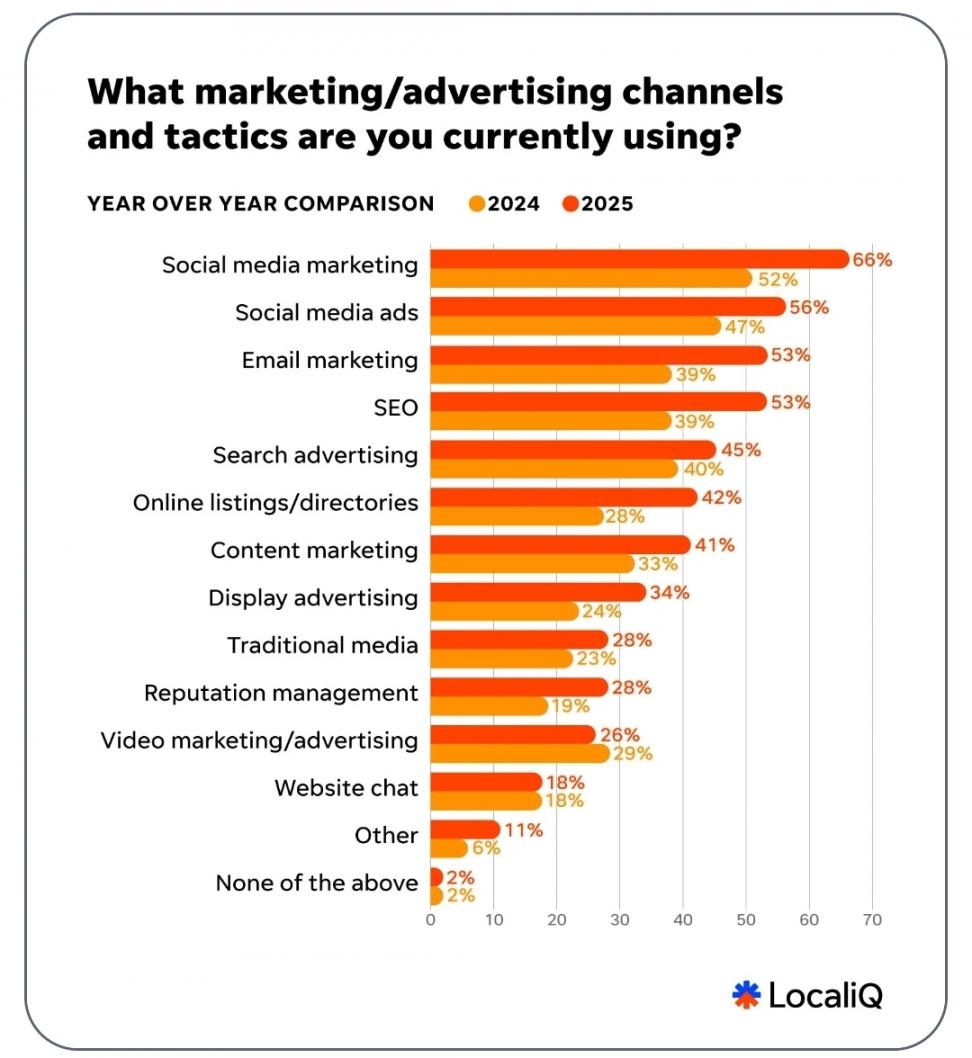
Image via LocaliQ
For social media lead generation, create posts that point people back to your website. This gives interested readers a simple next step and helps them learn more about your business.
Paid Search and Social Ads
Search ads help reach people already looking for your products or services. However, set up your landing page and follow-up process before spending money. Otherwise, you may pay for clicks without gaining new leads.
Google’s Local Services Ads charge per lead, and you can cap the bid, as the cost section shows. With ads, you enjoy the benefits of retargeting past visitors who showed interest in your services.
WordStream’s 2026 PPC benchmark found an average cost of $66.69 per lead. Your costs may differ based on your industry, offer, and target audience.
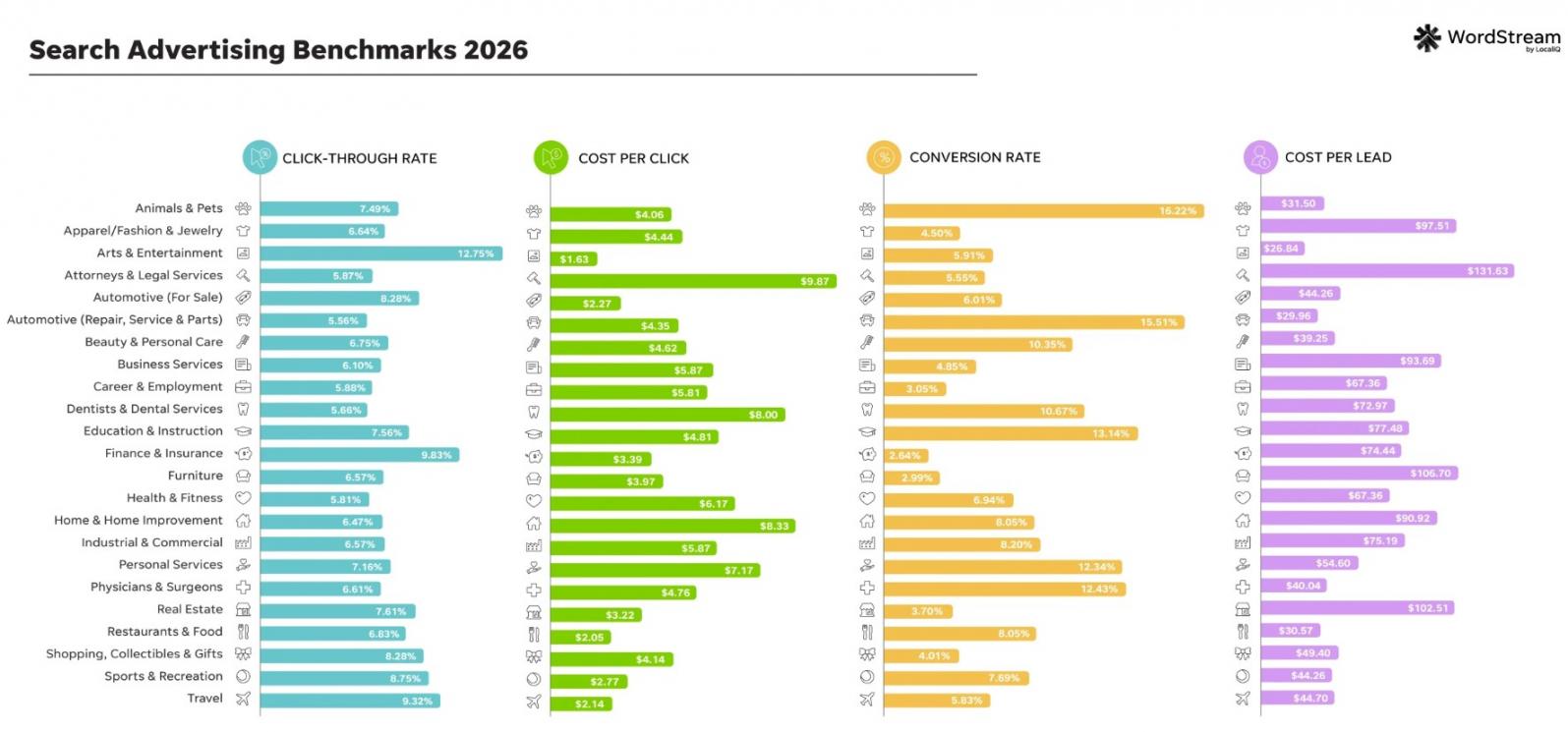
Image via WordStream
Track how many visitors become leads before increasing your ad budget. If lots of visitors reach your capture page but few fill out the form, more ads won’t help. In that case, landing page optimization services can find where visitors drop off.
Direct Outreach and Prospecting
Direct outreach reaches buyers who haven’t found you yet. It’s a staple of B2B lead generation for small business teams. It means short, relevant messages sent to a list of good-fit companies you picked on purpose. Among small business lead generation techniques, it’s the most targeted.
The reality is that generic pitches get ignored. In Gartner’s 2025 B2B buyer survey, 73% of buyers say they avoid suppliers who send irrelevant outreach.
Finding suitable companies and contacts by hand takes time. HubSpot’s Prospecting Agent can find companies showing buying signals. It can also suggest reasons to reach out and draft personalized messages. It is available on HubSpot’s Starter plan.
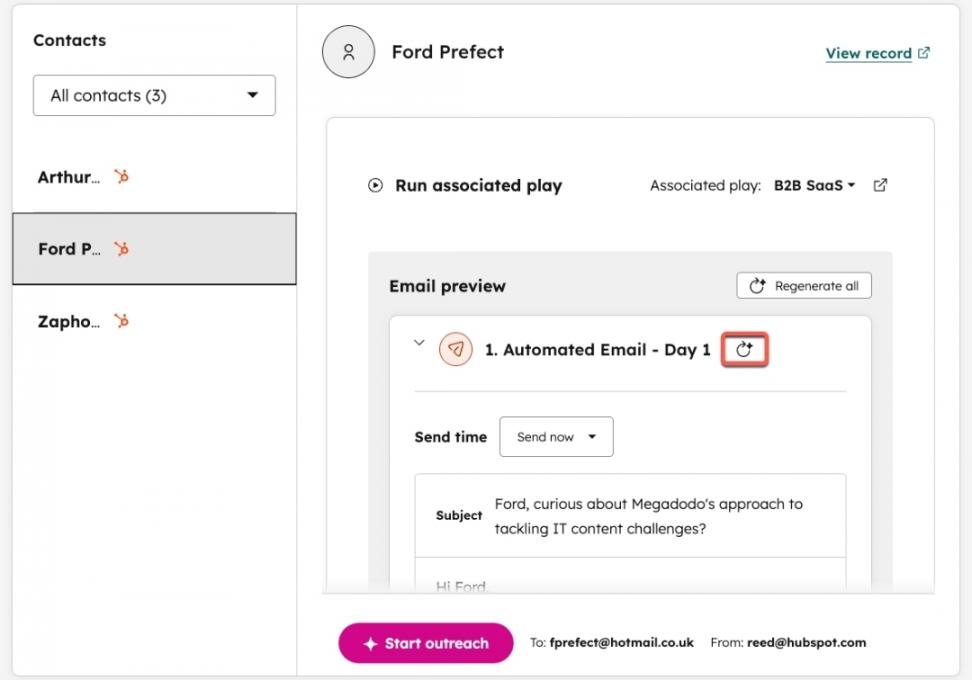
Image via HubSpot
Review each message before sending it to check its tone and details.
HubSpot Starter includes 500 HubSpot Credits monthly. Prospecting Agent uses 100 credits per recommended lead, costing $1 per lead.
Other AI prospecting tools offer similar features, but you should still review messages before sending them.
Local search and referrals suit businesses with local customers. Content, paid ads, and direct outreach help reach different audiences. Choose two strategies that fit your budget and goals.
What Does Lead Generation Cost a Small Business?
Small business lead generation costs depend on your chosen channels and the time you invest. To compare options, calculate each channel’s cost per lead by dividing spending by leads received. Then compare your cost per customer with the gross profit each customer brings.
The table below compares common small business lead generation costs, based on figures checked on October 27, 2026.
| Approach | What You Pay For | Example Cost (Checked October 2026) | Source |
|---|---|---|---|
| Free tools | Your time | Google Business Profile: free. HubSpot free tools: $0 for up to 2 users | Google; HubSpot pricing page |
| Paid CRM with forms and pages | Seats, monthly or annually | HubSpot Starter: $20 per seat per month list price, with a limited-time discount for new customers | HubSpot Starter page |
| Google search ads | Ad clicks | An average of $66.69 per lead | WordStream 2026 |
| Facebook leads campaigns | The ad budget you set | An average of $27.39 per lead | WordStream 2026 |
| Local Services Ads | Each lead | You pay per lead and can set a maximum bid | Google Local Services help |
| AI prospecting | Credits | Breeze Prospecting Agent: $1 per lead it recommends outreach for | HubSpot product page |
| Agency or bought leads | A retainer or each lead | Quotes vary, with no specific public benchmark | None |
Buying leads or hiring an agency costs money but can save time. Measure your marketing ROI to see whether the cost per customer makes financial sense.
Small businesses can use free tools, pay $20 monthly per CRM seat, or spend $27–$67 per advertising lead. Compare each channel’s cost per customer with gross profit to assess profitability.
How Can You Build a Small Business Lead Generation Plan?
You can build a small business lead generation plan using four steps. Choose one target customer, one offer, and two channels. Set a follow-up rule, track four numbers weekly, and review your results after 90 days.
1. Pick One Best-Fit Customer and One Offer
Start by naming one best-fit customer, the type of buyer you most want more of, and one offer built for them. A clear target makes every later choice easier, including which channels you test and what your capture page should say.
Ask your five most recent customers how they found you and why they chose you. Their answers show which channel to test first.
Next, ask three questions about each new lead:
- Do they have the problem your offer solves?
- Can they afford your price?
- Are they likely to buy within the next few months?
Keep these details handy as you plan your next steps.
2. Choose Two Channels, One Fast and One Long-Term
Choose one channel that can bring leads quickly and another that grows over time. Referrals, direct outreach, and small paid campaigns can bring early results. Reviews and content usually take longer to build.
This mix keeps your small business lead generation efforts moving while your slower channel grows.
For example, a cleaner could combine customer referrals with local reviews. A B2B consultant could pair direct outreach with useful website content.
Add both channels and their review date to your plan, then set your follow-up rule.
3. Set a Follow-Up Rule Before the First Lead Arrives
Decide how quickly you will reply and how often you will follow up. Your rule should set a reply target, the number of messages, and the time between them.
Write it down so you can follow it during busy days.
- Reply Target: Try to reply within five minutes when possible. This is often called the 5-minute rule. At minimum, aim to respond on the same day.
- Follow-up Schedule: Start with the same day, day 2, day 5, and day 10. Adjust this schedule to fit your buyers and offer.
- Text Consent: Get written consent before sending marketing text messages. The send rules below explain why this matters.
A common rule is the 3-3-3 rule, which has several versions and no single agreed meaning. One version suggests three touches across three channels within three days or weeks.
Another describes three stages of gaining attention, building interest, and following up. Neither replaces a schedule that fits your customers.
For later follow-ups, use email marketing platforms. They can help you send messages on a regular schedule.
4. Track Key Metrics Weekly and Review Quarterly
Track four numbers each week to see whether your plan is working. Record leads by source, cost per lead, lead-to-customer rate, and response time. A shared spreadsheet can work at first, but your CRM tool for small businesses may track automatically.
Each number has a simple formula and answers a different question.
| Number | How to Calculate It | What It Tells You |
|---|---|---|
| Leads by source | Count new leads from each channel | Which channels bring people in |
| Cost per lead | Channel spend ÷ leads from that channel | What each lead costs you |
| Lead-to-customer conversion rate | New customers ÷ leads, times 100 | How well leads turn into sales |
| Response time | Time from inquiry to your first reply | Whether your follow-up rule holds |
Review each channel’s cost per customer. Keep channels that bring profitable customers. Fix channels that attract leads but generate few sales. Give slower channels more time if they are still showing progress.
Once leads become sales opportunities, use the same metrics to build a sales pipeline you can forecast from. This helps you see which deals may close and estimate future sales.
Define your target customer, choose two channels, and set clear follow-up rules. Track leads, costs, conversions, and response times weekly to measure progress.
FAQ
1. What is the best way to generate leads for a small business?
A. The best approach is to choose two channels that match how your buyers find solutions. For small business lead generation, referrals, local search, content, and outreach can all work well. Send leads to one contact form and track them in your CRM. Test both channels and keep the ones that bring paying customers.
2. What is the 5-minute rule for leads?
A. The 5-minute rule recommends replying to new leads within five minutes when possible. It is an informal target, not a universal standard. If you cannot respond that quickly, aim to reply on the same day.
3. What is the 3-3-3 rule in sales?
A. The 3-3-3 rule is an informal sales approach that has several versions. One version suggests three touches across three channels within three days or weeks. Another recommends three seconds to gain attention, three minutes to build interest, and three days to follow up.
4. Should a small business buy leads?
A. Buy leads only when the numbers work, and you follow email and text rules. Compare your cost per customer with the gross profit from each sale. Purchased leads cost money upfront, and you remain responsible for how you contact them.
5. Can AI help a small business generate leads?
A. Yes, AI can help you attract and find potential customers. Answer common questions on your website to help buyers find your business through AI tools. AI prospecting agents can also find suitable companies and draft emails for you to review before sending.
6. When should you expect results from lead generation?
A. Referrals, outreach, and paid ads can bring leads within days or weeks. Content and organic search usually take months. Review your small business lead generation results regularly, but keep tracking key numbers weekly.
7. Does a small business need a CRM to manage leads?
A. Not always, but you need one place to store leads and contact notes. A shared spreadsheet may work when you receive only a few leads weekly. As leads grow across channels, a free CRM can help you manage follow-ups.
8. Can you generate leads with almost no budget?
A. Yes. You can generate leads with little money by investing your time. Try strategies like referrals, customer reviews, a free Google Business Profile, and personal outreach. Track inquiries in a free CRM and reply on time. Only invest once you know which channels can work for your business.
Ready to Generate More Leads?
Small business lead generation works best when you keep it simple and follow a system. Choose one target customer and two channels. Track every inquiry in one CRM, reply promptly, and review results.
Remember, not every lead will become a customer, and that’s normal. Focus on attracting people who need your offer and can afford it. Over time, your results will show where to invest more effort.
Need one place to manage your leads? Try HubSpot Starter to organize contacts and manage outreach.
Prefer expert support? Attrock's lead generation services can help manage campaigns while you focus on your business.
Disclaimer: This content contains some affiliate links for which we will earn a commission (at no additional cost to you). This is to ensure that we can keep creating free content for you.