- A GTM (go-to-market) strategy is a plan that helps startups reach the right customers and turn interest into sales
- To build a GTM strategy, define the ideal customer and product positioning, then choose pricing and the sales motion before launch
- Test your marketing channels to find where your target customers search for or discover your products, such as through referrals, events, or sales conversations
- A 90-day launch period gives you time to test your offer, measure results, and identify changes to your pricing, messaging, target audience, or sales approach
A go-to-market strategy for startups outlines how to reach target customers, communicate value, and increase revenue. It includes key components such as your ideal customer profile (ICP), value proposition, sales motion, pricing, distribution channels, and metrics.
Startup founders can waste time and money targeting the wrong customers, pricing products poorly, or choosing distribution channels that don't fit their market. Another costly mistake is to copy a later-stage company’s GTM strategy too early. Mature enterprises have more resources, established customer bases, and larger sales teams.
Building a GTM strategy for startups involves defining your target market and ideal customer profile. Next, tailor your message and choose a pricing model. Then pick a sales motion, such as product-led or hybrid. Choose distribution channels according to the sales motion, use the first 90 days as a launch-testing window, and track metrics. This guide explains exactly how to build a go-to-market strategy for startups.
Disclaimer: This content contains some affiliate links for which we will earn a commission (at no additional cost to you). This is to ensure that we can keep creating free content for you.
Table of Contents
What Is a Go-to-Market Strategy for Startups?
It’s a plan that helps you launch a new product and reach its target customers. An effective GTM strategy for startups and small businesses covers the market, target customers, positioning, sales motion, pricing, distribution channels, and key metrics:
- Market and Customer: The target market, the number of prospects you can reach, and the ideal customer profile (ICP), including buying signals, demographics, and customer pain points
- Positioning and Messaging: Your product's value, key differentiators, and reasons buyers should choose it over competing products
- Sales Motion: How the sale actually happens, which can be product-led, sales-led, or hybrid
- Pricing: What you charge and how customers pay, such as subscription or usage-based
- Distribution: The channels you use to reach buyers, such as SEO, paid ads, email marketing, or sales outreach
- Metrics: Key performance indicators like CAC (Customer Acquisition Cost), Customer Lifetime Value (LTV), conversion rates, and payback period
A go-to-market strategy for startups is different from a marketing strategy. For example, a digital marketing strategy uses online channels to build awareness, engage potential buyers, and generate leads. A GTM strategy covers how a product reaches customers and generates sales. It should also be informed by product-market fit.
CB Insights found poor product-market fit in 43% of the analyzed startup failures. A go-to-market strategy for startups can help founders align their offer with buyer needs and market demand. Other reasons for startup failure include running out of capital (70%), wrong market timing (29%), and being outcompeted by rivals (6%):
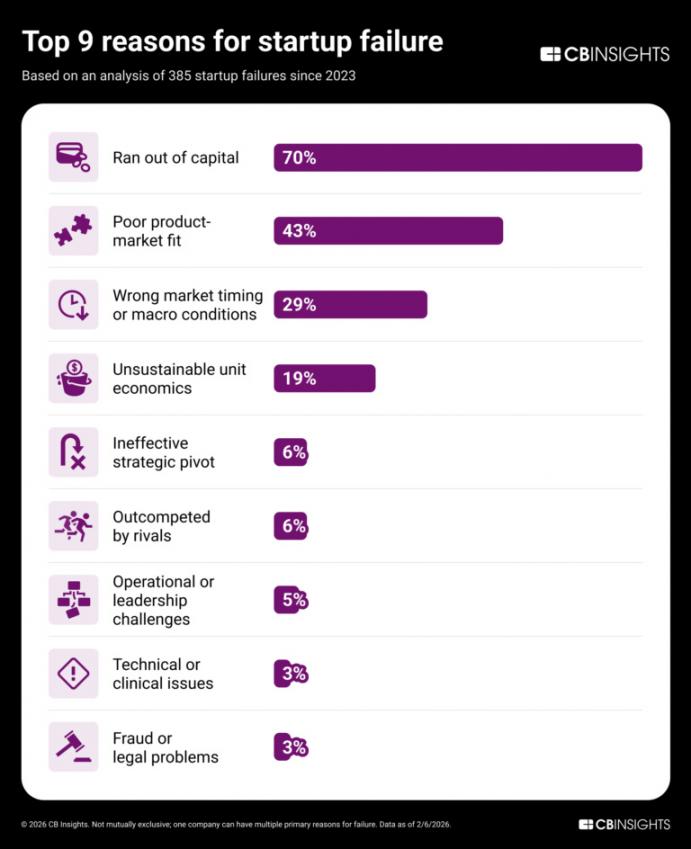
Image via CBInsights
It covers your target market, ideal customer, value proposition, pricing, sales motion, distribution channels, and performance metrics. These components help you reach the right buyers, test demand, and turn interest into sales.
How Do You Build a Go-to-Market Strategy for Startups?
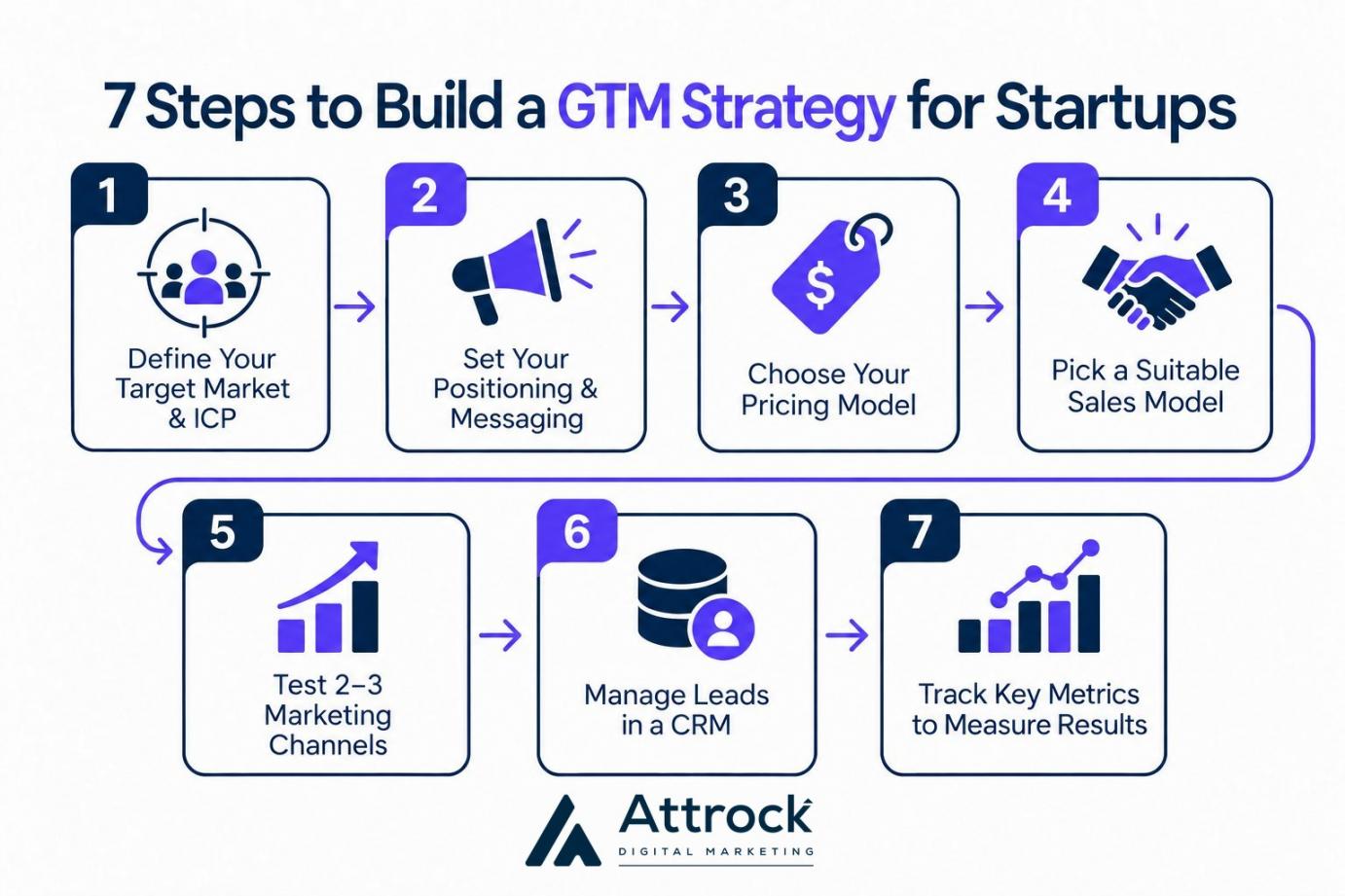
Start by defining your target market and ICP. Then develop your positioning and messaging around the ideal customer. Choose a sales motion and test a few channels that fit your buyers. Use a CRM tool to manage leads, organize contacts, track deals, and monitor sales performance.
Here are the seven steps at a glance:
1. Define Your ICP and Target Market
Choose a beachhead market, which is the small group of customers you plan to target first before expanding. For example, instead of selling project management software to every business, a startup might target small marketing agencies initially. Then write your ICP. This describes the company size, industry, budget, pain points, buying triggers, and decision-makers.
Vague targeting can cost you buyers. Gartner's 2025 survey found that 73% of B2B buyers actively avoided suppliers who sent irrelevant outreach.
Before choosing your first customer segment, estimate how large your potential market is and how much of it you can serve. Measure TAM (Total Addressable Market), SAM (Serviceable Available Market), and SOM (Serviceable Obtainable Market). The table below breaks down what each means. The figures in the table are examples only:
| Market Layer | What it Means | Illustrative Example |
|---|---|---|
| TAM | The revenue opportunity if every potential customer bought your product | 10,000 companies × $6,000/year = $60 million |
| SAM | The revenue opportunity among customers your product and business model can serve | 4,000 companies × $6,000/year = $24 million |
| SOM | The revenue you could realistically win in your target market | 200 companies × $6,000/year = $1.2 million |
Use these estimates to identify a market you can realistically serve. Then choose a beachhead segment with similar customer needs, buying habits, and sales cycles. Within that segment, document your ICP.
2. Define Your Positioning and Messaging
Positioning in a go-to-market strategy for startups defines how you want to be perceived relative to alternatives. You name your category, the current alternative, and the value of your product. Messaging is the language you use to communicate that value across your website, ads, and sales calls.
Buyers often decide which companies they prefer before they speak to a salesperson. In fact, 94% of buying groups had already ranked their shortlist of vendors before contacting sellers, according to 6sense. The vendor that ranked first before seller engagement won 77% of the time.
The point for startups is that your positioning matters early, meaning before buyers speak with sales teams. Buyers need to understand what your product does, why it fits their needs, and how it differs from alternatives before they talk to you.
A positioning statement gives your team a clear way to describe your product and its value. Use this example to structure your positioning statement:
We help [target customer] solve [specific problem] with [product]. Customers choose us when they need [key value] instead of [common alternative].
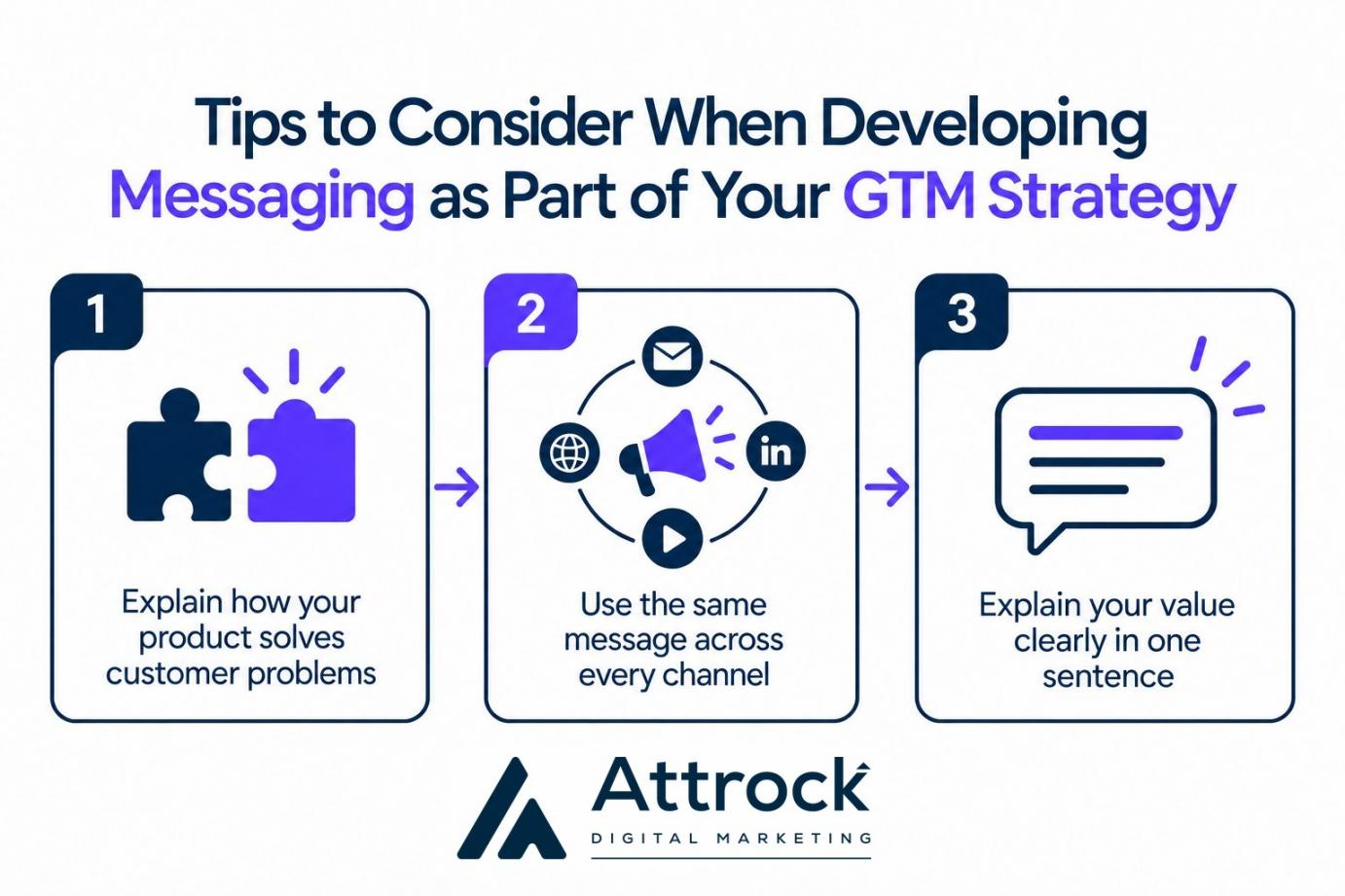
When developing your messaging, make sure it reflects what customers care about and is consistent across channels:
- Focus on Customer Needs: Explain how your product solves the problems your target customers face
- Keep Your Message Consistent: Use the same core message across your website, ads, and sales calls to help build brand awareness
- Make Your Value Clear: Explain what your product does and why customers should choose it over alternatives, in one sentence
3. Choose and Test Your Pricing Model
A pricing model is the framework that defines how a business calculates and charges customers for its product or service. For project management software, a startup could charge a flat fee or bill per user. You can also charge based on usage or combine a fixed fee with usage charges:
- Flat Fee: Customers pay one fixed price
- Per Seat: Customers pay for each user
- Usage-Based: Customers pay based on how much they use
- Hybrid: Customers can pay a fixed fee plus a usage-based charge
Choose a model that reflects how customers get value from your product, then test it with real buyers.
In 2026, 37% of B2B software and AI companies surveyed used hybrid pricing, up from 25% 12 months earlier. Among firms with less than $5 million in annual recurring revenue, flat fee was the most common model, at 37%, according to Growth Unhinged.
Your pricing should reflect how customers receive value. For example, you can charge by seats or usage as possible charging units. One option for early-stage startups is to start with a paid plan before adding tiers.
During discovery calls, ask potential customers about their budgets, what they value, and what they would pay for your product. Ask what alternatives they use, too. Review your pricing after launch and adjust it based on customer feedback. You can also use SaaS billing software to manage subscriptions and plan changes.
4. Pick the Sales Motion That Fits Your Deal Size
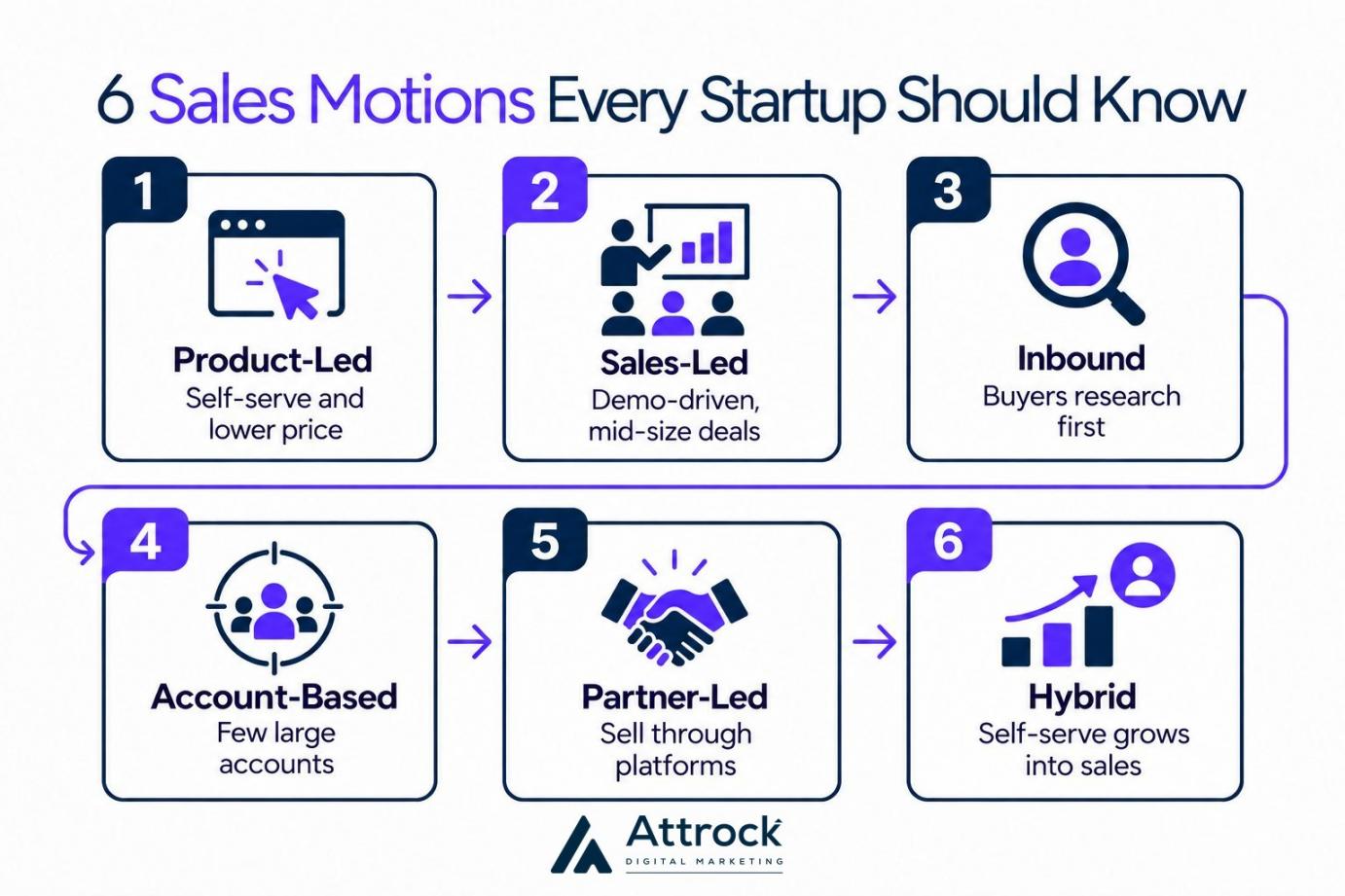
A sales motion in a go-to-market strategy for startups defines how buyers discover, evaluate, and buy the products startups offer. Common options include product-led, sales-led, inbound, account-based, partner-led, and hybrid or product-led sales.
The right choice for startups or small businesses depends on deal size and how much help buyers need before purchasing. The options below cover different ways startups reach and sell to buyers. Some options describe how startups acquire buyers rather than a pure sales motion. The table also breaks down which role to hire first and what to watch out for:
| Motion | Best Fit When | How Buyers Find and Buy | First GTM Hire | Watch Out For |
|---|---|---|---|---|
| Product-Led | Low price, quick value, users can start alone | Free plan or trial, then self-serve upgrade | Growth or product marketer | Free users who never upgrade |
| Sales-Led | Mid-size deals that need a demo | Outbound and demos, then a rep-led close | Account executive | Long cycles and rising cost per deal |
| Inbound (Marketing-Led) | Buyers research before they talk to sales | Content, search and social, then a sign-up or demo | Content marketing expert or demand marketer | Traffic that never turns into pipeline |
| Account-Based (Enterprise) | A few large accounts with big committees | Tailored outreach to a list of named accounts | Senior account executive | Long, costly cycles that need patience |
| Partner-Led | Buyers already use a platform or reseller | Marketplaces, integrations, or resellers | Partnerships manager | Partner priorities that differ from yours |
| Hybrid (Product-Led Sales) | Self-serve users work inside bigger companies | Self-serve start, then reps expand the account | Rep who works product-qualified leads | Sales and product chasing different metrics |
In 2026, 67% of B2B buyers say they prefer a rep-free experience, according to Gartner. A hybrid sales motion lets buyers explore your product on their own before involving sales. Reps can step in when buyers need help or want to discuss a larger plan.
Founders should close early deals themselves to learn common buyer objections. Hire sales reps once you can repeat those sales and explain what makes them work. For self-serve products, customer onboarding software can help users get started and reach their first goal.
5. Select Two or Three Distribution Channels to Test First
Your ICP describes the type of customer you need to reach. Choose channels those customers already use to find products or research solutions. These channels can include Google Search, LinkedIn, email, or social media. As a manageable starting point for early testing, use two or three channels with a set budget and deadline. This helps you compare their results without committing too much money upfront.
AI is now part of how buyers search. For example, potential customers may discover your product through AI-generated answers before visiting your website. They can get information from Google AI Overviews or through conversational AI.
Use these four steps to choose and test channels as part of your go-to-market strategy for startups:
- Find Where Your ICP Looks for Solutions: Identify where potential customers research products. This can be through search engines, AI assistants, LinkedIn, and industry communities.
- Match Channels to Your Sales Motion: Product-led startups can use trials and communities, while inbound teams can focus on content and SEO. Sales-led teams use direct outreach, while partner-led teams can use marketplaces.
- Set Test Rules: Give each channel a budget, a deadline, and one success measure. This lets you compare results without overspending.
- Review Results: Keep what works and fix or drop the rest. Use proven lead generation strategies to explore other ways to attract leads.

6. Capture Leads and Manage Sales Deals in One CRM
A CRM tool helps startups collect lead information, track customer interactions, and manage sales opportunities. Without a clear process, startups can lose track of leads and miss sales follow-ups. A CRM keeps contact details and deal updates in one place.
HubSpot, for example, combines lead capture with deal management. You can collect contact details through forms, then track sales opportunities in its deal pipeline.
- Capture Leads: Create a form in HubSpot Starter and add it to a landing page or website. When someone submits it, HubSpot creates or updates their contact record in Smart CRM. You can then track the contact and follow up.
- Manage Deals: Use HubSpot Starter's deal pipeline to track sales opportunities through different stages. You can also configure rules that assign follow-up tasks when deals change stages.
Learn more about building a sales pipeline with stages that reflect how your buyers make decisions.
7. Track Metrics to Check Whether Your GTM Strategy Is Working
Founders need to measure the results of putting their go-to-market strategy for startups into action. That means checking whether they're gaining customers, making sales, and earning enough revenue to sustain the business.
Track metrics like customer acquisition cost (CAC), CAC payback, and lead-to-customer conversion. You should also track metrics that match your sales motion and business model. Metrics include activation rate, win rate, and net revenue retention (NRR). This table defines the formula for each metric and what it tells you:
| KPI | Formula | What it Tells You |
|---|---|---|
| Customer Acquisition Cost (CAC) | Total sales and marketing costs divided by the new customers acquired in the same period | What it costs to win one customer |
| CAC Payback (Months) | CAC ÷ (monthly revenue per customer × gross margin %). This formula applies to businesses that earn recurring revenue, such as monthly or annual subscriptions. | How many months it takes to recover acquisition costs from gross profit |
| Lead-to-Customer Conversion | New customers from a defined lead cohort ÷ total leads in that cohort × 100 | What percentage of leads become customers |
| Activation Rate (Product-Led) | New users who reach a defined activation milestone ÷ new sign-ups in the same cohort × 100 | What percentage of new users reach a key product milestone |
| Win Rate | Deals won ÷ (deals won + deals lost) × 100 | The percentage of closed sales opportunities that are won |
| Net Revenue Retention (NRR) | (Starting MRR + expansion MRR − contraction MRR − churned MRR) ÷ starting MRR × 100. NRR is relevant to SaaS businesses and other recurring-revenue startups. | Whether existing customers grow or shrink your revenue |
You can review the results monthly and adjust your approach based on what the numbers show.
A startup GTM strategy begins with defining your ideal customer and how your product stands out. Next, set your pricing, choose a sales motion, test marketing channels, and manage leads in a CRM. Track customer acquisition costs, conversion rates, and retention to see what works.
How Do You Map Out a 90-Day Launch Plan for Your GTM Strategy?
Map out a 90-day launch plan for your go-to-market strategy for startups by dividing it into three 30-day phases. Prepare your offer, launch to early customers and test channels, then review results and decide what to improve or scale.
You shouldn't move to the next stage just because 30 days have passed. You should check whether you've achieved the goal for that stage. For example, before spending more money on marketing, check whether your channels produce qualified opportunities. These are prospects that are vetted by your sales team and have a defined budget and realistic timeline to purchase.
Here’s a table that breaks down goals, key actions, and exit checks for each phase:
| Phase | Goal | Key Actions | Exit Check |
|---|---|---|---|
| Days One to 30: Prepare | Be ready to sell to one segment | Finalize the ICP, positioning, pricing, and a short demo | Early buyer conversations confirm the problem and can indicate the willingness to pay the proposed price |
| Days 31-60: Launch and Test | Win first customers in the beachhead | Launch to design partners or a small beta, and run two channel tests | At least one channel produces qualified opportunities |
| Days 61-90: Learn and Scale | Put more behind what works | Review the metrics, refine messaging, and plan the next hire or channel | Some evidence that leads are moving through the sales process towards closed deals |
Assign each one an owner and a clear target, for example:
- Day 30, the Founder: Check the ICP and messaging through at least 10 buyer conversations
- Day 60, the Pipeline Owner: Count qualified leads from each test channel
- Day 90, the Founder: Compare CAC, lead quality, conversion rates, and sales-cycle data to decide which channels to keep, improve, or stop
Before day one, outline the core of your product launch strategy. Define your target customers, pricing, and test channels.
Structure your 90-day launch plan around three phases. These phases cover preparation, launch and testing, and reviewing results. Set a goal and exit check for each phase to track progress. Assign an owner to each checkpoint. Then use the results to decide what to change next. For example, decide which channels to keep depending on customer acquisition costs.
FAQ
Q1. How do you build a go-to-market strategy for startups?
A. Follow these seven steps to build a go-to-market strategy for startups:
- Define your target market and ICP
- Set your positioning and messaging
- Choose your pricing model
- Pick a suitable sales model
- Test two or three marketing channels
- Manage leads in a CRM
- Track key metrics to measure results
Q2. What are the five go-to-market strategies?
A. Common GTM strategies include sales-led, product-led, marketing-led, partner-led, and community-led. Sales-led strategies rely on sales teams to close complex deals. Product-led strategies rely on the product to attract and retain users.
The marketing-led approach helps generate demand through content, SEO, or advertising. Partner-led strategies use resellers and business alliances. Community-led strategies build user communities that drive adoption through peer recommendations.
Q3. What’s the best go-to-market strategy for startups?
A. There isn't necessarily a best strategy. The right strategy depends on your product, price, and the channels customers use to search and buy products. For example, product-led growth suits lower-cost products that users can try themselves. Sales-led or account-based strategies fit larger deals with multiple decision-makers.
Q4. What are the biggest go-to-market mistakes?
A. Startups may rush into a launch without understanding buyer pain points or researching competitors. Other mistakes include unclear messaging and poor coordination between sales and marketing teams. Setting prices without testing them with potential customers is also a beginner mistake and can lead to poor pricing decisions.
Lastly, some startup teams may overlook various stakeholders. These include economic buyers, who approve purchases for your customer’s company.
Q5. Should a startup hire salespeople or do founder-led sales first?
A. Founder-led sales can be a strong early-stage approach. Closing the first deals yourself teaches you what buyers question before they commit. Hire your first salesperson when you can repeat those deals and explain what makes them happen. For product-led growth, a growth or product marketer may be the better first hire.
Q6. What is the best marketing strategy for startups?
A. Focus on two or three channels where your ideal customers research products. Test each with a set budget, deadline, and success metric. For example, track how many qualified leads come from LinkedIn or Google search. Keep channels that bring real sales opportunities. Include answer engine optimization as part of your strategy since buyers can use AI to research options.
Q7. What should a pitch deck's go-to-market slide include?
A. A pitch deck's go-to-market slide should show your target market, your beachhead, and how you'll win it. Specify the sales motion, such as product-led or sales-led. Add your first two or three marketing channels, your 90-day plan, and metrics such as CAC payback.
Q8. What’s the difference between a marketing strategy and a go-to-market strategy?
A. A marketing strategy is a long-term plan aimed at building awareness, increasing engagement, and retaining customers. A go-to-market strategy for startups is a tactical, short-term plan that focuses on launching a new product or entering a new market.
Go-to-Market Strategy for Startups: What Are the Key Takeaways?
A go-to-market strategy for startups is a plan to reach the right customers, explain your product’s value, and turn interest into sales. Start by defining your ideal customer, positioning, pricing, sales motion, and marketing channels. Then manage leads in a CRM and track results.
Start by choosing one beachhead and one sales motion, such as product-led, sales-led, or hybrid. Implement a 90-day launch plan to test your offer, reach early customers, and decide what to change. If you want to reach the right audience and generate leads, explore Attrock's digital marketing services to plan and create content that supports your marketing goals.
You can also explore HubSpot Starter to capture leads through website forms and keep contact details in one place. It also allows you to track deals as they move through your pipeline and see which prospects need follow-ups.
Disclaimer: This content contains some affiliate links for which we will earn a commission (at no additional cost to you). This is to ensure that we can keep creating free content for you.