- Qualify Before You Close: Confirm the buyer is ready, identify all decision-makers, and agree on a clear close plan
- Match the Technique to the Buyer: Use one of seven closing methods based on their needs, concerns, and readiness
- Handle Objections with Clarity: Address concerns, involve key stakeholders, and confirm next steps in writing
- Track What Affects Results: Use your CRM to manage deals, then review close rates, stage conversion, and sales cycle length
Understanding how to close a deal starts with seven proven techniques: the assumptive, summary, option, question, puppy dog, urgency, and takeaway closes. Each provides a straightforward way to ask for the commitment. Learn the right one for your buyer, and you'll win deals.
The demo went well. Your buyer nodded, asked about onboarding, and promised to circle back. Then silence.
Many sellers treat closing as the last five minutes of a sales call. But the work starts much earlier, and the buyer often decides before you ask.
The seven techniques below provide the language for that final ask. You'll also learn the process behind it, and the sales stages that may be costing you deals.
Disclaimer: This content contains some affiliate links for which we will earn a commission (at no additional cost to you). This helps us keep creating free content for you.
Table of Contents
What Does It Mean to Close a Deal?
Closing a deal means turning a qualified buyer into a firm, documented commitment. This could be a signed agreement, a purchase order, or a countersigned contract. Knowing how to close a deal in sales is really about managing the steps needed to reach that commitment.
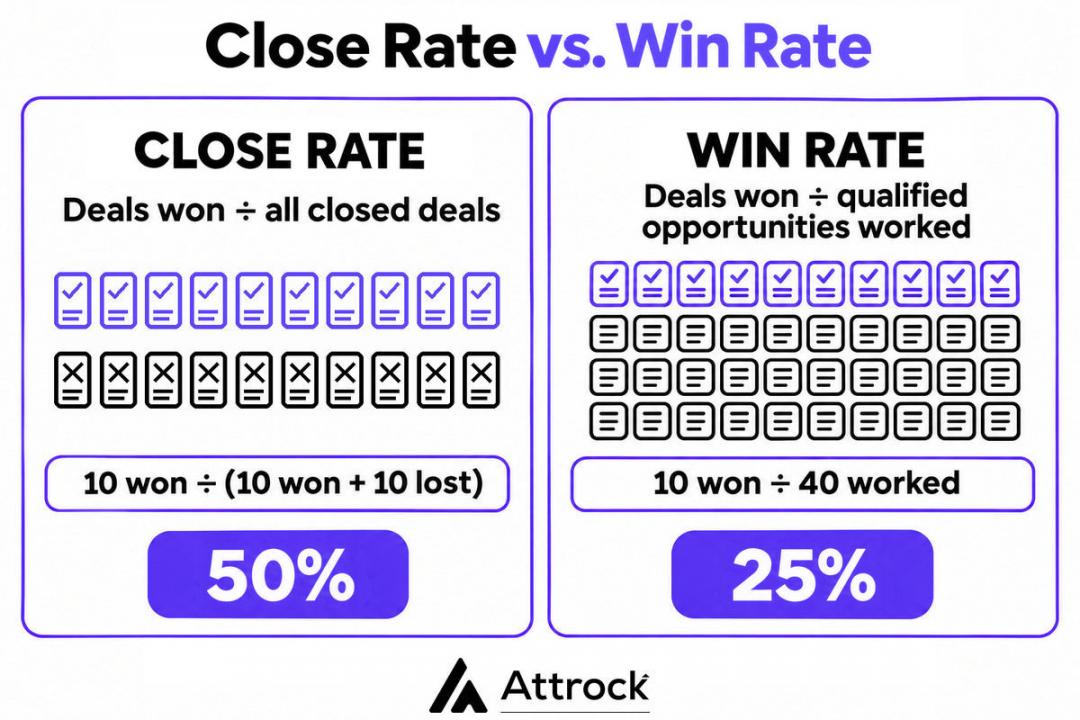
Two numbers get confused here, and definitions vary by source.
We use close rate for deals won, divided by all closed deals, both won and lost. Win rate means deals won divided by all qualified opportunities worked. Check which one your CRM uses before you compare yourself to anyone.
Timing matters more than many sellers expect. 6sense's 2026 B2B Buyer Experience Report puts vendor contact at 59.2% of the way through a 10.3-month buying cycle.
By then, buyers have often made much of their decision. The final conversation confirms their choice or reveals what still holds them back.
How to Close a Deal: The 6-Step Closing Process
To close a deal, confirm the buyer is ready, identify everyone who must agree, and recap the value. Then show the cost of waiting, agree on a close plan, and ask directly for commitment. These six steps turn a promising conversation into a signature.
Qualification carries the most weight. Ebsta's 2025 qualification benchmarks report, built with Fullcast across 440,000 opportunities, found well-qualified deals win 6.3 times more often than poorly qualified ones. Win rates ranged from 8% to 50%, and only 36% leave discovery with qualification written down.
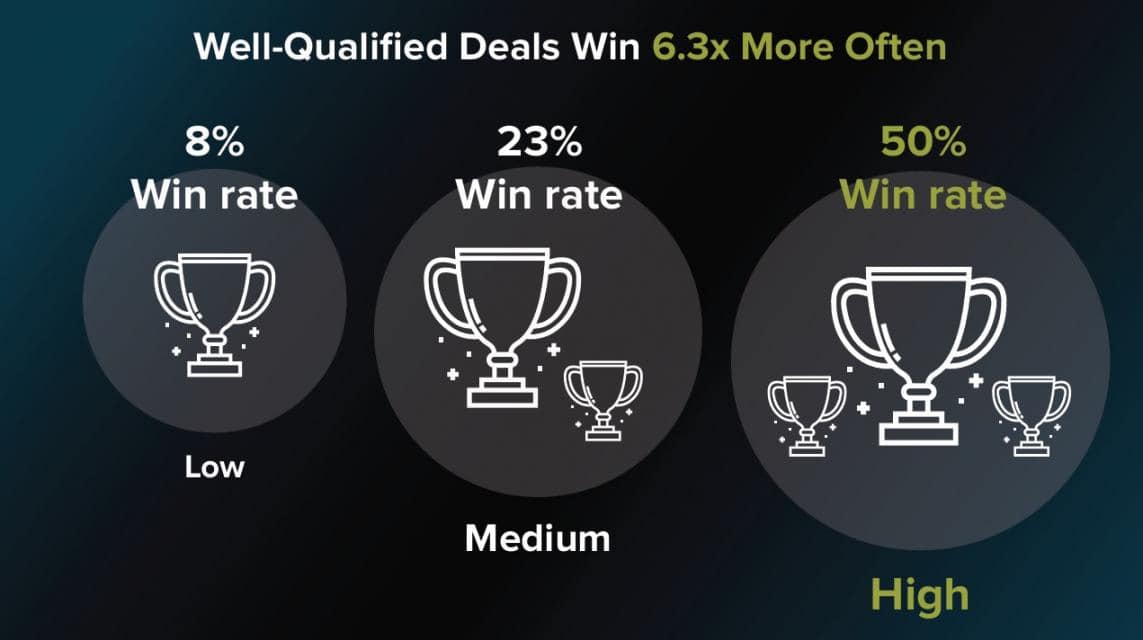
Image via Fullcast
- Confirm the deal is closeable. Check budget, authority, need, and a reason to act now. If one is missing, park it. That's a disqualification, not a failure. It beats three more calls about a lead your B2B SaaS lead generation efforts won't convert.
- Map everyone who has to say yes. List names, roles, and what each one needs to hear before agreeing.
- Recap the value in your buyer's words. Use their words for the problem, not your product's feature names.
- Name the alternative to buying. In most B2B deals, the real competitor is doing nothing. Show what waiting will cost them, and when that cost will hit.
- Agree on a mutual close plan. Set dates, owners, and actions in writing. This turns goodwill into a schedule you can both track.
- Ask directly, then stop talking. Make one clear request for commitment, then let your buyer respond.
Ask ten reps how to close a deal successfully, and most will describe clever phrasing. The real answer is process discipline.
Next Step: Review your three largest open deals and check step one honestly.
Start by confirming the deal is closeable, map everyone who must agree, and recap the value. Show the cost of waiting, agree on a dated close plan, and ask directly for commitment.
What Are the 7 Closing Techniques That Work, and When Do You Use Each?
There are seven ways to close a deal: the assumptive, summary, option, question, puppy dog, urgency, and takeaway closes. Each suits a different buying situation. The trick is to match your approach to what your buyer needs so they can commit.
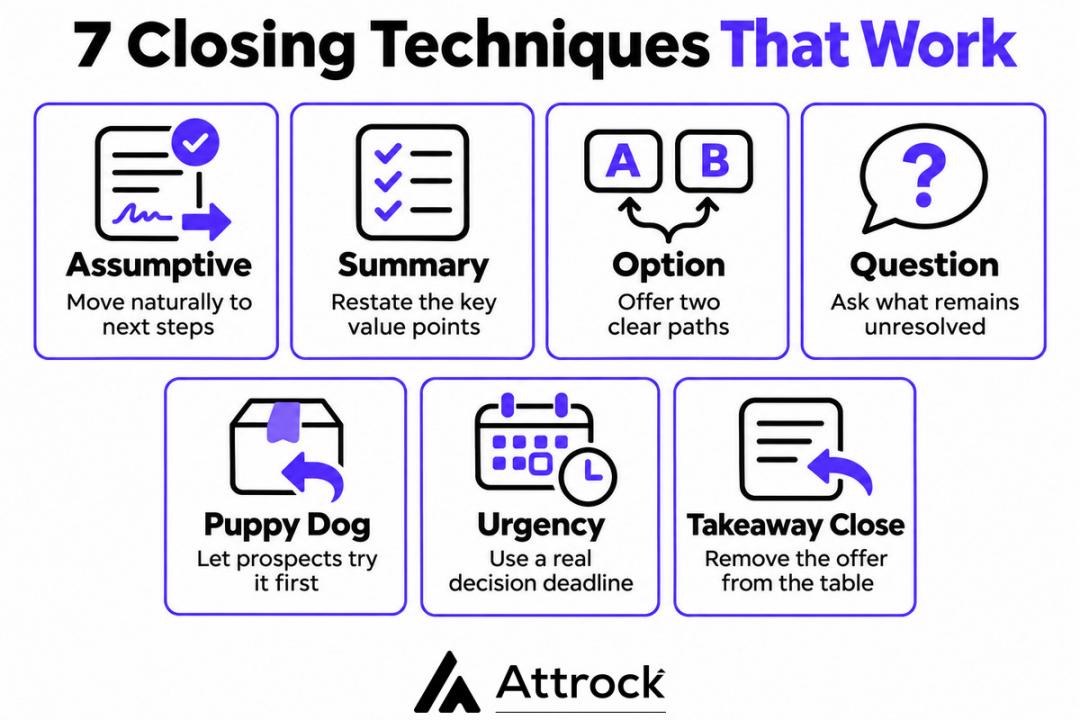
| Technique | Use It When | What To Say | Risk If Misused |
|---|---|---|---|
| Assumptive | Buying signals are strong, and objections are resolved | Move to logistics and dates | Reads as presumptuous, and your buyer digs in |
| Summary | The deal is complex, and the buyer agrees with several benefits | Recap their words, then ask | Sounds like a pitch replay if value was never agreed |
| Option | Your buyer is ready but stuck on a detail | Offer two acceptable start dates | Feels like a trap when a real objection is unspoken |
| Question | You suspect an unspoken objection | Ask what would move them closer to yes | Invites a list of problems you can't solve |
| Puppy Dog | Your buyer needs to test the product first | Offer a limited trial | Gives away revenue unnecessarily |
| Urgency | A real deadline already exists | State the actual deadline | Damages trust if the deadline is false |
| Takeaway | Your buyer hesitates over something they want | Offer to remove that part | Can end the deal if budget is the issue |
1. The Assumptive Close
The assumptive close treats the sale as decided and moves the conversation straight to logistics. These can include start dates, customer onboarding, and access. It works because a ready buyer is often waiting for permission to stop deliberating. Use it only once objections are resolved.
Say: “I'll get the paperwork over so your team can start Monday.”
Without clear buying signals, this approach sounds pushy and makes hesitant buyers defensive.
2. The Summary Close
The summary close brings together the problems your buyer shared and the benefits they've agreed on. It works well in complex deals where several points need to come together before the final decision.
Say: “So that's the reporting gap, the handoffs, and the Monday admin. Shall I send the agreement through?”
Use your buyer's words. Otherwise, the summary sounds like another sales pitch.
3. The Option Close
The option close replaces a yes-or-no question with two acceptable choices. It works when your buyer is ready to commit, but needs help deciding on a detail.
Say: “Would you rather start on the 1st or wait for the 15th?”
Both options must work for you. If the real objection is price, offering dates won't solve it.
4. The Question Close
The question close helps uncover objections your buyer hasn't raised. One useful approach is the scaling question. Ask where they stand on a scale of one to ten, then find out what would move them closer to ten.
Say: “What would need to be true for this to be a ten?”
This helps you address the real concern instead of guessing.
5. The Puppy Dog Close
The puppy dog close lets your buyer try the product before committing. It's useful when they need to see how it works before deciding to buy. Keep the trial limited to one team or use case, with a fixed end date.
Say: “Run it with your inside team for 30 days, then decide.”
Don't offer a trial to someone who is already sold.
6. The Urgency Close
The urgency close gives buyers a reason to act before a real deadline. This could be a price change, renewal date, or closing implementation window.
Say: “Current pricing holds until the 1st, so signing this week locks it in.”
Never invent a deadline to rush a buyer. False urgency damages customer trust.
7. The Takeaway Close
The takeaway close removes part of an offer to help your buyer reconsider what they want. You could take away a feature or tier. Use it when they're hesitating over something they clearly value.
Say: “Let's drop the premium tier for now and keep this simple.”
Only remove something you're genuinely willing to take away. If budget is the real issue, this approach may end the deal.
Match your closing technique to the buyer's needs. Use the:
- Assumptive close when they're ready
- Summary to recap agreed value
- Option when they're choosing between details
- Question to uncover objections
- Puppy dog to reduce risk
- Urgency close for real deadlines
- Takeaway when buyers hesitate over something they want
Who Needs to Say Yes Before a Deal Closes?
In most B2B sales, five groups, including the champion, economic buyer, users, procurement, and legal or security, typically need to sign off. Knowing how to close a deal with a client means understanding who these people are and what they need.
A close is a consensus, not a signature. And the group can be bigger than it looks. The previously cited 6sense 2026 report puts the average buying group at 10.2 members. Here's what each role needs:
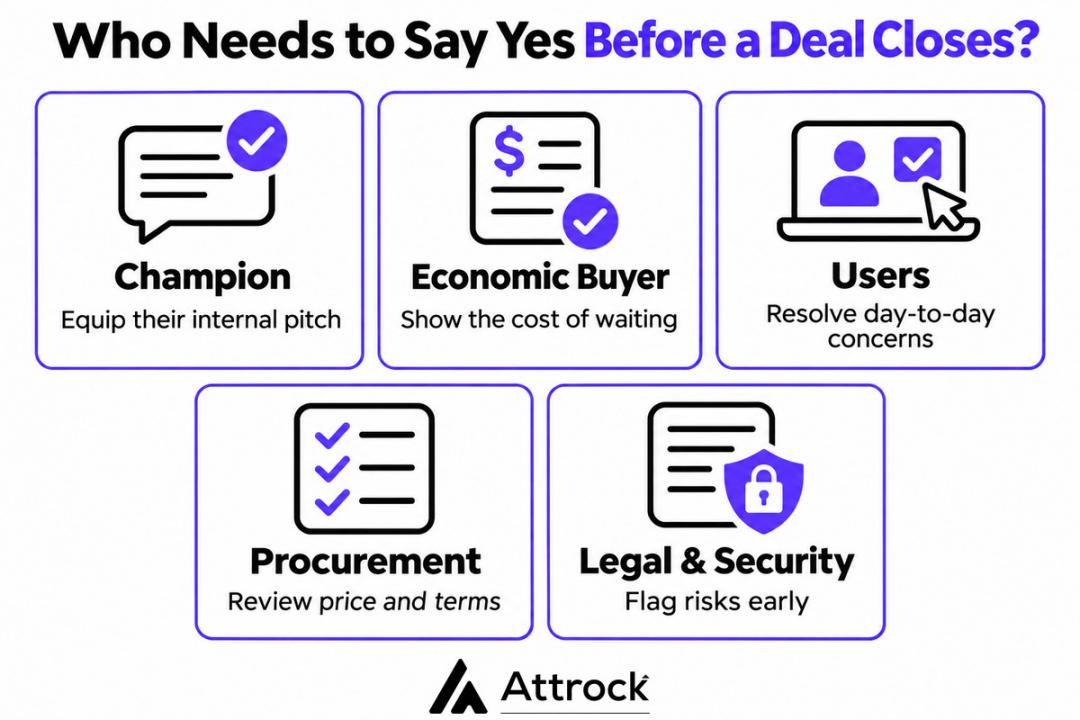
- The champion wants the solution and sells it internally. Give them the arguments they need to win support, not just your brochure.
- The economic buyer controls the budget and signs the deal. Show them the cost of doing nothing, not just the features.
- The users will work with the solution. Address their concerns early, before their objections kill your deal.
- Procurement reviews pricing and contract terms. Understand their requirements before the final negotiation.
- Legal and security review contracts and potential risks. Involve them early to avoid delays.
A verbal yes doesn't mean the deal is closed. Redlines, security questionnaires, and purchase orders can still stand between approval and a countersignature. That's why you need to map the people and steps between a verbal yes and a signed contract.
Usually five roles: a champion, an economic buyer, the users, procurement, and legal or security. A verbal yes isn’t a close. The signature needs all of them, so plan for procurement and start legal early.
How Do You Handle the Last Objection Before You Ask?
Repeat the objection back, separate price from value, trade rather than discount, and put the answer in writing the same day. A late objection isn't always a rejection. It often reveals something your buyer still needs to resolve. Address raised concerns before asking for commitment.
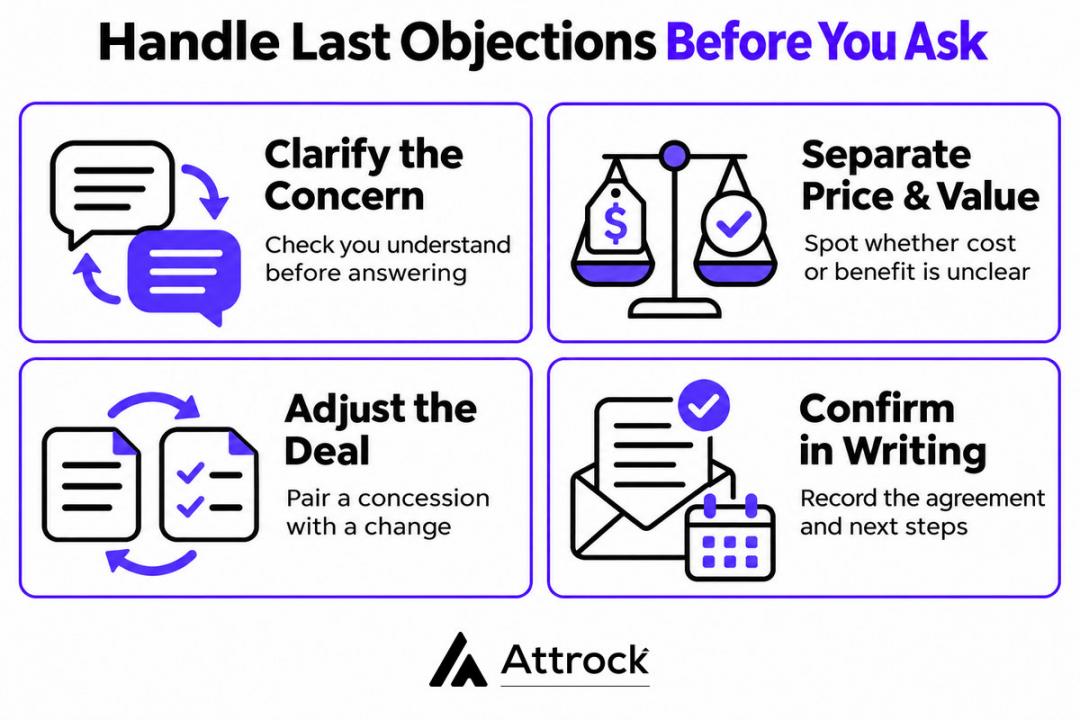
- Repeat the objection back. Say, “So the concern is the migration, not the price.” Let your buyer correct you before responding, and talk less than instinct suggests. Gong's 2025 analysis of 326,000 sales calls found winners talk 57% of the time, compared with 62% on lost deals.
- Separate price from value. A price objection means the cost is too high. A value objection means the buyer doesn't see enough benefit. Each needs a different response.
- Trade, don't discount alone. If you lower the price, adjust something else. That could be the contract term, scope, or start date.
- Confirm everything in writing. Send a recap email with the agreed solution, next steps, and dates.
These steps apply whether you're learning how to close a deal over the phone, on video, or in person.
Next Step: For your three largest open deals, list everyone who must approve and the objections each person may still have. Confirm which concerns are real before making your next ask.
Repeat it back and talk less than you want to. Separate a price objection from a value objection, then trade rather than discount. Confirm the solution and next steps in writing, with clear dates.
How Can You Close Deals Faster in Your CRM?
You can close deals faster in your CRM by setting clear pipeline stages and tracking close plans. Also, automate routine tasks and use AI to prepare for calls. These changes reduce admin and give salespeople more time to work with buyers.
HubSpot's own 2026 Sales Trends Report says 65% of salespeople lose at least one business day a month reconciling data. This highlights the cost of manual work. Use the four changes to get the most from your CRM:
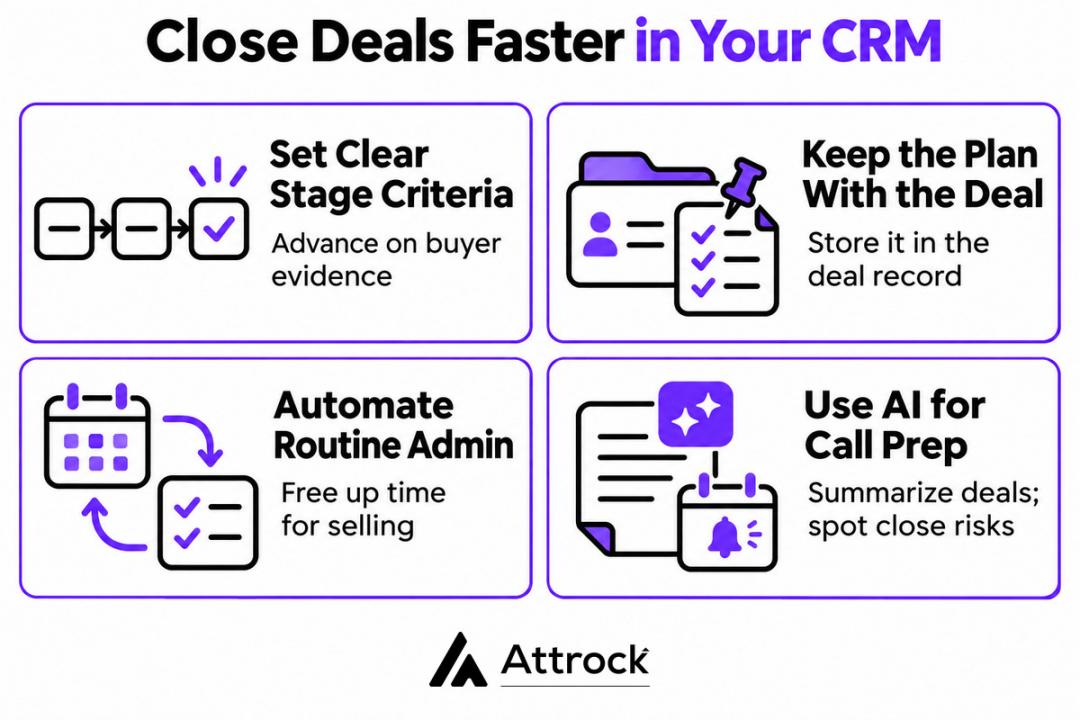
- Make deal stages exit criteria rather than activities. An exit criterion states what must be true before a deal moves forward. For example, the buyer has named the problem and agreed on the next step.
- Keep the close plan with the deal. A plan buried in someone's inbox isn't useful to the whole team. Attach it to the deal record, just like any sales enablement strategy asset.
- Automate routine admin. Use sequences, meeting links, and stage-based tasks to reduce manual work and free up selling time.
- Use AI to prepare for calls. Built-in assistants like Breeze Assistant summarize deal records and flag opportunities nearing close dates.
HubSpot Sales Hub supports deal tracking, meeting scheduling, AI-assisted preparation, and sales automation. Its free CRM supports up to two users and 1,000 contacts, while advanced features such as sequences and workflow automation require eligible paid plans.
Next Step: Write one clear exit criterion for your slowest sales pipeline stage.
Set exit criteria for every pipeline stage and attach the close plan to the deal record. Automate routine admin and follow-ups, and let AI brief you before calls. A CRM won’t close the deal, but it gives you back selling time.
Which Sales Metrics Show Where Deals Are Stalling?
Track close rate, win rate, stage conversion, sales cycle length, slippage rate, and average deal size. These metrics show where opportunities drop off, how long deals take, and whether your closing process needs attention. You can’t improve a close you don’t measure.
Learning how to close a deal often starts with spotting which of the six metrics is off. Quota attainment is drifting down. The Bridge Group’s 2026 study of 158 B2B companies puts 48% of account executives at quota, down from 51% in 2024.
Deal slippage is another signal worth watching. A deal slips when it misses its forecast close date. Ebsta's 2025 GTM benchmarks digest found that deals slipping by one week had an 18% win rate. That fell to 13% after a month, 8% after three months, and 3% beyond six months.
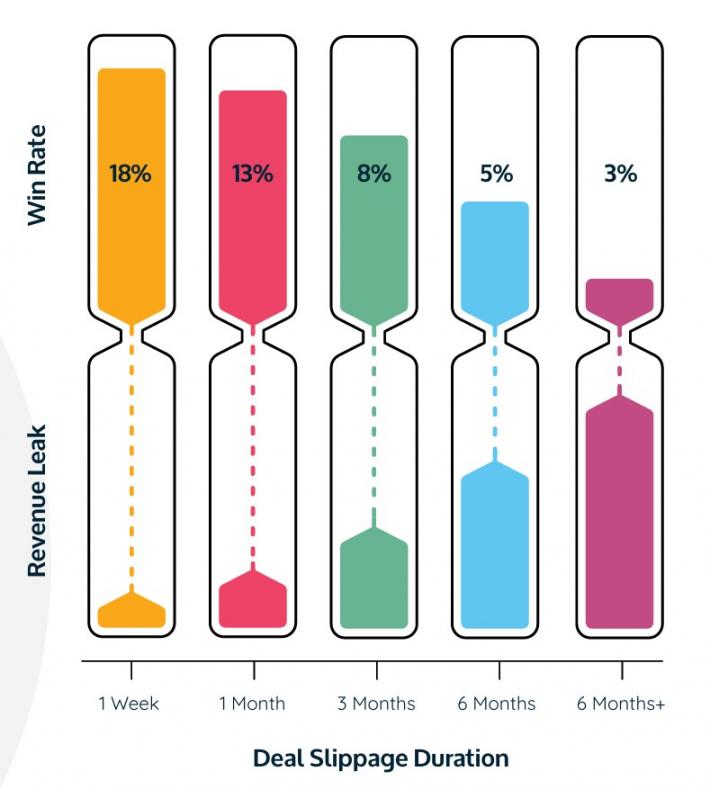
Image via Ebsta
Use these four steps to turn your sales data into action:
- Calculate close rate and win rate separately. One measures finished deals. The other covers all qualified opportunities worked.
- Find the stage that leaks. Measure stage-to-stage conversion to see where opportunities drop off. Focus on the weakest stage first.
- Track slippage alongside wins. Watch how often deals miss their forecast close dates. Repeated delays can signal weak qualification or unresolved objections.
- Test one change at a time. Change one part of your closing process, then compare the results. This helps you see what actually improves performance and how to close a deal more consistently.
| Metric | What It Tells You | How To Compute It | What To Watch |
|---|---|---|---|
| Close Rate | Your hit rate on finished deals | Deals won ÷ deals closed won and lost | A rising rate with falling volume can indicate selective qualification |
| Win Rate | Your hit rate on all qualified opportunities | Deals won ÷ all qualified opportunities | A dropping rate means you're losing more deals |
| Stage Conversion | Where deals stop moving | Deals advancing to the next stage ÷ deals that entered the current stage during a defined cohort or reporting period. | A weak stage points to an area that needs attention |
| Sales Cycle Length | How long a deal takes to close | Median days from qualified to closed won | Longer cycles may signal weak qualification |
| Slippage Rate | How often deals miss their forecast close date | Deals pushed ÷ deals forecast to close | A rising rate makes forecasts less reliable |
| Average Deal Size | Whether deal values are changing | Total won revenue ÷ deals won | Falling values with a flat win rate may signal more discounting |
Next Step: Pull last quarter's stage conversion figures and identify the weakest stage.
Track close rate, win rate, stage conversion, sales cycle length, slippage, and average deal size. Use these calculations to find weak stages, spot delays, and identify changes that could improve your closing results.
FAQ
Q1. What Do You Say When You're Closing a Deal?
A. Make one clear request, then stop. For example: “Unless anything else is open, shall I send the agreement over?” Avoid adding questions or offering a discount the buyer hasn't asked for. Give them time to answer without filling the silence.
Q2. What Are the Top Closing Techniques in Sales?
A. The seven common techniques are the assumptive, summary, option, question, puppy dog, urgency, and takeaway closes. Each suits a different buying situation. Choose the one that fits your buyer's needs and readiness to commit.
Q3. How Do You Effectively Close a Sales Deal?
A. Closing a sales deal starts before the final ask. Confirm the buyer is qualified, identify everyone who must approve, and recap the value. Agree on a dated close plan, address any remaining concerns, and ask directly for commitment.
Q4. How Do You Close a Deal With Existing Customers?
A. Start by confirming the customer's needs and readiness to buy. Address any concerns, explain what has changed or improved, and agree on a clear next step. When learning how to close a deal, clarity usually matters more than persuasion.
Q5. Are Closing Techniques Manipulative?
A. Not when they're honest and help buyers make informed decisions. A real deadline gives useful information. A fake one creates pressure and damages trust. Use closing techniques to clarify the decision, not to push someone into buying.
Q6. How Do You Close a Deal on the Phone?
A. How to close a deal on the phone often comes down to clear communication. Ask questions, listen for hesitation, and give the buyer time to respond. Since you can't read body language, make sure you understand their concerns. Then send a written recap and agree on the next step.
Q7. How Long Should a B2B Deal Take to Close?
A. It depends on the deal's size, complexity, and number of approvers. Use your team's median sales cycle as a benchmark, then compare it with similar deals. A published average can offer context, but it may not reflect your market or sales process.
Q8. What Should You Do When a Deal Stalls Instead of Closing?
A. Ask what's changed, whether anyone else is involved, and if the buyer still sees a reason to act. Agree on a clear next step if the deal is active. If there's no longer a fit or need, close it out in your CRM instead of leaving it in the forecast.
Ready to Close More of the Deals You Already Have?
Closing a deal takes more than a strong final pitch. You need qualified buyers, stakeholder alignment, and a clear path to commitment. That's what learning how to close a deal really involves.
Review one open opportunity this week and identify what's slowing progress. If you need more qualified prospects entering your pipeline, explore Attrock's lead generation services.
Once opportunities are in motion, consistent follow-through matters just as much. Use HubSpot Sales Hub to manage your pipeline, track deals, and keep your next steps visible.
Disclaimer: This content contains some affiliate links for which we will earn a commission (at no additional cost to you). This helps us keep creating free content for you.