- HubSpot and Apollo solve different problems. One manages customer data, while the other helps you find them.
- Apollo stands out for prospecting and outreach. HubSpot stands out for CRM, sales management, and reporting.
- Don't compare plans on price alone. Credit limits can change what you actually spend.
- Keep one source of truth for customer data. In most cases, that should be your CRM.
- Running both platforms takes more than connecting an integration. You'll also need to manage your data carefully.
The short answer to HubSpot vs Apollo is simple: they do different jobs. HubSpot is the CRM and system of record. Apollo is the prospecting database and outbound engine that feeds it. That's why many companies pay for both.
So the HubSpot vs Apollo decision is not about picking a winner. It's about deciding if you need both tools and whether the combined cost fits your budget.
In this post, I’ll cover pricing, contact data quality, the native integration, and the combined cost of running the two side by side.
The market context is worth noting before I start, because it frames the whole decision.
Salesforce’s seventh State of Sales 2026 report surveyed 4,050 sales professionals. Among teams without an all-in-one platform, 84% plan to consolidate. Those teams run eight standalone tools on average.
Disclaimer: This content contains some affiliate links for which we will earn a commission (at no additional cost to you). This is to ensure that we can keep creating free content for you.
Table of Contents
HubSpot vs Apollo: How Do They Compare at a Glance?
The HubSpot vs Apollo verdict comes down to what you need most. HubSpot is the better choice if you want one CRM for your entire customer journey. Apollo is stronger if your main goal is finding prospects and running outbound campaigns.
| HubSpot Sales Hub | Apollo | |
|---|---|---|
| Best for | Businesses that want every deal, forecast, and customer record in one platform. | Outbound teams that need prospect data plus email, calling, and LinkedIn sequences in one place. |
| Contact Data | No contact database at any tier. Enrichment of existing records only. | 240 million contacts, searchable across 65+ data points and filters. Winner |
| Sequences and Deliverability | Sequences aren't available on HubSpot's free plan. They start with the Professional tier, where each user can send up to 500 emails a day. | Unlimited sending starts with the Professional plan, which adds five SMTP mailboxes, and Organization adds fifteen. Winner |
| CRM Depth and Reporting | HubSpot has the deeper CRM. Deal pipelines grow from 1 to 2, 15, and 100 as you move up the plans. Forecasting and conversation intelligence start with the Professional plan. Winner | Apollo offers a capable sales CRM with contacts, accounts, deals, multiple pipelines, and built-in scoring. It also includes conversation intelligence. |
| Ease of Use | Guided onboarding is mandatory for Professional and Enterprise plan users, and costs priced at $1,500 and $3,500, respectively. The overall UI is intuitive and very easy to use. Winner | A rep can be prospecting on day one, with no onboarding fee. Ease of use is Apollo’s top G2 tag at 1,587 mentions, though many people also say that it has an initial learning curve. |
| Integrations | 2,286 apps in the marketplace, covering marketing, service, finance, and data tooling. Apollo connects to HubSpot directly. HubSpot’s AI tools even source contacts through it. | Connects to HubSpot and other major CRMs with two-way sync, plus mailbox and dialer integrations. It isn’t a full business-stack marketplace. |
| Pricing | Free Starter: $20/seat/month Professional: $100/seat/month Enterprise: $150/seat/month Winner | Free Basic: $65/seat/month Professional: $99/seat/month Organization: $149/seat/month |
| Free Plan | For up to two users, with one deal pipeline and three email templates. Email open tracking only, and no sequences at this tier | 900 credits per seat annually, which buys nine phone numbers a month. Two sequences per team, one mailbox, and 250 daily sends. |
| Ratings | G2: 4.4 Capterra: 4.5 | G2: 4.7 Capterra: 4.5 |
Note: Pricing is verified from official websites, as of August 2026
Verdict: When comparing HubSpot vs Apollo, HubSpot wins as the system of record for the full customer lifecycle. It also starts lower per seat. Apollo wins for outbound teams that need prospect data and multichannel sequences. HubSpot sells no contact database at any tier. Past a few reps, most teams end up running both.
HubSpot vs Apollo: What Do They Actually Do?
HubSpot and Apollo aren’t competing products in the same category. HubSpot stores and manages customer data across your business. Apollo helps sales teams find prospects and turn them into opportunities.
That distinction settles most of the argument before it starts. Let’s see what each offers.
HubSpot Sales Hub
Think of HubSpot Sales Hub as the sales side of HubSpot's Smart CRM. It handles deals, pipelines, quotes, forecasting, and sequences, with HubSpot’s AI tools supplying the AI layer across all of it. The CRM underneath is the same record marketing and service teams work from.
The real benefit is that everyone works from the same customer record. When a deal closes, marketing and support already have the information they need. Nothing has to be copied into another system.
HubSpot has also grown into one of the largest CRM platforms. Its Q1 2026 results report 299,458 customers, up 16% year on year.
Pricing for HubSpot Sales Hub starts at $20 per seat monthly on the Starter plan, with no seat minimums.
Apollo
Apollo is a go-to-market platform built around a contact database. It holds 240 million contacts, searchable across 65+ data points and filters. On top of that data sit sequences, a dialer, meeting scheduling, and a lightweight CRM.
The database is the product. Everything else exists to help you work it.
Apollo claims 98% email accuracy and under 1% invalid direct phone numbers. Reviewer data complicates that claim, and the contact data section unpacks it properly.
Paid plans start at $65 per seat per month.
Why This Is Not a Like-for-Like Comparison
At first glance, HubSpot vs Apollo looks like a CRM comparison. It isn't. HubSpot is built to manage the full customer lifecycle, while Apollo helps sales teams find prospects and book meetings.
They solve different problems, so many businesses use both instead of choosing one.
HubSpot even lists Apollo as one of its contact data providers. That's a good sign these platforms complement each other rather than compete directly.
That’s why this comparison looks at HubSpot Sales Hub, not Marketing Hub, because that's where the feature overlap exists.
HubSpot focuses on customer management, forecasting, and reporting. Apollo focuses on prospecting, contact data, and outbound sales. Most businesses choose based on which part of the sales process they need help with.
How Did I Compare HubSpot vs Apollo?
I compared HubSpot and Apollo using official product information, live pricing, and customer reviews. I verified prices from their websites, as of August 2026.
Here are the various criteria I used for comparing HubSpot vs Apollo.
| Criterion | Why It Matters | Weight | Where It’s Decided |
|---|---|---|---|
| Contact Data | Every downstream step inherits the quality of the record | High | Database size, filter depth, credit cost per record |
| Sequences and Deliverability | Sets how much a rep can send without burning a domain | High | Send caps, mailbox count, the tier sending starts at |
| CRM Depth and Reporting | Decides whether the system survives headcount growth | High | Objects, pipelines, forecasting, custom reports |
| Ease of Use | Drives ramp time and how much admin the team absorbs | Medium | Setup effort and daily friction for reps |
| Integrations | Determines how much work stays manual | Medium | Marketplace depth and native connectors |
| Pricing | The commitment that’s hardest to undo mid-year | High | List price, onboarding fees, credit rules |
HubSpot vs Apollo: What Are Their Pros and Cons?
Each tool has one weakness that shows up repeatedly in its review profile. For HubSpot, it’s tier gating, and for Apollo, it’s data quality.
HubSpot Sales Hub
Pros
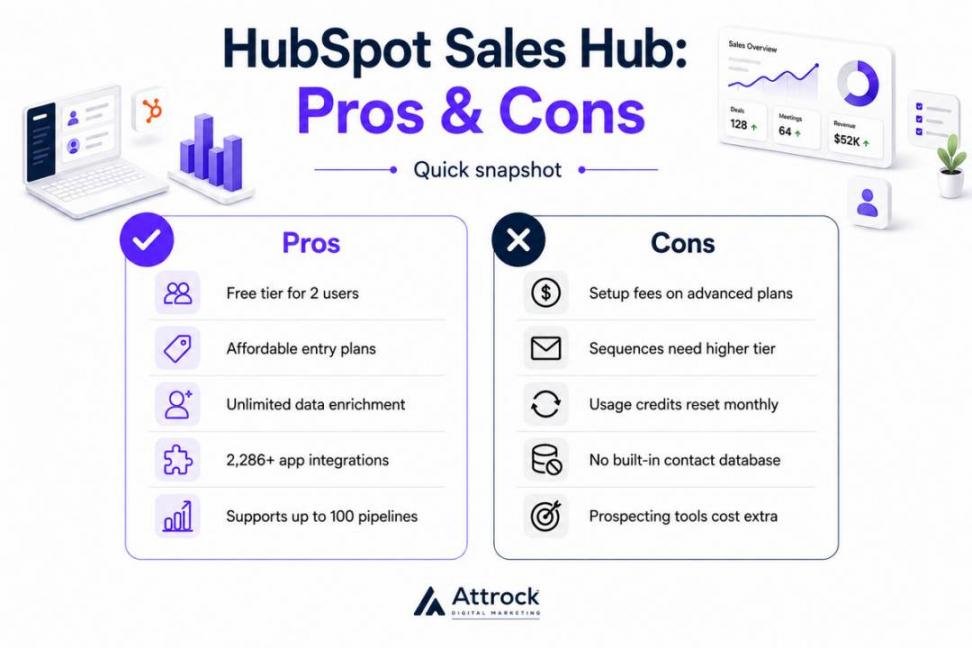
- The free plan gives two users access to one deal pipeline, three email templates, and email open tracking without a monthly fee.
- The Starter plan costs $20 per seat each month and has no minimum seat requirement, making it affordable for small teams.
- Every paid plan includes enrichment with no credit limits. It pulls from 100 million company domains and 380 million email addresses.
- Integrates with 2,286 apps, which keeps the CRM at the center of an existing stack.
- Deal pipelines grow from one to 100 across the plans, so there are plans for different needs.
Cons
- Professional and Enterprise plans come with mandatory onboarding fees.
- You'll need the Professional plan to access sales sequences.
- HubSpot Credits reset every month, with no rollover.
- HubSpot enriches contacts but doesn't include its own contact database.
- Prospect recommendations cost extra.
Apollo
Pros
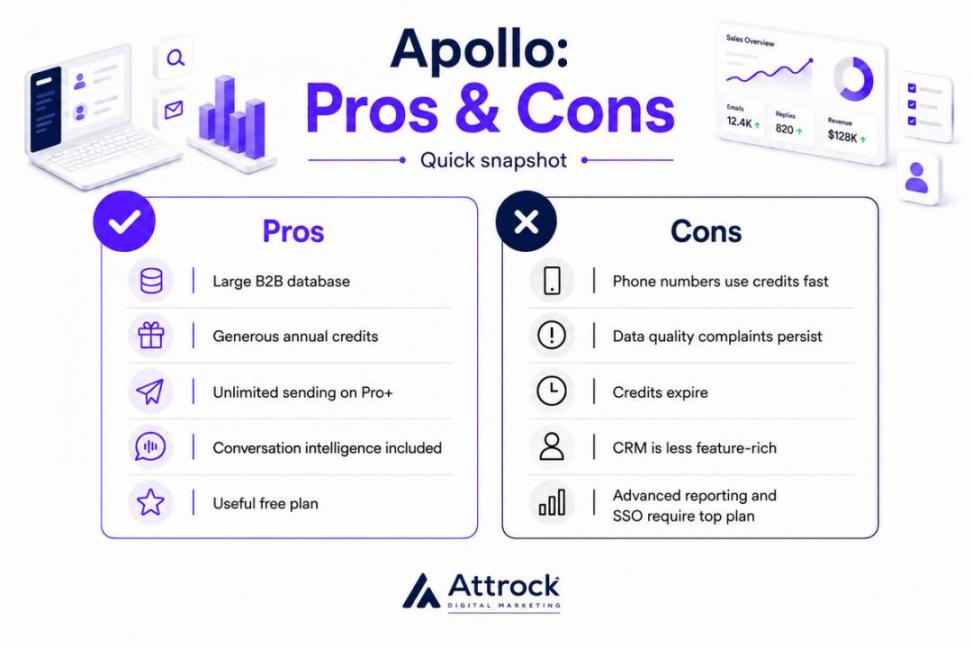
- Large B2B database makes prospecting easier.
- Annual credits go a long way on paid plans.
- Sending is unlimited starting from the Professional plan, with 5 extra SMTP mailboxes.
- Conversation intelligence covers 4,000 minutes on the Professional plan and 8,000 minutes on the Organization plan.
- The free plan includes 900 credits per seat per year, plus two sequences per team.
Cons
- Phone numbers cost 8 credits each, so the free plan’s 900 annual credits buy roughly 9 numbers a month.
- Data quality is still a common complaint among Apollo users, despite 98% accuracy claims.
- Credits expire instead of rolling over to the next term.
- The CRM leaves out several features found in more feature-rich platforms.
- Custom reporting and SSO are available only on the Organization plan.
HubSpot gives you a stronger CRM but reserves several important features for higher tiers. Apollo offers one of the best prospecting databases available, yet data accuracy is still its most common criticism.
HubSpot vs Apollo: Which One Wins on Contact Data and Prospecting?
Apollo wins this criterion decisively, because Apollo is a prospecting database and HubSpot is not one. That single distinction explains almost every difference below.
The stakes are concrete. Validity’s 2025 CRM data study surveyed 602 CRM users and administrators. Among them, 76% said less than half their CRM data is accurate and complete. Another 37% said they lose revenue as a direct result of data quality.
How HubSpot Handles Contact Data
HubSpot has no native prospecting database at any tier. What it offers instead is enrichment, which fills in records you already hold. It draws on 100 million company domains and 380 million email addresses.
Enrichment is included in paid plans and consumes no HubSpot credits. That’s a genuine cost advantage on records already in your system.
For net-new sourcing, HubSpot points you toward the Prospecting Agent in Agent Hub. It costs $1.00 per recommended lead.
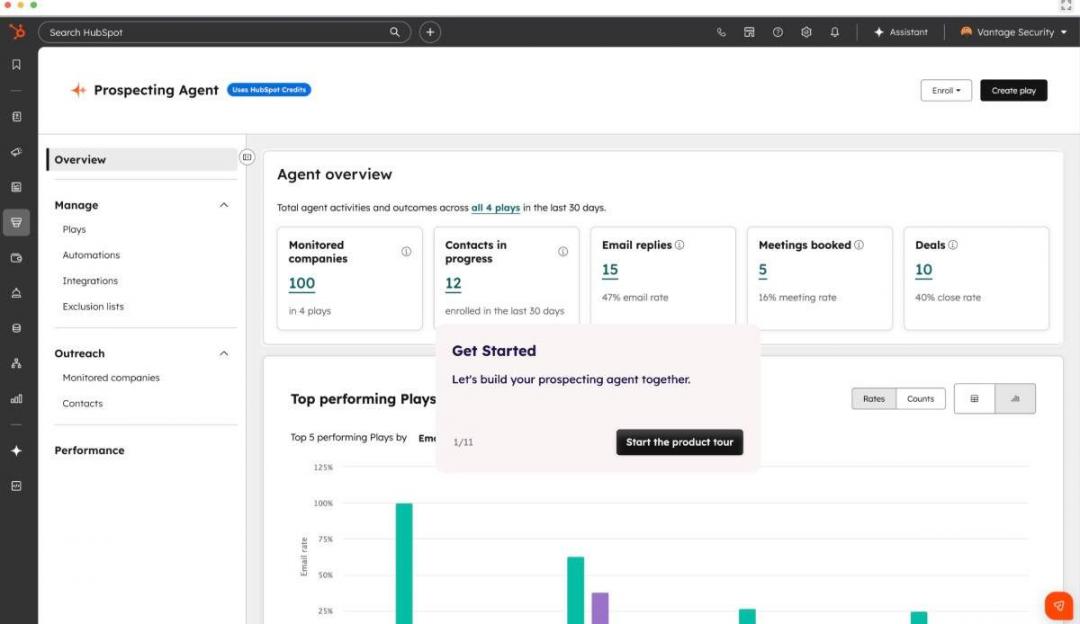
Image via HubSpot
That agent sources from connected providers like ZoomInfo, Apollo, and Surfe. So HubSpot’s own outbound path runs through the vendors it gets compared against.
If you’re already weighing ZoomInfo alternatives, that dependency is worth understanding before you buy.
How Apollo Handles Contact Data
Apollo treats contact data as its core product. Everything else is built around helping sales teams find and reach the right prospects.
Its database includes 240 million contacts and more than 65 search filters. That makes it easy to narrow your list by buying intent, company technology, funding, hiring, and other signals.
Here’s what a contact record looks like.
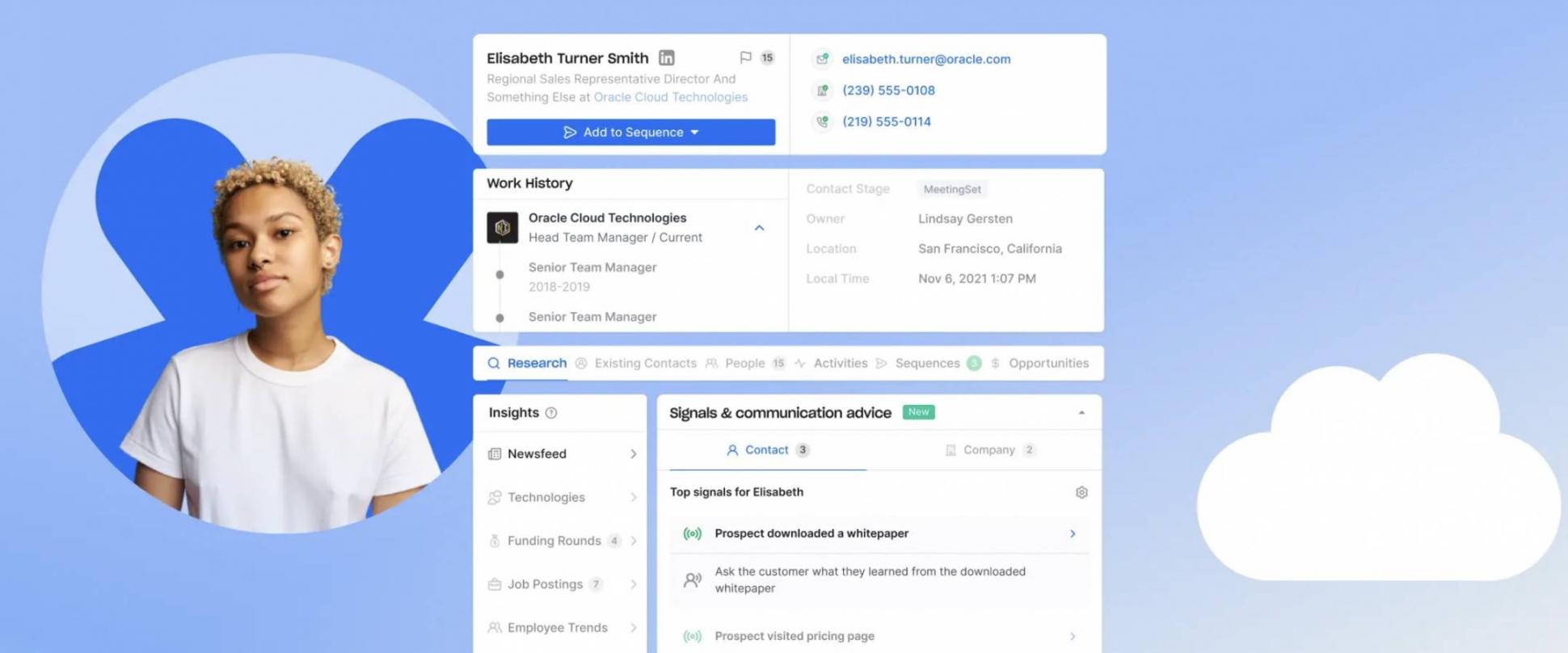
Image via Apollo
Most teams use Apollo to:
- Build new prospect lists
- Find buyers already showing interest
- Spot companies with fresh buying signals
- Enrich incomplete CRM records
Apollo also shares its own accuracy figures, but it's worth comparing those claims with customer reviews before making a decision.
Apollo is the clear winner because prospecting is its core strength. HubSpot manages customer data well, but you'll need connected providers to find new leads.
HubSpot vs Apollo: Which One Wins on Sequences and Deliverability?
Apollo wins this round of HubSpot vs Apollo because it's built for outbound sales. HubSpot includes sequences, but they're mainly designed to follow up with leads already in your CRM. Apollo gives outbound teams more flexibility to prospect at scale.
How HubSpot Handles Outreach
HubSpot includes sales sequences on the Professional plan and above. They aren't available on the Starter or free plans.
Sending limits increase with each plan. Professional supports 500 emails per user each day, while Enterprise supports 1,000.
Here’s what the dashboard looks like.
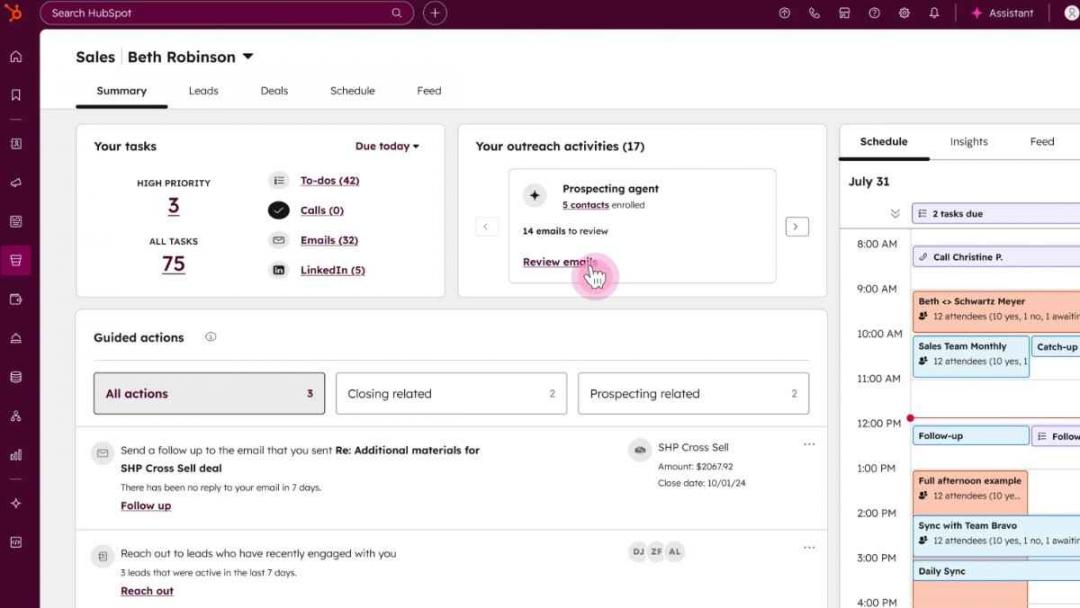
Image via HubSpot
LinkedIn actions require Sales Navigator Advanced Plus, which comes as a separate subscription. Teams building LinkedIn lead generation motions should budget for it upfront.
The biggest benefit is context. Sales, marketing, and customer service teams all see the same emails, tasks, and customer history.
How Apollo Handles Outreach
Apollo is built for outbound sales, so it gives you much more room to scale email campaigns than HubSpot. The Professional plan removes daily sending limits, and higher plans let you connect more SMTP mailboxes.
The free and Basic plans only support Gmail and Microsoft mailboxes, while the free plan also limits you to 250 emails a day.
You can use it to set up calls and book meetings with prospects.
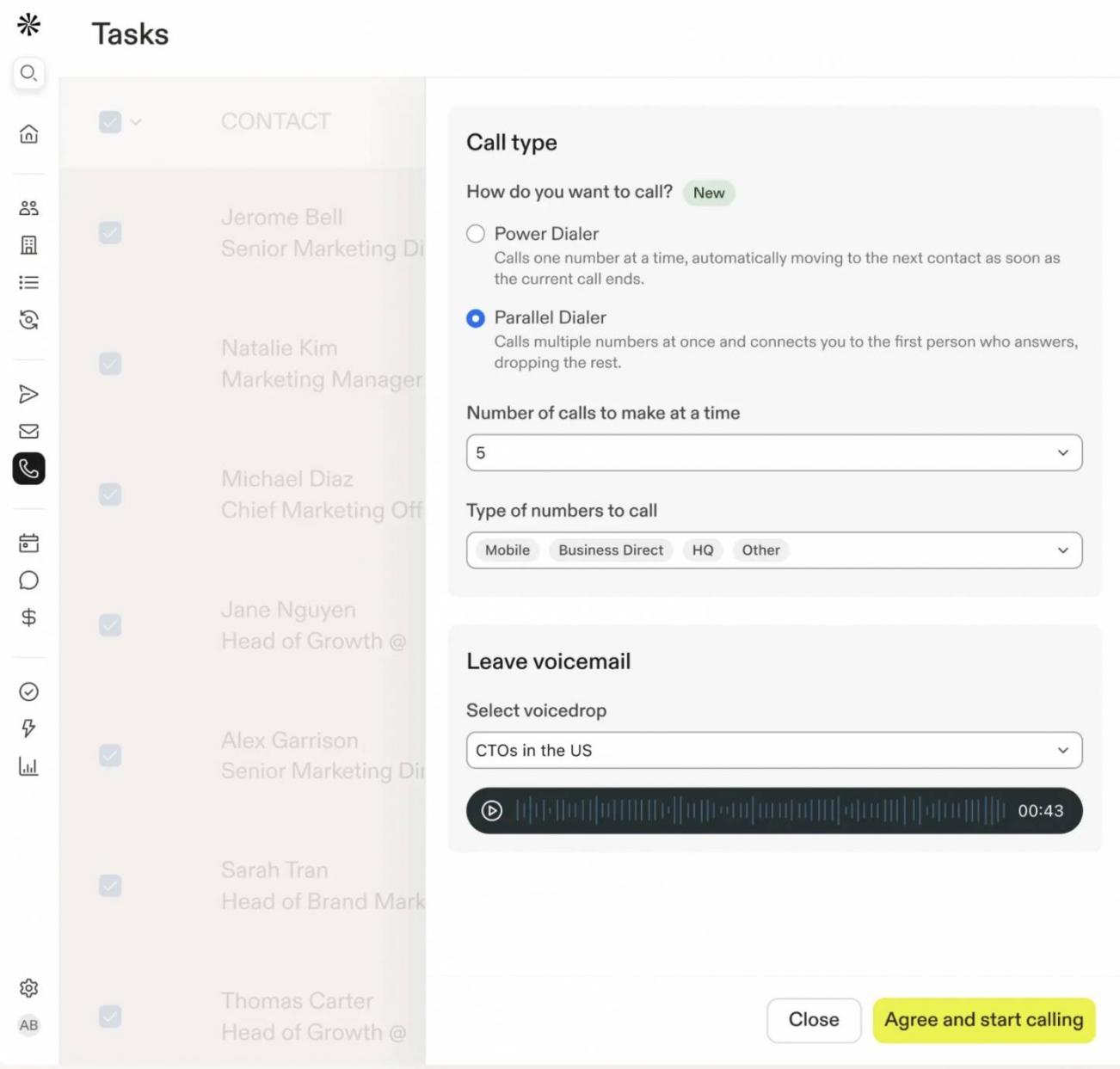
Image via Apollo
Apollo also combines email, LinkedIn tasks, and phone calls into the same sequence. That’s why it’s one of the best sales engagement solutions.
If your team relies on multichannel outreach, you can manage every touchpoint from one place. This is great for reps who use LinkedIn for B2B sales.
Apollo is the winner because outbound sales is what it does best. HubSpot includes sequences, but they're built more for nurturing existing leads than finding new ones.
HubSpot vs Apollo: Which One Offers Better CRM Depth and Reporting?
HubSpot is the clear winner in HubSpot vs Apollo for CRM and reporting. Apollo does a good job supporting outbound sales, but HubSpot offers the stronger CRM. It helps in managing deals, forecasting, reporting, and customer relationships.
HubSpot’s CRM Depth
HubSpot gives you much more room to grow than Apollo. That's one reason it ranks among the best CRM for growing SaaS companies.
You can add more pipelines, forecast revenue, use conversation intelligence, and create custom objects as your business becomes more complex.
Most of those features start with the Professional plan, while Enterprise increases usage limits.
Every customer record is shared across sales, marketing, and customer service teams. So, reporting stays accurate as customers move through the business.
Teams can see the entire history of each customer, as it acts as a single source of truth for all teams.
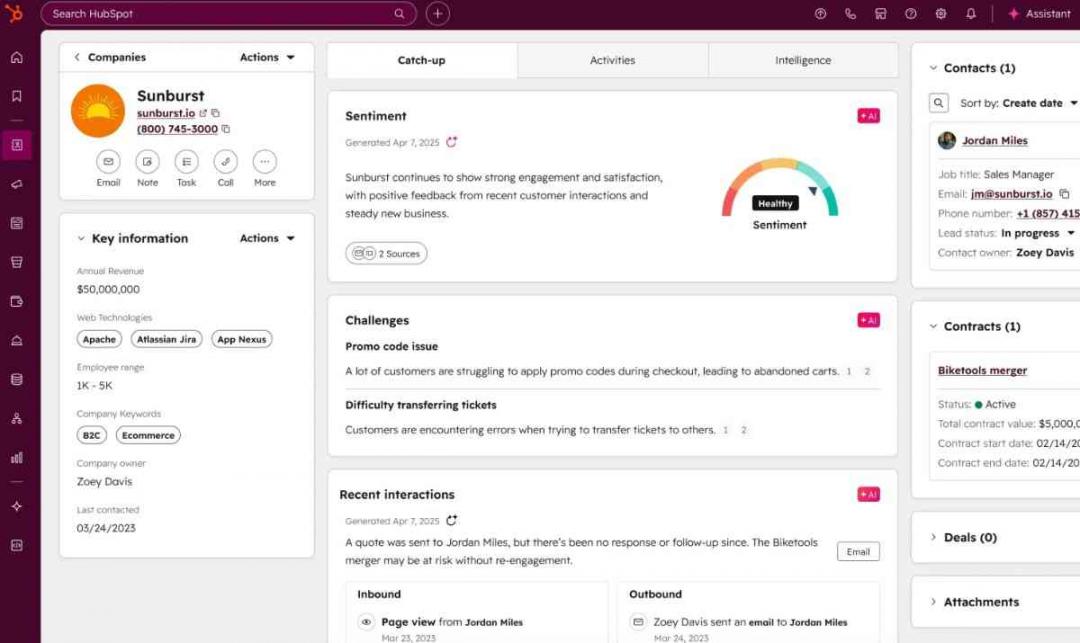
Image via HubSpot
If you're comparing CRM options, see HubSpot vs Salesforce.
Apollo’s CRM Capabilities
The HubSpot vs Apollo comparison shows a clear gap once you compare CRM depth. Apollo handles day-to-day sales work well, but it leaves out many features growing businesses need.
Conversation intelligence is available on the Professional plan and above, while custom reporting and SSO require the Organization plan.
Apollo also leaves out custom objects, marketing automation, customer service, and ticketing. Those gaps become more noticeable as your business grows.
If you're comparing lower-cost CRMs, also see HubSpot CRM vs Insightly.
HubSpot wins because it gives sales teams a complete CRM with deeper reporting and forecasting. Apollo helps teams manage prospects and deals, but it isn't built for the full customer lifecycle.
HubSpot vs Apollo: Which is Easier to Use?
In the HubSpot vs Apollo comparison, the better choice depends on what you mean by “easy.” Apollo is easier to start with, while HubSpot is easier to use once your team is fully set up.
HubSpot Sales Hub Setup
The HubSpot Sales Hub asks for more work upfront. The Professional and Enterprise plans require paid onboarding, while the Starter plan doesn't.
The benefit comes later. Most teams find the platform easy to use once everything is in place, which matches its strong G2 ratings.
HubSpot also offers plenty of training resources. Between HubSpot Academy, help articles, and in-app guidance, new users have several ways to learn the platform at their own pace.
See the various training courses you can get via the HubSpot Academy.

Image via HubSpot
Apollo Setup
Apollo makes it easy to start prospecting right away. The setup is easy. Most teams can connect their email, build prospect lists, and start outreach within their first session.
At the same time, many reviewers say it takes time to learn. Trustpilot ratings also show a much wider range of experiences than HubSpot.
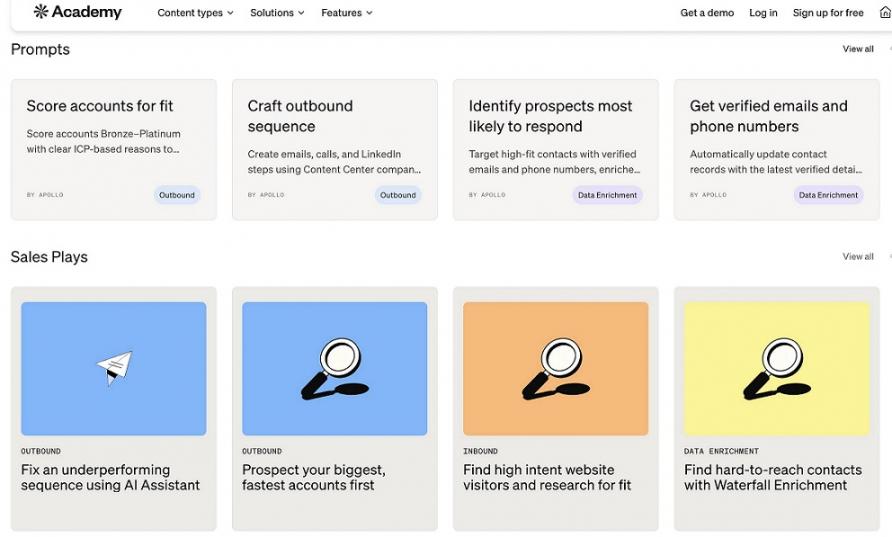
Image via Apollo
Apollo makes it easier to connect your tools and begin prospecting right away. HubSpot takes longer to set up, but many teams find it easier to use once everything is in place. So, HubSpot wins by a slight margin.
HubSpot vs Apollo: Which Offers Deeper Integrations?
In this HubSpot vs Apollo comparison, HubSpot is the stronger choice for integrations. Apollo covers the tools most sales teams need to prospect and close deals. HubSpot supports those tools too, while also connecting with software used across the rest of the business.
That difference becomes more important as your company grows. HubSpot's marketplace includes 2,286 apps, giving businesses far more flexibility when building their tech stack. Apollo's integrations are much more focused on outbound sales.
HubSpot's Ecosystem
The HubSpot vs Apollo comparison becomes much clearer once you look beyond sales integrations. HubSpot's marketplace includes apps that support almost every business function.
It offers two-way data sync between key apps.
Image via HubSpot
That gives growing businesses much more flexibility over time. Different teams can connect the software they already use while keeping customer information in one shared system.
If you're also considering smaller CRM platforms, I've compared those in detail. Check out HubSpot vs monday CRM and HubSpot CRM vs Insightly for a closer look.
Apollo’s Ecosystem
The HubSpot vs Apollo comparison shows that Apollo keeps its integration strategy focused on sales. Instead of supporting thousands of business tools, it prioritizes the apps outbound teams use most.
CRM integrations start with the Basic plan. Apollo also supports only one connected CRM, making temporary dual-CRM setups harder to manage.
Free users can connect one mailbox, and it must be Gmail or Microsoft.
HubSpot wins because it supports a much wider range of integrations across different business functions. Apollo does a good job serving outbound sales teams, but it isn't designed to power your entire tech stack.
HubSpot vs Apollo Pricing: Which Offers More Value for Money?
When comparing HubSpot vs Apollo pricing, the cheapest plan isn't always the best value. HubSpot costs less to get started, while Apollo includes more prospecting features on its lower plans. Which one costs less depends on how your team sells.
HubSpot keeps its lower tiers simple, then unlocks more CRM features as you move up the plans. Apollo gives sales teams more prospecting power earlier, but the value of each plan depends on how quickly your team uses its credits.
The comparison table below breaks down each plan, its monthly price, and the biggest feature differences.
| Tier | HubSpot Sales Hub | Apollo | What’s Gated? |
|---|---|---|---|
| Free | $0 (up to 2 users) | $0 | HubSpot: 1 deal pipeline, 3 email templates, email open tracking only, no sequences. Apollo: 900 credits per seat per year, 2 team sequences, 1 Gmail or Microsoft mailbox, 250 daily email sends. |
| Entry | Starter – $20/seat/month | Basic – $65/seat/month | HubSpot: Sales sequences remain unavailable. Apollo: CRM integrations start here, plus 30,000 credits per seat per year. |
| Mid | Professional – $100/seat/month + $1,500 one-time onboarding | Professional – $99/seat/month | HubSpot: Adds sales sequences, forecasting, and conversation intelligence. Apollo: Adds unlimited sending, 48,000 credits per seat per year, and 5 SMTP mailboxes. |
| Top | Enterprise – $150/seat/month + $3,500 one-time onboarding | Organization – $149/seat/month (3-seat minimum) | HubSpot: Up to 100 deal pipelines and higher conversation intelligence limits. Apollo: Adds custom reporting, SSO, 72,000 credits per seat per year, and 15 SMTP mailboxes. |
Verdict: HubSpot offers stronger value if your CRM is the center of your sales process. Apollo is the better buy for outbound teams that depend on prospecting every day.
Before I wrap up this HubSpot vs Apollo comparison, let me leave you with an easy way to make a choice. Here’s a simple decision tree you can use to choose the right option.
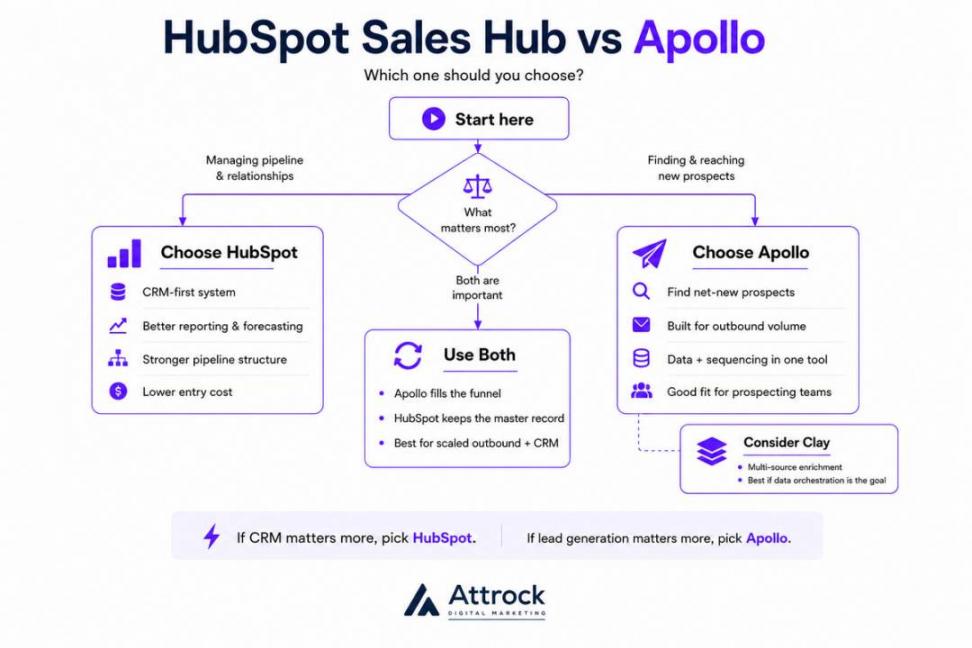
FAQ
Q1. What’s the difference between Apollo and HubSpot?
A. HubSpot is a CRM and sales platform, and Apollo is a prospecting database with sequences attached. HubSpot holds the customer record across sales, marketing, and service. Apollo finds people who aren’t in your database yet. The difference is ownership of the record versus discovery of the contact.
Q2. Is Apollo a CRM?
A. Apollo includes CRM features, but it isn’t a full CRM platform. It has no Leads object, no custom objects, and no ticketing. There’s no marketing automation or CMS either. For small outbound teams, it can work as a lightweight CRM. Larger orgs usually outgrow it.
Q3. Does HubSpot have a contact database like Apollo?
A. No, HubSpot has no contact database you can use for prospecting. It offers enrichment instead, covering 100 million company domains and 380 million email addresses. Enrichment fills in records you already have. Prospecting Agent sources leads from connected providers, including Apollo, at $1.00 per recommended lead.
Q4. Can you use Apollo and HubSpot together?
A. Yes. The HubSpot vs Apollo comparison doesn't always end with choosing one platform. Many businesses use Apollo to generate pipeline and HubSpot to manage customers after they enter the CRM. They use the native integration to run both together.
Q5. Is Apollo cheaper than HubSpot?
A. No, not on entry seat price. HubSpot Sales Hub Starter is $20 per seat against Apollo Basic at $65 on annual billing. What Apollo bundles is contact data. HubSpot’s Starter seat doesn’t include a prospecting database, so you’re paying for different things.
Q6. What does the Apollo HubSpot integration actually sync?
A. Contacts, accounts, and deals sync bidirectionally between Apollo and HubSpot. Emails, calls, tasks and notes push one way, from Apollo into HubSpot. HubSpot’s Leads object isn’t supported. Contacts sync in 15 to 30 minutes, while deals and activities take up to 24 hours.
Q7. How accurate is Apollo’s contact data?
A. The HubSpot vs Apollo comparison doesn't have a simple answer when it comes to data accuracy. Apollo shares strong performance numbers, but customer reviews suggest results can vary depending on your market and target accounts. Testing a sample of contacts against your own ideal customer profile is usually the best way to judge the data.
Q8. Does HubSpot’s free plan include sequences?
A. No, sequences aren’t part of HubSpot’s free plan. Free covers up to 2 users and one deal pipeline. Sequences start at Sales Hub Professional, which lists at $100 per seat monthly. So free HubSpot works for tracking deals, not for running outbound cadences.
Q9. Which Is Better for Cold Email, Apollo or HubSpot?
A. Apollo is the stronger fit for cold email at volume. It pairs prospect data with sequences in one seat, and sending is unlimited from Professional. HubSpot’s sequences are built for warm follow-up on contacts you already own. Cold outbound isn’t what they’re designed for.
Q10. Should I replace HubSpot with Apollo?
A. Usually no, because Apollo isn’t built to be your system of record. It has no Leads object, no custom objects, and no marketing automation or ticketing. Replacing HubSpot means giving up that structure. Adding Apollo alongside is the more common move.
Final Verdict: Which Tool Wins This HubSpot vs Apollo Comparison?
After comparing features, pricing, integrations, and ease of use, HubSpot vs Apollo comes down to two different strengths. HubSpot wins as the better CRM, while Apollo wins for prospecting and outbound sales. Neither platform replaces the other completely, which explains why many businesses invest in both as they grow.
Whichever way you go, the tool won’t do the work by itself. Choosing the software is the easier half. Building the pipeline is harder.
If you’d rather not run outbound in-house, my team offers lead generation services that build the pipeline for you.
Need an all-in-one sales solution built on top of a powerful CRM? Choose HubSpot Sales Hub.
Disclaimer: This content contains some affiliate links for which we will earn a commission (at no additional cost to you). This is to ensure that we can keep creating free content for you.