- The CRM boundary: CRM stores the customer record; CXM manages the experience.
- The perception gap: Twilio’s 2025 research found 83% of leaders claim deep customer understanding, while 45% of consumers feel understood.
- Five components, not one tool: Journey mapping, voice of the customer, personalization, unified data, closed-loop action.
- Measurement breaks before strategy does: Most programs collect NPS and CSAT without connecting them to revenue.
- Cost is a stack question: Per-seat vendors publish rates; interaction-based vendors quote privately.
Customer experience management (CXM) is the discipline of designing and improving every interaction a customer has with your company. The scope runs from the first ad a prospect sees to the renewal call.
Most companies believe they already handle this well. However, their customers routinely describe a different experience.
That gap sits between what a brand intends and what a customer actually feels. It shows up as churn that finance never traces back to a service failure.
Here’s what we’ll cover: what customer experience management (CXM) is, how it’s different from CRM, what it costs, and how to track your success.
A November 2025 study by the Qualtrics XM Institute found that bad customer experiences put about $3 trillion in global sales at risk.
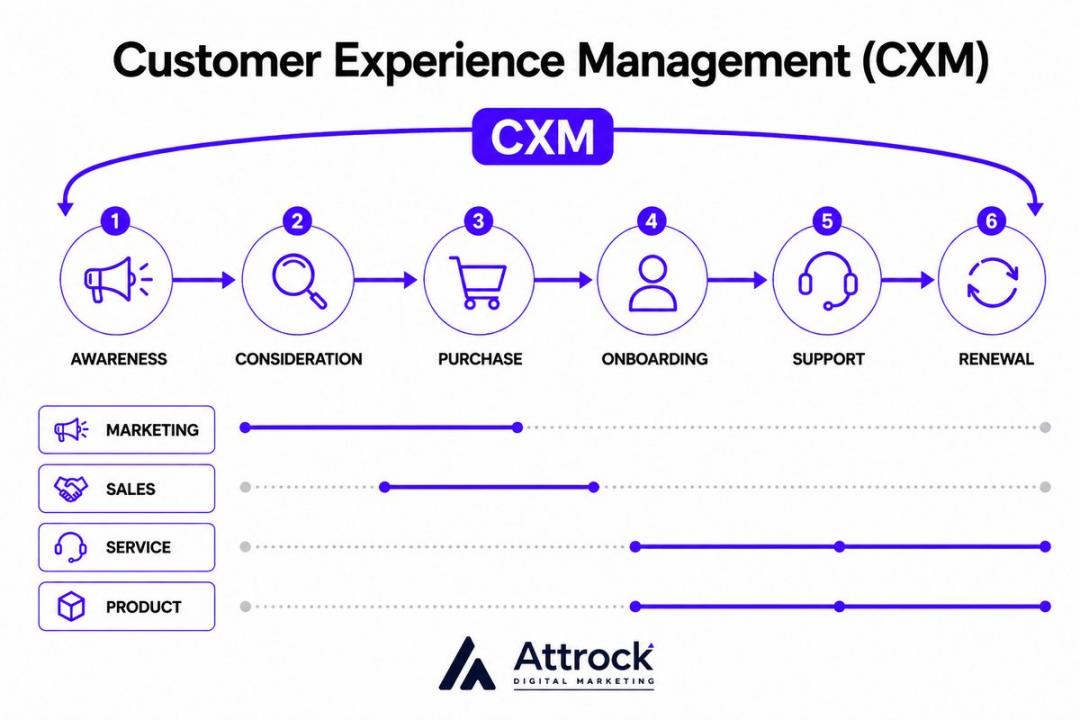
The graphic below maps CXM across the whole customer journey.
Disclaimer: This content contains some affiliate links for which we will earn a commission (at no additional cost to you). This is to ensure that we can keep creating free content for you.
Table of Contents
What Is Customer Experience Management?
Customer experience management (CXM) is the practice of tracking, analyzing, and improving every customer interaction with a brand. CXM covers the full customer journey, from first ad impression to renewal or churn. CXM gives experience an owner and a measurable target inside the business.
In practice, that customer experience management definition names an owner for every touchpoint. Measurement without intervention is just a survey habit.
CXM and CEM both mean customer experience management. Vendors use the labels interchangeably.
CXM’s five core components are covered in full below. Together, they turn scattered feedback into one accountable operating loop.
Grand View Research put the global CXM market at USD 15.5 billion in 2025. Its market sizing report, published in February 2026, projects USD 47.7 billion by 2033, a 15.2% CAGR.
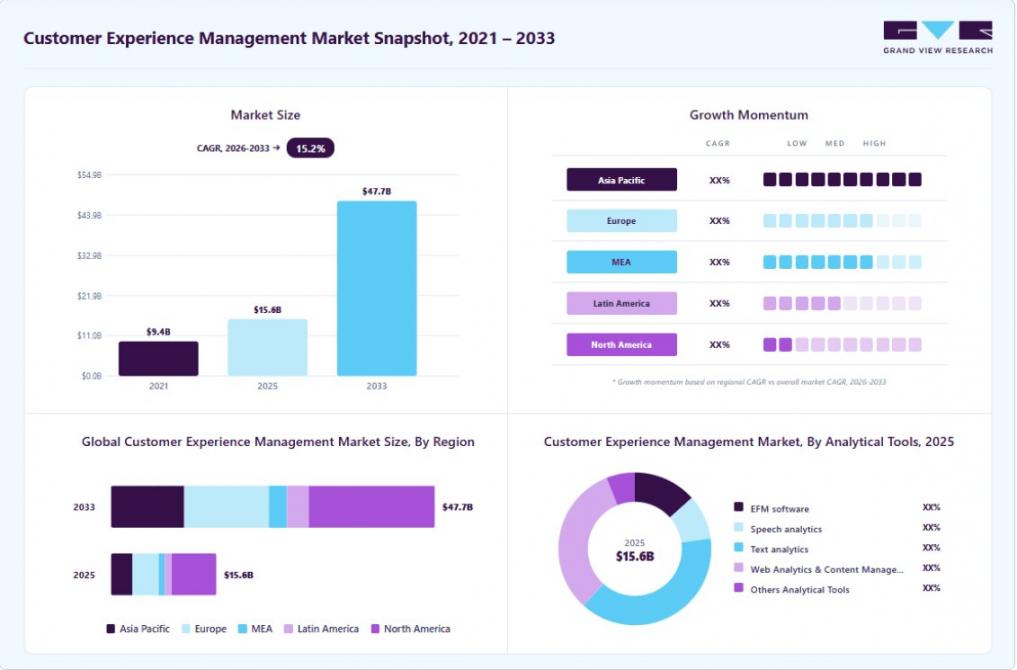
Image via Grand View Research
In my work with clients, I see the same problem over and over. Teams track customer satisfaction, but nobody actually takes responsibility for the customer's journey. I share a version of this card in kickoff meetings to help fix that.
CXM vs CX vs Customer Service: The Terms People Mix Up
Customer Experience (CX) is how a customer feels about your brand overall. Customer Service, on its part, is just one part of that. It’s the support you offer when someone reaches out with a question or problem.
Customer Experience Management (CXM) brings it all together using the actual strategy, tools, and budget needed to manage that entire journey.
| Term | What It Means | Who Owns It |
|---|---|---|
| Customer experience (CX) | Perception across every interaction | Nobody by default, or a CX lead |
| Customer service | Reactive fixes after a complaint | Support teams, under operations |
| Customer experience management (CXM) | The discipline that improves perception | A cross-functional owner, often the CMO |
Both. CXM is a discipline first, and software only enforces decisions already made.
CXM vs CRM vs CDP vs Customer Success Platform: Who Owns What?
CXM manages perception, CRM manages the relationship record, CDP manages identity, and a customer success platform manages retention.
A customer data platform (CDP) pulls all of a customer’s info into a single profile, while a customer success platform helps keep them happy so they stay and renew.
Search for CRM customer experience management, though, and the lines between all four quickly get blurry.
| Dimension | CXM | CRM | CDP | Customer Success Platform |
|---|---|---|---|---|
| Primary job | Improve brand perception | Record deals and tickets | Resolve identity | Drive renewal |
| Core data | Feedback and sentiment | Contacts and transactions | Events and identity keys | Usage and renewal dates |
| Main user | Experience and insights teams | Sales and service reps | Data and marketing ops | Success managers |
| Typical owner | CMO or CX lead | Revenue operations | Data or IT leadership | Chief customer officer |
| Key metric | Satisfaction and loyalty | Pipeline and win rate | Profile match rate | Net revenue retention |
Grand View Research valued the CRM market at USD 79.6 billion in 2025, roughly five times the CXM market.
Its CRM market forecast projects $161.3 billion by 2033. That gap explains why buyers assume the CRM covers experience.
A CRM tells you a renewal was lost, not that a support handoff months earlier lost it.
The CRM/CXM boundary is where HubSpot’s Smart CRM and Service Hub sit, weighed as both.
As of July 2026, HubSpot’s Smart CRM product page reports that 83% of users call HubSpot effective at unifying company data. That is HubSpot’s own customer-reported data, not independent research.
If your program relies mostly on surveys, you'll probably want a dedicated feedback platform. However, if you handle a high volume of support tickets, helpdesk-style tools are a better fit.
Put simply, CRMs track data points, while CXMs track how customers actually feel.
Which System Owns Which Job
The CRM owns two of the five jobs below; the other systems each own one.
| Job to Be Done | System That Owns It | Why |
|---|---|---|
| Know what happened | CRM | Holds the transaction and interaction log |
| Know how the customer felt | CXM | Only source of moment-level sentiment |
| Store the record | CRM | System of record for accounts |
| Unify identity across channels | CDP | Identity resolution is its function |
| Drive renewal | Customer success platform | Health scoring sits with usage |
When You Need Both
You need a CRM and a CXM layer once the CRM can no longer explain why accounts leave. The record shows the churn date, never the moment the customer gave up.
A 20-person company just needs a CRM and a regular habit of asking for feedback. A 2,000-person company needs a full data platform and a formal system to make sure every complaint gets resolved.
No. A CRM records what the company did. A CXM system records what the customer experienced.
How Does Customer Experience Management Work?
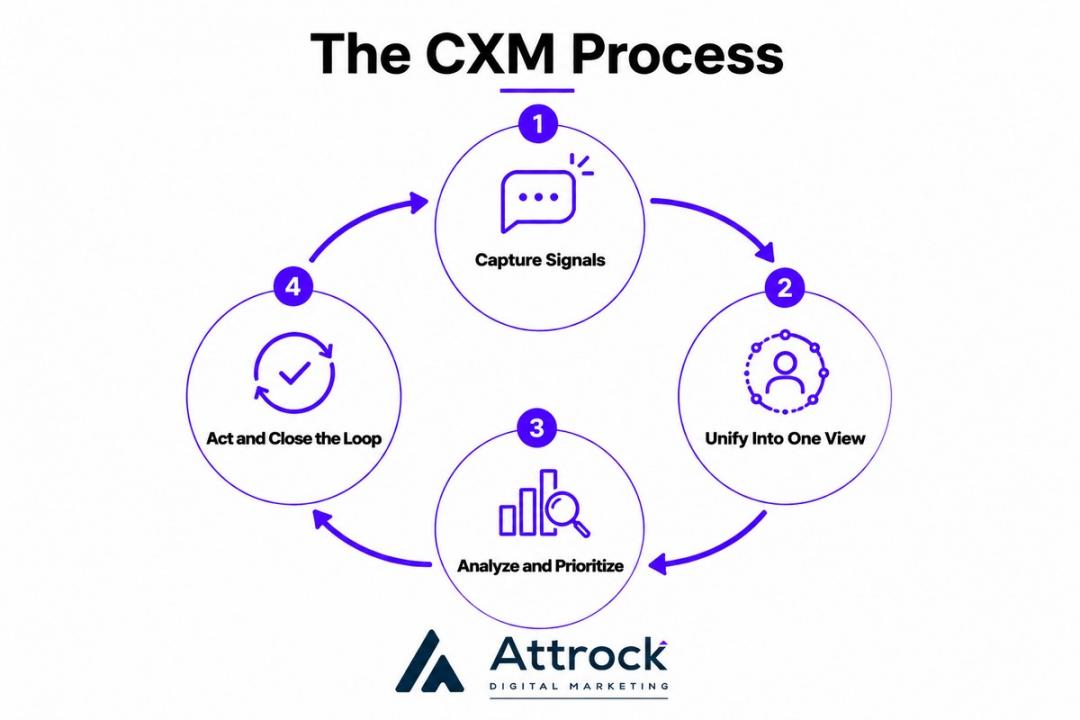
Customer experience management works as a continuous loop across four operating steps. A break at any point stalls the cycle.
The image below maps the four steps and their handoffs.
Step 1: Capture Signals at Every Touchpoint
Start by collecting signals from every place a customer can reach you. That means solicited feedback, such as surveys and reviews, plus behavioral signals, such as tickets, chat logs, and product usage.
Most teams capture the first and ignore the second. Behavior records what a customer did, and a survey records what they recall.
Step 2: Unify Them Into One Customer View
Merge all captured signals into a unified customer profile, keyed to a single identity. A survey response and a support ticket from the same person belong in a single record.
Genesys published the fifth edition of its State of Customer Experience study in July 2026. It found that 95% of consumers expect information to be remembered across channels.
Yet 48% of organizations do not automatically pass information between virtual and human agents. That is the gap step two closes.
Here’s the thing. During client audits, I keep finding the feedback tool and the helpdesk holding separate records of the same person.
Support answers the ticket without seeing that customer’s poor survey score.
Step 3: Analyze and Prioritize
Read the unified data for patterns, then rank them by business impact. Volume alone is a poor sort order.
Text analytics reads open-ended comments at scale and surfaces themes that scores hide.
The prioritization call stays human: which broken moment costs the most to leave alone?
Step 4: Act and Close the Loop
Fix the highest-impact problem, then go back to the customers who reported it. Closing the loop means telling them what changed.
Step four is the one that programs skip. Never responding trains customers to stop answering.
The fix generates new signals, and step one starts again.
Capture signals at every touchpoint, then unify them into one customer profile. Analyze and prioritize, then act and report back to the customer.
Why Customer Experience Management Matters?
The importance of customer experience management sits in one gap: what companies think they deliver versus what customers feel.
The Perception Gap
The perception gap is the difference between how companies rate their service and how customers rate it.
Twilio measured it in its State of Customer Engagement Report, sixth annual edition, published June 2025. It found that 82% of business leaders claim to deeply understand their customers. Yet, only 45% of consumers feel understood, down from 46% in 2024.
Self-assessment is not measurement, and a gap this wide is expensive. Customers rarely announce that they feel unheard, and customer retention slips before anyone notices.
What Bad Experience Actually Costs
Bad customer experience costs you the customer, and one incident is enough. Churn shows the cost before a survey score does.
Verint surveyed US consumers for its State of Customer Experience 2026 report, published in May 2026. It found that 79% would switch to a competitor after a single negative experience.
Qualtrics measured the upside in its 2026 Consumer Experience Trends, published in October 2025. Satisfied customers are 4.1x more likely to recommend and 3.8x more likely to trust a brand.
They are also 2.3x more likely to purchase more. Recommendation is the raw material for the social proof examples that buyers check.
But here’s the catch. Forrester reported in its CX Index 2025, published in June 2025, that US brand scores fell.
Across the brands it evaluated, 25% showed statistically significant losses and only 7% improved. So the honest read is that CX quality is declining across the industry, not improving.
Most pages on this topic claim the opposite.
Customers act on experience in both directions. Verint found 79% switch after one bad interaction, and Qualtrics found a 4.1x higher likelihood to recommend.
What are the Components of a Customer Experience Management Framework?
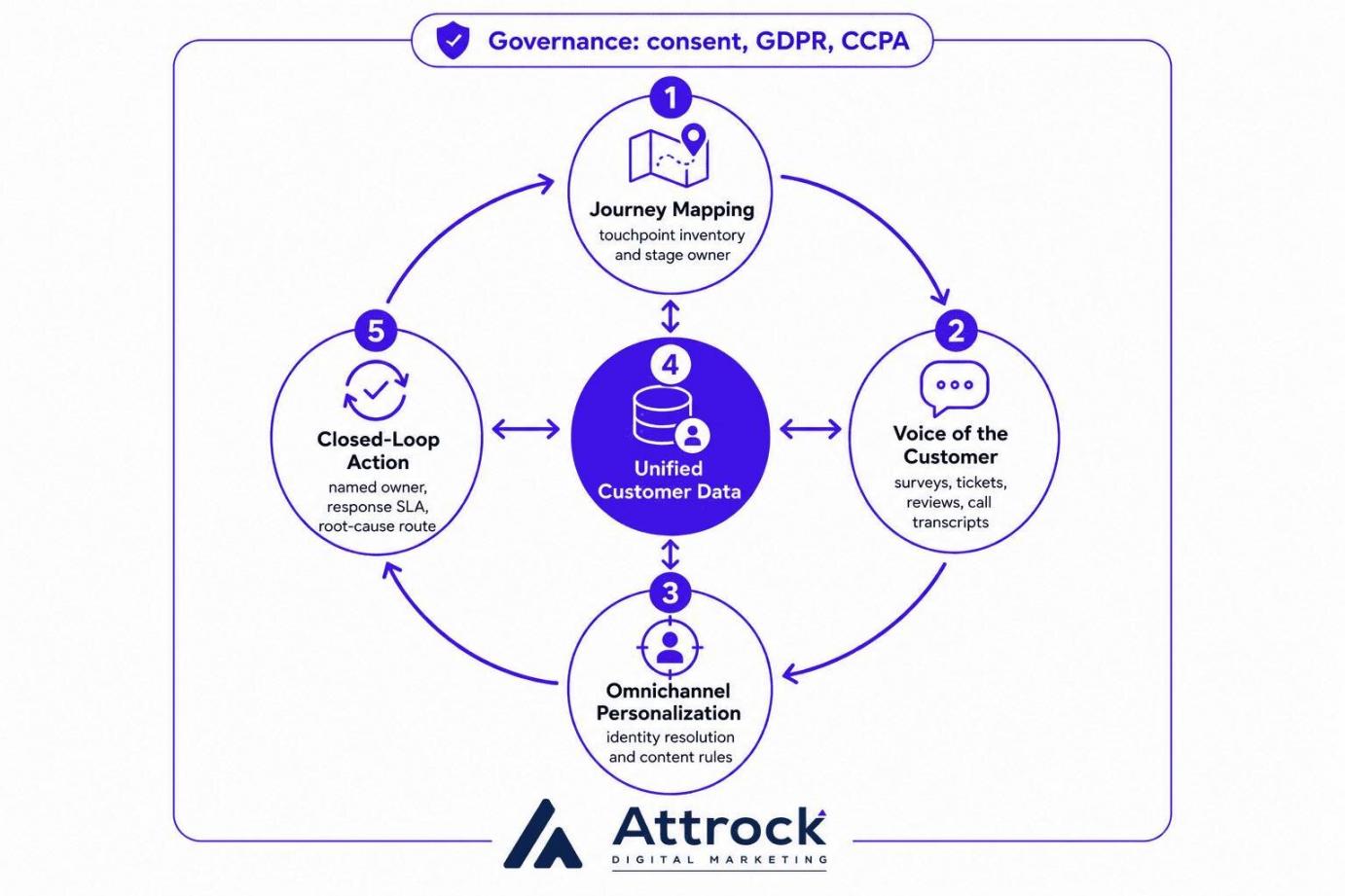
A customer experience management framework has five core components. They are journey mapping, voice of the customer, omnichannel personalization, unified customer data, and closed-loop action.
The diagram below maps the five components.
Journey Mapping
Journey mapping documents every step a customer takes with a brand, in sequence.
Voice of the Customer
Voice of the customer (VoC) captures what customers say about you, unprompted.
Omnichannel Personalization
Omnichannel personalization provides a customer with a consistent, tailored experience across every channel.
The same profile drives lead nurturing strategies down the funnel.
Unified Customer Data
Unified customer data is a single record per customer, assembled from all source systems.
MuleSoft, part of Salesforce, published its 2026 Connectivity Benchmark Report in February 2026. The average organization runs 957 applications, and only 27% are connected. The same report found that 82% of IT leaders name data integration as a top AI challenge.
The reality is messier. Merging records is a governance decision before it is a technical one. GDPR and CCPA both require a lawful basis for each processing purpose.
Consent has to travel with the record, not sit in the tool that collected it.
Below, siloed records merge into one profile.
Closed-Loop Action
Closed-loop action means every piece of feedback ends in a decision, fix, or reply.
Closed-loop feedback has an inner loop for the complaint and an outer loop for the process. Most programs skip the second.
| Component | What It Does | What It Needs |
|---|---|---|
| Journey mapping | Sequences steps and owners | Touchpoint inventory, stage owners |
| Voice of the customer | Collects and codes feedback | Sampling plan, coding scheme |
| Omnichannel personalization | Tailors experience per channel | Identity resolution, content rules |
| Unified customer data | Builds one customer record | Identity matching, consent status |
| Closed-loop action | Turns feedback into fixes | Named owner, SLA, root-cause route |
Journey mapping, voice of the customer, omnichannel personalization, unified customer data, and closed-loop action. The other four depend on unified data: partial records produce partial decisions.
How to Measure Customer Experience Management?
Measure customer experience management with five metrics: loyalty (NPS), satisfaction (CSAT), effort (CES), churn rate, and customer lifetime value.
Most programs measure all five and never connect any to revenue.
Forrester published its 2025 State of Feedback Management Survey in August 2025. Only 27% of teams communicate insights in a timely way. Only half can link CX metrics to business outcomes, and fewer than a third can set realistic targets.
TELUS Digital and Statista found that 54% still rely on traditional metrics like CSAT. Only 23% track digital self-service adoption. Both come from Digital Customer Experience Priorities, 2025, fieldwork late 2024.
Qualtrics XM Institute reported in November 2025 that fewer than 1 in 3 consumers give feedback. Qualtrics published its 2026 Consumer Experience Trends in October 2025. It found that 30% of customers who leave tell no one.
NPS alone proves nothing about revenue. When I audit a CX program, I check score ownership.
The graphic below compares the three metrics.
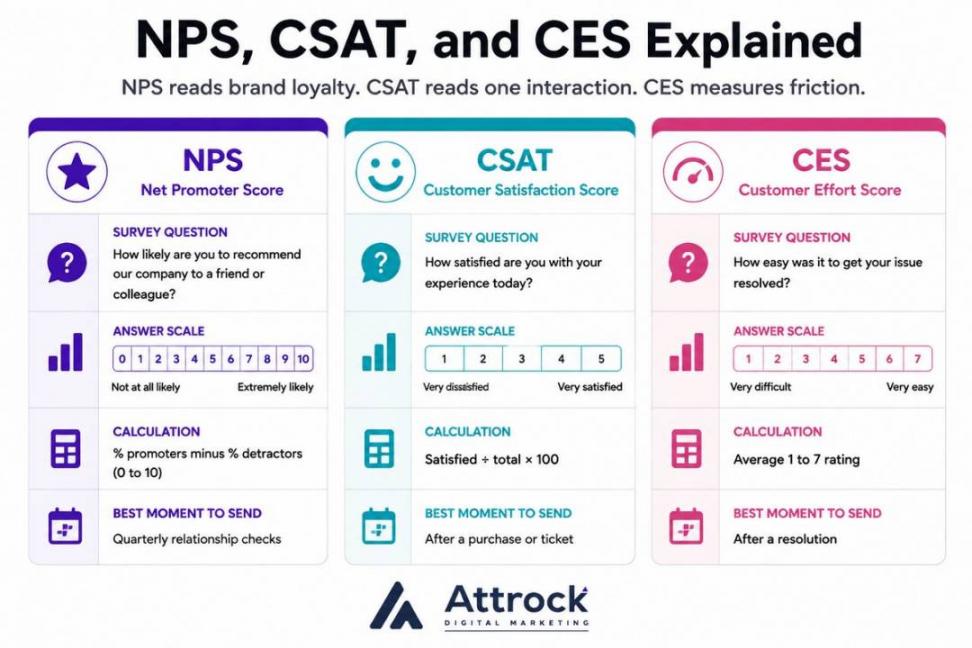
NPS, CSAT, and CES Explained
NPS reads brand loyalty, and CSAT one interaction. CES measures friction.
| Metric | What It Measures | Calculation | When to Use |
|---|---|---|---|
| Net Promoter Score (NPS) | Loyalty and advocacy | % promoters minus % detractors (0 to 10) | Quarterly relationship checks |
| Customer Satisfaction Score (CSAT) | One specific interaction | Satisfied ÷ total × 100 | After a purchase or ticket |
| Customer Effort Score (CES) | Friction in an outcome | Average 1 to 7 rating | After a resolution |
| Churn rate | Customers lost | Lost ÷ starting customers × 100 | Monthly or quarterly |
| Customer lifetime value (CLV) | Profit per relationship | Revenue × margin × lifespan | Sizing a CX fix |
Tying CX Metrics to Revenue
Tie CX metrics to revenue by converting a retention gain into customer lifetime value. Let’s break it down.
Closing customer feedback loops is what moves the number.
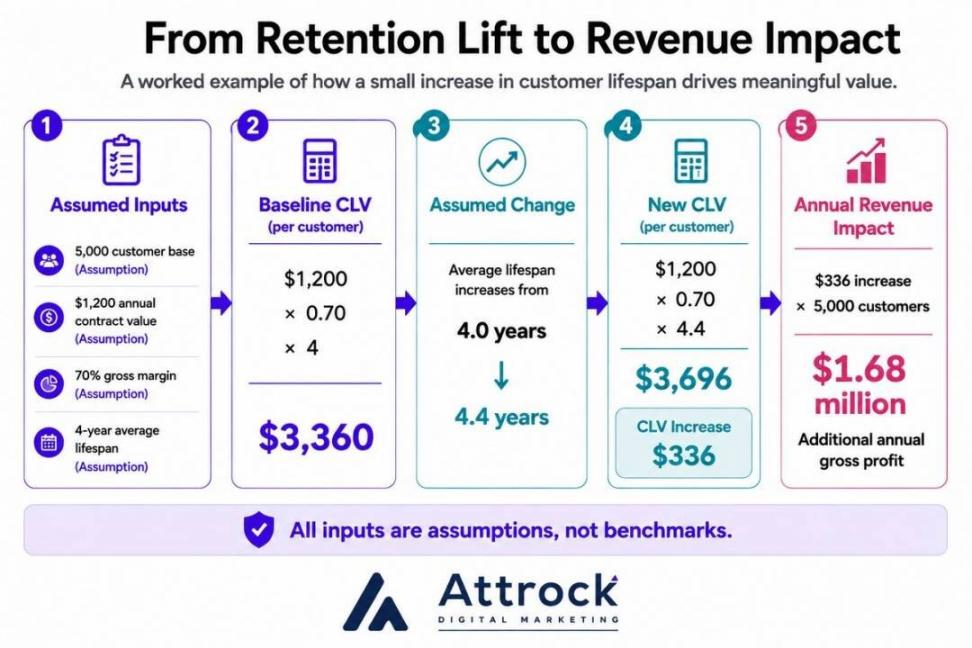
Assume a 5,000-customer base, a $1,200 annual contract value, and a 70% gross margin.
Assume a four-year lifespan. CLV is $1,200 × 0.70 × 4, or $3,360.
Now assume a fix that stretches lifespan to 4.4 years. CLV becomes $3,696, a gain of $336.
Across the assumed 5,000-customer base, that is $1.68 million.
Every input is an assumption, not a benchmark.
None alone. Revenue impact appears when a retention gain converts into lifetime value, then annual dollars.
What is the CXM Tech Stack and What It Actually Costs?
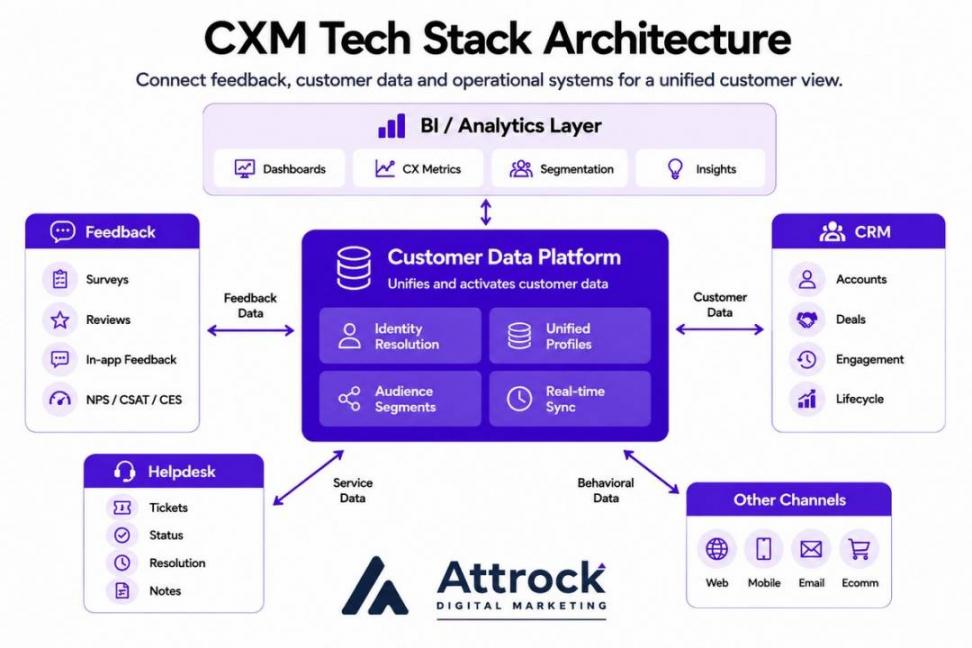
Customer experience management runs on a stack, not one product. The license fee is the smaller half of the cost.
Here’s how the layers connect.
The Five Tool Categories
A CXM stack has five tool categories. No vendor I’ve seen covers all five.
| Category | What It Does | Example Platforms | Typical Pricing Model |
|---|---|---|---|
| Feedback and VoC | Survey and sentiment capture | Qualtrics, Medallia | Per interaction |
| Helpdesk and service | Tickets and agent workflows | Zendesk, Freshdesk | Per agent, monthly |
| Customer data platform | One profile per customer | Segment, Tealium | Platform fee, quote-only |
| Analytics and BI | Trends and dashboards | Looker, Tableau | Per user, quote-only |
| Orchestration and personalization | Next-action delivery, cross-channel | Braze, Adobe Experience Platform | Platform fee, quote-only |
Category five overlaps with customer engagement platforms; check for duplicate spend.
InMoment is no longer independent. Qualtrics acquired Press Ganey Forsta, which owned InMoment, in a deal closing May 18, 2026.
Pricing Models and Total Cost of Ownership
CXM pricing splits along an architectural line. Seat-based vendors publish their prices, while interaction-based vendors typically don't. Help desk platforms charge per agent, whereas VoC platforms price based on customer interactions or response volume.
| Platform | Pricing Model | Pricing |
|---|---|---|
| Zendesk | Per agent | Support Team: $19/agent/month; Suite Professional: $115/agent/month; AI Copilot: +$50/agent/month |
| Qualtrics | Response-based | $420/month (billed annually), includes up to 1,000 responses |
| Zendesk AI Agents | Per automated resolution | Charged only when AI fully resolves a ticket without human intervention |
The published price is only part of the total cost. Most enterprise CXM platforms require custom quotes, and additional expenses such as onboarding, AI overages, interaction limits, and premium add-ons can significantly increase the final investment.
Before purchasing a CXM platform, ensure your CRM data is clean and centralized. Otherwise, the platform will simply deliver faster insights based on inaccurate customer records.
Seat-based tools publish their prices; Zendesk starts at $19 per agent per month as of July 2026. Interaction-based and enterprise platforms are quote-only.
How to Build a Customer Experience Management Strategy?
Building a customer experience management strategy takes five steps, in order. Skip the order, and you buy tooling too early.
These customer experience management best practices run in sequence.
1. Define the Outcome You’re Managing Toward
Pick one business outcome before you touch a survey. Retention, expansion revenue, and support cost qualify. “Better experience” does not.
2. Map the Journey You Actually Have
Map the journey your customers take now, not the one in your deck. Trace the paths backward from last month’s tickets.
Your content marketing touchpoints belong on that map too.
3. Instrument the Moments That Matter
Instrument only the moments when customers decide to stay or leave. Onboarding, first support contact, and renewal are where I start.
4. Close the Loop Before You Scale
Close the loop on feedback you already collect before collecting more. A response nobody acts on is data, not management.
Assign an owner to every detractor response.
5. Connect the Data You Already Own
Connect your existing systems before buying a new one. Your helpdesk, CRM, and billing system hold most of the answers.
My team can help map your touchpoints and handle the instrumentation work.
Where CXM Programs Fail
CXM programs fail at execution. The strategy is usually sound, and the money is already spent.
In Gartner’s July 2026 survey, service and support leaders invested a median of 12% of their 2025 budget in AI. That was the highest share of the ten business functions assessed.
Only 24% demonstrated positive financial returns across their AI use cases.
Forrester’s CX Index 2025 documents the same gap from the customer side.
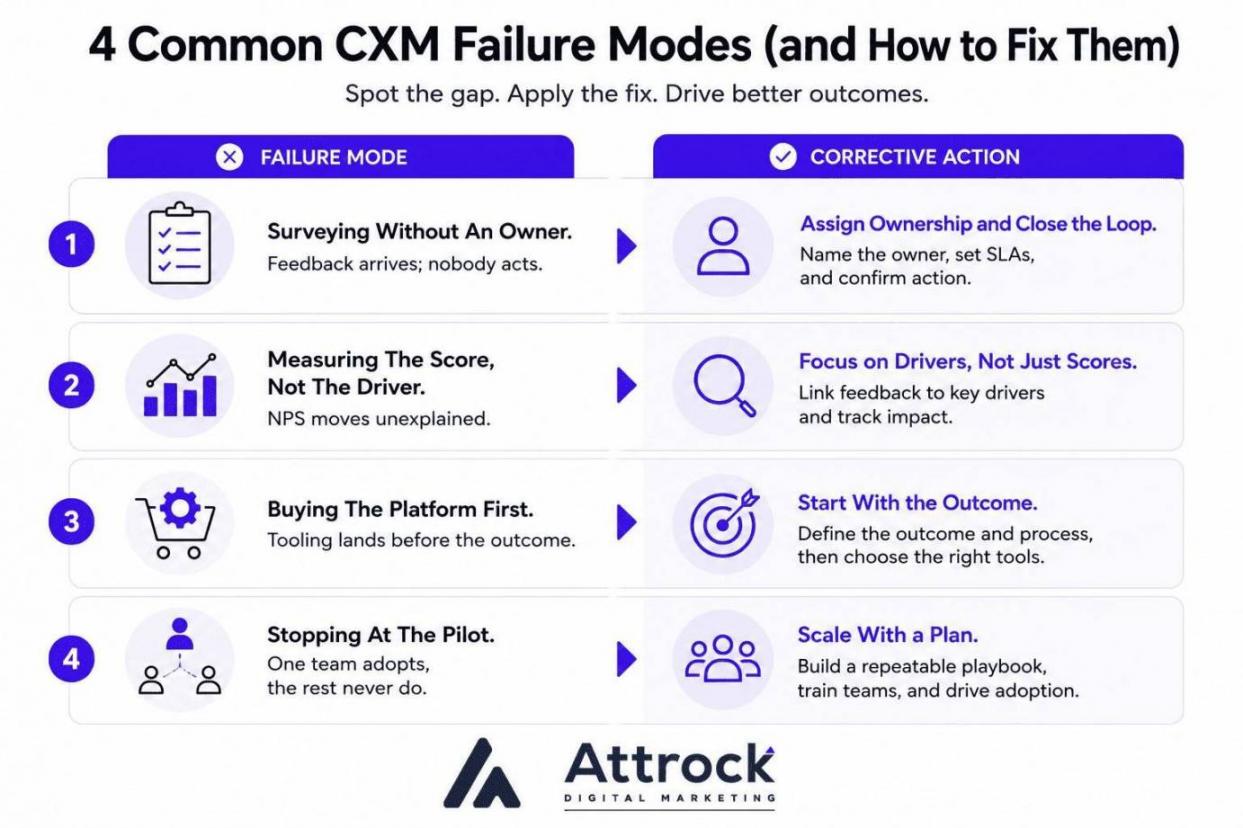
The four failure modes I see most often:
- Surveying Without An Owner. Feedback arrives; nobody acts.
- Measuring The Score, Not The Driver. NPS moves unexplained.
- Buying The Platform First. Tooling lands before the outcome.
- Stopping At The Pilot. One team adopts, the rest never do.
The same four modes, as a quick diagnostic.
Most customer experience programs break at the closing-the-loop step, long after the survey goes out. Assign a named owner to every piece of feedback.
How Is AI Transforming Digital Customer Experience Management in 2026?
In 2026, digital customer experience management has fundamentally shifted. AI stopped merely suggesting replies to human agents and started resolving cases end-to-end.
Salesforce put a number on it in its State of Service report, seventh edition, published November 2025. Service teams there estimate that AI currently handles about 30% of cases and projects 50% by 2027.
A Gartner survey from July 2025 found that 51% of customer service journeys now begin on third-party platforms. Google, YouTube, and ChatGPT are the front door. Among Gen Z, the share climbs to 74%.
Deploying AI and getting customers to use yours are two different problems.
A separate Gartner survey shipped in that same July 2026 release. It found customers were about 3x more likely to use third-party generative AI than a company’s own chatbot.
Company chatbot use has remained statistically unchanged since 2022.
If a customer gets their answer directly from ChatGPT or Perplexity, you’ll never see a log, a ticket, or a bad satisfaction score. You just lose the touchpoint completely.
I’d plan for both. Instrument the assistants you own and earn the public AI answers.
Well-scoped ecommerce chatbots handle order status and returns at a cost no human queue matches.
AI now resolves service cases rather than drafting suggestions. The harder change is that customers increasingly ask third-party AI tools, not your chatbot.
FAQ
Q1. What Do You Mean by Customer Experience Management?
A. Customer experience management is the operating discipline a company uses to manage how customers feel about it. It pulls signals from every touchpoint and turns recurring complaints into fixes with a named owner and deadline.
Q2. What Is the Difference Between CRM and CEM?
A. CRM manages your relationship record; CEM, which is the same thing as CXM, manages the customer’s perception. CRM tells you what the customer did; CEM tells you how the experience landed. Most companies run both.
Q3. What Is CX in Customer Experience?
A. CX is the customer’s perception of your brand across their entire journey. It’s an outcome—you can't change a customer's feelings directly. CXM is the active management of the tools, processes, and touchpoints that influence that outcome. In short: CX is what the customer feels; CXM is what your team does.
Q4. What Is the CXM Process?
A. It’s a four-part cycle: Capture, Unify, Analyze, and Act.
- Capture customer feedback and usage data across all channels.
- Unify those signals into a single customer profile.
- Analyze the data to decide which issues need fixing first.
- Act on those insights and follow up to close the loop.
Q5. What Are the 5 C’s of Customer Experience?
A. There’s no agreed-upon standard. People simply borrowed the “5 C's” label from traditional marketing strategy, leading to several conflicting versions floating around. If you see a list of 5 C's for CX, it's just one author's individual take rather than an industry standard.
Q6. What Are the 4 P’s of Customer Experience?
A. They actually don't exist. The 4 P’s od customer experience are Product, Price, Place, and Promotion—are a classic marketing framework from the 1960s. Whenever people try to adapt them for CX, everyone invents a different definition. If you want a real framework for customer experience, look at Forrester’s model instead, which focuses on three things: Ease, Effectiveness, and Emotion.
Q7. What Is the Role of a Customer Experience Manager?
A. A customer experience manager owns the whole journey, across teams that each own one piece. They run feedback collection, name priority fixes, and chase them to closure. Without the title, that work lands on marketing or support leadership.
Q8. Is Customer Experience Management Worth It for a Small Business?
A. Yes, and you actually have a comparative advantage. Small teams have shorter customer journeys, and owners can still hear complaints directly. That’s an advantage giant corporations spend huge budgets trying to recreate. Just focus on fixing the two main spots that trigger the most support tickets.
Q9. How Long Does a CXM Program Take to Show Results?
A. It happens in stages rather than on a set timeline. You’ll see quick wins first as support teams fix common complaints identified in feedback. Real drops in churn take longer to show up because they depend on how often your customers actually buy from you. Track results based on your own sales cycle.
Q10. Do I Need CXM Software to Start?
A. No. Start by reading the support tickets and cancellation reasons you already have, which most teams never do systematically. Buy software when manual review can no longer scale. Buying a platform to fix a process problem makes it more expensive.
Conclusion
Investing in Customer experience management pays off only if a real person takes charge of the key moments that stick with customers. A CRM won't point those moments out for you, because bad metrics usually ruin the effort before the strategy even gets a chance.
On the subject of cost, remember that you're paying for an entire setup of connected tools, not just a single software subscription.
Pick just one customer journey that people constantly complain about and fix how you track it. Resolving that single loop will teach you far more than comparing a dozen different software tools.
HubSpot’s Service Hub keeps your feedback, support tickets, and customer history on a single platform. It’s perfect for teams that want everything working together right out of the box instead of building a complex setup tool by tool.
If you want help turning those touchpoints into conversions, my team runs conversion rate optimization services.
Disclaimer: This content contains some affiliate links for which we will earn a commission (at no additional cost to you). This is to ensure that we can keep creating free content for you.