The selection of the best healthcare CRM software depends on your practice size, budget, and compliance needs. For example, HubSpot CRM works well for clinics and hospital networks that need an all-in-one platform with HIPAA compliance. Similarly, tools like NexHealth and Cheers are better suited for practices already embedded in specific EHR ecosystems.
Each tool offers a distinct advantage and caters to specific needs, so the choice matters.
In this post, we'll look at some of the best healthcare CRM software for managing patient relationships. We'll break down their features to help you find the right fit. Let's get started!
Disclaimer: This content contains some affiliate links for which we will earn a commission (at no additional cost to you). This is to ensure that we can keep creating free content for you.
How We Chose the Best Healthcare CRM Software
Not all CRM software caters to the complex needs of healthcare providers. In our search for the best healthcare CRM software, here are the key features we looked out for:
- HIPAA Compliance: Patient data is sensitive. Your CRM must protect that data and comply with HIPAA laws. We chose platforms that include a Business Associate Agreement (BAA), audit logs, and data encryption.
- EHR Integrations: Your CRM should connect seamlessly with your EHR system. This keeps your patient's electronic health records accurate and removes the need for manual data entry.
- Patient Communication Tools: With the best healthcare CRM software, you can automate appointment reminders, follow-ups, and outreach campaigns. This way, you keep patients engaged without adding extra work for your team.
- Marketing Automation: The best healthcare CRM software offers built-in marketing automation tools. These let you send targeted campaigns based on patient behavior, demographics, or care needs.
- Scalability and Pricing: We looked for CRMs that can scale with your practice. Whether you run a small clinic or a large hospital network, the best CRM must include flexible pricing and features that scale with your needs.
We evaluated healthcare CRM software based on essential features like HIPAA compliance, EHR integrations, patient communication tools, and marketing automation. We also prioritized platforms with flexible pricing and scalability.
Best Healthcare CRM Software in 2026: Comparison Table
Here's a quick side-by-side look at the seven best CRM tools we’ve found. Hopefully, this will help you make a faster, more informed decision.
| CRM | Best For | HIPAA Compliant | Key Features | Pricing | Free Plan Available |
|---|---|---|---|---|---|
| HubSpot CRM | Clinics, specialty practices, and hospital networks | Yes (Enterprise plan) | Breeze AI, workflow automation, data enrichment, Sensitive Data Management | Paid plans from $45/seat/month | Yes |
| Salesforce Health Cloud | Large hospitals, health networks, payers, and public health organizations | Yes | Agentforce AI, intelligent appointment management, Patient 360 for Health | From $350/user/month | No, but offers a 30-day free trial |
| Zoho CRM | Small to mid-sized clinics and hospitals | Yes | Omnichannel communication, appointment scheduling, digital signature solution | Paid plans from $14/user/month | Yes |
| LeadSquared | Dental clinics, fertility clinics, diagnostic centers, hospice providers, and healthtech companies | Yes | Patient acquisition tools, appointment booking automation, and healthcare analytics | From $40/user/month | No, but you can request a demo |
| Cheers | Hospitals and health systems already using Epic's EHR, including contact centers and multi-location practices | Yes | Care gap management, Provider Finder, call management, and campaign tracking | Custom pricing | No |
| NexHealth | Dental, medical, and specialty practices | Yes | Online scheduling and payments, digital forms, and insurance verification | Custom pricing | No, but offers a free demo |
| Freshsales | Solo practitioners and small group practices | Requires configuration | Freddy AI, built-in phone and email, visual pipeline, and workflow automation | Paid plans from $9/user/month | Yes |
The best healthcare CRM software depends on your needs. That said, HubSpot CRM checks the key boxes, with its robust features, affordable pricing, and HIPAA compliance.
Best Healthcare CRM Software for 2026
There are many healthcare CRM tools available today, each with different features, pricing, and use cases. To make your search easier, we've tested several tools and narrowed the list to seven of the best healthcare CRM software options. Let’s begin with the strongest.
1. HubSpot CRM
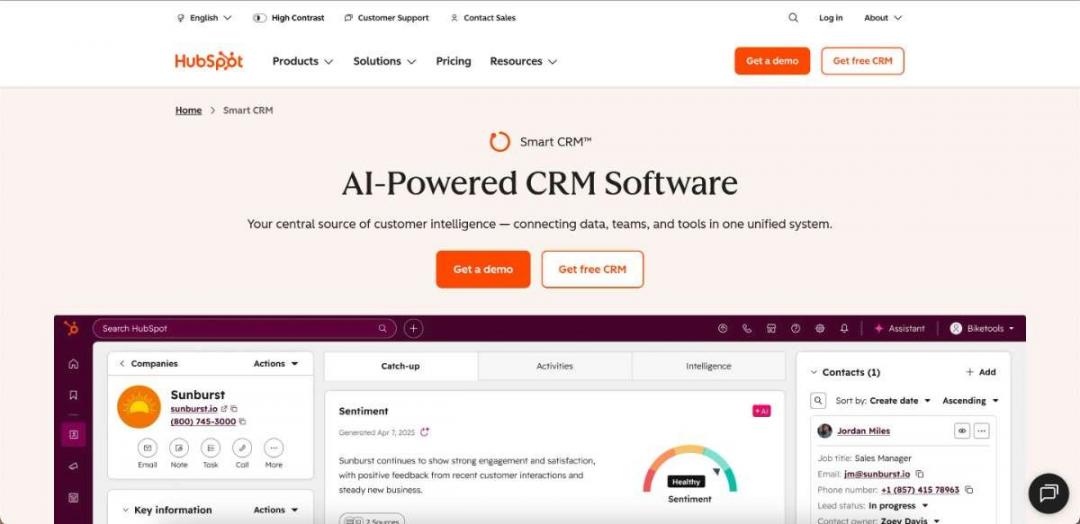
Image via HubSpot
HubSpot CRM offers marketing automation, customer support, and patient relationship management. It’s a good option for both small clinics and large hospital networks.
For example, healthcare company Santagostino used HubSpot's platform to send personalized pediatric communications to parents based on patient segments. Mental health startup Mindgram also improved customer satisfaction after integrating HubSpot's help desk features.
The software ensures HIPAA compliance. As an Enterprise subscriber, you can turn on Sensitive Data settings and sign a Business Associate Agreement (BAA) within the platform.
This is why HubSpot is one of the best healthcare CRM software solutions that deliver real results. If you need a scalable, compliant, and connected platform, this is worth a try.
Key Features
- Breeze AI updates contact records with actionable patient insights
- Data enrichment improves patient records with tracking emails and real-time data syncing
- Workflow automation streamlines patient communication and task handling
- Custom reporting turns patient data into performance and care insights
- Integration with over 2,000 business apps with the HubSpot Marketplace
- Secure storage and management of sensitive patient information directly within the platform
Pros
- Easy setup with a clean, intuitive interface
- Strong all-in-one tools (CRM, marketing, service)
- Scales well from small clinics to large hospital networks
- Enterprise-level HIPAA features are available
Cons
- HIPAA-related features are locked to the Enterprise plan
- Costs can increase as you scale seats and features
Pricing
HubSpot CRM offers a free plan for up to two users, along with two paid plans:
- Professional: $45/seat/month
- Enterprise: $75/seat/month
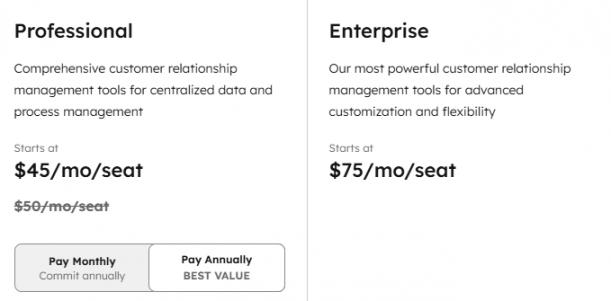
Image via HubSpot
Tool Level
- Beginner-friendly to intermediate level
Usability
- HubSpot CRM is easy to use for beginners, thanks to its clean interface and visual tools. It’s great for teams that want a quick setup without too much technical training.
Pro Tip: Enable automation workflows early. Even basic triggers like appointment follow-ups can significantly reduce manual work.
2. Salesforce Health Cloud
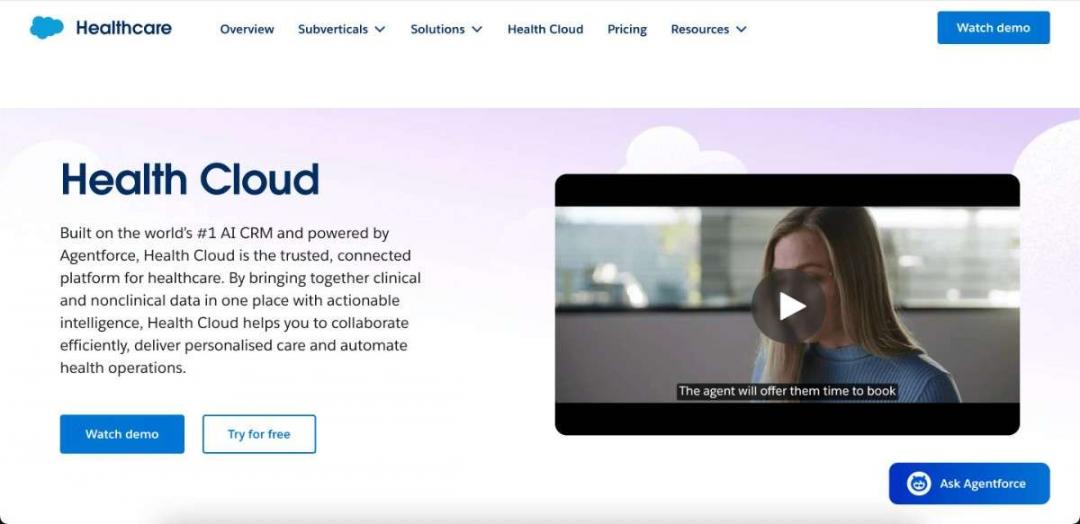
Image via Salesforce Health Cloud
Salesforce Health Cloud is one of the best healthcare CRM software built on the Salesforce platform. It offers a single-patient view, care-coordination tools, and workflow automation.
Its key feature is that it can bring clinical, claims, and behavioral data into a real-time patient profile. This provides a comprehensive view of every patient, allowing you to deliver personalized care.
Salesforce Health Cloud is a good choice for large hospitals, health networks, payers, and public health organizations. That’s because it offers advanced features and strong compliance. However, it might be a bit complex and costly for smaller practices.
Key Features
- Agentforce for healthcare streamlines your health services and personalizes patient interaction
- Intelligent appointment management to reduce no-shows
- Integrated care management for building flexible care plans
- Interoperability connects health data across systems using FHIR APIs, mobile apps, and clinical data models
- Data 360 for Health unifies clinical, claims, and behavioral data into a real-time patient profile
Pros
- Powerful patient data unification with a 360-degree patient view
- Advanced care coordination and analytics tools
- Highly customizable for large health systems
- Strong interoperability via APIs
Cons
- Complex setup that requires technical expertise
- High pricing makes it unsuitable for small clinics
Pricing
Salesforce Health Cloud offers four plans, billed annually per user per month:
- Enterprise: $350/user/month
- Unlimited: $525/user/month
- Agentforce 1 for Service: $750/user/month
- Agentforce 1 for Sales: $750/user/month
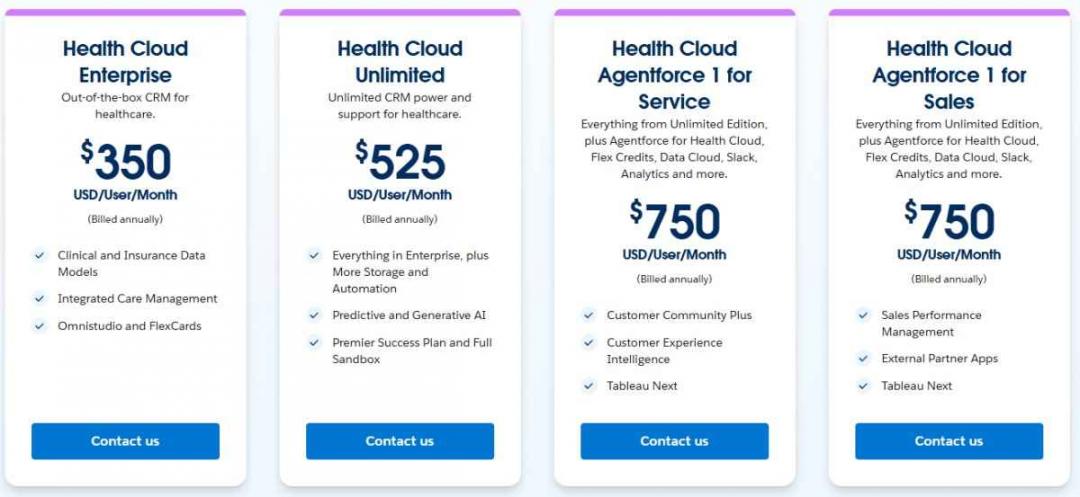
Image via Salesforce
Tool Level
- Enterprise-focused
Usability
- Salesforce Health Cloud requires technical knowledge to set up and manage. It’s perfect for large healthcare organizations with dedicated IT teams.
Pro Tip: Invest in proper onboarding and system architecture planning. You need carefully designed workflows to optimize Salesforce.
3. Zoho CRM
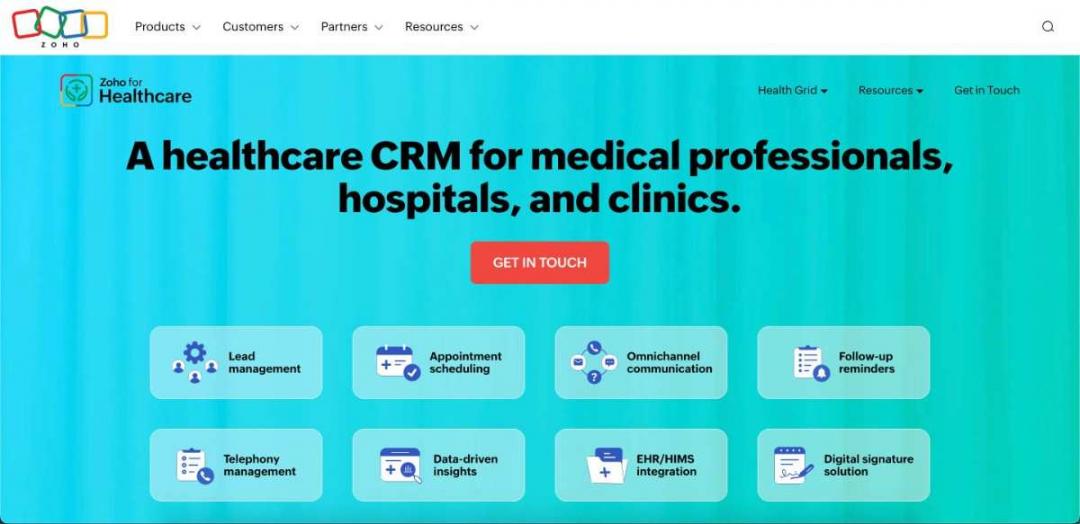
Image via Zoho CRM
Zoho CRM is an affordable, flexible CRM solution that works well for all sizes of healthcare companies. It helps with patient management, appointment scheduling, and marketing automation. This makes it a good option if your practice needs strong features without the enterprise price tag.
What sets Zoho apart from other best healthcare CRM software is its ease of use, built-in scheduling, and multichannel communication tools. So, even if you’re a small or mid-sized practice, you can get up and running quickly without needing a huge IT team.
This platform is one of the best healthcare CRM software for small to mid-sized clinics and hospitals. You have access to an affordable, easy-to-use CRM with built-in scheduling, communication, and HIPAA compliance tools.
Key Features
- Omnichannel communication enables patient outreach with automated messaging and pre-built email templates
- Integration with EHR or HIMS for real-time updates and accurate patient data
- Appointment scheduling to manage in-person and telehealth bookings with calendar sync and automated reminders
- Telephony management for tracking patient calls
- Digital signature solution secures consent forms and agreements with encrypted, compliant e-signatures
Pros
- Affordable pricing with a free plan
- Easy-to-use scheduling and communication tools
- Strong multichannel patient engagement (SMS, WhatsApp, email)
- Strong integration with EHR/HIMS systems
Cons
- UI may feel outdated compared to other best healthcare CRM software
- Limited scalability for large hospital systems
Pricing
Zoho CRM offers a free plan for up to three users. It also has four paid plans, with a 15-day free trial:
- Standard: $20/user/month
- Professional: $35/user/month
- Enterprise: $50/user/month
- Ultimate: $65/user/month
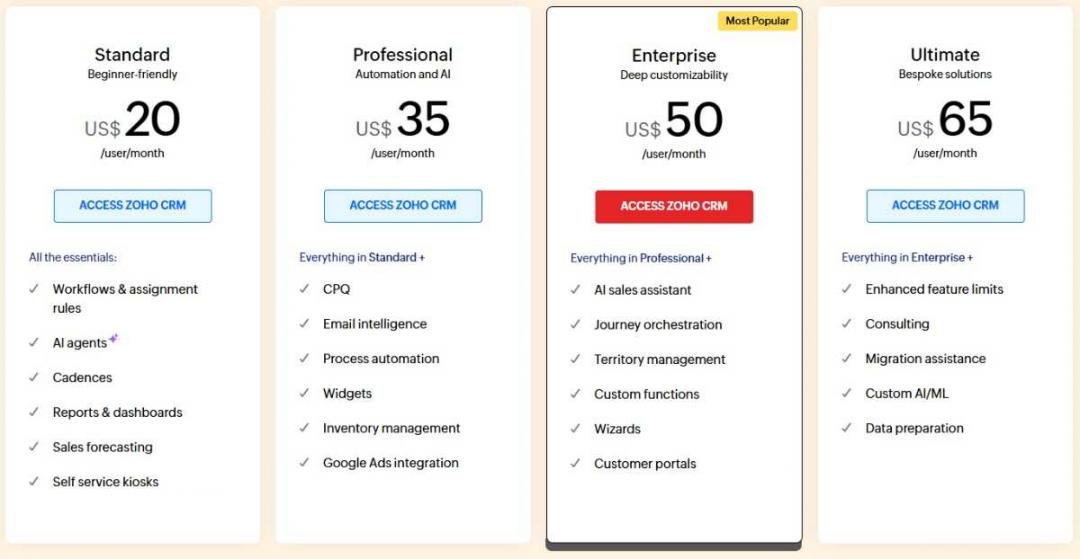
Image via Zoho CRM
Tool Level
- Beginner to intermediate
Usability
- Zoho CRM is beginner-friendly due to its simple interface and straightforward setup. It works best for small to mid-sized practices that want to get started quickly.
Pro Tip: Start with omnichannel communication workflows first. They quickly improve patient engagement without complex setup.
4. LeadSquared
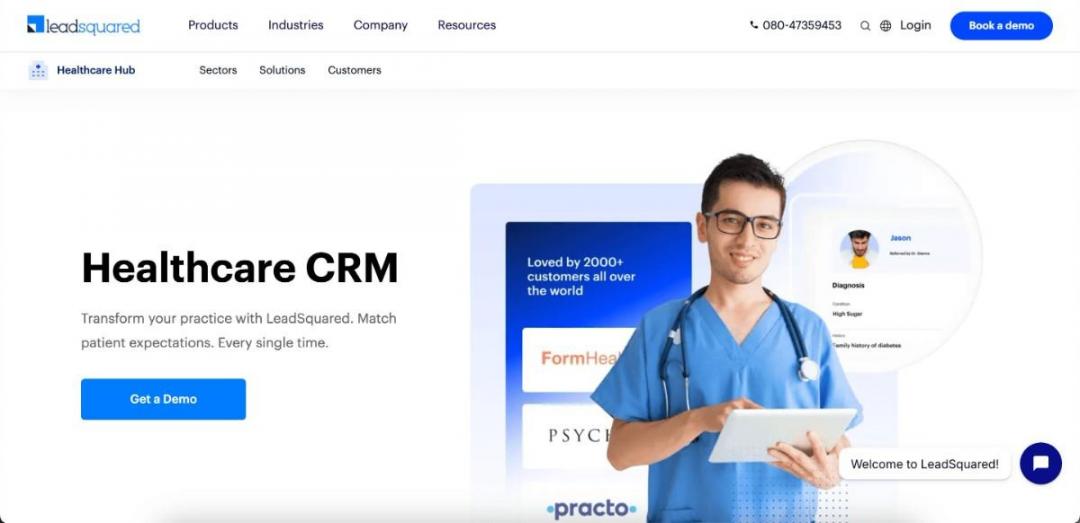
Image via LeadSquared
LeadSquared is one of the best healthcare CRM software solutions that manages the full patient journey from first inquiry to post-care follow-up. It combines marketing automation, patient engagement, and EHR integrations in one platform. It’s best for dental clinics, healthtech companies, diagnostics centers, and fertility clinics.
One thing that makes LeadSquared stand out is its focus on patient retention, not just acquisition. Your healthcare team can track every touchpoint in the patient journey and act on that data quickly. This leads to improved patient care and retention.
Key Features
- Patient acquisition tools capture inquiries from various sources with smart routing and segmentation
- Appointment booking automation enables self-scheduling with reminders and rescheduling to reduce no-shows
- Personalized outreach workflows based on patient behavior and history
- Mobile CRM for on-site care for managing patients and tasks on the go
- Healthcare analytics tracks acquisition sources, engagement rates, no-shows, and patient experience metrics
Pros
- Strong patient acquisition and lead tracking tools
- Excellent automation for booking and follow-ups
- Detailed healthcare analytics and reporting
- Mobile-friendly for on-the-go teams
Cons
- Increased pricing with advanced modules
- The interface may be a bit overwhelming for first-time users
Pricing
LeadSquared offers the following healthcare CRM plans, with 15-day free trials:
- Sales Pro: $60/user/month
- Sales Super: $100/user/month
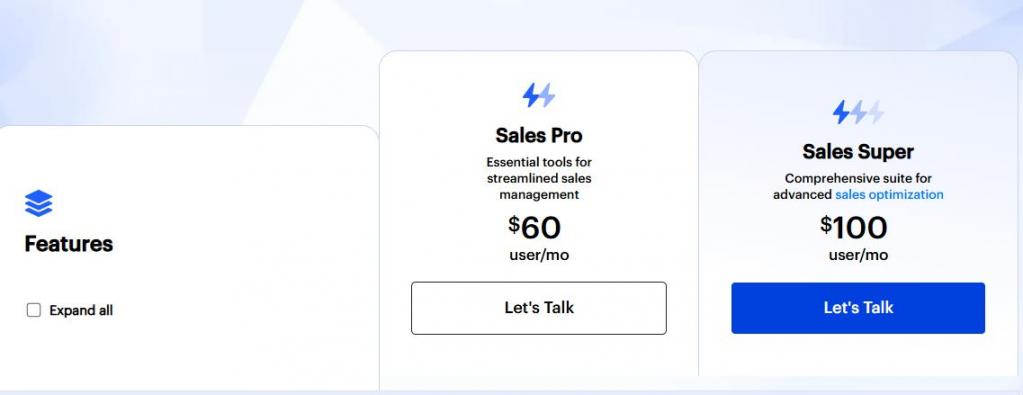
Image via LeadSquared
Healthcare providers can also avail these marketing plans:
- Marketing Pro: $2000/account
- Marketing Super: $3500/account
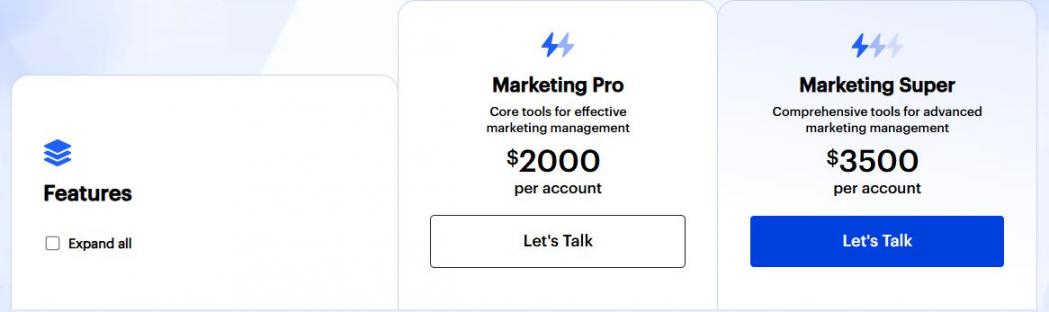
Image via LeadSquared
Tool Level
- Intermediate
Usability
- Due to its more advanced workflows and automation, LeadSquared is best for teams that can handle structured setup and ongoing optimization.
Pro Tip: Focus on setting up lead routing rules early. This ensures every patient inquiry reaches the right department right away.
5. Cheers (By Epic)
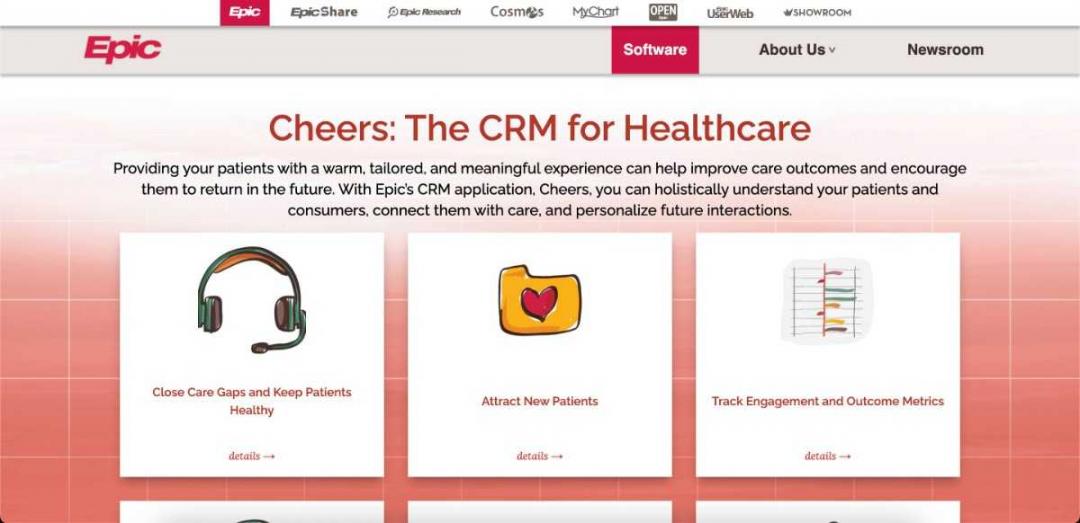
Image via Cheers
Cheers is a healthcare CRM built within the Epic ecosystem. It helps healthcare providers understand their patients, connect them with care, and personalize every interaction.
It works best if your healthcare practice already uses Epic's EHR platform. This allows you to provide a seamless, fully connected patient experience.
Key Features
- Care gap management identifies and addresses preventive care needs during patient interactions
- Provider Finder helps patients locate and switch healthcare providers
- Call management gives agents a full view of caller history for more personalized support
- Patient attraction and outreach automates follow-ups from website inquiries and flags patients for relevant services
- Campaign tracking monitors patient engagement and marketing performance, including email marketing metrics
Pros
- Reliable integration with Epic EHR systems
- Strong care gap and outreach management tools
- Detailed call and patient interaction tracking
Cons
- Not suitable outside the Epic ecosystem
- Limited flexibility for smaller practices
Pricing
Cheers doesn’t list its pricing publicly. Contact directly for a custom quote based on your organization's size and needs.
Tool Level
- Expert level
Usability
- Cheers is designed for teams already familiar with Epic systems. Large healthcare organizations benefit most, especially with their trained staff and existing infrastructure.
Pro Tip: Use it alongside Epic’s core EHR workflows to fully unlock patient journey tracking and outreach efficiency.
6. NexHealth
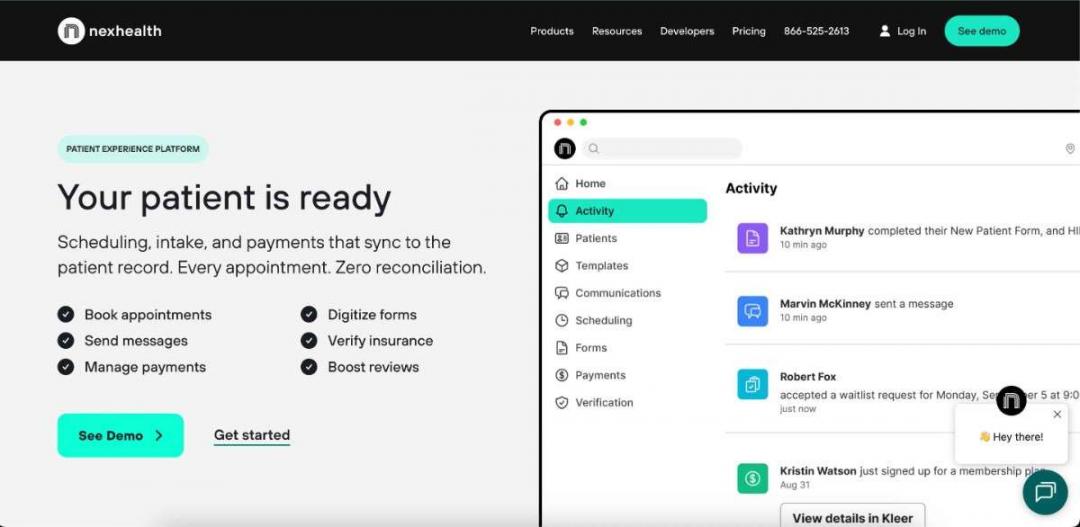
Image via NexHealth
NexHealth is a patient experience platform built for healthcare providers, especially dental and medical practices. It connects with EHRs bidirectionally to streamline your patient journey from booking to payment.
This way, patient medical history flows seamlessly between NexHealth and your existing EHR system in real time. You don’t need manual data entry, which helps reduce errors.
This CRM also offers digital forms, automated reminders, and online payments. You also have access to marketing automation tools.
Key Features
- Online scheduling and waitlist automation enable real-time booking with automatic fill for cancellations
- Digital forms streamline patient intake with automated form delivery and synced record updates
- Automated communications manage reminders, follow-ups, and patient journeys through email and SMS
- Online payments support digital payment processing with automatic syncing to practice records
- Insurance verification checks eligibility in advance to reduce billing issues and appointment disruptions
Pros
- Easy online scheduling and patient intake
- Reduced manual work via real-time EHR syncing
- Strong patient experience features, including forms, payments, and reminders
Cons
- Limited advanced CRM customization
- Pricing isn’t transparent (custom quotes only)
Pricing
NexHealth doesn’t publish standard pricing online. Plans are subscription-based. They also vary depending on practice size and features needed. However, a free demo is available on request. Contact NexHealth directly for a custom quote.
Tool Level
- Beginner-friendly
Usability
- With its intuitive setup and easy-to-use patient tools, NexHealth is great for beginners. It helps improve scheduling and patient experience without technical difficulty.
Pro Tip: Prioritize digital forms and automated reminders first. This helps you reduce front-desk workload and no-shows.
7. Freshsales
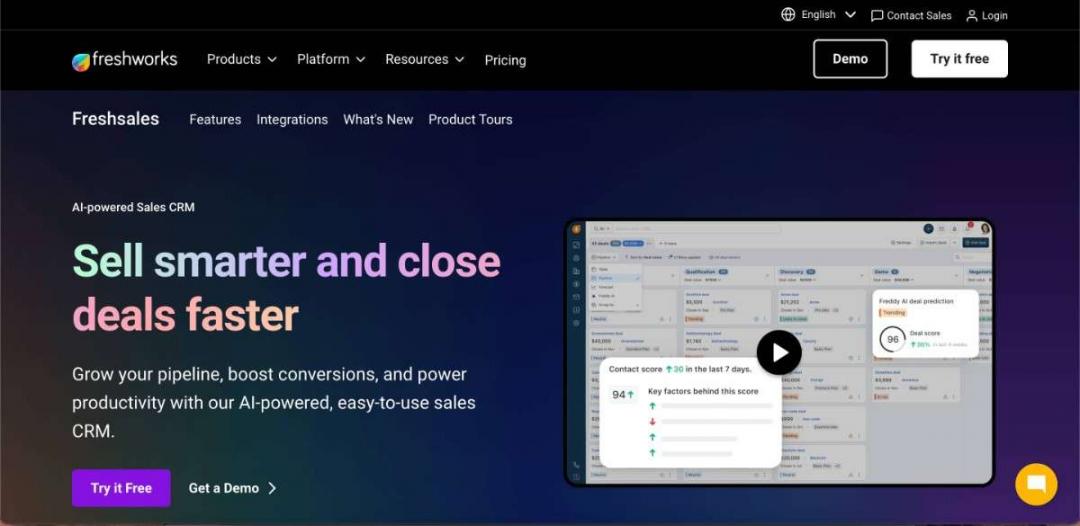
Image via Freshsales
Freshsales is a budget-friendly CRM software solution from Freshworks that works well for startups or small healthcare practices. It provides contact management, marketing automation, and AI-powered insights in one clean platform.
One thing that makes Freshsales stand out from other top healthcare CRM software platforms is its simplicity. If your team is currently tracking patients in spreadsheets, you can easily switch to Freshsales.
Freshsales is also great for solo practitioners and small group practices. You have access to core CRM features at a low price with no steep learning curve.
Key Features
- Freddy AI for AI-powered lead scoring based on behavior and engagement
- Built-In phone and email enable direct communication while automatically logging all interactions
- Visual pipeline management tracks patient inquiries and appointments through a clear stage-based workflow
- Workflow automation streamlines follow-ups, reminders, and data entry
- 360-degree patient view consolidates patient history, appointments, and communication in a unified profile
Pros
- Built-in calling, email, and automation tools
- Affordable pricing with a free plan
- Strong AI lead scoring for prioritization
Cons
- Not healthcare-specific out of the box
- Not suitable for large hospital networks
Pricing
Freshsales offers a free plan for three users, no credit card necessary. Its paid plans, providing a 21-day free trial, are as follows:
- Growth: $12.32/user/month
- Pro: $26.70/user/month
- Enterprise: $72.56/user/month
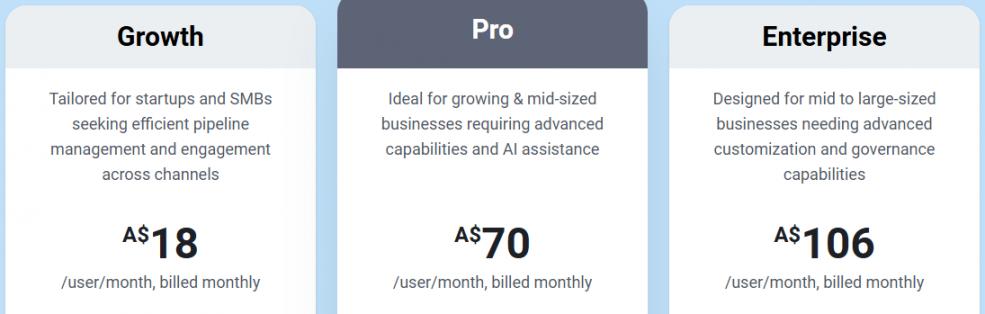
Image via Freshsales
Tool Level
- Beginner-friendly
Usability
- Freshsales is easy for beginners to navigate, especially for teams transitioning from spreadsheets.
Pro Tip: Leverage pipeline automation to track patient journeys visually. It’s the easiest way to replace spreadsheets and manual tracking.
FAQ
Q1. What is the best CRM for healthcare?
A. The best healthcare CRM software depends on your practice size and needs. If your team focuses on patient engagement and marketing automation, HubSpot CRM is a good choice. It offers a free plan, scales with your practice, and supports HIPAA compliance at the Enterprise level.
Q2. Is HubSpot HIPAA compliant?
A. HubSpot CRM can be configured to support HIPAA compliance. You need an Enterprise account to enable Sensitive Data settings and sign a Business Associate Agreement (BAA) with HubSpot.
Q3. What features should a healthcare CRM have?
A. A good healthcare CRM should include HIPAA compliance, EHR integrations, and patient communication tools. It should also offer marketing automation and scalable pricing. HubSpot's CRM covers all of these in a single solution.
Q4. How does HubSpot compare to Salesforce for healthcare?
HubSpot CRM is more accessible and easier to implement than Salesforce Health Cloud. Salesforce is better suited for large hospital systems with dedicated IT teams. However, HubSpot works well for practices of all sizes and offers a faster, more intuitive setup.
Q5. Can small clinics use a CRM?
A. Yes. Tools like Zoho CRM, Freshsales, and HubSpot all offer free plans or affordable pricing tiers that work well for smaller healthcare practices.
Q6. Is there a free healthcare CRM?
A. Yes. HubSpot CRM offers a free plan that includes basic marketing, sales, and service tools. Zoho CRM and Freshsales also offer free plans for small teams.
Q7. How long does it take to implement a healthcare CRM?
A. Implementation time varies by platform. HubSpot software is known for its fast setup. For instance, Healthcare company CancerIQ onboarded new sales team members remotely without a CRM engineer. This shows how intuitive this healthcare CRM software is.
Which Healthcare CRM Software Is the Best?
Choosing the best healthcare CRM software for your practice can ensure better patient relationships, streamlined operations, and sustainable growth.
The tools on this list cover a wide range of needs. You have enterprise-level platforms like Salesforce Health Cloud and budget-friendly options like Zoho and Freshsales. Regardless of your practice size and budget, you can find software that fits your needs.
However, one platform that combines comprehensive marketing automation, customer support, and patient engagement tools in one place is HubSpot CRM. It scales with your practice and supports HIPAA compliance at the Enterprise level.
Even more, it gives your team everything they need to deliver a better patient experience. Try it for free to see how it meets your needs.
Disclaimer: This content contains some affiliate links for which we will earn a commission (at no additional cost to you). This is to ensure that we can keep creating free content for you.