AI content optimization is the practice of structuring and writing content so AI systems can find, extract, and cite it in their generated answers. Tools like HubSpot AEO, Semrush, and Clearscope help you track where your brand appears in those answers — and where it doesn't.
Buyers now get answers directly from ChatGPT, Perplexity, and Google AI Overviews before they ever click a link. If your content isn't structured for AI systems to extract and cite, it won't appear in those answers. But your competitors' content will.
This post covers what AI content optimization is, why it matters, and how to do it well. You'll find a step-by-step process, a breakdown of the best tools, and the practices that make content more likely to get cited.
Disclaimer: This content contains some affiliate links for which we will earn a commission (at no additional cost to you). This is to ensure that we can keep creating free content for you.
Table of Contents
What Is AI Content Optimization?
In practice, AI content optimization covers everything from how you structure a heading to how you open a paragraph. Every element either makes your content easier for AI systems to extract or harder to interpret.
Traditional SEO targets keyword rankings, but AI search works differently. Platforms like Google AI Overviews, ChatGPT, and Perplexity synthesize information from multiple sources into a single answer.
A page can rank well on Google or traditional search engines and still be completely absent from those answers. That's because AI systems don't evaluate content the way a crawler does. They look for meaning, context, and clear structure.
Structured content that answers questions directly and clearly is more likely to get cited. Content built around keyword frequency alone generally doesn't.
Conductor's AEO/GEO benchmarks report found that AI Overviews now appear in 25.11% of Google searches. AI content optimization is how brands ensure their content gets found, cited, and trusted across AI search platforms.
AI content optimization is about structuring and writing content so AI systems can extract and cite it in their answers. It focuses on semantic clarity, direct answers, and clean content structure.
Why AI Search Visibility Matters Now
Most buyers no longer start their research by visiting websites directly. They type a question into ChatGPT, Perplexity, or Google and get a direct answer on the spot.
Research from Bain & Company found that about 60% of searches now end without the user visiting another site at all. This shift has two implications worth understanding:
1. Search Behavior Has Already Moved On
Similarweb's AI visibility report found that 35% of US consumers now use AI tools at the product discovery stage. By comparison, just 13.6% use traditional search engines at the same stage.
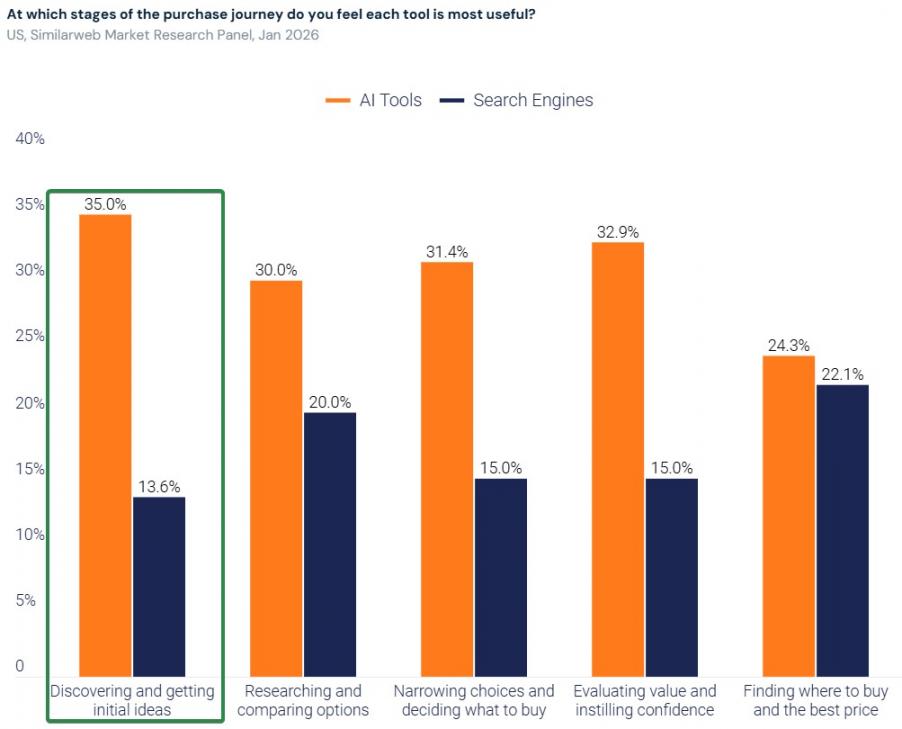
Image via Similarweb
The quality of that traffic matters too. According to Semrush, visitors arriving via AI search convert at 4.4x the rate of standard organic visitors. The traffic volume is smaller, but visitor intent is considerably higher.
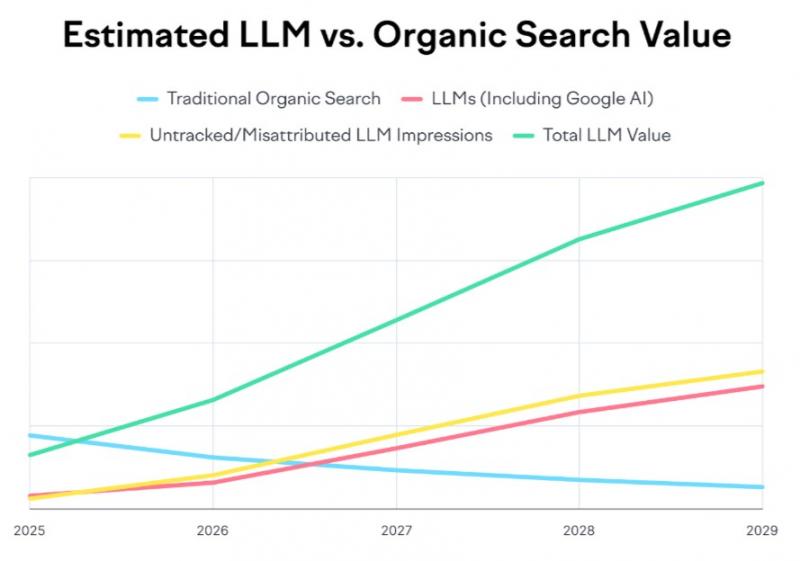
Image via Semrush
It’s worth noting that SEO best practices still lay the foundation for AI visibility. But they don't address the growing share of discovery that happens within AI answers before a search bar is even opened.
2. Most Brands Are Behind on Measuring This
The bigger problem is that most marketing teams have no visibility into how their brand appears in AI-generated answers.
A study by GoodFirms found that only 14% of marketers currently track AI citations — even though 43% name AI search optimization as a core 2026 priority.
AI search visibility is quickly becoming a competitive advantage. If your content isn't being cited, a competitor's content is filling that space. A strong content strategy built around AI content optimization is the practical starting point.
Over 60% of searches now end without a click. Only 14% of marketers track AI citations — even though 43% say AI search optimization is a core 2026 priority. The gap between awareness and action is where competitive ground is being lost.
Traditional SEO vs. AI Content Optimization
Traditional SEO focuses on ranking for keywords in search results. AI content optimization focuses on being cited inside AI-generated answers. These are related goals, but they require different strategies to achieve.
Here’s a quick snapshot of the difference between the two:
| Traditional SEO | AI Content Optimization |
| Targets keyword rankings in SERPs | Targets citations in AI-generated answers |
| Measures clicks and impressions | Measures brand mentions and AI citation frequency |
| Builds content for crawlers and users | Builds content for extractability and AI understanding |
| Optimizes title tags and meta descriptions | Optimizes for semantic clarity and structured answers |
| Keyword density and backlinks are core signals | Content depth, structure, and E-E-A-T are core signals |
| Success is page one rankings | Success is appearing in AI Overviews, ChatGPT, and Perplexity |
Traditional SEO and AI content optimization share the same foundation. Quality content, clear structure, and authoritative coverage matter for both approaches alike.
Brands with strong existing content foundations already have an advantage. They just need to extend that work into AI visibility.
However, over-optimized content packed with repetitive keywords tends to perform poorly in both traditional and AI search.
The key difference lies in how AI systems evaluate content. They use natural language processing (NLP) to interpret user intent rather than simply matching keywords.
AI systems favor content that answers questions directly and clearly over content written primarily for keyword rankings.
Traditional SEO and AI content optimization share the same foundation, including quality content, clear structure, and content depth. The difference is in how AI systems evaluate content — they interpret meaning and user intent, not just keyword matches.
Key Benefits of AI Content Optimization
AI content optimization produces outcomes that go well beyond search rankings. Done right, it improves website traffic quality, strengthens brand visibility, and makes content work harder across every channel. Here's what that looks like in practice:
Better Visibility in AI-Generated Answers
When your content is optimized for AI visibility, it gets cited in Google AI Overviews, ChatGPT, and Perplexity. These are the platforms where more of your buyers are searching right now.
According to Adobe research, web traffic from AI-driven referrals grew more than tenfold in the US between July 2024 and February 2025 alone. That growth makes being cited a measurable competitive advantage.
Higher-Quality Traffic
Visitors arriving via AI search are further along in their decision-making. They've already got a direct answer. They click through because they want deeper information.
Adobe found that AI-referred traffic converted 42% better than non-AI traffic. Those visitors also spent 48% longer on the site.
Stronger Topical Authority
AI systems favor brands that cover topics in depth. One well-written article isn't enough on its own. What matters is a body of content that signals real expertise across a subject.
A well-linked content system helps AI crawlers map your knowledge across related topics. Good internal linking for SEO is a core part of building that topical authority.
More Consistent Brand Presence
Without AI content optimization, your visibility in AI answers is largely unpredictable. SparkToro research found there's less than a 1-in-100 chance that ChatGPT will return the same brand list twice across 100 identical queries.
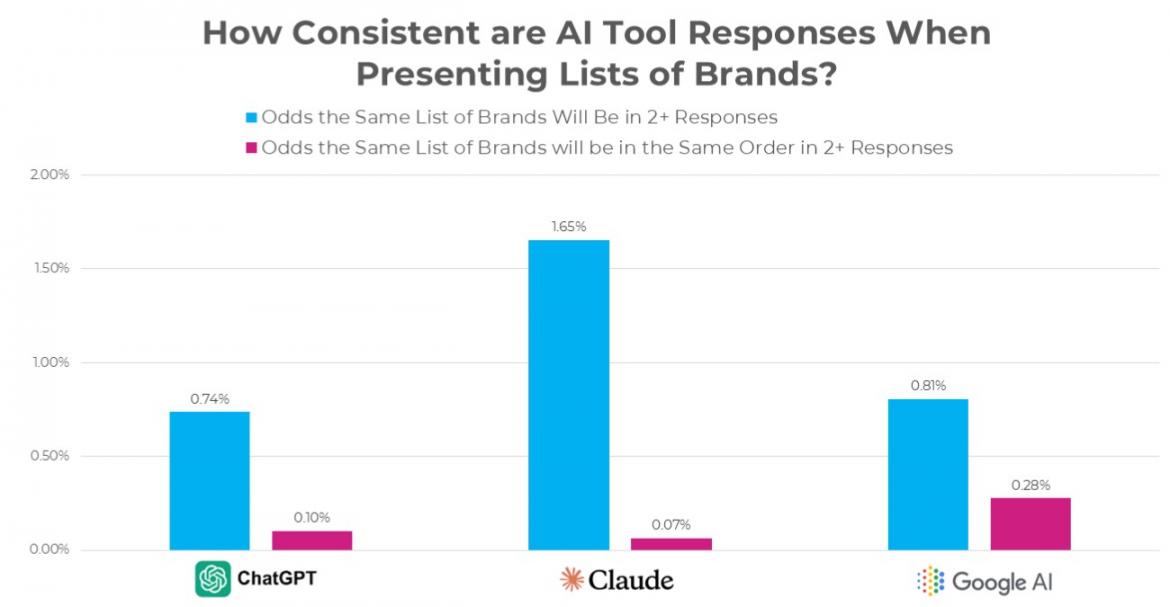
Image via SparkToro
The brands that show up most reliably have the strongest content presence across relevant topics. That consistency comes from sustained optimization, not luck.
Stronger Performance Across Channels
AI content optimization improves more than just AI visibility. Content built for clear extraction is also easier for human readers to use.
Direct answers, logical headings, and clean content structure all improve the reading experience. That leads to more featured snippets, better time on page, and stronger SEO results overall.
Also, the content marketing tools you already use become more effective when the content they distribute is built this way.
AI content optimization improves traffic quality, brand consistency, and topical authority, and not just AI visibility. Adobe Digital Insights found AI-referred sessions grew more than tenfold in the US between July 2024 and February 2025.
6 Steps to Put AI Content Optimization Into Practice
Every brand's starting point looks different. But the process of doing AI content optimization well follows a consistent path. Here's what that looks like in practice:
1. Audit Your Existing Content
Before creating anything new, take stock of what you already have. A proper content audit helps you identify your strongest pages, flag thin content, and spot which pages already appear in AI Overviews.
Look for keyword clusters you already rank for, pages with outdated statistics, and key articles that cover relevant topics but aren't structured for direct extraction.
Pay particular attention to your introductions. An analysis of 18,012 citations found that 44.2% of citations come from the first 30% of the content piece.
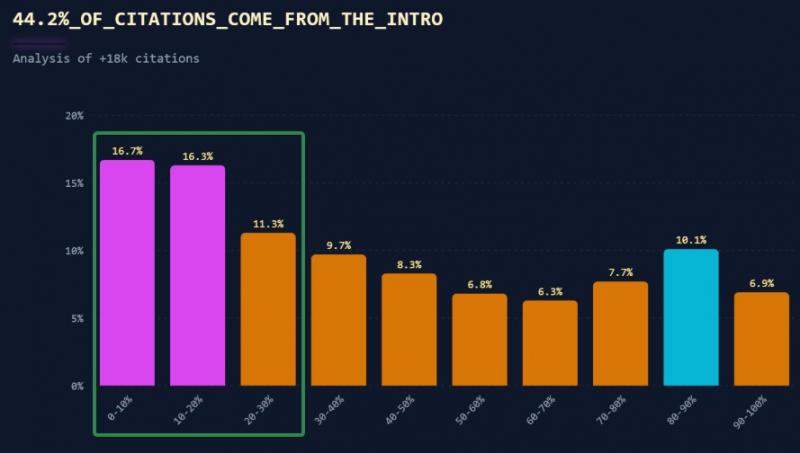
Image via Growth Memo
Run a content gap analysis alongside your audit to uncover gaps in your coverage. This helps identify topics where competitors are being cited and your brand is absent. This kind of performance tracking early in the process saves significant effort later.
2. Map Your Content to AI Search Intent
In addition to matching keywords, AI systems interpret the intent and context behind a query. Your content should answer the exact question users are asking, not a generalized version of it.
Map your target topics to actual questions people are asking in AI tools.
Use Google's “People Also Ask” and search features to identify those questions and gain a deeper understanding of your target audience's needs. Then use your keyword research to prioritize by search intent, volume, and relevance.
3. Optimize Your Content Structure for AI Readability
AI systems don't read a page from top to bottom. They extract content in modular chunks. This means every section needs to stand on its own.
Use H2 and H3 headings that reflect actual questions or topics. Open each section with a direct answer in the first one to two sentences. Also, keep paragraphs to two to four sentences and use numbered lists for step-by-step processes.
Apply the same thinking to your meta descriptions and title tags. Both should reflect the page's primary question, not just describe what it covers. Avoid complex sentences and passive voice in these elements as AI systems favor concise, active, and direct language.
4. Add Structured Data and Technical Markup
Adding structured data helps AI systems understand what a page is about without having to infer it from context. Use schema markup where appropriate:
- FAQPage schema for FAQ sections
- HowTo schema for process content
- Article schema for editorial pieces
Beyond schema, check that your robots.txt file allows AI crawlers to access your key pages. GPTBot, CCBot, and Google-Extended all need explicit access. Online content blocked from these crawlers won't be cited, regardless of how good it is.
5. Build and Refresh Topical Authority
One well-optimized article won't establish authority on its own. AI systems favor brands that cover topics in depth and consistently across their content.
Build content clusters around your key topics. These are pillar pages supported by detailed subpages, all interlinked logically. Then keep that content fresh.
Superlines’ tracking data found that AI visibility can drop by 36% in just five weeks without active content maintenance. Consider building update cycles into your content strategy and not just your publishing calendar.
6. Measure Your AI Visibility and Close the Gaps
Traditional tools like Google Search Console don't track AI citations. You need dedicated AI visibility tracking tools like HubSpot AEO to understand how your brand appears across ChatGPT, Perplexity, and Gemini.
Monitor which prompts cite you, which cite competitors, and where you're completely absent. Use that data to identify content gaps and close them by adding or updating content.
The AI optimization process follows six steps:
- Audit content
- Map to AI search intent
- Optimize structure
- Add structured data
- Build topical authority
- Measure AI visibility
Best Tools for AI Content Optimization
The right AI content optimization tools depend on where you are in the process and what problem you're trying to solve. Some focus on content creation, others on optimization, and others on tracking AI visibility.
Here's a look at five AI content optimization tools worth knowing, starting with HubSpot AEO, which is purpose-built for AI search visibility.
| Tool | Best For | Starting Price | AI Visibility Tracking | Content Optimization | CRM Integration |
|---|---|---|---|---|---|
| HubSpot AEO | End-to-end AI visibility + action | $50/month | ✅ | ✅ | ✅ |
| Semrush | SEO + AI Overview tracking | $299/month | ✅ | ✅ | ✅ |
| Clearscope | Semantic content optimization | $129/month | ✅ | ✅ | ❌ |
| Surfer SEO | Real-time on-page optimization | $119/month | ✅ | ✅ | ❌ |
| Frase | SEO and GEO content optimization | $49/month | ✅ | ✅ | ✅ |
1. HubSpot AEO
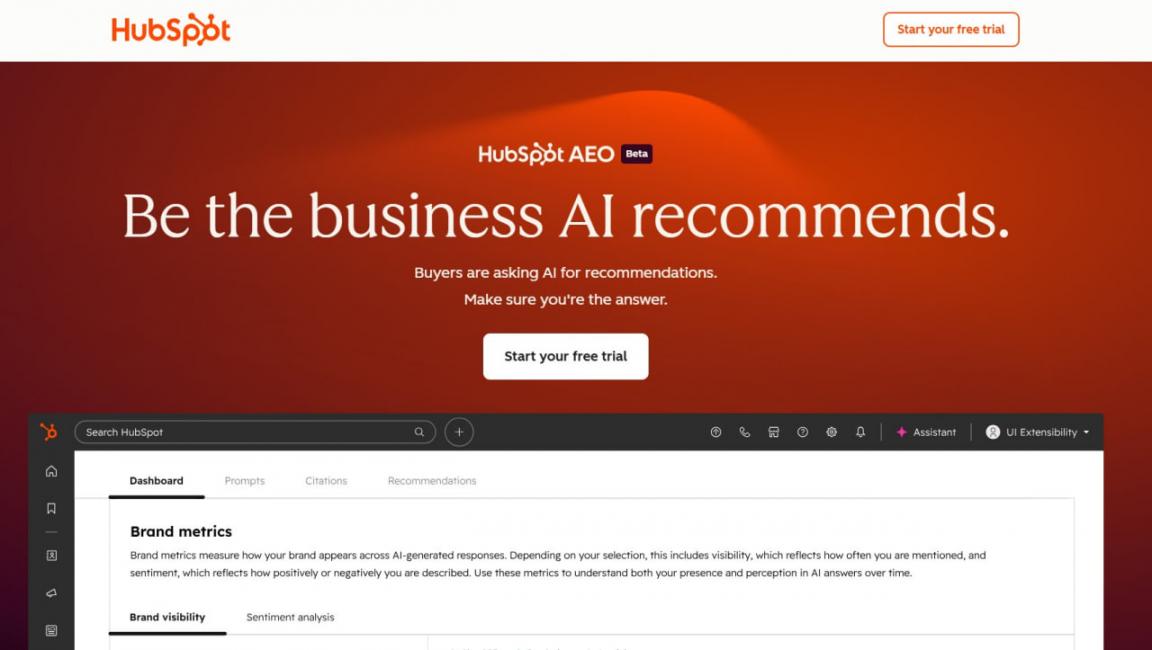
Image via HubSpot AEO
HubSpot AEO tracks how your brand appears across ChatGPT, Gemini, and Perplexity. It shows where competitors are being cited instead of you and delivers prioritized recommendations to close those content gaps.
It's the only tool on this list that connects AI visibility tracking to your CRM data. That means prompt suggestions are based on what your actual buyers are searching for, not generic guesses.
From there, you can create workflows that move you from identifying a gap straight to publishing content — all inside one platform.
HubSpot launched AEO at its Spring 2026 Spotlight. Beta users saw AI referral traffic grow 20% compared to brands not using the tool.
Key Features
- AI visibility score across ChatGPT, Gemini, and Perplexity
- Competitor share-of-voice (SOV) tracking
- Citation and sentiment analysis
- CRM-powered prompt suggestions
- Weekly AI visibility score tracking and trend alerts
Pros
- Closed-loop workflow from gap detection to content publishing
- No AEO expertise required
- Included at no extra cost in Marketing Hub Pro and Enterprise
Cons
- Full CRM prompt intelligence requires existing HubSpot data
- Tracks only 25 prompts per month on the standalone plan — additional prompt packs are available for purchase if your tracking needs exceed that limit
Pricing
- Free: One-time brand visibility report
- HubSpot AEO: From $50/month for continuous AEO monitoring
- Marketing Hub Professional and Enterprise: From $890/month
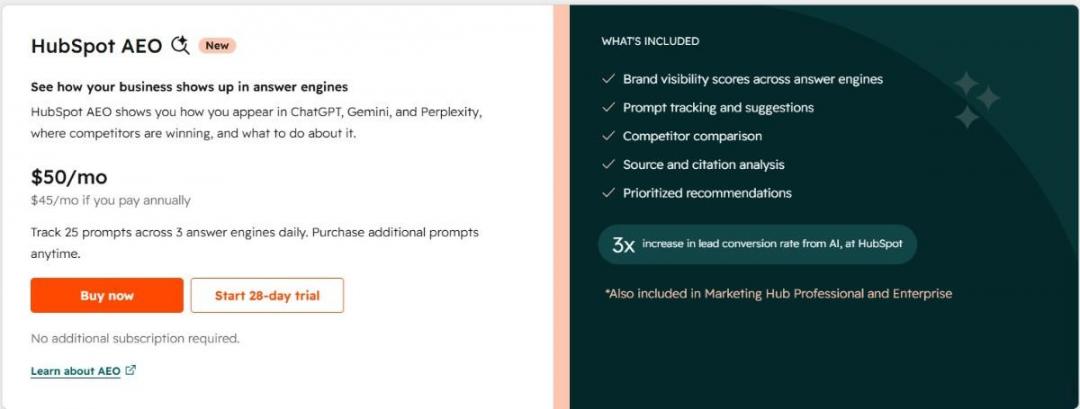
Image via HubSpot AEO
Usability: Low learning curve — purpose-built for marketing teams
Best For: Marketing teams who want a single platform for tracking, measuring, and acting on AI search visibility
2. Semrush
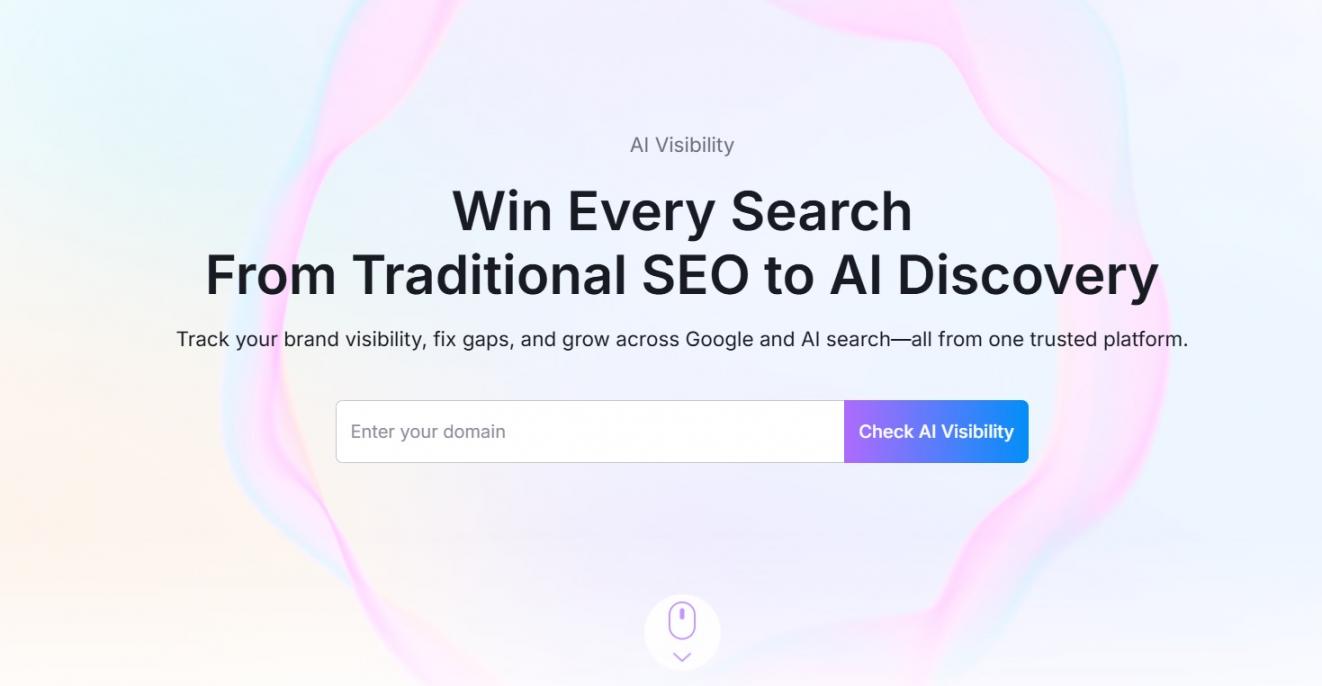
Image via Semrush
Semrush is a comprehensive SEO platform with AI visibility tracking built into its AI Visibility Toolkit.
It monitors brand appearances across ChatGPT, Gemini, Perplexity, Google AI Overviews, and AI Mode alongside traditional SEO data. That makes it a strong fit for teams that want both in one place.
Key Features
- AI visibility score across ChatGPT, Gemini, Perplexity, and Google AI Overviews
- Competitor share-of-voice and citation benchmarking
- Brand sentiment analysis
- Site audit checking for blocked AI crawlers
Pros
- Combines traditional SEO and AI visibility in one platform
- Strong competitive intelligence and data depth
Cons
- AI Visibility Toolkit is a $99/month add-on on the Classic SEO plans
- Can be overwhelming for smaller teams
Pricing
- AI Visibility Toolkit: $99/month/domain
- Semrush One (SEO + AI Visibility bundled): From $299/month
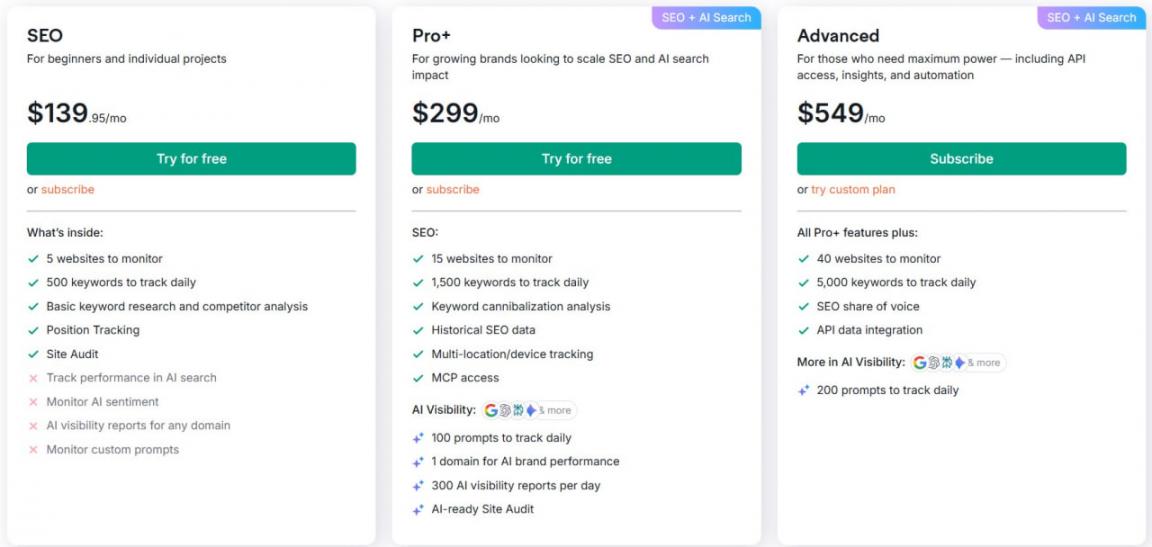
Image via Semrush
Usability: Moderate learning curve
Best For: SEO-focused teams wanting AI tracking within an existing workflow
3. Clearscope
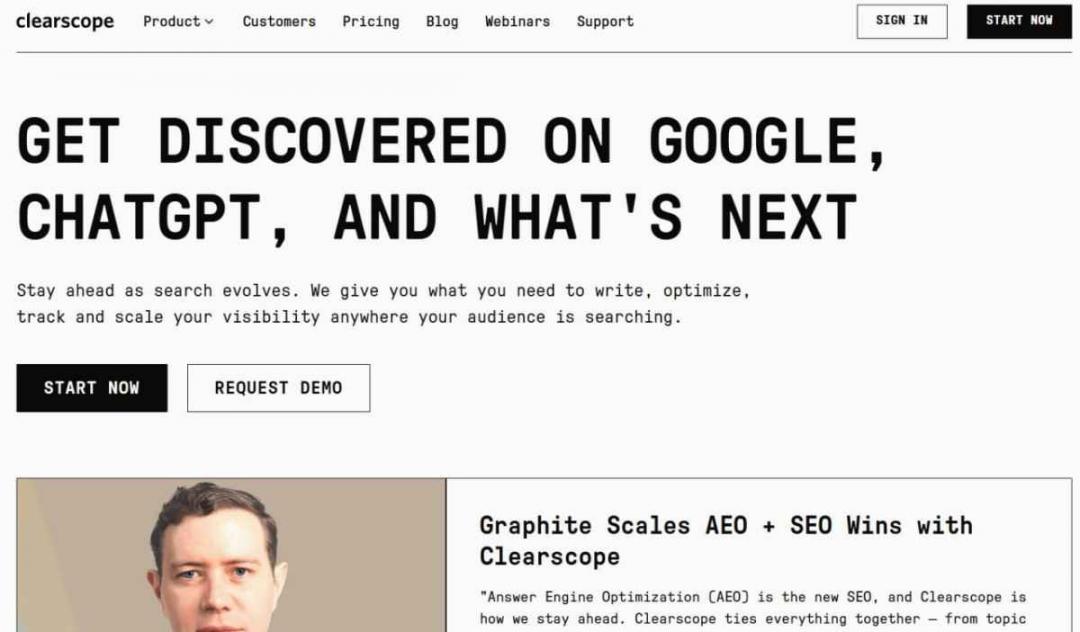
Image via Clearscope
Clearscope is an AI content optimization platform focused on semantic relevance and keyword coverage. It grades content in real time, surfacing related terms and entities so your articles cover a topic thoroughly.
It's Prompt Tracking feature measures how often your brand is cited across AI platforms like ChatGPT and Gemini. That gives you a clear baseline for tracking whether your content investments are influencing AI responses.
Key Features
- Real-time content grading against top-performing pages
- NLP-powered keyword and entity suggestions
- Prompt Tracking for AI brand citation measurement
- Google Docs and WordPress integration
Pros
- Strong semantic depth optimization
- Clean, intuitive interface with minimal setup
Cons
- AI citation tracking is limited to ChatGPT and Gemini
- No free plan available
Pricing
- Essentials: $129/month
- Business: $399/month
- Enterprise: Custom quote
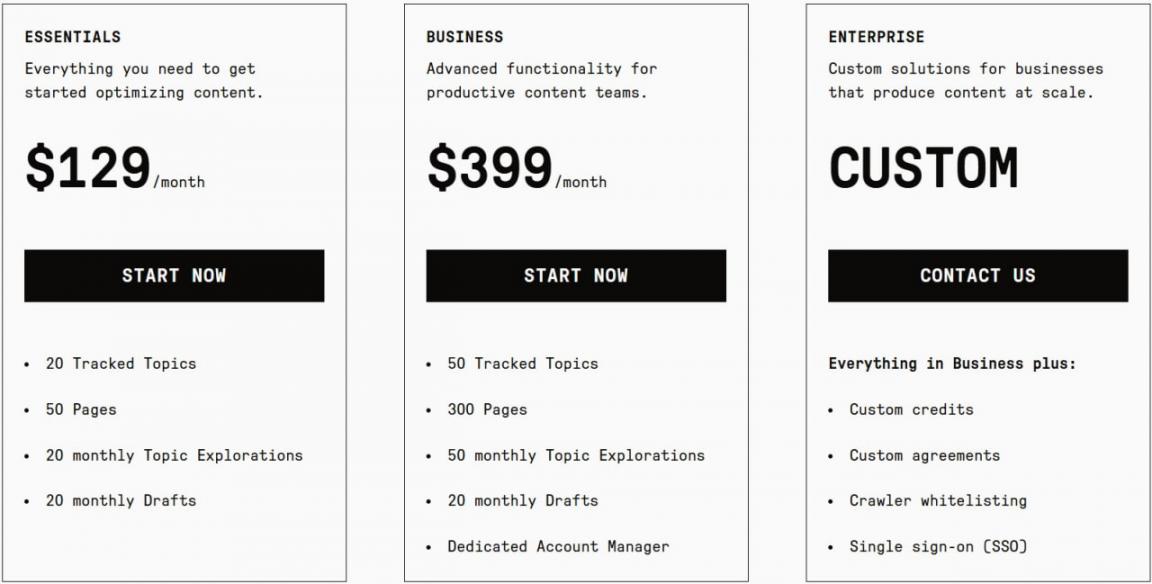
Image via Clearscope
Usability: Intuitive
Best For: Content teams that want semantic optimization and basic AI citation tracking in one platform
4. Surfer SEO
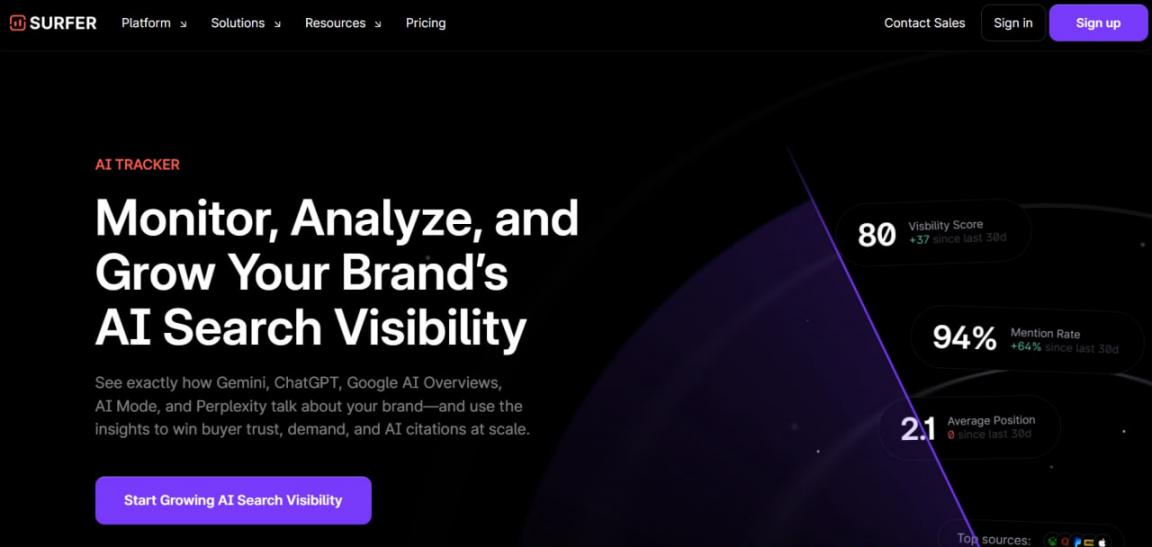
Image via Surfer SEO
Surfer SEO is an AI content optimization platform with visibility tracking built into its AI Tracker feature.
It scores your content against top-performing pages in real time and monitors brand mentions across ChatGPT, Perplexity, Google AI Overviews, Gemini, and AI Mode.
Key Features
- Real-time content scoring against top-ranking pages
- AI Tracker for brand visibility across five AI platforms
- Topical Map for content cluster planning
- Content Audit with refresh recommendations
- Mention Gap analysis showing where competitors appear in AI answers and you don't
Pros
- AI Tracker monitors sentiment and competitor share-of-voice
- One of the few tools that connects content creation directly to AI visibility tracking
Cons
- AI Tracker is limited to ChatGPT only on the Standard plan
- No free plan or free trial
Pricing
- Standard: $119/month
- Pro: $219/month
- Peace of Mind: $359/month
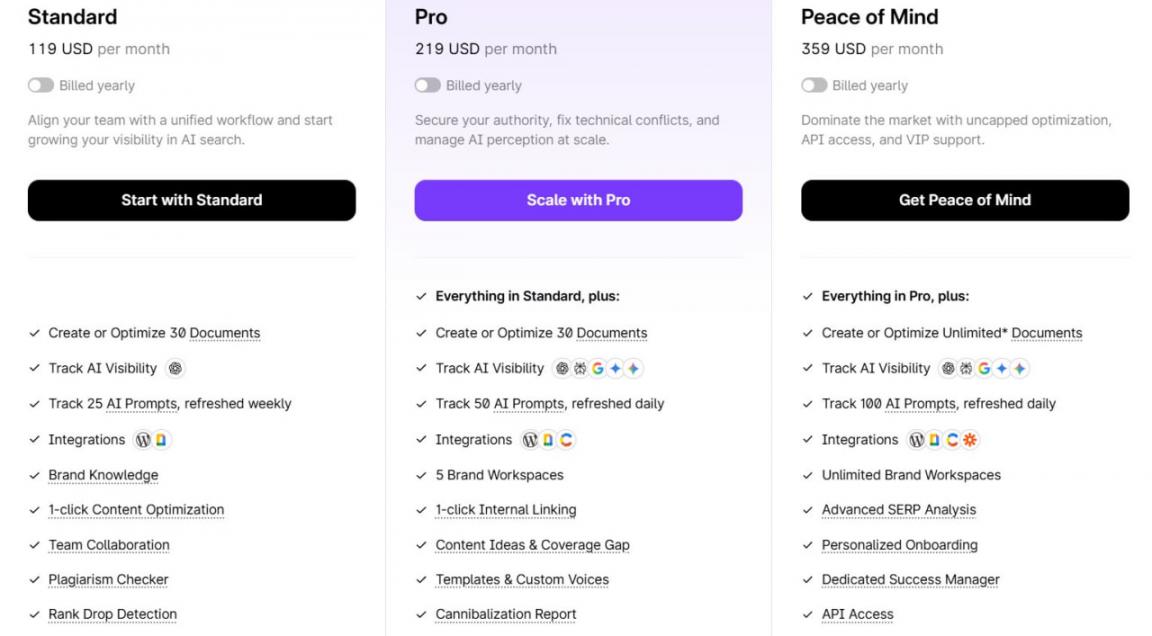
Image via Surfer SEO
Usability: Short learning curve with intuitive interface
Best For: Content teams that want real-time on-page optimization alongside AI visibility tracking
5. Frase
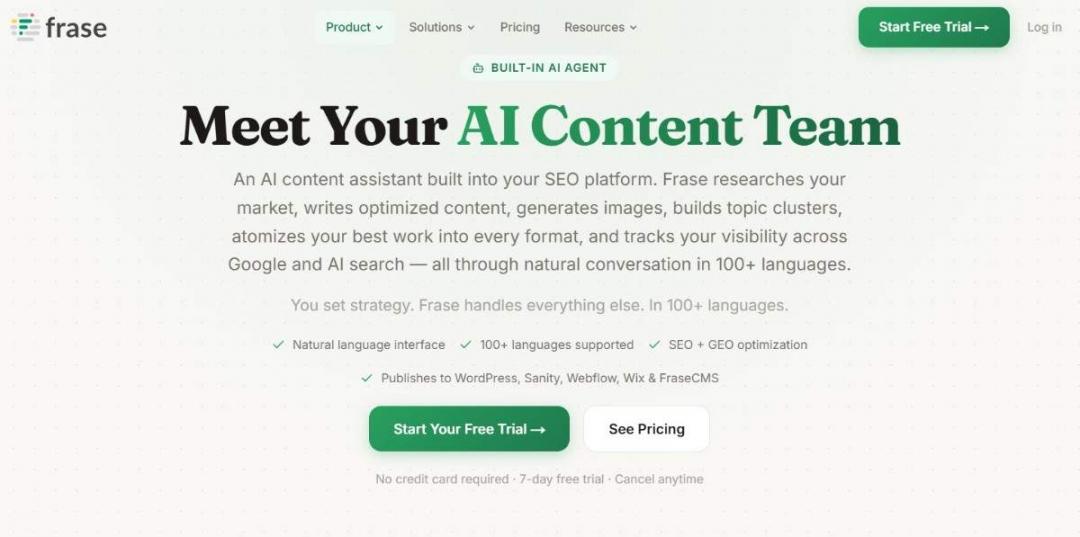
Image via Frase
Frase is an AI content optimization platform built for both traditional SEO and generative engine optimization.
Its dual scoring system gives you separate SEO and GEO scores in real time as you write. This allows you to create content that performs well in both traditional and AI search.
Human readers and AI systems both benefit from the clearer structure that the scoring encourages.
Key Features
- Dual SEO and GEO content scoring
- AI Search Tracking across ChatGPT, Perplexity, Claude, Gemini, and more
- AI Agent with 80+ skills for research, writing, and optimization
- Site audits and content opportunity monitoring
Pros
- One of the few tools with native dual SEO and GEO scoring built into the editor
- AI visibility tracking is included in every plan
Cons
- Less granular SERP data depth compared to other dedicated tools
- AI writing output requires human editing before publishing
Pricing
- Starter: $49/month
- Professional: $129/month
- Scale: $299/month
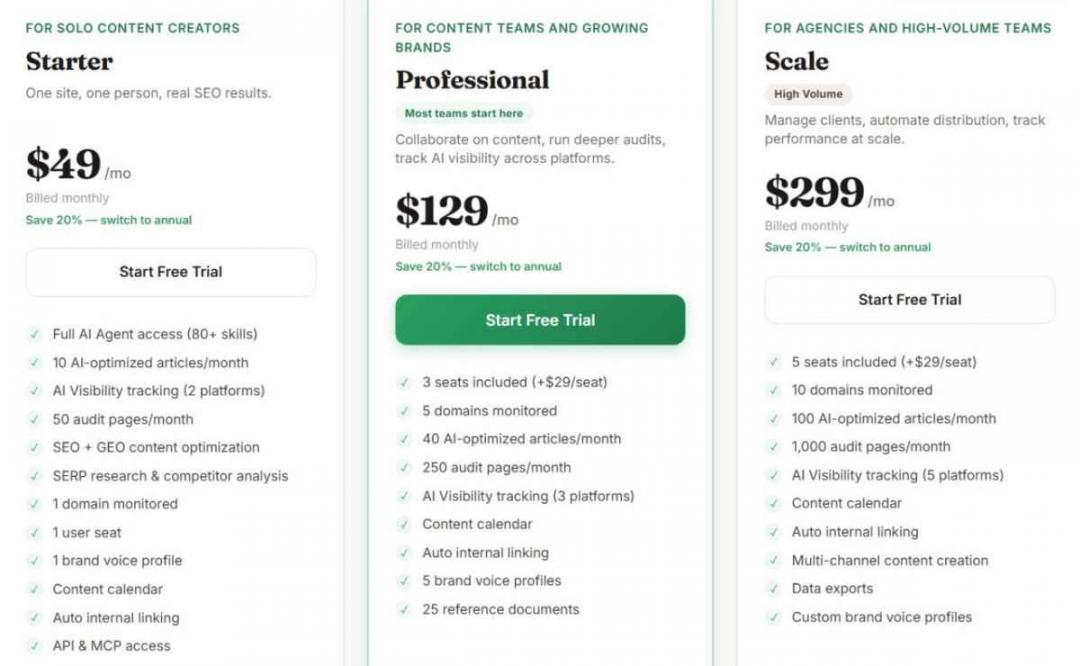
Image via Frase
Usability: Feature-rich interface with a short learning curve
Best For: Content teams that want SEO and GEO optimization in one platform
The right tool for AI optimization depends on where you are in the process. HubSpot AEO is the only option here that connects AI visibility tracking directly to CRM data. This makes its recommendations tailored to your business rather than generic benchmarks.
AI Content Optimization Best Practices
Getting the fundamentals of AI content optimization right matters. But the brands that consistently show up in AI-generated answers tend to follow principles that go beyond the basics.
Here's what separates content that gets cited from content that gets overlooked:
1. Answer the Implied Questions, Not Just the Stated Ones
AI systems often respond to queries by addressing related follow-up questions alongside the main one. Content that anticipates and answers those adjacent questions gets cited more broadly. Use Google's “People Also Ask” and AI-generated follow-ups to identify what those questions are before you write.
2. Monitor What AI Says About Your Brand
AI systems can misrepresent your brand information. This could include wrong pricing, outdated features, or misleading associations. Periodically audit what the top AI search engines actually say about you. Where inaccuracies exist, publish clear, authoritative content that corrects the record.
3. Lead With Original Data
First-party data from your own surveys, customer research, or audits is uniquely valuable because it's not available elsewhere. AI systems favor content that contributes something new to a topic over content that summarizes what's already out there.
4. Build Depth Before Breadth
AI systems reward comprehensive coverage of a specific topic more than shallow coverage of many. Dominate a few subject areas before expanding. Use strong internal linking for SEO to connect related content so AI crawlers can map your expertise.
5.Keep Your Brand Voice Consistent
Consistency in how your brand discusses a topic helps AI systems associate your content with that topic over time. Define your brand voice at the content system level and not just article by article.
6. Distribute Content Beyond Your Own Site
Publishing only on your own domain limits your citation footprint. PR coverage, guest posts, and earned media all contribute to AI visibility. A Stacker's study found that earned media distribution produces a median 239% lift in AI search visibility. That's compared to brands publishing only on their own site.
7. Build Content Update Cycles Into Your Calendar
AI search systems typically favor fresher sources. Scheduling regular content reviews is one of the most practical habits a content team can build. A solid content audit template makes that process faster and more consistent.
Also, teams using AI-powered email workflows can automate update reminders so nothing slips through.
The brands that show up consistently in AI answers lead with original data, distribute content beyond their own site, and treat content updates as an ongoing cycle.
Common AI Content Optimization Mistakes
Even teams with solid content foundations make avoidable errors when it comes to AI visibility. Here are five mistakes worth knowing before they cost you citations:
1. Optimizing Structure Without Improving Substance
Clean formatting and schema markup help AI systems read your content. But they won't get weak content cited. AI systems look for pages that genuinely answer a question well, and content quality is the deciding factor.
2. Chasing Citation Volume Over Citation Relevance
Appearing in AI answers unrelated to your business doesn't drive results. Optimize for the prompts your actual buyers are using. High citation volume means little if those citations aren't relevant to your business.
3. Publishing Unedited AI-Generated Content at Scale
After Google's March 2026 core update, mass-produced AI-generated content saw significant ranking drops. Human oversight is what adds accuracy, depth, and original insight to AI-generated content. A good set of AI detection tools can help you assess the quality of output before it goes live.
4. Neglecting Technical Access for AI Crawlers
Even great content is invisible if AI crawlers can't reach it. Firewall rules, CDN settings, and CMS configurations can quietly block GPTBot, CCBot, or Google-Extended.
5. Treating Content Length as a Proxy for Quality
Keyword stuffing and padding content to hit a word count without adding value (over-optimized content) reduces its citability. AI systems favor content that efficiently delivers useful information.
Structure and schema help AI systems read your content. But they won't get weak content cited — substance comes first. Optimization works on top of genuinely useful, accurate, well-researched content.
FAQ
Q1. What is AI content optimization?
A. AI content optimization is the process of structuring and writing content so AI systems can understand, extract, and cite it in their generated answers.
Q2. How is AI content optimization different from traditional SEO?
A. SEO targets keyword rankings in traditional search results. AI content optimization targets citations in AI-generated answers. Both are important in your content strategy, but they require different approaches to content structure and intent signaling.
Q3. Why does AI search visibility matter for my brand?
A. If AI systems don't cite your content, your brand is invisible where a growing share of buyers now search. AI-generated answers are driving more zero-click searches than ever. This means buyers get what they need without visiting any site at all. If you're not cited, you're not even in that conversation.
Q4. How often should I run AI content optimization updates?
A. For high-priority pages, aim to carry out AI content optimization updates every 30–60 days. AI engines favor fresher sources, and visibility can drop significantly without active content maintenance.
Q5. How does HubSpot AEO help with AI content optimization?
A. HubSpot AEO tracks your brand's visibility across ChatGPT, Perplexity, and Gemini. It identifies content gaps that hurt your AI presence and delivers plain-language recommendations, all from one dashboard.
The Takeaway on AI Content Optimization
The way buyers find information has shifted significantly, and AI content optimization is how brands stay visible in that new reality.
Start by auditing your existing content thoroughly. Then optimize its structure, track where you appear in AI answers, and close the gaps you find. Repeat that cycle consistently, and your visibility compounds over time.
If you want to see where you stand today, HubSpot AEO is a practical starting point at $50/month.
AI content optimization is how brands stay discoverable as search shifts from links to answers. Audit your content, optimize its structure, track your AI visibility, and consistently close the gaps.
Disclaimer: This content contains some affiliate links for which we will earn a commission (at no additional cost to you). This is to ensure that we can keep creating free content for you.