Choosing between HubSpot vs Klaviyo depends on how your business operates. Klaviyo is the stronger option for ecommerce and DTC brands that rely on email and SMS driven by shopping behavior. HubSpot Marketing Hub works better for B2B teams that need marketing connected to a wider CRM system. Both handle email well, but they differ in the type of business they are built to support.
For most ecommerce and DTC brands that grow through email and SMS, Klaviyo is the better pick. For B2B teams, or anyone who wants marketing on top of a full CRM, HubSpot Marketing Hub wins.
That is the short version of the HubSpot vs Klaviyo comparison, and it holds up across almost every rating that follows.
Many people compare HubSpot vs Klaviyo because both offer great email marketing tools. But the choice is about much more than sending emails. It is about choosing the platform that best supports the way your business attracts, manages, and keeps customers.
One platform is built around an online store and its customers. The other is built around a full customer database and the marketing that runs on it.
According to Fortune Business Insights, the marketing automation software market reached an estimated $7.23 billion in 2025 and is on track for $8.14 billion in 2026. So, the marketing software you pick now will shape years of campaigns.
By the end of this guide, you'll know which one between Klaviyo vs HubSpot fits your business, your budget, and your channels.
Disclaimer: This content contains some affiliate links for which we will earn a commission (at no additional cost to you). This is to ensure that we can keep creating free content for you.
Table of Contents
HubSpot vs Klaviyo: The Summary Box
Here is a quick overview of HubSpot vs Klaviyo.
| HubSpot Marketing Hub | Klaviyo |
|---|---|
 |  |
| HubSpot Marketing Hub is a marketing platform that works with HubSpot's CRM. It combines email marketing, marketing automation, customer data, and reporting in one place. Best for B2B businesses and teams that want marketing tools connected to a complete CRM. | Klaviyo is an ecommerce email and SMS platform built on real-time store data. Its edge is turning shopping behavior into automated revenue. Best for DTC and online retailers, especially on Shopify. |
HubSpot vs Klaviyo: Product Ratings
The ratings below are based on my hands-on assessment of each platform on a 5-point scale, not third-party scores. You'll find the G2 and Capterra ratings for HubSpot vs Klaviyo later in this guide.
| Criteria | HubSpot Marketing Hub | Klaviyo |
|---|---|---|
| Overall | ⭐⭐⭐⭐⭐ | ⭐⭐⭐⭐⭐ |
| Support | ⭐⭐⭐⭐⭐ | ⭐⭐⭐⭐ |
| Features | ⭐⭐⭐⭐⭐ | ⭐⭐⭐⭐⭐ |
| User-Friendliness | ⭐⭐⭐⭐ | ⭐⭐⭐⭐ |
| Value for Money | ⭐⭐⭐⭐ | ⭐⭐⭐⭐⭐ |
HubSpot Marketing Hub Pros and Cons
| Pros | Cons |
|---|---|
| All-in-one marketing platform with a built-in CRM | Cost climbs as contacts grow |
| Offers a generous free plan for getting started | Many advanced features require the Professional plan |
| Strong automation and reporting | Template editor can feel rigid |
| Huge integration ecosystem | Lacks the ecommerce features of a dedicated platform |
Klaviyo Pros and Cons
| Pros | Cons |
|---|---|
| Built for ecommerce stores | Does not include a built-in B2B sales CRM |
| Native email and SMS together | Cost climbs at high profile counts |
| Includes predictive analytics for customer lifetime value and churn | SMS credits expire monthly |
| Low entry price for stores | Learning curve for new teams |
HubSpot Marketing Hub Pricing Plans
| Pricing Plan | Cost (per month) |
|---|---|
| Free tools | $0 (up to 2 users) |
| Starter | $20/month/seat |
| Professional | $890/month/seat |
| Enterprise | $3,600/month |
Prices as of July 2026. Verify on HubSpot's pricing page. Professional and Enterprise add one-time professional onboarding fees.
Ready to try it? Get started with HubSpot.
Klaviyo Pricing Plans
| Pricing Plan | Cost (per month) |
| Free | $0 (up to 250 profiles, 500 emails) |
| $20 at 500 profiles | |
| Email + SMS | Email price + a mobile add-on (starts at $15 for up to 1,250 credits) |
Prices as of July 2026. Verify on Klaviyo's pricing page. Klaviyo scales by active profiles.
Verdict: HubSpot Marketing Hub wins for B2B and all-in-one teams that want marketing tied to a full CRM. Klaviyo wins for ecommerce and DTC brands that run on email and SMS. For most online stores, I would start with Klaviyo. For a growing or multi-channel business that needs a CRM, I would start with HubSpot. The deciding variable is your business model, not which one writes a prettier email.
HubSpot vs Klaviyo: Quick Comparison Table
The table below gives you a side by side comparison of HubSpot vs Klaviyo. Each category links to a detailed section later in this guide, where you can learn more about the differences between the two platforms.
| Criterion | HubSpot (Marketing Hub) | Klaviyo |
|---|---|---|
| Best For | B2B businesses and teams that need an all in one platform | Ecommerce and DTC brands |
| Core Focus | Marketing, automation, and Smart CRM in one platform | Ecommerce email + SMS marketing |
| Email Marketing | Strong, CRM-data driven | Strong, ecommerce-native |
| Automation and Flows | Omnichannel workflows, lead nurturing | Ecommerce flows (cart, post-purchase) |
| Native SMS | Includes SMS as a paid add-on | Yes, native (credit-based) |
| Segmentation and AI | Customer segmentation using CRM data with AI features | Real-time customer segments with predictive AI insights |
| Integrations | 2,000+ app marketplace + Shopify | 350+ apps, strong ecommerce and Shopify support |
| Free Plan | Yes (free tools) | Yes (250 profiles, 500 emails/month) |
| Starting Paid Price | Starter — $20/month/seat | Email from $20/month for 500 profiles |
| G2 Rating | 4.4/5 | 4.6/5 |
Prices and ratings as of July 2026. Verify current pricing on each vendor's site before relying on it.
HubSpot vs Klaviyo: Use Case and Persona Table
The easiest way to choose between HubSpot vs Klaviyo is to think about how your business operates. Check the use case that best matches your business, then read the detailed comparison below to see why that platform is the better fit.
| Your Business | HubSpot Fit | Klaviyo Fit | Best Fit |
|---|---|---|---|
| Shopify or DTC store | Works via Shopify sync | Built for it (real-time store data) | Klaviyo |
| B2B SaaS or services | Marketing linked to a full CRM platform | No sales pipeline | HubSpot |
| Inbound and content marketing | Native CRM + landing pages + blog | Marketing only | HubSpot |
| High-volume email + SMS retention | SMS is secondary | Native email + SMS in one place | Klaviyo |
| Ecommerce business that also handle B2B | Handles the CRM side | Handles the ecommerce side | Both |
| Solo founder or startup on a free plan | Free tools | Free up to 250 profiles | Tie |
Use Klaviyo if you are an ecommerce or DTC brand that runs email and SMS marketing. Use HubSpot Marketing Hub if you are B2B, run content and inbound, or want digital marketing connected to CRM. Many growing stores eventually run both.
How I Compared HubSpot vs Klaviyo
I compared HubSpot vs Klaviyo on the six criteria that matter most when choosing a marketing platform. These are the same criteria broken down in the detailed review below.
- Email Marketing and Campaign Creation: How easily each builds and personalizes emails.
- Marketing Automation, Flows, and SMS: The automated journeys each runs, and how native SMS marketing is.
- Segmentation, Data, and AI: How each platform segments audiences and what it predicts.
- CRM and All-in-One Depth: How much each does beyond digital marketing.
- Ecommerce Integrations: How deeply each plugs into Shopify and the rest of your stack.
- Pricing: What each costs, and the real cost as you scale.
I placed the most weight on ecommerce automation and long term pricing because those are the areas that matter most to many businesses comparing these platforms.
I also considered feedback from real users on G2, Capterra, and the Shopify and Klaviyo communities. I verified features and pricing using the official HubSpot and Klaviyo websites as of July 2026. Plus, I have also pointed out any details that should be checked again before you make a final decision.
HubSpot vs Klaviyo: Detailed Review and Comparison
Klaviyo performs better for ecommerce SMS and email marketing, while HubSpot Marketing Hub stands out for its all-in-one platform and CRM-powered marketing tools. The sections below compare both platforms across each key category and explain why each winner earned its place.
Email Marketing and Campaign Creation
Email remains one of the highest-ROI marketing channels, delivering up to $45 for every dollar spent, according to the Litmus 2025 report, which is why this choice matters.
For this category, both Klaviyo and HubSpot offer strong features, but they are built for different senders.
HubSpot Marketing Hub: A drag-and-drop builder with personalization pulled from any CRM field, plus predictive lead scoring on higher-tier paid plans (Professional and Enterprise).
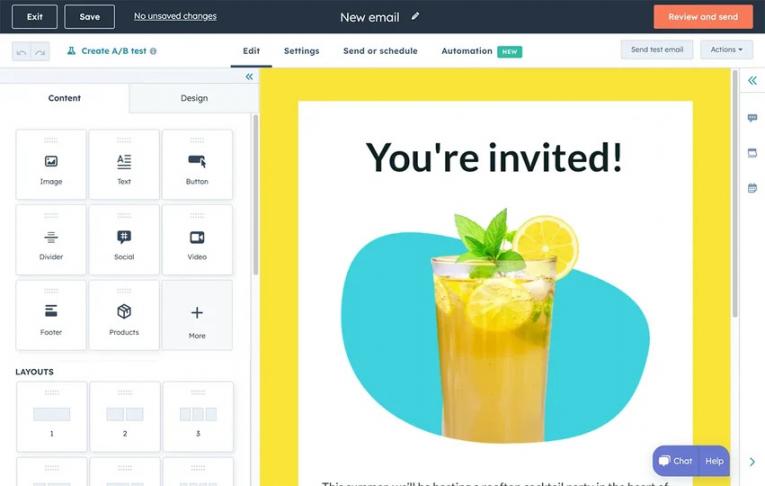
Image via HubSpot
HubSpot connects email marketing with its CRM platform, so you can personalize emails using details like a customer's lifecycle stage or other information stored in their profile. That level of personalization goes beyond simply adding a customer's name.
The CRM connection makes HubSpot a strong choice for B2B businesses and companies with longer sales cycles. You can automatically send emails when someone fills out a form, visits a page, or moves to a new stage in the sales pipeline.
You can also track how those emails contribute to lead generation, sales, and revenue. However, some HubSpot users say the email editor offers less design flexibility than they would like when creating highly customized branded emails.
Klaviyo: An email editor built for ecommerce. It includes product blocks, personalized product recommendations, and back-in-stock content that automatically pulls information from your online store.
You can also add recently viewed products to an email without manually importing customer or product data.
Klaviyo also offers 160+ customizable email templates. You can create welcome emails, abandoned cart reminders, product launches, and other ecommerce campaigns without starting from scratch.
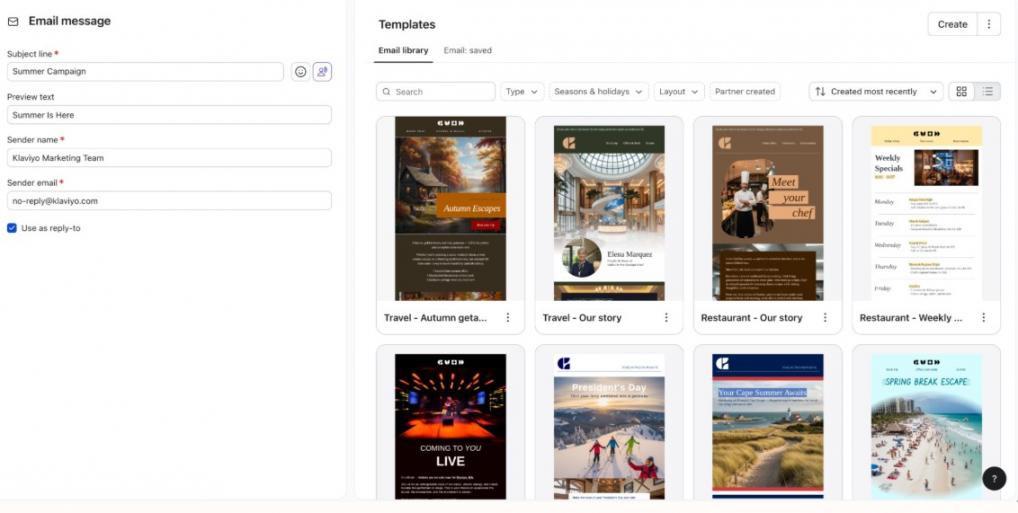
Image via Klaviyo
Many ecommerce businesses choose Klaviyo because of its strong reputation for email deliverability. But new users may need some time to learn the platform because it includes many features and settings.
Winner: Klaviyo for ecommerce email because of its product-focused features. HubSpot for B2B and CRM-driven email because of its customer lifecycle data.
Marketing Automation, Flows, and SMS
This is where HubSpot vs Klaviyo tend to differ. Klaviyo is built for ecommerce flows and native SMS, whereas HubSpot Marketing Hub is built for omnichannel sales workflows and lead nurturing. Both do marketing automation well, but they automate different journeys.
HubSpot Marketing Hub: HubSpot lets you build everything from simple automations to advanced multichannel workflows. You can automate emails, score leads, route prospects to the right sales team, trigger actions from forms, and guide leads through personalized customer journeys.
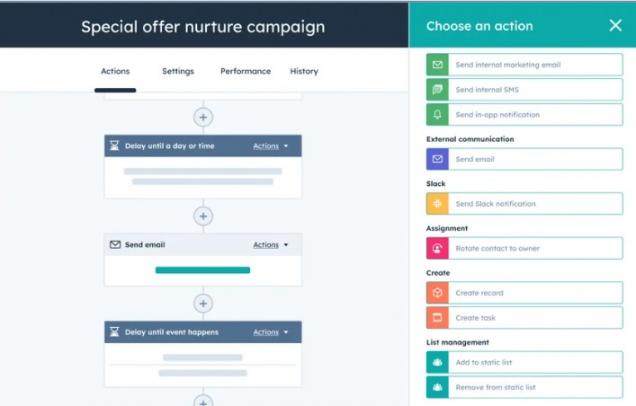
Image via HubSpot
It also includes AI tools to help you build workflows and manage customer engagement. Marketing and sales teams also work from the same CRM data, which keeps every interaction connected. SMS is available but as an add-on.
Klaviyo: Flows purpose-built for stores, including abandoned cart, welcome, browse abandonment, post-purchase, and win-back, all triggered by live behavior.
It also includes Flows AI, which lets you describe the automation you want in plain language. Flows AI then suggests the trigger and workflow before you customize the details.
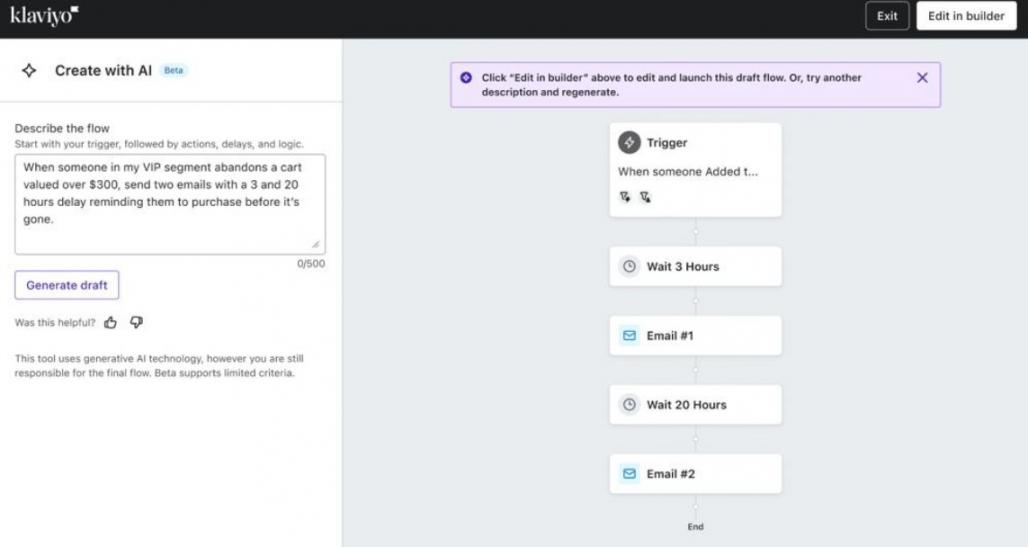
Image via Klaviyo
SMS is native and sits in the same flows as email, so you can blend channels in one automation. For a store, that single-canvas, behavior-first design is hard to beat.
This category matters because ecommerce automation pays off. Automated flows are about 5.3% of sends but generate roughly 41% of email revenue, according to Klaviyo's 2026 benchmarks across 183,000+ customers.
Winner: Klaviyo eads for ecommerce flows and native SMS. HubSpot for B2B lead nurturing and CRM-connected workflows.
Segmentation, Data, and AI/Predictive Analytics
In this segment of HubSpot vs Klaviyo comparison, both platforms offer advanced customer segmentation and AI features, but they use them in different ways.
HubSpot Marketing Hub: Lets you create customer segments using any data stored in your CRM. You can group contacts by lifecycle stage, email activity, website visits, form submissions, or custom properties.
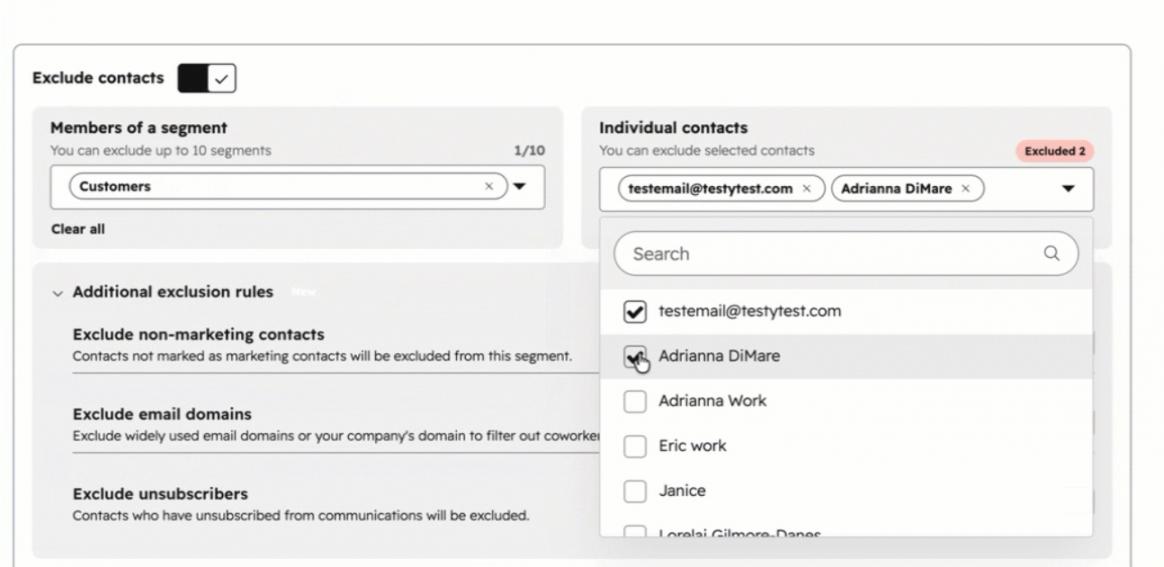
Image via HubSpot
HubSpot also includes AI tools to help create content, identify high-value leads, and improve campaign performance. Higher plans include multi-touch revenue attribution and customer journey analytics, so you get a complete view of your sales and marketing funnel.
Klaviyo: Updates customer segments in real-time as shoppers browse, buy, or leave your store. With the segment builder, you can use different filters and tags to create segment profiles.
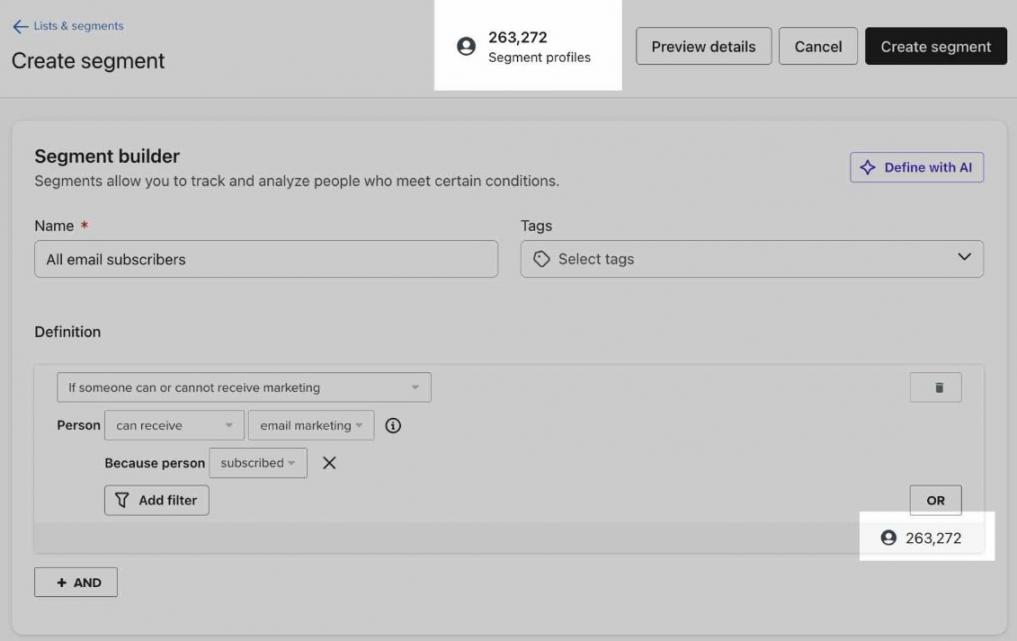
Image via Klaviyo
It uses Klaviyo AI (K:AI), its AI tool, to predict customer lifetime value, churn risk, and when a customer is likely to place their next order.
It can also group customers by Recency, Frequency, and Monetary value to help you create more targeted campaigns. According to Klaviyo's 2026 benchmarks, AI-powered product recommendations increase average email click rates to about 3.75%.
Winner: Klaviyo for ecommerce-behavioral prediction. HubSpot for cross-funnel segmentation and attribution.
CRM, Sales, and All-in-One Platform Depth
The biggest difference between HubSpot vs Klaviyo is the CRM. This is where HubSpot Marketing Hub pulls ahead because it runs on HubSpot's CRM, so your contacts, marketing data, and reporting all live in one place.
If customer relationship management beyond marketing matters to you, that unified foundation is the difference.
HubSpot: Its Marketing Hub is built on HubSpot's CRM, and it integrates with the Sales Hub. It stores contact data, lifecycle stages, and customer journey reports in one place.
For a business that also runs a sales pipeline, marketing data sits in the same system the sales team already uses, so the marketing-to-sales handoff is clean. This CRM-backed approach is the core of inbound marketing at HubSpot, and it is the reason B2B teams lean toward it.
Klaviyo: It brands itself as a B2C CRM, and that is fair as far as it goes. It unifies customer profiles, adds a self-service customer hub, and offers service tools, all tuned to a consumer relationship.
What it does not have is B2B sales machinery — no deal pipeline, no quote-to-close workflow, no rep-focused lead scoring. It manages buyers and their behavior, not a sales process, and for a pure ecommerce brand, that is usually enough.
Winner: HubSpot Marketing Hub, for marketing that runs on a real CRM. Klaviyo is a focused B2C marketing and customer platform.
Ecommerce Integrations and Ecosystem
Klaviyo is ecommerce-native; HubSpot is broader but less store-deep. Both connect to Shopify, but for different reasons.
HubSpot Marketing Hub: A large ecosystem with more than 2,000 native integrations in its App Marketplace, plus a native Shopify data sync for customers, orders, and products.
You can connect HubSpot with your CRM, CMS, webinar platform, and many other third-party tools. The Shopify integration works well, but it is only one part of HubSpot's larger ecosystem.
Klaviyo: 350+ integrations with dedicated connections to Shopify, BigCommerce, WooCommerce, Magento, and Wix. Catalog, behavior, and order data flow in cleanly to power product blocks, flows, and predictions.
Klaviyo integrations are fewer than HubSpot, but its ecommerce connections are deeper.
Winner: Klaviyo for ecommerce-store depth. HubSpot for a breadth of business-app integrations.
HubSpot Marketing Hub is marketing built on an all-in-one CRM, best for B2B and full-funnel teams. Klaviyo is an email and SMS platform built on real-time store data, best for ecommerce businesses. The right pick follows your business model.
HubSpot vs Klaviyo: Pricing Comparison
On pricing, “cheaper” depends entirely on what you are buying. The plan tables are in the Summary Box above. Here is a breakdown of how HubSpot compares with Klaviyo in cost as you scale.
HubSpot Marketing Hub: It charges per seat and marketing contact and bundles a whole platform. As your contact count crosses a tier, the cost automatically steps up, so the bill grows with your database. Real marketing automation and reporting begin at the Professional tier, which is a meaningful jump from the Starter price.
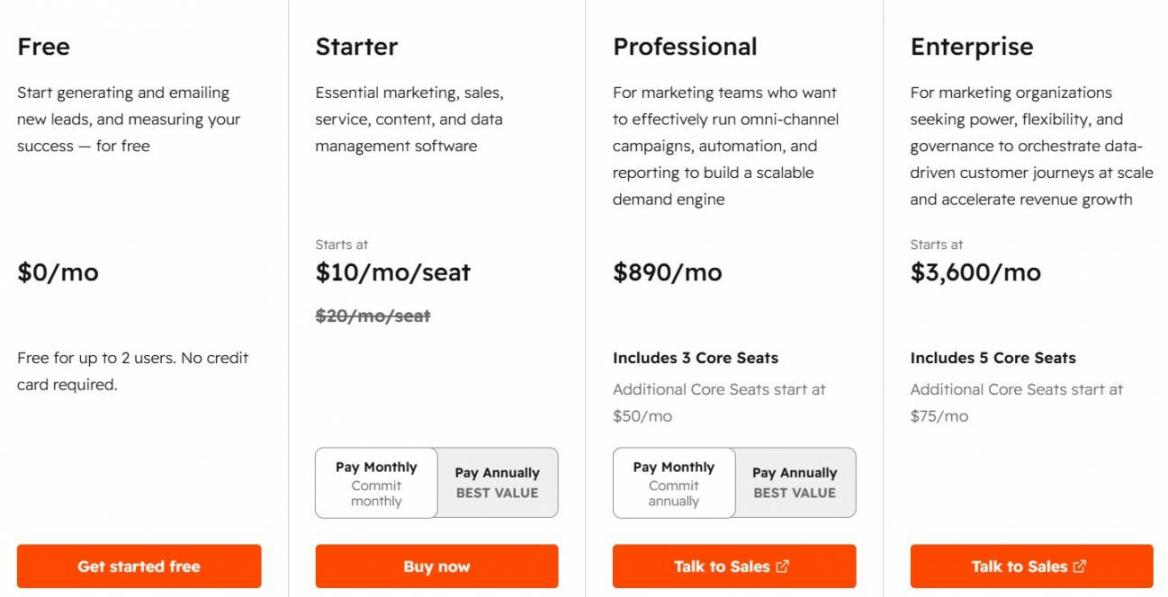
Image via HubSpot
Klaviyo: It charges by active email profiles and SMS credits. It is simple and cheap to start, but the cost can climb steeply at high-profile counts, especially if part of your list is not engaged.
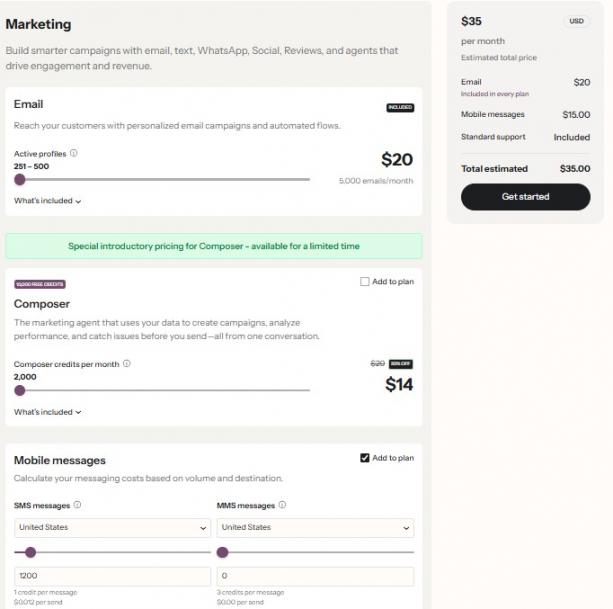
Image via Klaviyo
An ecommerce brand that only needs email marketing for a few thousand contacts will pay Klaviyo less each month than HubSpot's Professional tier.
But those are not the same purchase. Klaviyo's price only gets ecommerce messaging, while HubSpot's offers marketing plus a full CRM, so the fair comparison should be the value provided.
Winner: For a pure ecommerce email and SMS use case, Klaviyo has the lower-entry point and a simpler model. It is the better-value choice if you only need messaging and marketing for ecommerce brands.
HubSpot's price gets marketing features and CRM, not just email. For businesses that also need pipeline management, sales tools, and customer data in one place, the higher price can replace multiple separate subscriptions.
Klaviyo has a lower entry price for ecommerce email and SMS. HubSpot Marketing Hub costs more because it bundles marketing, automation, and sales with a full CRM. They bill on different models, so map the cost to what you actually need.
HubSpot vs Klaviyo: What Real Users Say About Them
Beyond my own assessment, here is how real users rate HubSpot vs Klaviyo on two reputable review sites, with a representative review for each.
| Platform | G2 rating | Capterra rating | A representative user review |
|---|---|---|---|
| HubSpot Marketing Hub | 4.4/5 (14,833 reviews) | 4.5/5 (6,239 reviews) | Jo D. “Everything is in one place, ease of use for the whole team. We have integrations rolling with Google Sheets, Slack and Sales Navigator. Good value for our whole business with us being able to have good visibility alongside tracking performance on the marketing team. We have a great CSM who checks in regularly and is currently helping us with the AI side of Hubspot mainly the AEO setup.” |
| Klaviyo | 4.6/5 (1,355 reviews) | 4.6/5 (530 reviews) | Tejas K. “What i like most about klaviyo is how simple it makes email marketing automation. i user it my projects, and setting up flows like welcome emails or abandoned cart is very easy.The segmentation is powerful and helps target the right audience, I also like the custimization options for camagians. The analytis give clear insignts into performance. Overall, it saves time and works reliably once everything is set up.” |
Ratings and review counts as of July 2026.
Both platforms are rated highly. Klaviyo edges ahead in user satisfaction among ecommerce senders, while HubSpot carries far more reviews across a broader product. The recurring theme for HubSpot vs Klaviyo is the same — users love what each does.
Ecommerce businesses often prefer Klaviyo because it works well with Shopify and offers strong ecommerce automations. B2B companies and larger marketing teams usually favor HubSpot Marketing Hub because it gives teams one place to manage campaigns and customer relationships.
HubSpot vs Klaviyo: Which One Should You Choose?
The choice between HubSpot vs Klaviyo comes down to your business model and channel mix. Use the checklist below to guide your decision.
| Choose HubSpot Marketing Hub if… | Choose Klaviyo if… |
|---|---|
|
|
|
|
|
|
|
|
Consider running both if you sell online and also need a CRM, or you are scaling an ecommerce brand into B2B or wholesale. Klaviyo works for the store messaging, while HubSpot handles the CRM and broader marketing.
FAQ
Q1. Is Klaviyo better than HubSpot?
A. Klaviyo is a better choice if your business depends on ecommerce marketing and customer retention. HubSpot is a better option if you need a platform that combines marketing, sales, and customer management. The best choice depends on your business goals rather than the size or popularity of the platform.
Q2. Is Klaviyo a CRM?
A. Klaviyo is a B2C, customer-data CRM built for ecommerce, with customer profiles and service tools. It is not a B2B sales CRM. It has no deal pipeline or sales-rep workflow, which is where HubSpot's CRM leads.
Q3. Can you use HubSpot and Klaviyo together?
A. Yes. Using both platforms together is a good option if one tool cannot meet all of your needs. Many growing businesses use Klaviyo to power ecommerce email and SMS campaigns while HubSpot manages customer data, sales activities, and lead nurturing. Integrating both platforms keeps customer information in sync and gives each platform a specific role.
Q4. Is HubSpot good for ecommerce?
A. HubSpot Marketing Hub works for ecommerce through its Shopify data sync and broad app marketplace, and it shines if you also want a CRM. For pure, high-volume store messaging, a store-native tool like Klaviyo usually offers deeper ecommerce flows.
Q5. Does HubSpot have SMS like Klaviyo?
A. Yes, HubSpot supports SMS marketing through add ons and integrations rather than as a core feature. Klaviyo includes native SMS marketing, allowing you to manage email and SMS campaigns together in the same automated workflows.
Q6. Is Klaviyo or HubSpot cheaper?
A. Klaviyo is generally more affordable for ecommerce businesses because it has a lower starting price for email and SMS marketing. HubSpot usually costs more because it includes a full CRM along with marketing, sales, and customer service tools. The better value depends on the features your business needs and how you plan to use the platform.
Q7. Which is better for a Shopify store, HubSpot or Klaviyo?
A. Klaviyo is usually the better choice for Shopify stores because it has a deep integration with Shopify and includes features built specifically for ecommerce. HubSpot is a better option if your store also needs a CRM to manage leads, customer relationships, and sales activities alongside marketing.
Q8. Which has better email deliverability?
A. Both platforms have a good reputation for email deliverability. However, inbox placement depends more on the quality of your email list, the relevance of your content, and your sending practices than on the platform itself. Following email marketing best practices will have a much greater impact on your results.
Q9. Should B2B companies use Klaviyo or HubSpot?
A. B2B companies are better served by HubSpot Marketing Hub. It offers the CRM-backed marketing, lead scoring, and nurturing workflows that supports longer sales cycles, none of which is Klaviyo's focus.
Conclusion
When deciding between HubSpot vs Klaviyo, the right answer depends on your business model. Klaviyo is the better pick for ecommerce and DTC brands that grow through email and SMS, thanks to its store-native flows and predictive analytics.
HubSpot Marketing Hub is the stronger fit for B2B teams and businesses that want marketing connected to a robust CRM system. The real decision comes down to whether you need a dedicated ecommerce marketing platform or a broader system for managing customer relationships.
If your business needs marketing and CRM in one place, get started with HubSpot and see if it fits your team.
Disclaimer: This content contains some affiliate links for which we will earn a commission (at no additional cost to you). This is to ensure that we can keep creating free content for you.