AI tools for customer success fall into four groups. These are dedicated CS platforms, conversation and email intelligence, support and ticketing AI, and engagement tools.
For most teams, I'd start with HubSpot for an all-in-one Service Hub and timetoreply for email response analytics. Add Gainsight or ChurnZero when you need full customer success management. Your team’s size as well as how you connect with clients should ultimately influence your choice.
Customer success teams manage more accounts every year, but headcount rarely keeps pace. AI helps close that gap by automating repetitive work, surfacing risks, and helping teams respond faster.
According to Gainsight's 2025 Customer Success Index, 52% of customer success teams already use AI. Those teams report saving more than 10 hours each week on manual tasks.
I researched and tested these tools, checked real G2 ratings and current prices, and matched each to its best use. Here’s how the top AI tools for customer success stack up, and how to pick the right one for your team.
Disclaimer: This content contains some affiliate links for which we will earn a commission (at no additional cost to you). This is to ensure that we can keep creating free content for you.
What Are AI Tools for Customer Success?
AI tools for customer success are software platforms that use machine learning and generative AI. They predict churn, automate routine CS work, and surface the accounts that need attention.
These tools turn scattered signals like product usage, emails, and support tickets into health scores and alerts. That helps customer success teams support more customers without adding headcount.
The 4 Types of AI Customer Success Tools
AI tools for customer success generally fall into four categories. Each category focuses on a different stage of the customer journey, from engagement and onboarding to support and ticketing.
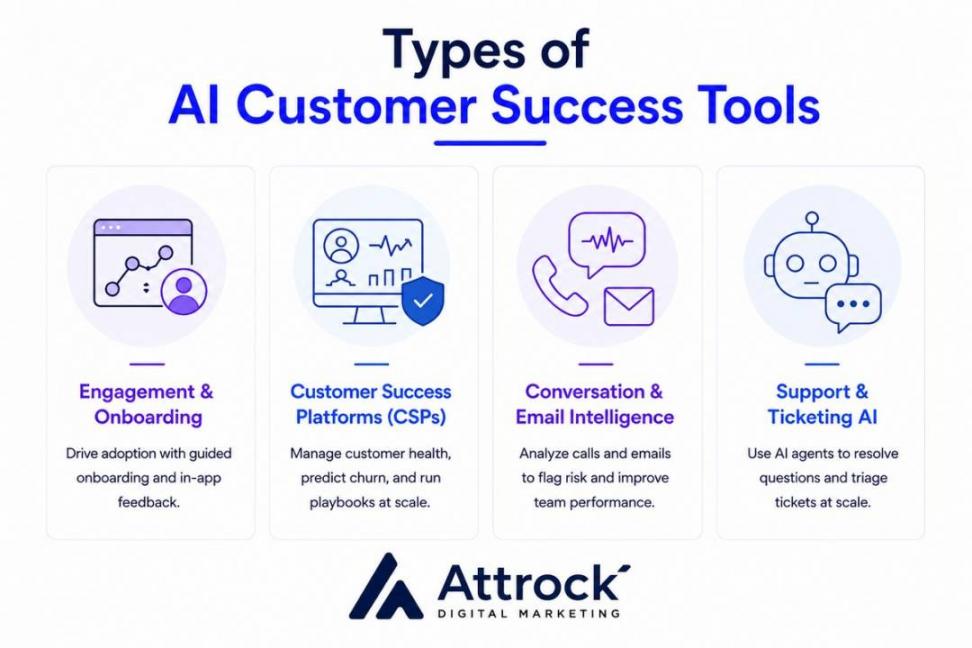
Image via Attrock
- Engagement and Onboarding: Product-led tools that drive adoption through guided onboarding and gather feedback in-app. Pendo is the clearest example here.
- Dedicated Customer Success Platforms (CSPs): Purpose-built for CS, with health scoring, churn prediction, and playbooks. Examples include Gainsight, ChurnZero, Vitally, Totango, and Planhat.
- Conversation and Email Intelligence: Tools that analyze calls and inboxes to flag risk and coach teams. Gong covers calls, while timetoreply tracks email response times and SLA performance.
- Support and Ticketing AI: AI agents that resolve customer questions and triage tickets at scale. Examples include Intercom's Fin, HubSpot's Breeze Customer Agent, and Salesforce Agentforce.
One term worth defining is agentic AI. It's software that acts on its own, resolving a ticket or updating a record instead of just suggesting it. It's the fastest-moving part of this market in 2026.
Software that predicts churn, automates CS busywork, and flags at-risk accounts. The four types are CS platforms, conversation and email intelligence, support and ticketing AI, and engagement tools.
How AI Is Transforming Customer Success
AI helps customer success teams in three main ways: spotting risks sooner, acting faster, and managing more accounts without hiring more people. That’s why automation tools have become standard in just two years.
Here's where AI tools for customer success earn their keep:
- Churn Prediction and Health Scoring: Models read usage, support, and sentiment data to flag accounts before they go quiet. That gives you time to intervene while you still can.
- Onboarding at Scale: AI personalizes onboarding steps and automatically answers common setup questions. This protects time-to-value for every new customer.
- Meeting Prep and Follow-Ups: AI joins calls, writes the recap, and logs it to the CRM. A 2025 Salesforce report found reps using AI spend 20% less time on routine tasks.
- Expansion Signals: Usage patterns surface upsell and cross-sell moments a CSM would otherwise miss. These signals turn passive accounts into active revenue opportunities.
- Voice of Customer: Sentiment analysis turns email and ticket text into early warning signs. It also generates coaching data your team can act on.
- 24/7 AI Agents: Autonomous agents answer routine questions any hour of the day. That frees up humans to focus on the judgment calls.
The pattern is consistent. AI takes the repetitive work, and the CSM keeps the relationship.
To predict churn, automate onboarding and follow-ups, surface upsell signals, analyze customer sentiment, and run 24/7 support agents. It frees CSMs for strategic, relationship work.
How I Evaluated the Best AI Tools for Customer Success
I chose these tools as I would recommend them to a client, not as a vendor would sell them. My goal was to create an honest shortlist that a real CS leader can use.
Each of these AI tools for customer success had to clear six bars:
- Genuine AI capability, not a chatbot bolted onto old software
- Customer success fit, so the AI moves CS metrics like retention and time-to-value
- Integrations with the CRM and the inbox your team already uses
- Transparent or verifiable pricing, in original monthly USD
- Verified user sentiment from G2, Capterra, and real practitioners
- Value at your stage, since a 5-person team and a 50-person team need different things
I checked each rating against its live G2 or Capterra profile and verified every price on the vendor’s pricing page. If I couldn’t confirm a number, I flagged it instead of guessing.
Real AI capability, CS fit, integrations, honest pricing, verified reviews, and fit for your team's stage. Ratings and prices were checked against live sources.
Quick Comparison of AI Customer Success Tools
Below is a comparison table of AI tools for customer success, outlining best use cases, capabilities, pricing, and ratings.
| Tool | Best for | AI capability | Starting price | G2 rating | Free option |
|---|---|---|---|---|---|
| HubSpot Service Hub | All-in-one CS + support + CRM | Breeze AI agent, copilot, health | $20/seat/month | 4.4/5 | Free plan |
| timetoreply | Email response analytics | conversation summaries, real-time agent help | $38/mailbox/month | 4.3/5 | Free trial |
| Gainsight | Enterprise CS operations | Churn prediction, Staircase AI | Custom | 4.5/5 | Demo only |
| ChurnZero | Mid-market SaaS | AI summaries, health, journeys | Custom | 4.7/5 | Demo only |
| Vitally | Modern, customizable CS | AI Copilot, meeting recorder | Custom | 4.5/5 | Demo only |
| Totango | Fast-scaling teams | Health, expansion signals | Custom | 4.3/5 | Demo only |
| Planhat | Complex, data-heavy CS | Health, automation, BYO-LLM | Custom | 4.5/5 | Demo only |
| Gong | Conversation intelligence | Call analysis, risk signals | Custom | 4.7/5 | Demo only |
| Intercom | Support deflection | Fin autonomous AI agent | $0.99/resolution | 4.5/5 | 14-day trial |
| Pendo | Product-led, digital CS | Product AI, feedback synthesis | Custom | 4.4/5 | Free plan |
| Salesforce Agentforce | Salesforce-native enterprises | Agentforce, Einstein | $2/conversation | 4.4/5 | Free trial |
All prices are original monthly USD, verified against each vendor's pricing page where public. “Custom” means quote-only. Ratings link to the live source profile.
How to Choose the Right AI Customer Success Tool
Match the tool to your customer success approach and team size, not your wish list. An all-in-one platform like HubSpot handles several tasks, while a specialist tool excels at one. A five-person team running email-led CS needs something different from a 50-person enterprise operation.
Choose Your AI Customer Success Tool If
Here's how to narrow it down, based on your team size and your CS motion.
By team size:
- 1–10 CSMs: HubSpot Service Hub, timetoreply, or Pendo's free tier
- 11–25 CSMs: ChurnZero, Vitally, or Totango
- 26–100 CSMs: Gainsight, Planhat, or Salesforce Agentforce
By motion/approach:
- High-touch enterprise: Gainsight, Planhat, Gong
- Low-touch / digital CS: Pendo, Vitally, HubSpot
- Email-led customer-facing teams: timetoreply
- Support-led CS: Intercom Fin, HubSpot, Salesforce Agentforce
5 Questions to Ask Before You Sign
Before you sign, run the tool through these five checks:
- Is the AI real, or bolted on? Look for health scoring, predictive analytics, and autonomous resolution, rather than a simple AI chatbot.
- Will it read my data safely? Confirm SOC 2, data residency, and an option to exclude your data from model training (more on this below).
- Does it fit my stack? Native CRM and inbox integrations make adoption much easier.
- What's the real total cost? Per-resolution and credit pricing can become expensive as your customer base grows.
- What happens at renewal and scale? Make sure the pricing and data model can scale with your business.
If you want a more detailed guide, check out my customer retention walkthrough.
Start with your team size and customer success approach, then decide whether you need an all-in-one platform or specialist tool. Finally, compare AI features, integrations, security, pricing, and scalability.
11 Best AI Tools for Customer Success in 2026
Here are the 11 tools, starting with the most versatile options. Each section explains what the tool does, where it fits best, its pros and cons, and current pricing.
1. HubSpot Service Hub
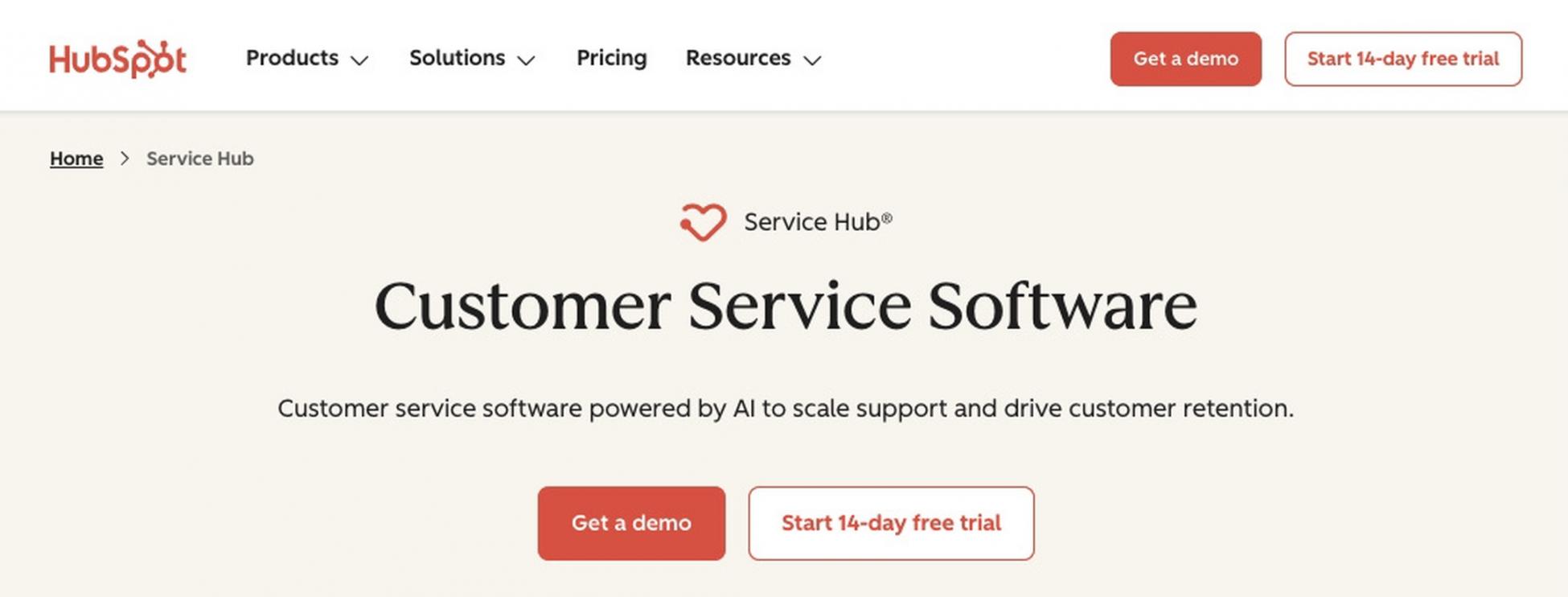
Image via HubSpot
HubSpot Service Hub is a strong starting point for teams that want AI tools for customer success inside a single platform. It runs on HubSpot’s Smart CRM and uses Breeze AI to support service operations.
Service Hub combines help desk, knowledge base, customer portal, and SLA tracking in one system. With Breeze AI, it helps draft replies, summarize conversations, and flag at-risk accounts before churn risk grows.
The platform is best suited for SMB and mid-market teams seeking unified customer success, support, and CRM capabilities.
Key Features
- Breeze Copilot: Summarizes tickets, drafts replies, and surfaces account context from the Smart CRM
- Breeze Customer Agent: An autonomous AI agent that resolves common customer questions around the clock across channels
- Help Desk and Tickets: Shared inbox, routing, SLAs, and a self-service knowledge base
- Customer Portal and Feedback: NPS, CSAT, and surveys track sentiment over time
Pros
- Breeze grounds its answers in your real customer data
- One platform for CRM, support, and AI, which lowers total cost for growing teams
- Genuinely easy to adopt, with a usable free tier to start
Cons
- The Breeze Customer Agent is usage-priced on top of a seat, so heavy volume adds up
- Less specialized than a dedicated CSP for deep churn modeling
- Advanced reporting sits in the higher tiers
Pricing
- Free
- Starter: $20 per seat/month
- Professional: $100 per seat/month
- Enterprise: $150 per seat/month
- Breeze Customer Agent: $0.50 per resolved conversation
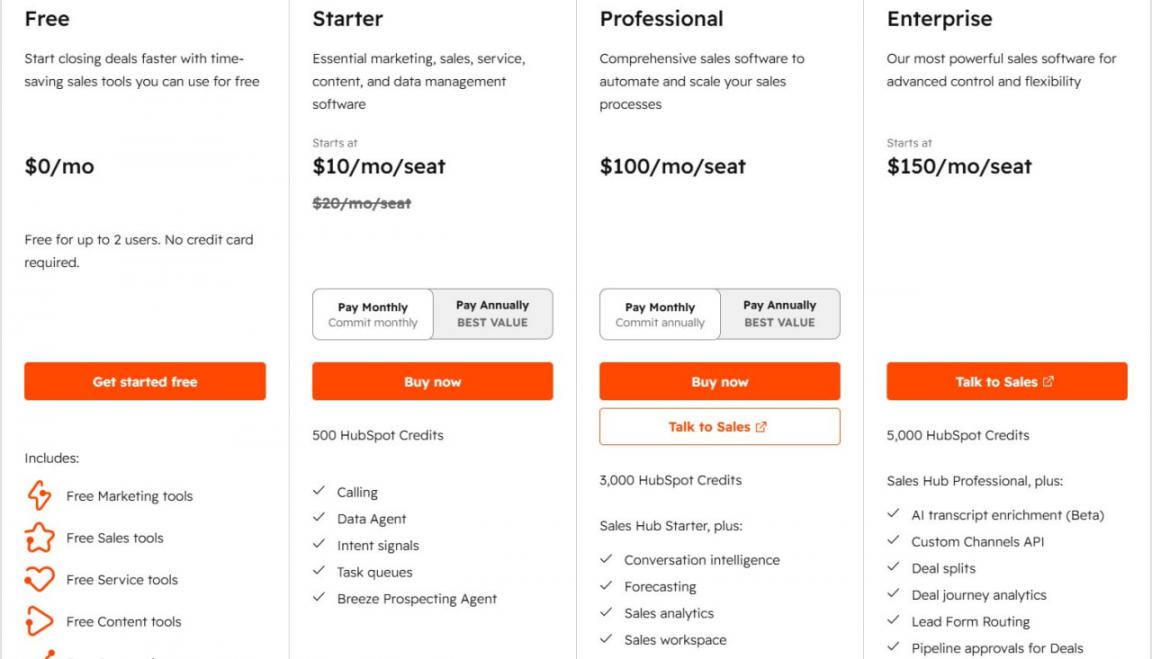
Image via HubSpot
Tool Level
- Beginner to Intermediate
Usability
- One of the easier platforms to roll out, with strong onboarding and a large template library
Pro Tip: Start with free tools and enable Breeze Copilot first. Only move to the autonomous agent after your team trusts AI-generated replies.
2. timetoreply
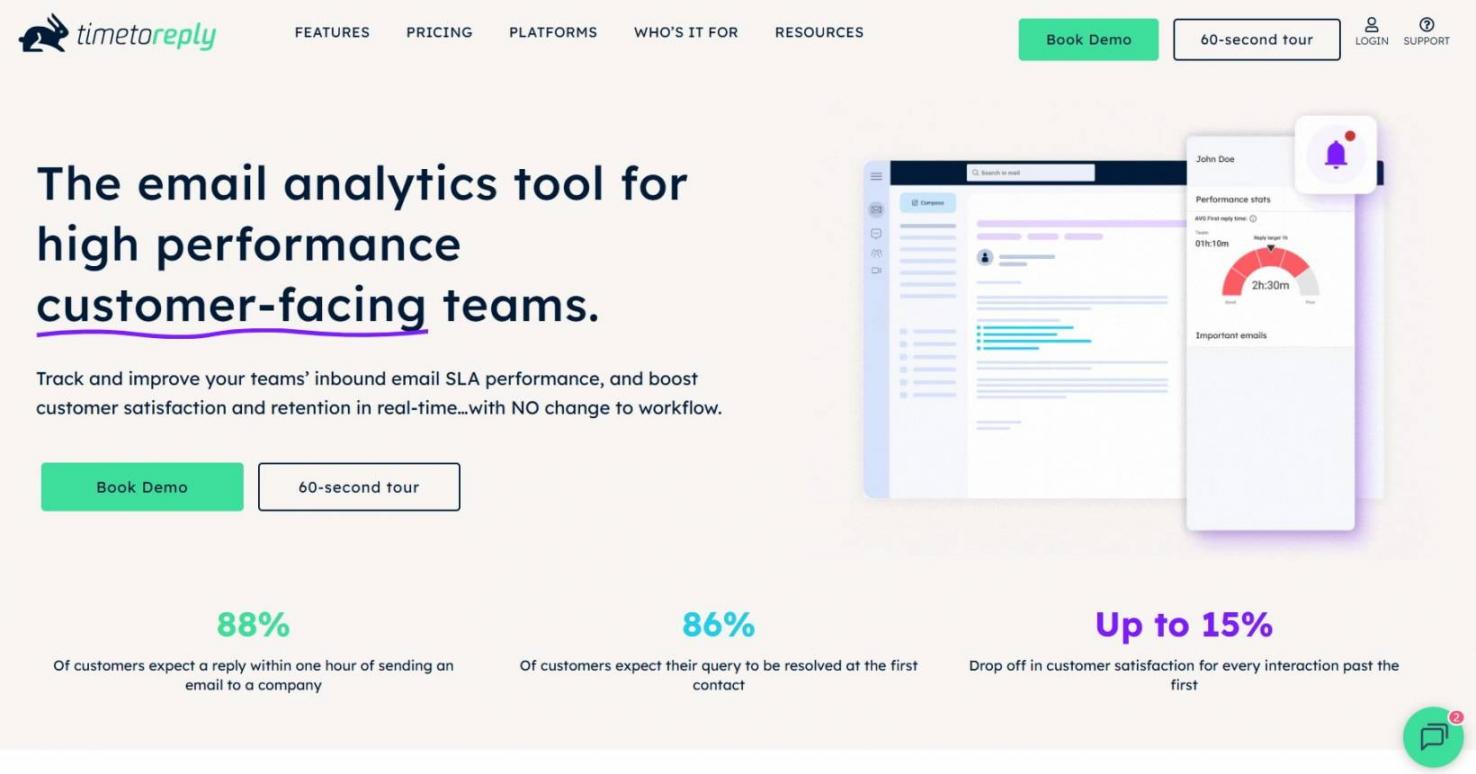
Image via timetoreply
Among AI tools for customer success, my top pick for email response analytics is timetoreply. You can use it to track reply times, SLAs, and team performance across Outlook, Microsoft 365, and Gmail.
Its results are hard to ignore. Ontellus raised email responsiveness from 62% to 86%. Meanwhile, Telarus cut response times in some teams from seven hours to two.
For mid-market and enterprise customer-facing teams that need SLA accountability, timetoreply is perfect. These include email-intensive industries such as travel, logistics, insurance, and professional services.
Key Features
- Shared-Mailbox Analytics: Provides visibility into group inboxes, leaderboards, and per-agent performance
- Response-Time and SLA Tracking: Set reply-time goals by team, customer, or account tier, with at-risk alerts
- Email Volume and Workflow Balancing: Highlights bottlenecks and volume spikes so teams can reallocate resources and prevent service risks early
- In-Inbox Coaching: Live stats and prioritized queues without changing how the team works
Pros
- Works inside the inbox your team already uses, with no workflow change
- Strong security posture (SOC 2 Type II, ISO 27001, HIPAA, and GDPR), plus header- and metadata-only analysis without reading message content
- Measures email responsiveness, a blind spot most CS tools ignore
Cons
- Email-led, not a full customer success platform with product usage health scores
- Built for teams with 15 or more mailboxes, so small teams need timetoreply lite
- Identifies service delays but can't predict churn trends or percentages
Pricing
- Essentials: $38 per mailbox/month
- Pro: $44 per mailbox/month
- Premier: Custom pricing
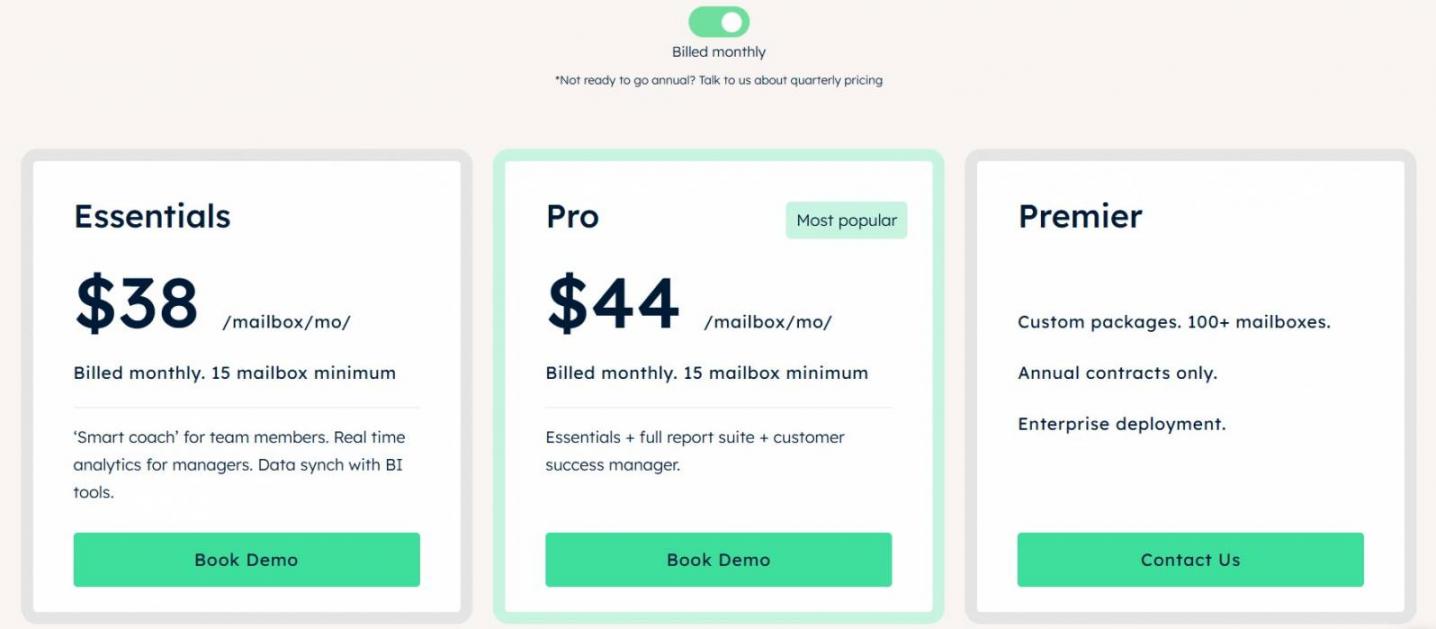
Image via timetoreply
Tool Level
- Intermediate
Usability
- Connects in under an hour and shows two weeks of historical data immediately, so you get value quickly
Pro Tip: Set different reply-time SLAs for each customer tier. Use timetoreply's automated alerts to protect your highest-value accounts first.
3. Gainsight
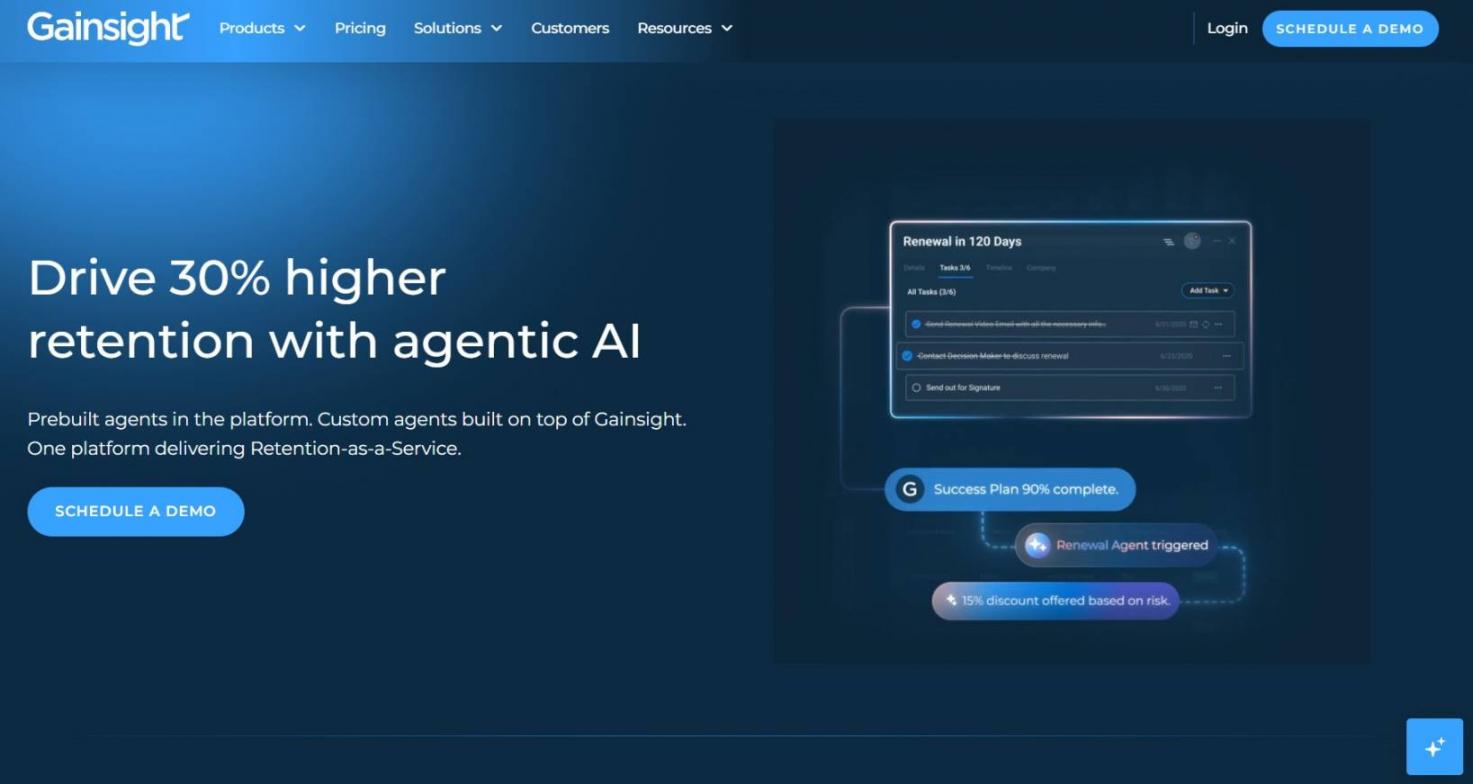
Image via Gainsight
Gainsight is the enterprise standard among AI tools for customer success. It pulls usage, support, and financial data into one health picture.
Its AI identifies churn risks, renewal opportunities, and accounts that need proactive engagement. Automated playbooks help customer success teams prioritize the right actions across complex account portfolios.
Gainsight works best for large enterprises with dedicated customer success operations. If your organization has a high-touch customer success program, it'll benefit the most from Gainsight's depth and automation.
Key Features
- Gainsight MCP: Pipes customer intelligence into ChatGPT, Claude, or Gemini
- Health Scoring and Churn Prediction: Configurable scorecards across usage, support, and sentiment
- Staircase AI (Insight Agent): Analyzes emails and meetings to catch disengagement weeks before usage drops
- Playbooks and Automation: Triggered CS workflows for onboarding, renewals, and risk
Pros
- Strong reporting for executive and board reviews
- The deepest feature set for enterprise CS operations
- AI reads relationship signals, not just product data
Cons
- Cost and implementation effort are significant
- Overkill for small teams
- Needs clean CRM data to perform
Pricing
- Essentials: Custom pricing
- Enterprise: Custom pricing
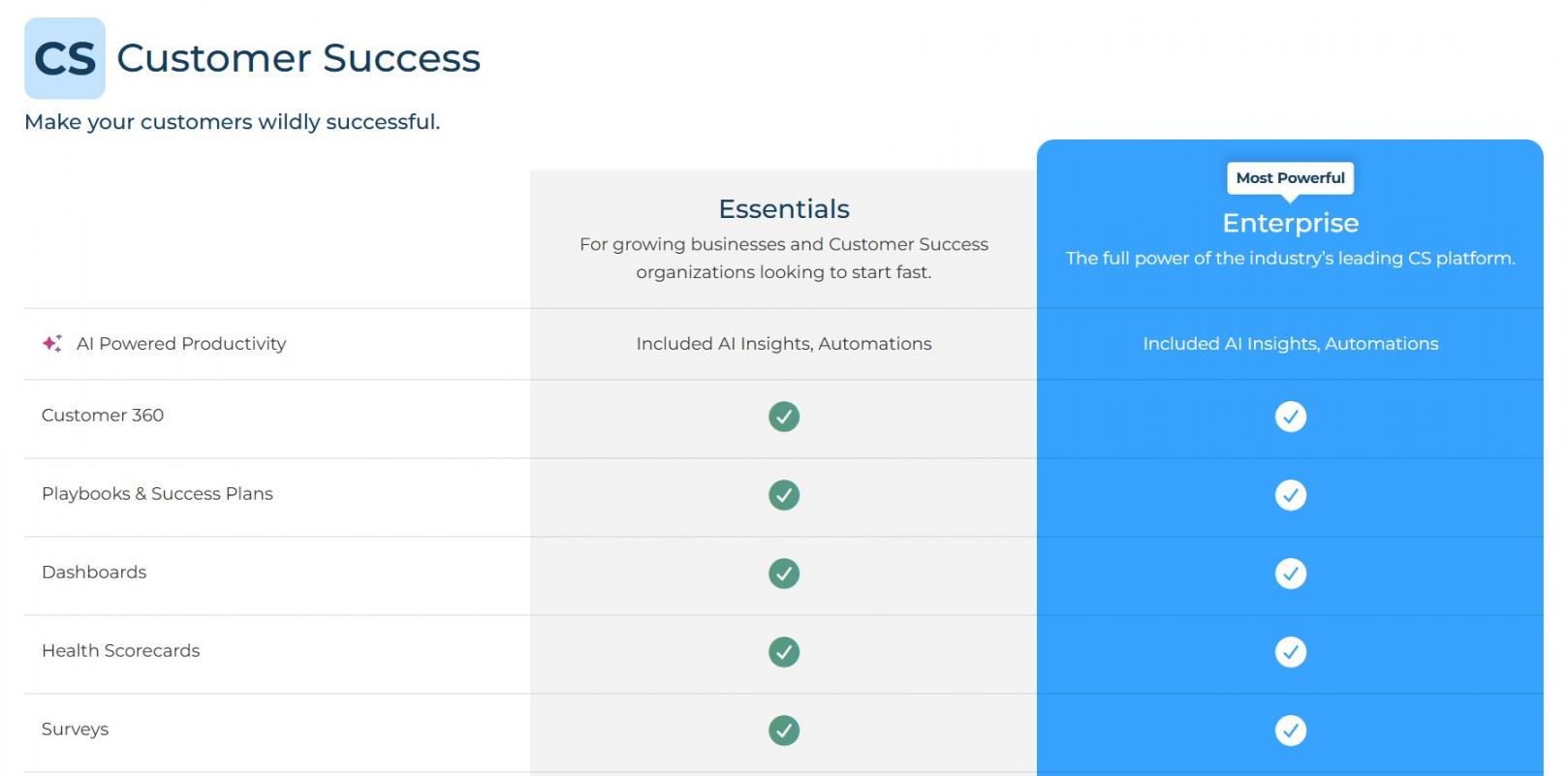
Image via Gainsight
Tool Level
- Advanced
Usability
- It’s a powerful tool, but you’ll need dedicated onboarding, administration, and ongoing training
Pro Tip: Prioritize executive outreach when stakeholder engagement starts to decline. Staircase AI's relationship signals reveal churn risk before product usage drops.
4. ChurnZero
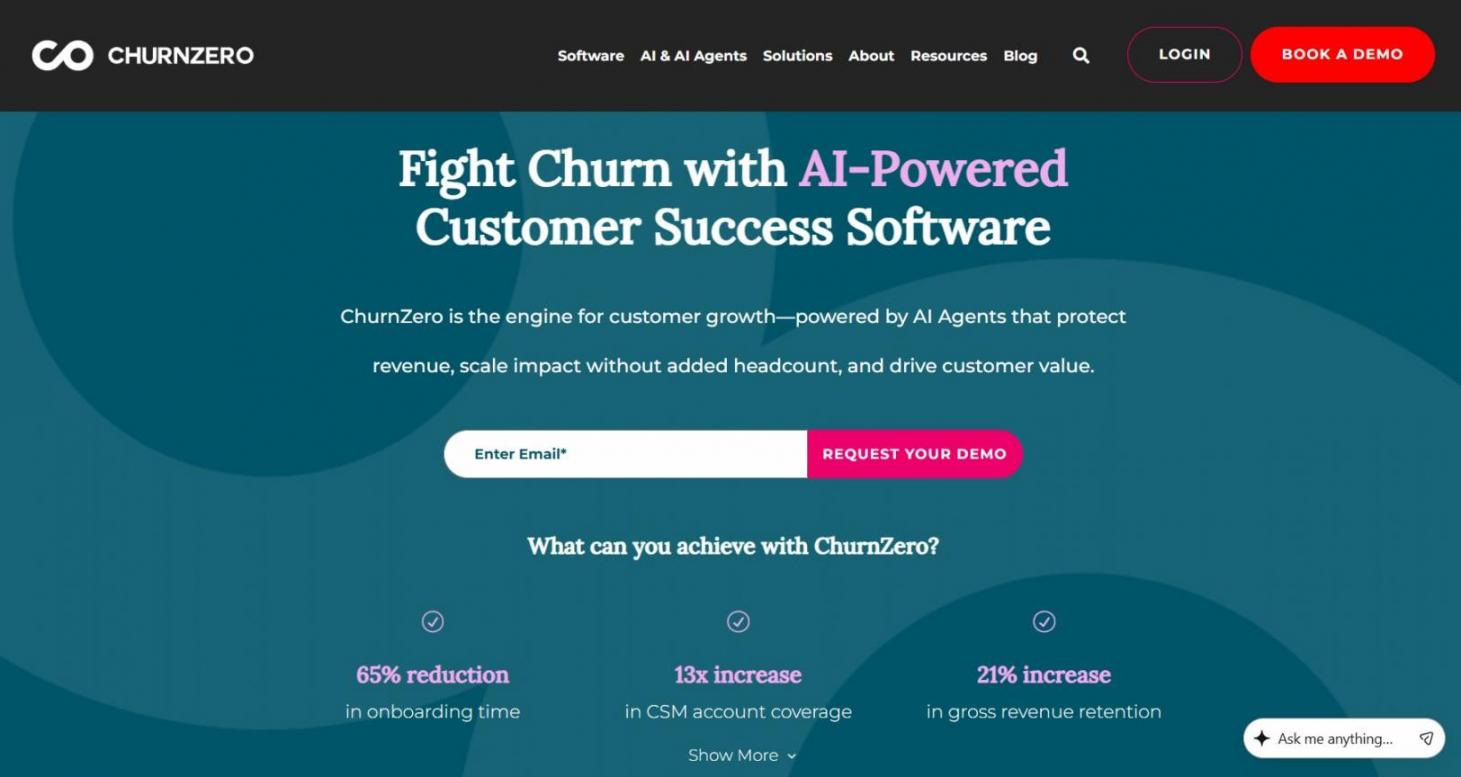
Image via ChurnZero
Among AI tools for customer success, ChurnZero is my top pick for mid-market SaaS companies. It's purpose-built for onboarding, product adoption, renewals, and customer expansion.
Its AI helps identify churn risks, track customer health, and trigger automated success journeys based on customer behavior. The platform also earns consistently high ratings from G2 for its customer success capabilities.
ChurnZero works best for mid-market B2B SaaS teams. If you need enterprise-level capabilities without enterprise-level complexity, this is the platform for you.
Key Features
- Health Scores and Risk Signals: Real-time account health with alerts
- AI Summaries and CS Assistant: Drafts and summarizes so CSMs move faster
- Automated Journeys: Onboarding and renewal playbooks that run themselves
- Customer Success AI: Unifies customer data and AI in one workspace
Pros
- Excellent fit for SaaS subscription and renewal motions
- Among the highest-rated CS platforms by users
- Strong automation for adoption and onboarding
Cons
- Quote-only pricing with annual contracts
- No free trial to test first
- Best value at mid-market scale, not for tiny teams
Pricing
- Contact ChurnZero for custom pricing
Tool Level
- Intermediate to Advanced
Usability
- Easier to adopt than many enterprise platforms, with responsive onboarding and customer support
Pro Tip: Build customer journeys around product milestones instead of calendar dates. That way, onboarding nudges appear when customers actually need help.
5. Vitally
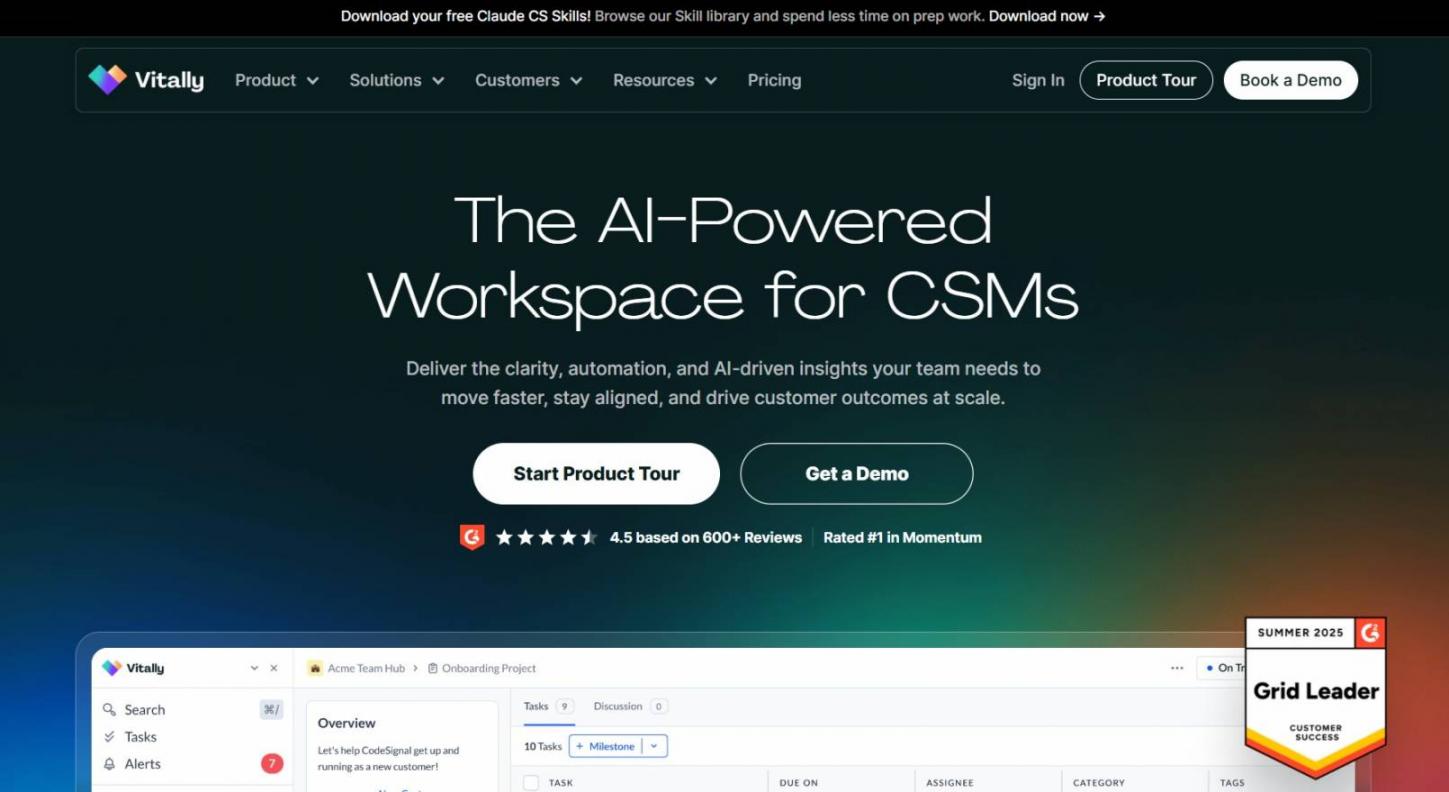
Image via Vitally
Vitally is one of the modern AI tools for customer success that stand out for speed of setup and flexibility. It's built for CS teams that want powerful automation without lengthy setup.
The platform's AI Copilot identifies customer risks, surfaces insights, and recommends next steps. A built-in meeting recorder also captures conversations and generates summaries automatically.
Where heavier platforms need weeks of admin work to customize, Vitally is designed to bend quickly to your team's workflow. This makes it ideal for SMB and mid-market customer success teams.
Key Features
- AI Copilot: Surfaces account risks and next steps
- Meeting Recorder: Auto-joins, transcribes, and summarizes calls
- Plays: Automated CS workflows triggered by signals
- Health Scoring: Flexible, data-rich account health
Pros
- Great fit for CS ops leaders who want control
- Fast, highly customizable setup
- Purpose-built AI, not a bolt-on
Cons
- Quote-only pricing, scaled by accounts managed
- Fewer enterprise-grade controls than Gainsight
- Smaller ecosystem than the incumbents
Pricing
- Tech-Touch: Custom pricing
- Hybrid-Touch: Custom pricing
- High-Touch: Custom pricing
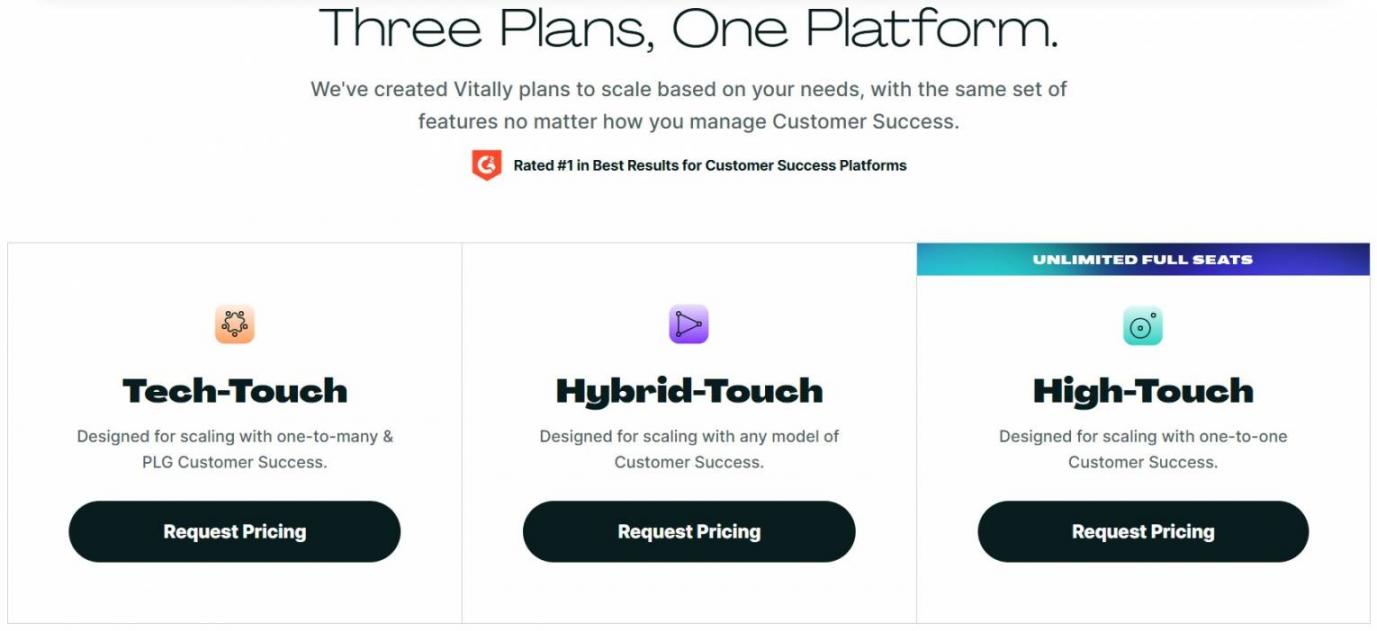
Image via Vitally
Tool Level
- Beginner to Intermediate
Usability
- One of the quickest AI tools for customer success to configure, with a clean and intuitive interface
Pro Tip: Lean on Vitally's meeting recorder to auto-log call notes. Trigger a Play when sentiment dips to keep follow-ups on track.
6. Totango
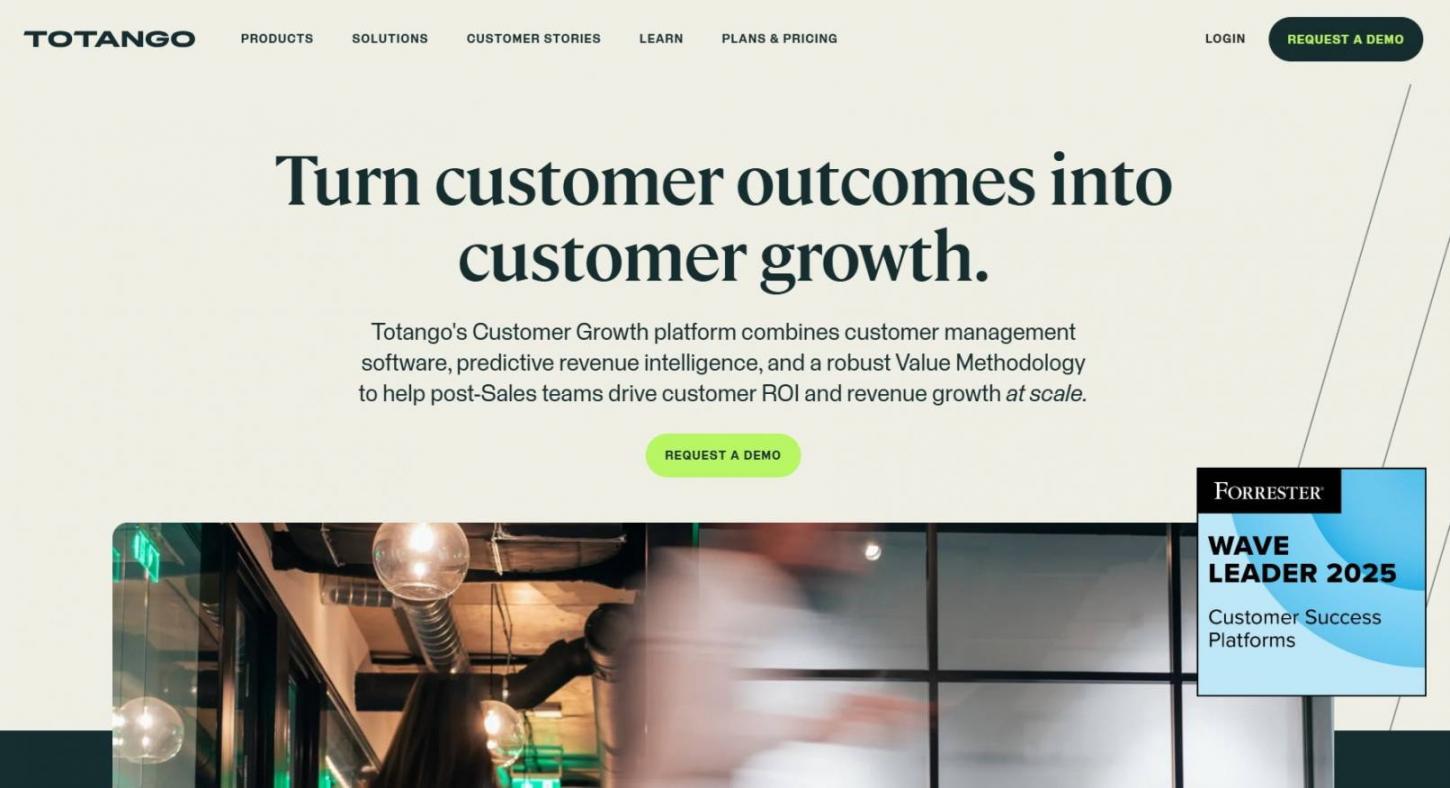
Image via Totango
Totango is one of the most solid AI tools for customer success teams that are scaling fast and need structure to match. Now combined with Catalyst, the platform supports both digital and high-touch customer success strategies.
Its Unison AI drives health scoring, risk detection, and expansion signals across the platform. The modular design also lets organizations expand their workflows without replacing the platform.
What sets Totango apart is its focus on revenue expansion, not just retention. It works best for growing customer success teams that prioritize customer expansion and need software that scales with them.
Key Features
- SuccessBLOCs and SuccessPlays: Modular, reusable CS workflows
- Unison Intelligence: AI-driven health and expansion signals
- Segmentation: Smart targeting across customer journeys
- Expansion Focus: Built to surface upsell and cross-sell moments
Pros
- Flexible and modular for evolving teams
- Strong on expansion and growth motions
- Combined Totango and Catalyst feature depth
Cons
- Quote-only pricing
- Performance lag under heavy data loads
- Configuration can sprawl without governance
Pricing
- Enterprise: Custom pricing
- Premier: Custom pricing
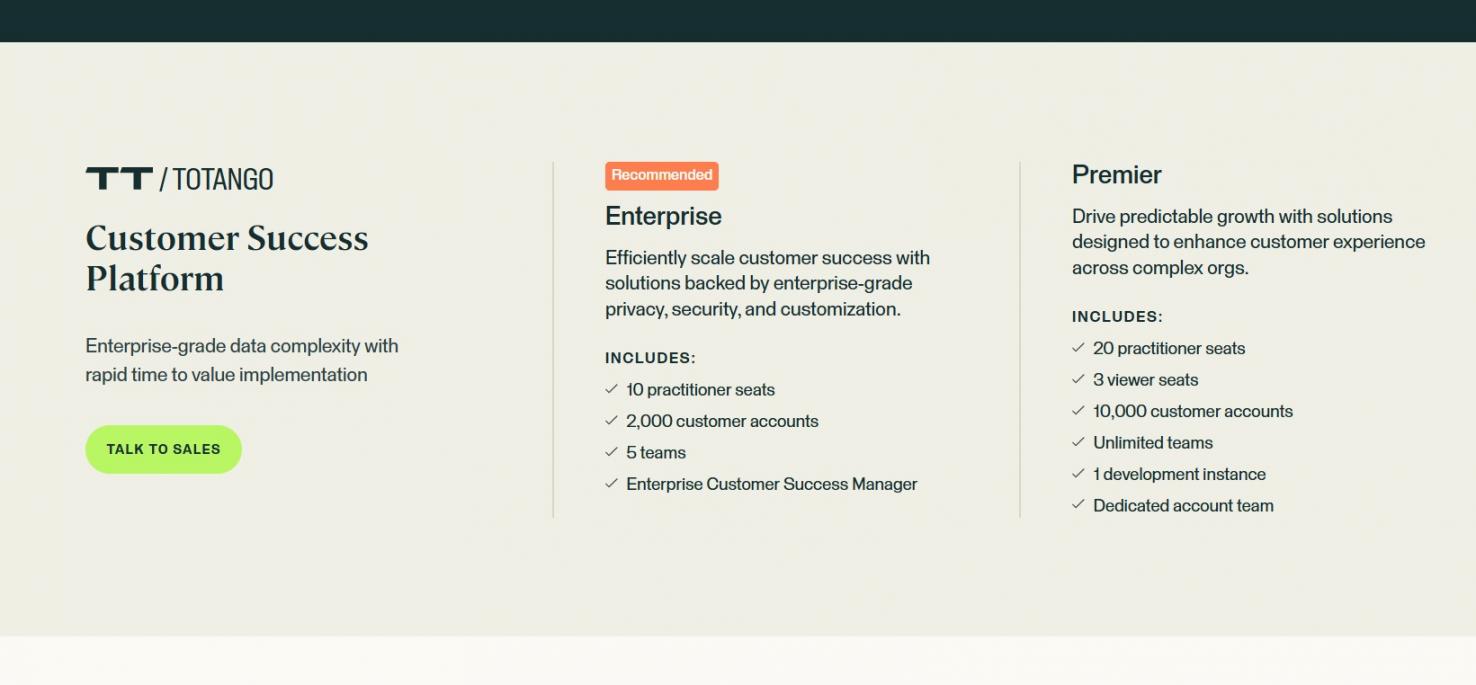
Image via Totango
Tool Level
- Intermediate to Advanced
Usability
- Modular and highly adaptable, though that flexibility works best with a clear setup plan
Pro Tip: Start with a small set of standardized SuccessBLOCs. Then, expand your workflows only after your team adopts the first set consistently.
7. Planhat
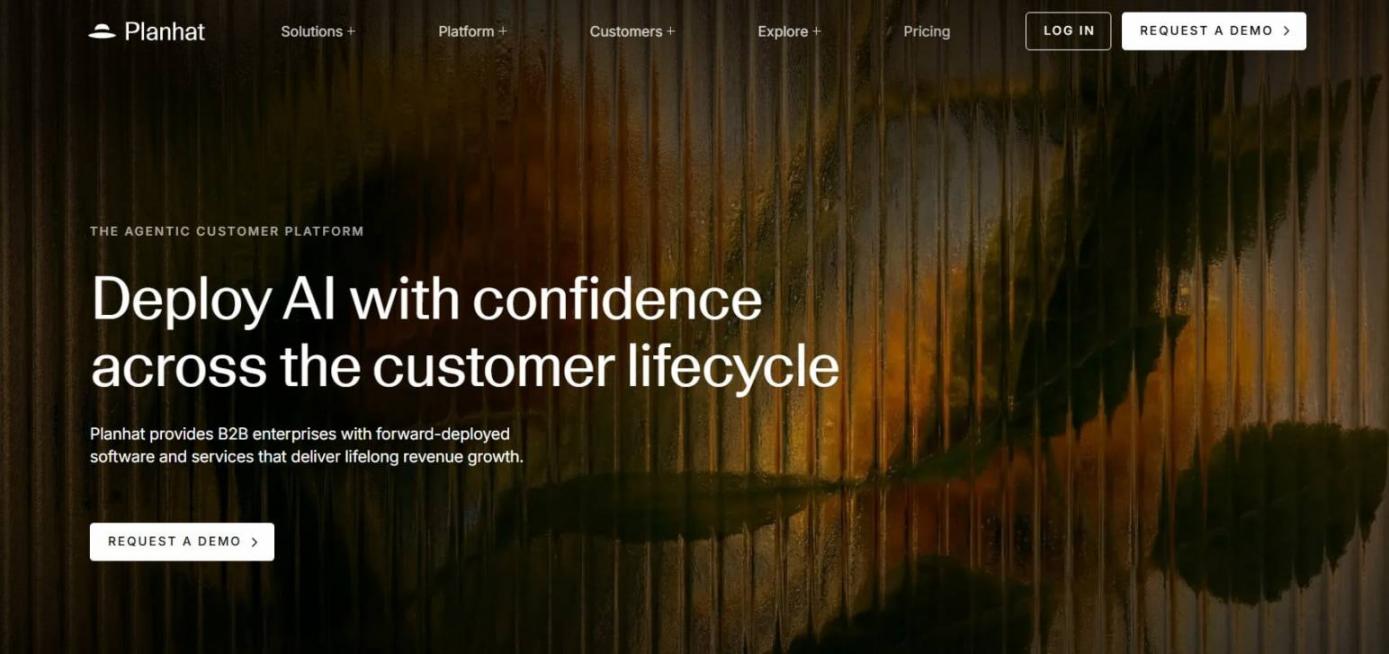
Image via Planhat
Planhat is a top pick among AI tools for customer success teams running complex, data-heavy operations. It models account health, renewal risk, and expansion opportunity in a deeply customizable system. Plus, it connects directly to leading LLMs.
Most CS platforms offer fixed health score templates. With Planhat, you can define your own data model from the ground up. That means the platform reflects your actual business logic, not a generic framework.
Planhat is built for mature CS teams that know what they need and have the time to build it right.
Key Features
- Customer 360 Data Layer: A single source of truth for account data
- Health and Renewal Tracking: Configurable scoring and risk views
- AI and Automation: Across the customer journey, with bring-your-own-LLM options
- MCP Server: Connects external AI agents to your customer data
Pros
- Exceptional data flexibility for complex use cases
- Scales across multi-product and multi-geo CS
- Open to modern AI architectures
Cons
- Setup complexity is real
- Steep initial learning curve
- More than smaller teams need
Pricing
- Contact Planhat for custom pricing
Tool Level
- Advanced
Usability
- Highly configurable, but expect more planning and setup than most customer success platforms
Pro Tip: Map your data model before launch. Planhat rewards teams that define account health inputs clearly from day one.
8. Gong
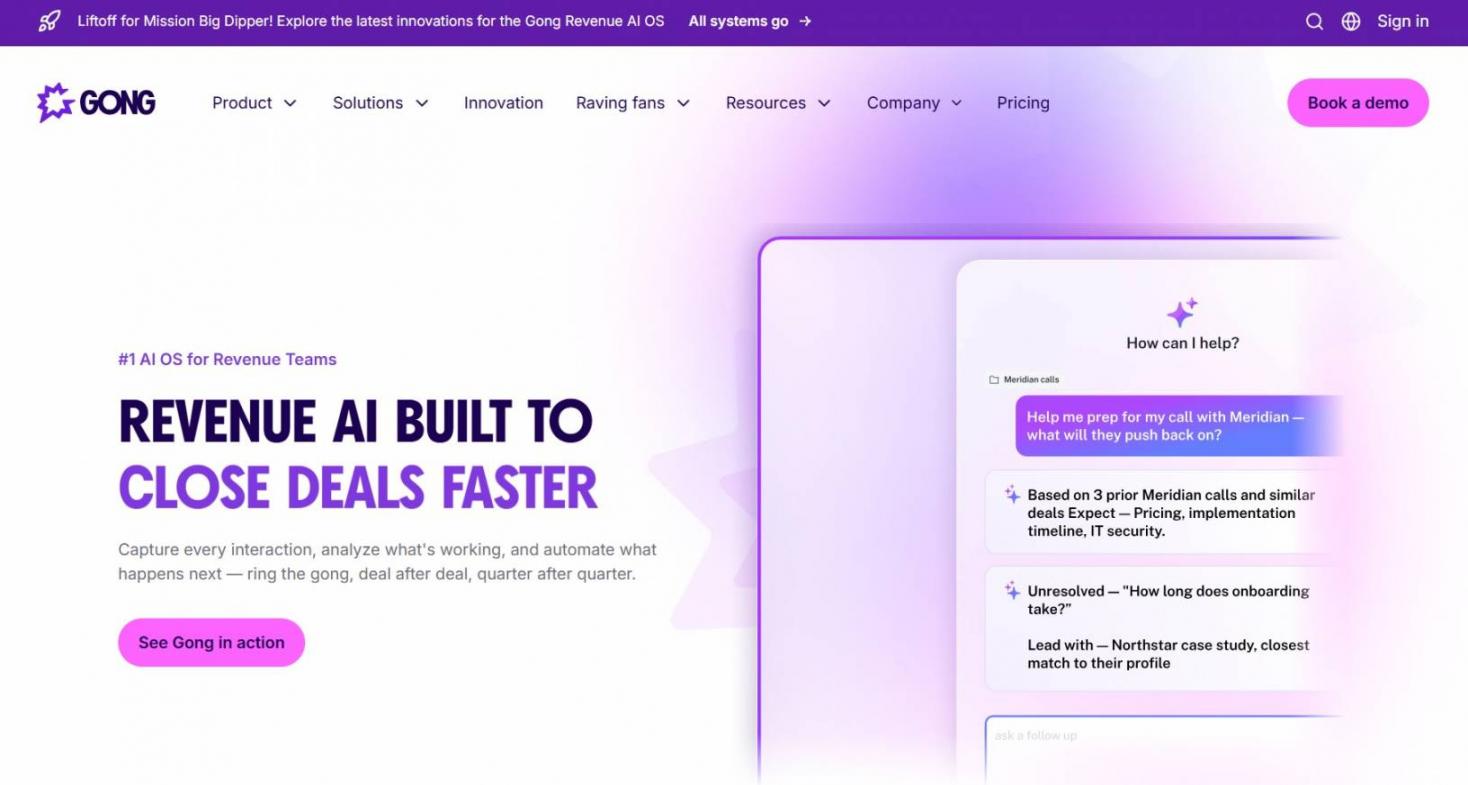
Image via Gong
Among AI tools for customer success, Gong is the leading conversation intelligence platform for customer-facing teams. It helps customer success managers understand what happens during customer conversations and turn those insights into action.
Instead of replacing a customer success platform, Gong complements one by revealing trends that product and support data may miss. That makes it especially valuable for renewal planning, customer retention, and team coaching.
It works best for revenue-focused customer success teams that spend much of their time on customer calls.
Key Features
- Call Recording and AI Summaries: Every customer conversation captured and analyzed
- Risk Signals: Churn and renewal risk from conversation patterns
- Ask Anything AI: Query your conversation data in plain language
- Coaching Analytics: Where CSMs can improve their calls
Pros
- Best-in-class conversation intelligence
- Surfaces risks humans miss on calls
- Strong adoption and very high ratings
Cons
- Priced for scale, not small teams
- Not a full CS platform on its own
- Best value when paired with a CSP
Pricing
- Contact Gong for custom pricing
Tool Level
- Intermediate to Advanced
Usability
- Easy for customer success teams to use, though administrator setup requires careful planning
Pro Tip: Set up automated Slack alerts for churn risks. Configuring Smart Trackers for risk keywords lets Gong ping you when those words are spoken on a call.
9. Intercom
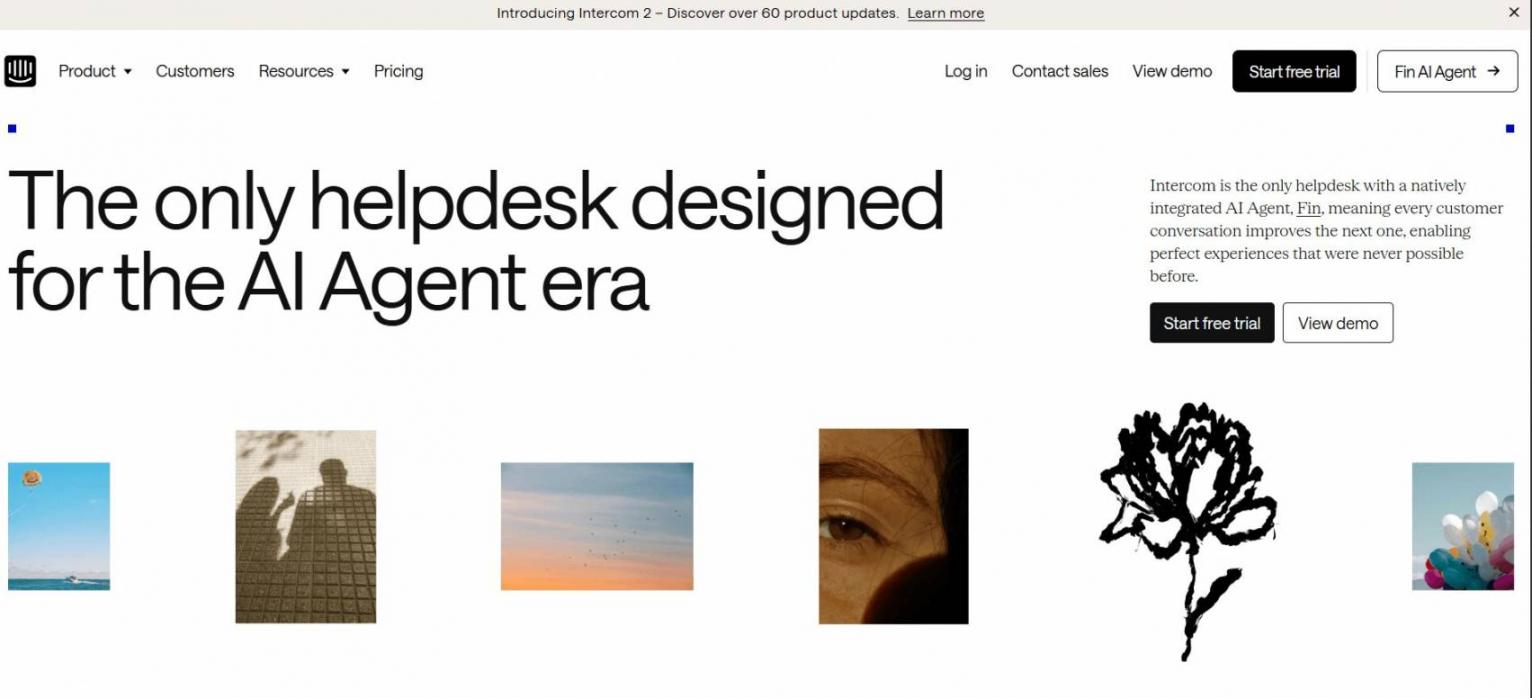
Image via Intercom
Intercom earns its place among AI tools for customer success on the strength of its autonomous AI agent Fin. Fin resolves customer questions across channels without a human. That deflects volume, so CSMs focus on relationships and risk.
By handling repetitive support requests, Fin lets CS teams spend more time on retention, renewals, and relationship building. The AI agent learns from your content rather than requiring manual training from scratch.
Intercom is ideal for support-led CS teams. It's great for automating routine conversations while keeping complex cases with human agents.
Key Features
- Fin AI Agent: Autonomous resolution across chat, email, and more
- AI Copilot: Helps human agents answer faster
- AI insights: Trends and gaps from support conversations
- Omnichannel: One inbox across customer channels
Pros
- Among the strongest autonomous AI agents available
- Transparent per-resolution pricing
- Fast to deploy on existing channels
Cons
- Per-resolution cost adds up at high volume
- Help desk seats are priced separately
- Support-led, so it complements rather than replaces a CSP
Pricing
- Fin AI Agent: Starts from $0.99 per resolution
- Essential: $39 per seat/month
- Advanced: $99 per seat/month
- Expert: $139 per seat/month
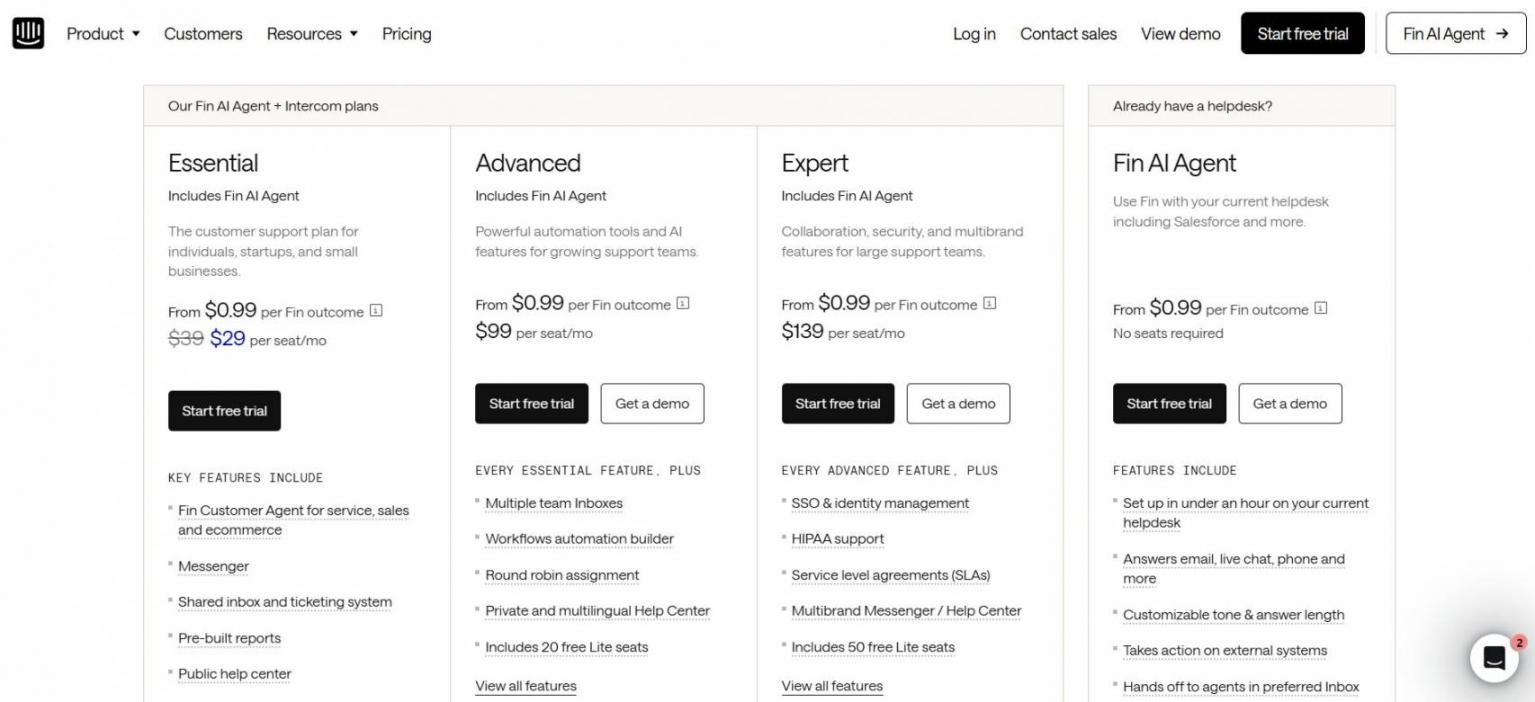
Image via Intercom
Tool Level
- Beginner to Intermediate
Usability
- Quick to deploy, plus tuning its knowledge base early improves the quality of its answers
Pro Tip: Route your highest-value accounts directly to human agents. Let Fin handle routine questions and lower-priority requests.
10. Pendo
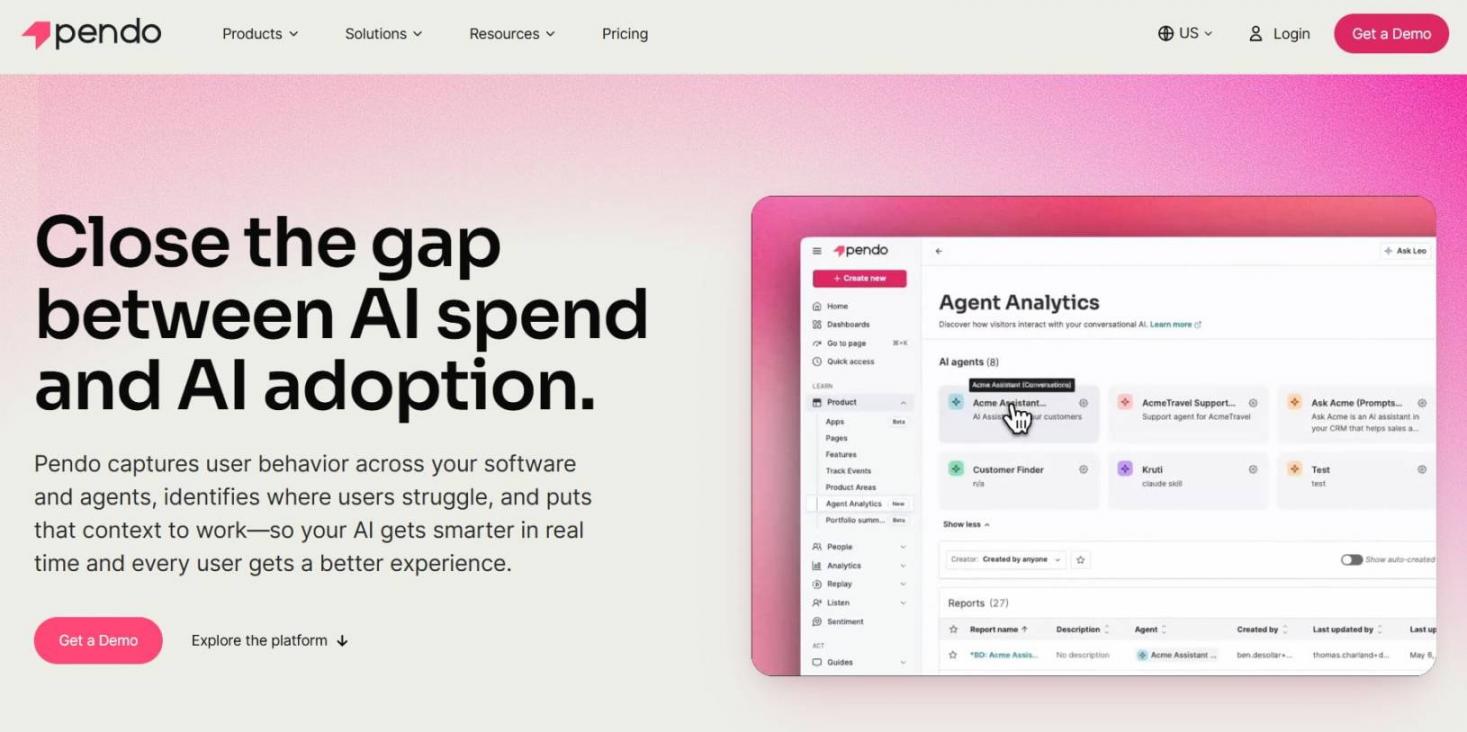
Image via Pendo
Pendo is one of the stronger AI tools for customer success teams running a product-led or low-touch CS motion. It helps teams increase product adoption, guide onboarding, and collect feedback inside the application.
Where most CS platforms start with relationship data, Pendo starts with product behavior. It shows exactly how customers use your product, then layers in sentiment through NPS and feedback tools. This way, your team sees the full engagement picture.
Pendo works best for product-led businesses and digital customer success teams that rely on tech-touch engagement.
Key Features
- Product Analytics: See exactly how customers use your product
- In-App Guides: Onboard and educate users without a CSM in the loop
- Pendo AI (Listen): Synthesizes feedback and usage signals
- NPS and Feedback: Sentiment tied to real behavior
Pros
- Excellent for scaling digital, low-touch CS
- Ties adoption data to onboarding actions
- Genuinely useful free tier
Cons
- Analytics-first, not a churn-prediction CSP
- Paid tiers are custom-quoted
- Needs product instrumentation to shine
Pricing
- Free
- Base: Custom pricing
- Core: Custom pricing
- Ultimate: Custom pricing
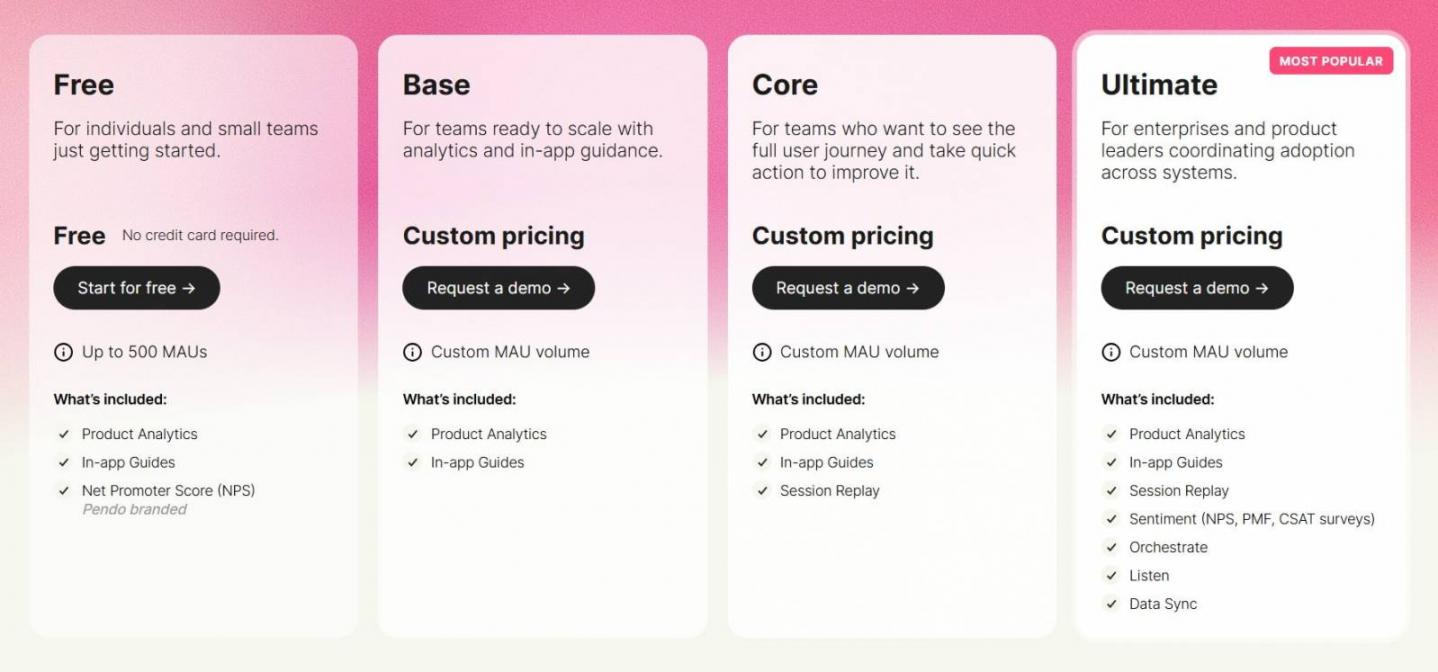
Image via Pendo
Tool Level
- Beginner to Intermediate
Usability
- Setup requires product tagging, but it delivers detailed adoption insights once implemented
Pro Tip: Trigger in-app guides from customer usage patterns. This helps users out before low adoption turns into churn.
11. Salesforce Agentforce
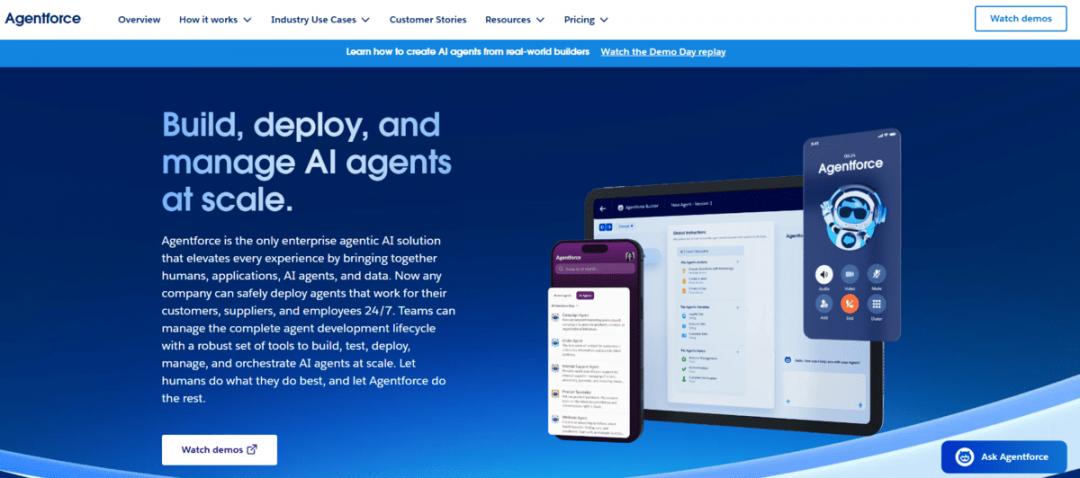
Image via Salesforce
For those invested in the Salesforce ecosystem, Salesforce Agentforce is the strongest among AI tools for customer success. It brings Einstein AI and autonomous AI agents directly into customer service and success workflows.
The platform's real advantage is its native CRM foundation. Agentforce agents operate on live Salesforce data, so every action reflects what's actually in the record. Workflows and customer data stay connected in one platform.
It works best for enterprises that already use Salesforce and have dedicated CRM administrators.
Key Features
- Agentforce: Autonomous AI agents for service and CS tasks
- Einstein AI: Generates summaries, classifies cases, and recommends actions
- Native CRM: All agents, analytics, and workflows run inside Salesforce
- Data Cloud: Grounds generative AI in unified customer data
Pros
- Powerful for enterprises already on Salesforce
- Deep agentic and generative AI capabilities
- Unifies service, data, and AI
Cons
- AI features sit in higher tiers and add-ons
- Complex to implement
- Per-conversation agent pricing adds up
Pricing
- Salesforce Foundations: Free
- Flex Credits: $500/100k credits
- Conversations: $2 per conversation
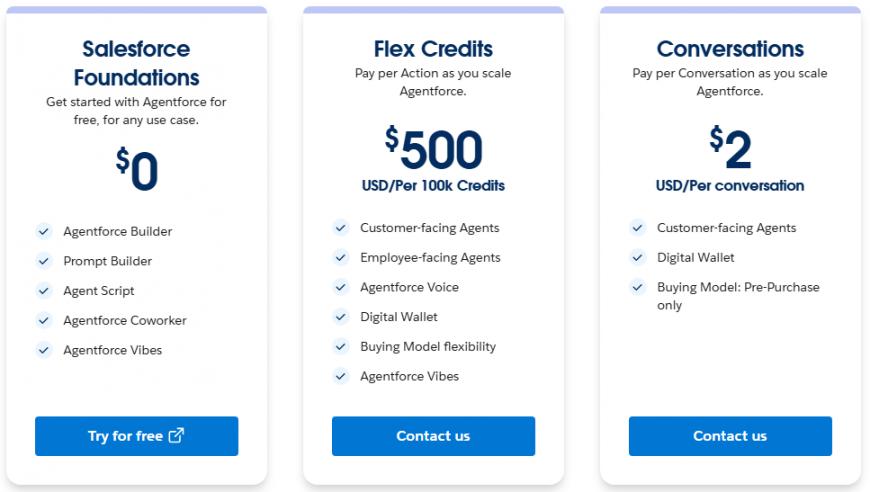
Image via Salesforce
Tool Level
- Advanced
Usability
- Most effective with experienced Salesforce administrators and a well-configured Salesforce environment
Pro Tip: Start Agentforce on a narrow, high-volume use case. Expand once you've proven resolution quality against a control group.
The best AI tools for customer success range from all-in-one platforms like HubSpot Service Hub to enterprise solutions like Gainsight and Salesforce Agentforce. Specialized tools such as timetoreply, Gong, and Pendo also excel for specific customer success workflows. The right choice depends on team size, customer success approach, and existing stack.
How to Measure the ROI of AI in Customer Success
Measure the impact of AI tools for customer success on two levels. First, the business outcomes it moves. Second, whether the AI itself is actually working. Most teams track the first and skip the second, which is how AI budgets quietly underperform.
On the business side, four metrics matter most. These are retention and net revenue retention, time-to-value, CSAT or NPS, and CSM capacity.
For context, SaaS Capital in 2025 pegged median net revenue retention for private SaaS at 102%. Even a tiny reduction in churn can deliver meaningful revenue gains.
When it comes to AI quality, track these metrics to confirm your AI delivers real value:
| AI capability | CS KPI it moves | How to verify it's working |
|---|---|---|
| Churn prediction | Retention, NRR | Measure the precision of flagged accounts and compare results with a control group |
| AI support agent | Deflection, cost per contact | Track resolution, escalation, and ticket reopen rates |
| Health scoring | Time-to-intervention | Monitor false positives and how early customer risk is detected |
| AI summaries / drafts | CSM capacity | Measure hours saved per CSM each week |
The process is straightforward. Set a baseline before you turn the AI on, then compare against a control. AI tools for customer success only pay off when you measure them this way.
There’s a simple conclusion if there’s no lift over a control group. You're paying for features instead of outcomes. The same principle applies to any customer retention strategy.
Measure retention, NRR, time-to-value, and CSM capacity, plus AI quality metrics like churn-model precision and resolution rate. Always compare against a baseline and a control group.
Data Security and Governance for AI in Customer Success
Before you feed customer data to any AI tool, check how it handles that data. In 2026, this is a buying criterion, not a footnote, especially for US B2B teams in regulated industries.
Run every vendor through a short checklist:
- Certifications: SOC 2 Type II and ISO 27001 at a minimum, and HIPAA where health data applies
- Data Residency: Where's your customer data stored and processed?
- Model-Training Opt-Out: Confirm your data won't train the vendor's shared models
- Data Scope: Does the tool read full message content, or only metadata? (timetoreply, for example, reads header and metadata only)
- Human-in-the-Loop: Can a person review or approve AI actions before they reach a customer?
- Audit Trails: Ensure AI actions are recorded, traceable, and reviewable
Transparency matters to customers too.
Zendesk’s 2026 CX research shows 95% of consumers want clear explanations for AI decisions. Eight in 10 CX leaders also agree that transparency in customer-facing AI is non-negotiable. Tell customers when they're talking to AI, and keep a human path open.
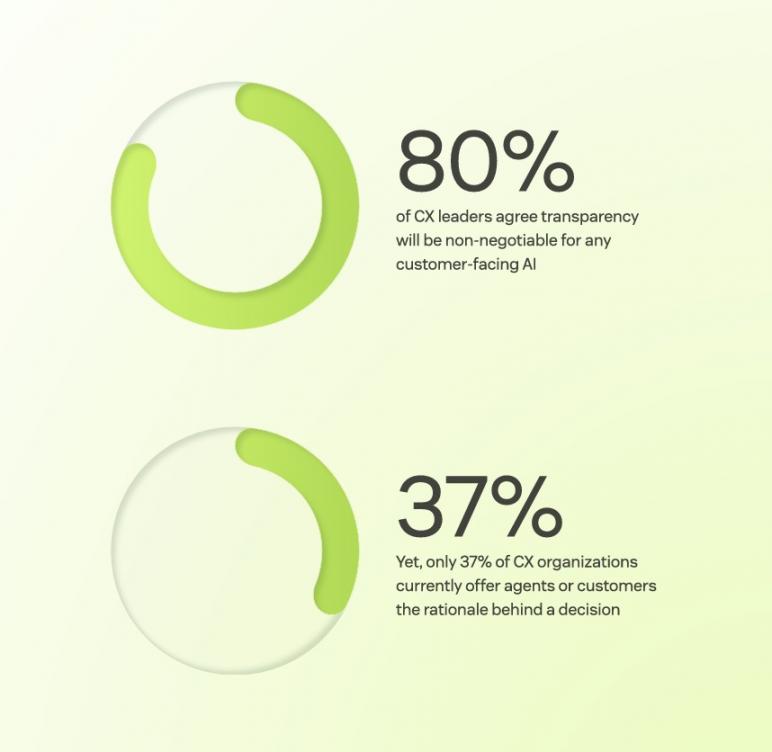
Image via Zendesk
Only with the right controls. Require SOC 2 and ISO 27001, a model-training opt-out, and clear data residency. Add human-in-the-loop review and audit logs before connecting customer data.
Will AI Replace Customer Success Managers?
No, AI tools for customer success aren't replacing managers. Instead, they remove busywork so CS managers can focus on what matters. A 2025 Gartner survey found that only 20% of customer service leaders report AI-driven staff cuts. The headline fear isn’t showing up in the data.
The honest division of labor looks like this:
| What AI does well | What the CSM owns |
|---|---|
| Health scoring and churn flags | The relationship and trust |
| Summaries, drafts, and CRM logging | Strategy and account planning |
| Ticket triage and 24/7 answers | Negotiation and renewals |
| Surfacing upsell signals | Judgment on complex, sensitive cases |
It’s also important to keep the hype in perspective.
Gartner expects that over 40% of agentic AI projects will be canceled by the close of 2027, often due to unclear value or weak controls. The most successful teams use AI to support their people, not replace them.
No. AI handles scoring, summaries, triage, and routine answers, while CSMs own relationships, strategy, and judgment. Only 20% of service leaders report AI-driven headcount cuts.
The Future of AI in Customer Success
Over the next two years, agentic AI will mature. AI tools for customer success are shifting from being copilots that suggest actions to coworkers that take action. Approval gates will protect anything customer-facing.
A few shifts to watch:
- Autonomous Resolution Scales: Agentic AI will resolve 80% of common customer service issues by 2029, according to Gartner. That will shift customer success teams toward managing relationships instead of routine requests.
- AI Handling Jumps Fast: Salesforce projects AI-handled service cases rising from 30% today to 50% by 2027. The 2025 findings also reveal that AI jumped from #10 in priority for service leaders to #2 in a year.
- Consolidation Continues: Vendors will continue expanding through acquisitions and mergers to deliver broader customer success platforms. Examples include Gainsight's acquisition of Staircase AI and Totango's merger with Catalyst.
- Open AI Architectures: More CS platforms will support flexible AI architectures and customer-controlled models. Features like bring-your-own-LLM options and MCP support will give organizations greater control over AI deployments.
The implication for CS leaders is to build the governance now to adopt autonomy safely as it matures.
More autonomous AI agents with human approval gates, a jump in AI-handled cases, platform consolidation, and open AI architectures. Build governance now to adopt safely.
FAQ
Q1. What are AI tools for customer success?
A. AI tools for customer success are software platforms that use AI to predict churn, automate routine CS work, and flag at-risk accounts. They consist of dedicated customer success platforms, conversation and email intelligence, support and ticketing AI, and engagement and onboarding tools.
Q2. How is AI used in customer success?
A. AI absorbs repetitive work so customer success managers can focus on relationships and strategy. It's used to:
- Write meeting recaps
- Personalize onboarding
- Predict churn through health scoring
- Analyze customer sentiment
- Run 24/7 support agents
- Surface upsell signals
Q3. What are the best AI tools for customer success?
A. HubSpot Service Hub leads for all-in-one teams, timetoreply for email response analytics, Gainsight for enterprise operations, and ChurnZero for mid-market SaaS.
Gong covers conversation intelligence, and Intercom's Fin handles support deflection. The best fit depends on your team size and motion.
Q4. Can AI replace customer success managers?
A. No. AI tools for customer success handle health scoring, summaries, triage, and routine answers. Meanwhile, CSMs own relationships, strategy, negotiation, and judgment. Gartner found that only 20% of service leaders report AI-driven staff cuts. So, AI is adding capacity, not removing roles.
Q5. How do AI tools reduce churn?
A. AI tools for customer success read product usage, support history, and sentiment to score account health and flag risk early. That early warning lets a CSM intervene while the relationship is still recoverable. You avoid finding out at renewal, when the decision is already made.
Q6. Can customer success be automated?
A. Partly. AI tools for customer success can automate data entry, health scoring, follow-ups, onboarding nudges, and routine answers. It can't automate trust, hard renewal conversations, or judgment on sensitive accounts. The goal is a hybrid model where automation handles volume and humans handle value.
Q7. What's the best AI customer success tool for small teams?
A. Small teams do well with HubSpot Service Hub, which has a free tier. Pendo's free plan also covers up to 500 monthly active users. Both deliver AI-assisted customer success without the cost of an enterprise platform.
Q8. How do you choose an AI customer success tool?
A. Match the tool to your CS motion and team size. Confirm the AI is real and check data security. Verify it integrates with your CRM and inbox, and model the total cost, including per-resolution pricing. Then, confirm it still fits when your book scales.
Q9. What is generative AI for customer success?
A. Generative AI creates text and answers from your customer data. In customer success, it drafts replies, summarizes tickets and calls, and answers questions in plain language. Most modern CS platforms now include generative AI as an assistant for the CSM.
Q10. How much do AI tools for customer success cost?
A. Pricing depends on the vendor and pricing model. Seat-based tools typically start around $20 to $34 per user or mailbox each month. Dedicated CS platforms usually require a custom quote. AI agents often use consumption-based pricing, such as per resolution, conversation, or credits, which can increase costs as usage grows.
Conclusion
The best AI tools for customer success come down to fit. So, choose a tool that matches your team size and approach.
This way, you’ll spot risks sooner, reduce busywork, and increase capacity without hiring more people. AI handles repetitive tasks so your CS team can focus on important conversations and relationships.
If you're looking for an all-in-one starting point, try HubSpot Service Hub‘s free tools first. When you're ready, enable Breeze AI to automate more of your customer success workflows.
Disclaimer: This content contains some affiliate links for which we will earn a commission (at no additional cost to you). This is to ensure that we can keep creating free content for you.