- Customer retention software helps businesses keep customers engaged, reduce churn, and increase long-term revenue.
- The best solution depends on your business model, whether you need customer success, loyalty, product adoption, or marketing capabilities.
- Modern platforms use automation, AI, and customer insights to identify risks, improve engagement, and strengthen customer relationships.
- This guide compares the top customer retention software, covering their features, pricing, pros and cons, and tips for choosing the right one.
Customer retention software is the fastest way to protect the revenue you already earned. The best platforms in 2026 fall into a few camps. These include all-in-one tools like HubSpot, customer success software like Gainsight, and ecommerce loyalty apps like Smile.io. Over 12 years in marketing, I have watched brands pour budget into acquisition while their existing customers quietly slip away.
Keeping a customer costs far less than winning a new one. The likelihood of selling to someone who already trusts you is also much higher. So the smarter money sits with the customers already in your CRM.
In this guide, I rank the seven best customer retention software platforms for 2026. I show how I picked them and how to choose the right one for your model. You will also learn which retention metrics actually deserve your attention.
Disclaimer: This content contains some affiliate links for which we will earn a commission (at no additional cost to you). This is to ensure that we can keep creating free content for you.
What Is a Customer Retention Software Solution?
Customer retention software solutions help you keep existing customers engaged, satisfied, and loyal. They can track customer data, score account health, predict churn, and automate timely re-engagement, which can help reduce churn and grow repeat revenue. Basically, they can interpret isolated signals and transform them into timely action before customers leave.
Here is how it works. The software pulls behavior and account data into one view. It then scores each customer's health and flags the ones at risk. From there, it triggers a play: an email, an in-app nudge, or an alert to your team.
The category is broad, so the label covers several tool types. These include all-in-one CRM platforms, customer success software, and customer service software. They also cover product analytics tools, feedback and CX platforms, and ecommerce loyalty programs. Each serves a different retention motion, so your business model matters more than any feature list.
It spots customers who are drifting and helps you automatically win them back. The strongest tools combine health scoring, churn prediction, and automated outreach in one place.
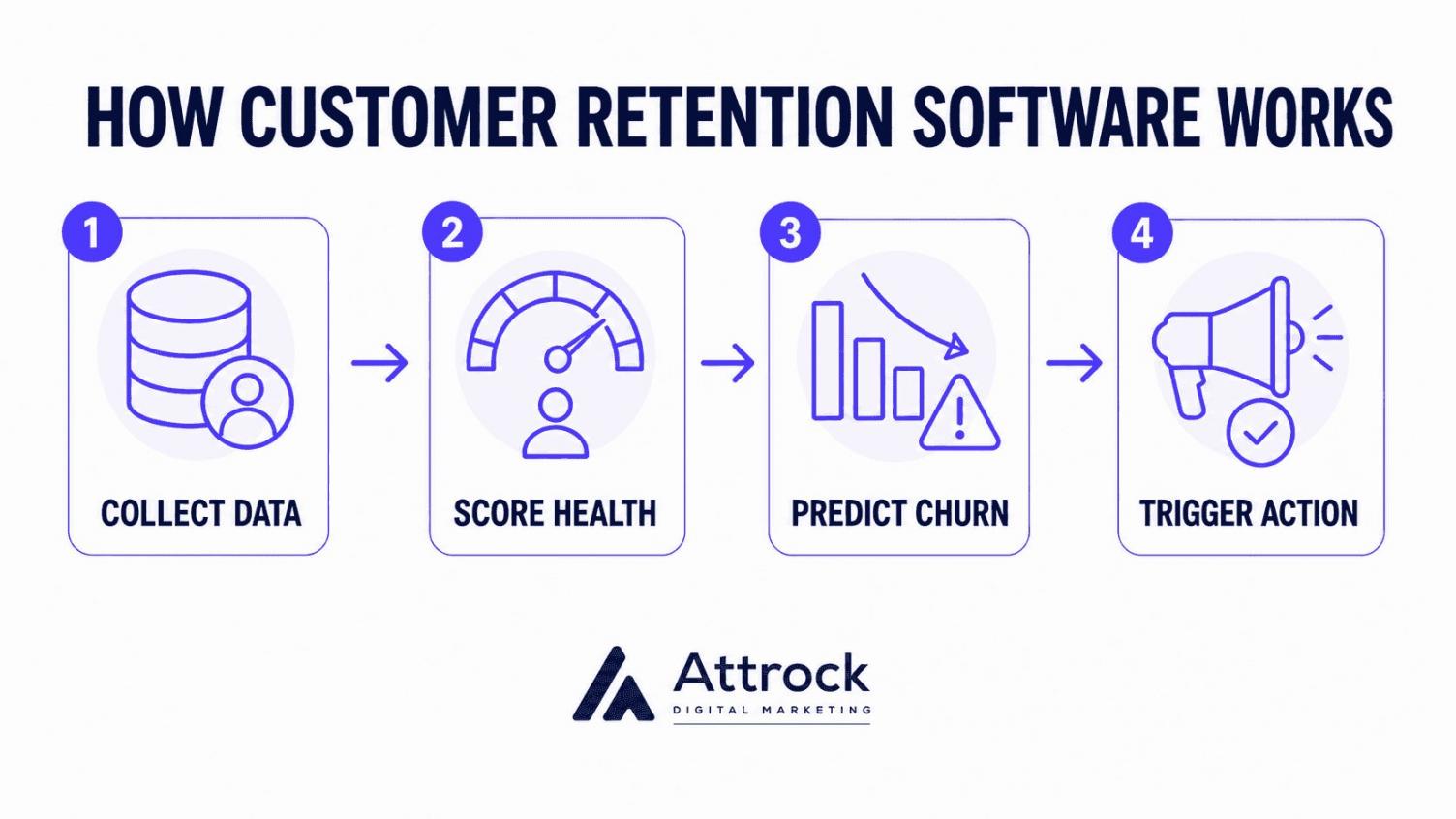
Image via Attrock
Why Customer Retention Software Matters in 2026
Retention software is important because keeping customers is far cheaper and more profitable than chasing new ones. The cost of acquiring new customers continues to climb, and keeping churn low can positively impact your bottom line in the medium to long term.
Acquiring a new customer costs roughly five to twenty-five times more than retaining an existing one, according to research compiled by Invesp. The classic Bain & Company finding still holds true: a 5% lift in repeat business can boost profit by as much as 95%. According to SaaS Capital, median net revenue retention can also increase profits by 25% to 95%.
Recurring revenue net revenue retention for B2B SaaS is estimated at about 106% in 2025, with companies at the top end of the spectrum clearing 130%. Gross retention is about 90%, while the average annual churn rate is approximately 3. 8%. Minor gains here and there can have a significant impact on a company's entire trajectory.
You also sell to existing customers more easily. The odds of selling to a current customer are far higher than selling to a cold prospect. So improving customer retention is at the top of your growth plan, not the bottom. The right software exists to boost customer retention without piling on manual work.
Retention protects revenue you already paid to win. A few points of churn reduction can outperform a costly new acquisition push.
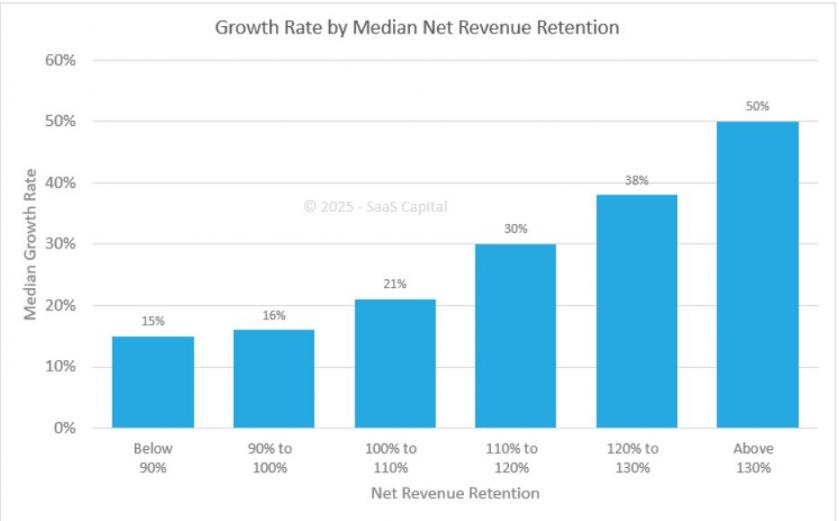
Image via SaaS Capital
Key Features to Look For in Customer Retention Software
The features that matter are the ones that catch churn early and simplify outreach. Strong customer retention tools share a common core, and I weigh each of these before recommending a platform. You may treat this list as your evaluation checklist.
- Customer health scoring: Rates your customers based on how often they use your product, how they interact with you, and their support history
- Churn prediction: Uses AI to flag accounts that are losing interest before they actually cancel, giving you time to save them
- Unified customer view: Gathers every detail into one single profile for each customer
- Automation and workflows: Automatically sends out win-back emails, creates tasks for your team, and sets off alerts
- Segmentation: Groups your customers by their account health, how much they spend, or how they act, so your messages always feel relevant
- Feedback and NPS: Ask customers how they feel about your business, catching their frustrations before they turn into complaints
- Integrations: Links up directly with your CRM, help desk, and email system so all of your data stays in one connected place
- Security and compliance: Protects sensitive data using official privacy laws (like GDPR) and control settings, keeping your customer interactions safe
No single tool does all eight of these perfectly. A loyalty app focuses heavily on rewards, while a customer success platform focuses on account health. Many teams also integrate marketing automation software to handle automated emails. Pick the software that is best suited to the specific job you need done.
Health scoring plus churn prediction. Together, they answer the only question that counts: which customers are about to leave, and what should I do today?
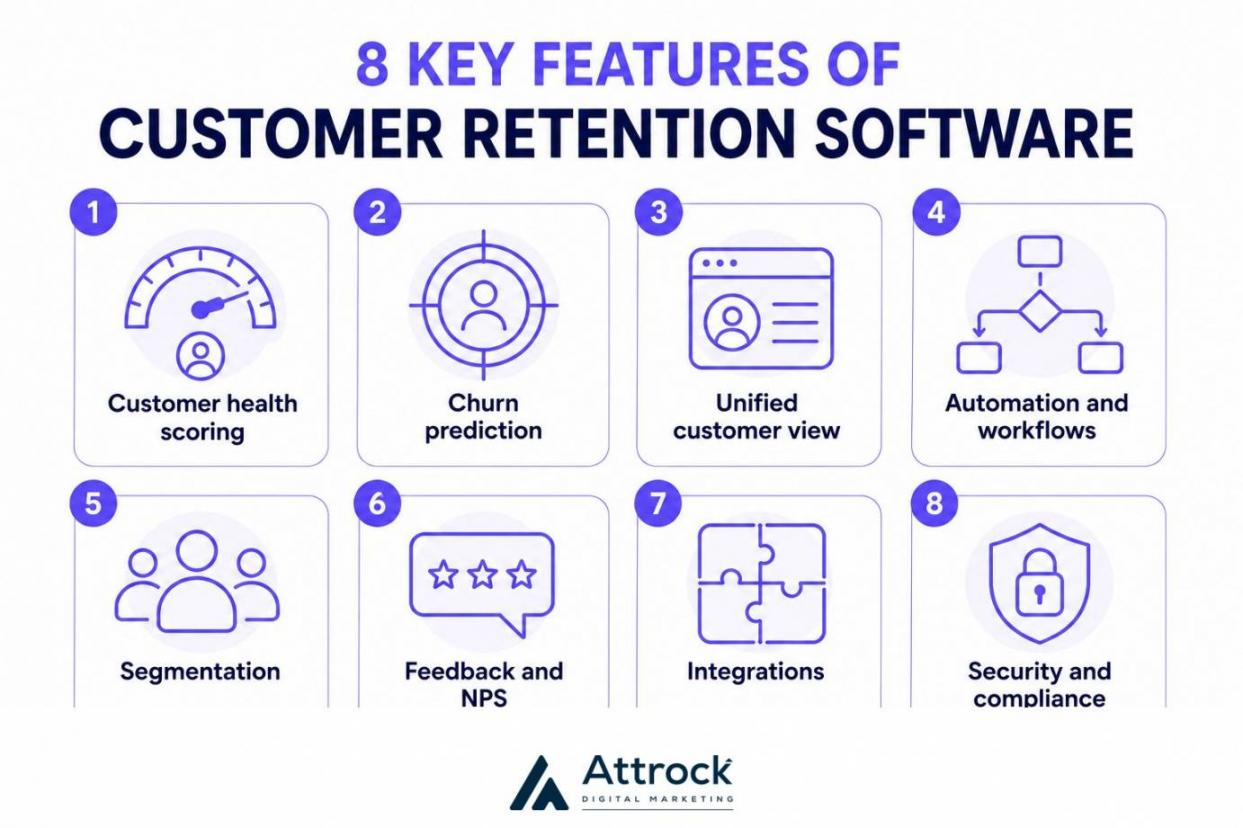
Image via Attrock
How I Picked the Best Customer Retention Software
I chose these tools based on five key factors that matter most to real buyers. My goal was to create a list that works irrespective of whether you run a software company, a B2B service, or an online shop. Here is what I looked at:
- Retention-specific capability: Does it score health and predict churn, or just store contacts?
- Pricing transparency and value: Is the pricing straightforward, and do the features justify the price?
- Integrations: Does it fit a real stack without heavy custom work?
- Usability and onboarding: Can a team adopt it without a six-month rollout?
- Verified user ratings: What do buyers say on G2 and Capterra?
I have spent over 12 years helping brands grow with SEO, content, and customer relationship management. So I read these tools through an operator's lens. Where a platform shines for one audience and struggles for another, I say so plainly.
Quick Comparison of the Best Customer Retention Software
Here is the side-by-side review of the best customer retention software. Use it to shortlist two or three tools, then read their full sections below. Prices are the starting monthly rates as of July 2026.
| Tool | Best For | Starting Price (mo) | G2 Rating | Free Plan |
|---|---|---|---|---|
| HubSpot | All-in-one retention | Free; Service Hub from $20/seat | 4.4/5 | Yes |
| Salesforce Service Cloud | Enterprise CX | From $25/user | 4.4/5 | No (trial) |
| Zoho CRM Plus | Value SMB suite | $25/user | 4.3/5 | No (trial) |
| Gainsight | Enterprise customer success | Custom quote | 4.4/5 | No |
| ChurnZero | Mid-market SaaS success | Custom quote | 4.7/5 | No |
| Userpilot | Product-led retention | From $299 | 4.6/5 | No (trial) |
| Smile.io | Ecommerce loyalty | Free; paid from $15 | 4.5/5 | Yes |
All prices are original monthly USD, verified against each vendor's pricing page where public. “Custom” means quote-only. Ratings link to the live source profile.
How to Choose the Best Customer Retention Software for Your Business
Match the tool to your model and your retention motion, not the longest feature list. The best customer retention software for a Shopify store looks nothing like the best fit for an enterprise success team.
Ecommerce teams, for instance, should also weigh a dedicated best ecommerce CRM. Start with how you actually keep customers, then narrow from there.
Choose Your Customer Retention Software If
These customer retention software solutions are tailored to these business models:
- All-in-one for most teams: HubSpot or Zoho CRM Plus
- Enterprise customer experience: Salesforce Service Cloud
- B2B SaaS, high-touch success: Gainsight or ChurnZero
- Product-led SaaS: Userpilot
- Ecommerce and DTC: Smile.io
These are the best customer retention software solutions based on team size:
- Under 10 seats: HubSpot free tier or Smile.io
- Mid-market: ChurnZero, Zoho, or Userpilot
- Enterprise: Gainsight or Salesforce
The best customer retention software solution for you should be the one that aligns most closely with your business goals. Here are the best options based on primary motion:
- Service-led retention: HubSpot or Salesforce
- Success-led retention: Gainsight or ChurnZero
- Loyalty-led retention: Smile.io
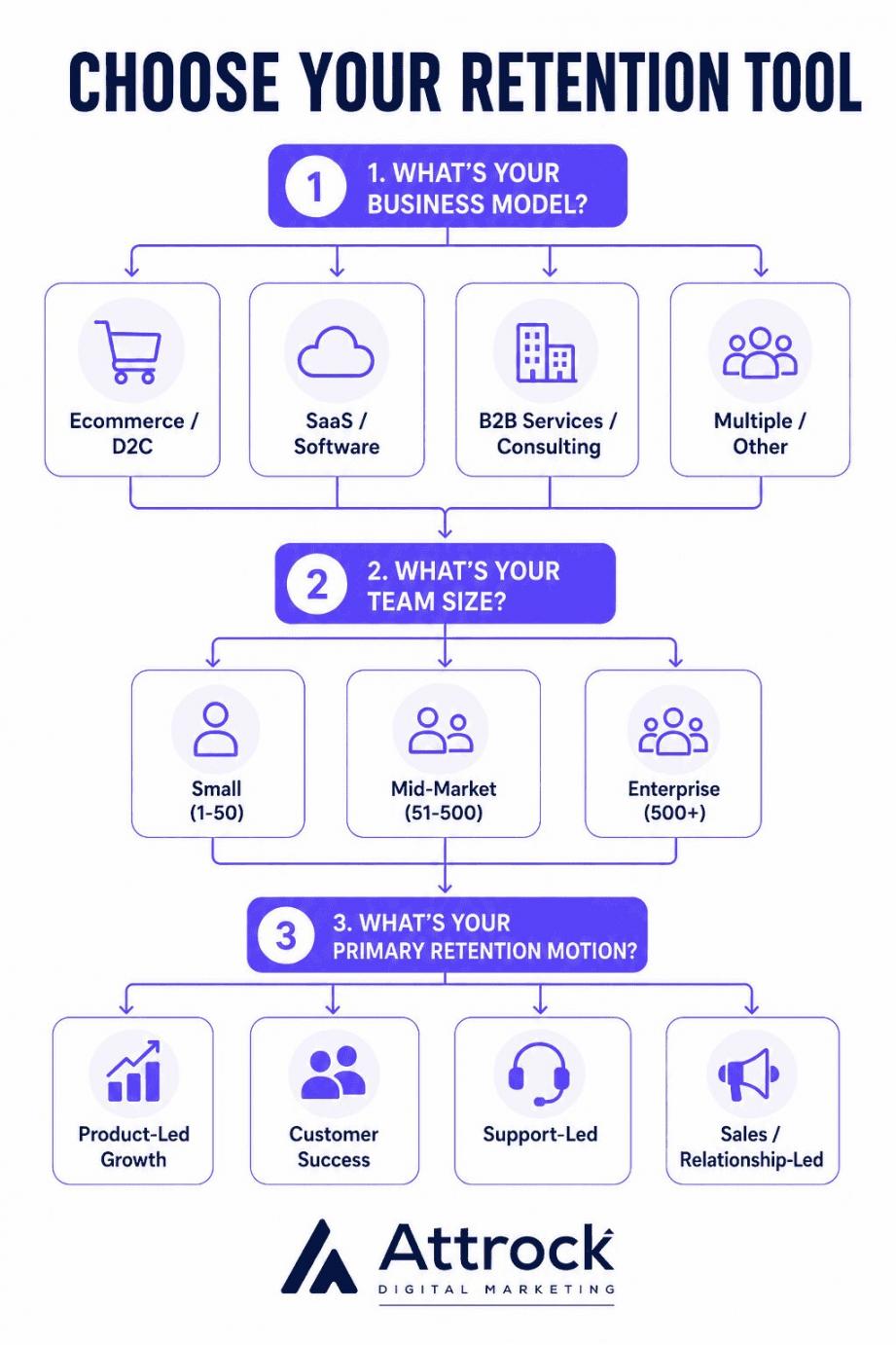
Image via Attrock
Before you sign, ask these five questions. They expose the costs and risks that demos tend to hide:
- What is the real cost, including onboarding and add-ons, not just the sticker price?
- Will my team actually adopt it, or will it sit unused?
- Does it integrate with my current stack out of the box?
- What happens at year three, when my data and usage grow?
- How hard is it to leave if the fit doesn't work out?
If you are weighing this against a broader rollout, my guide to customer retention strategies pairs well with the tool you choose.
Which Are the Best Customer Retention Software Platforms?
Here is a close look at seven best platforms to satisfy your customers. To make sure the comparison is fair, each tool is broken down in the exact same order: key features, pros, cons, pricing, who it is for, how easy it is to use, and a quick pro tip.
1. HubSpot
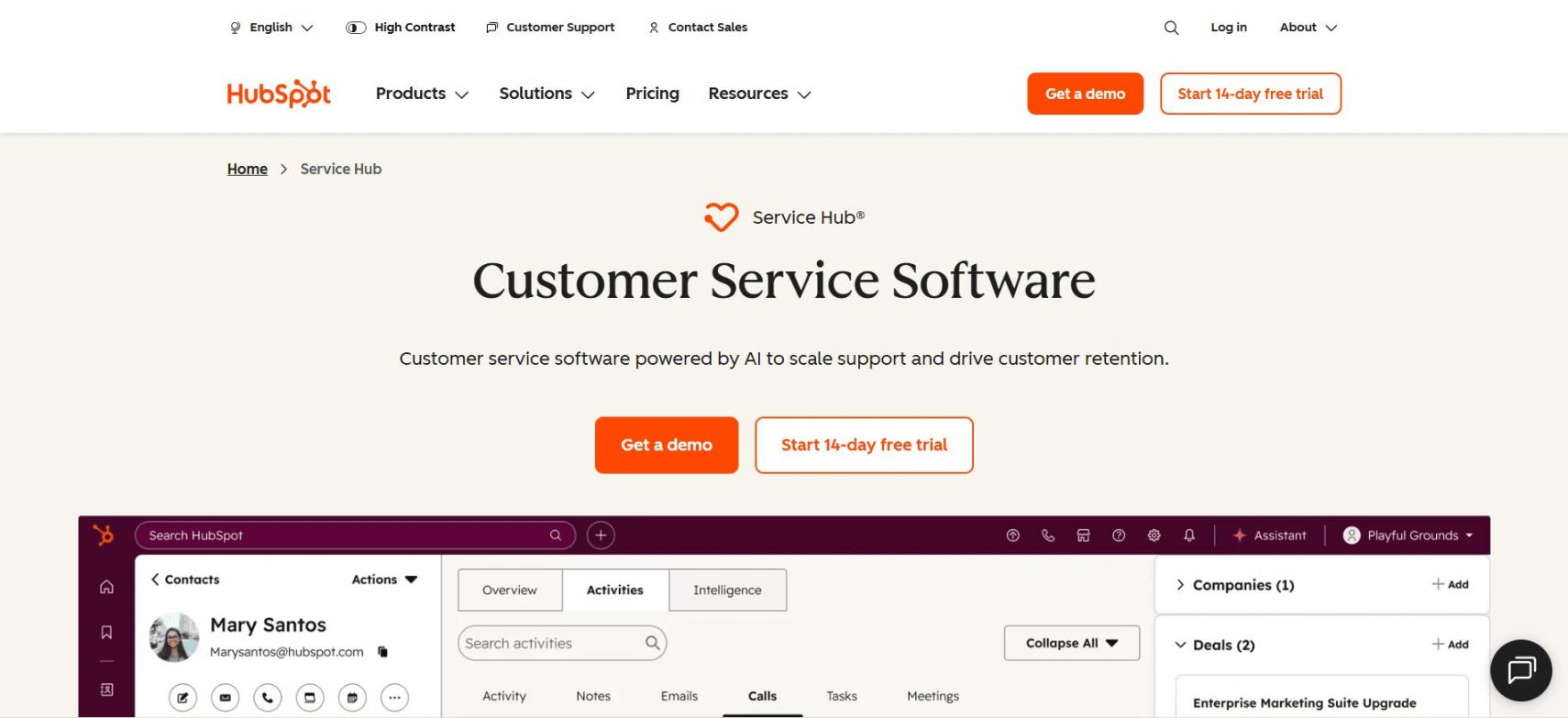
Image via HubSpot
HubSpot is the top choice for customer retention software if you want your customer service, customer records (CRM), and marketing all in one place. Its retention features live in the Service Hub, which connects features such as customer health scores and real-time usage data directly to your free Smart CRM base. Because all your data is in one spot, your team can easily stop problems before they snowball.
Key Features
- Customer health scores: Service Hub rates your customers based on how active they are, helping you spot accounts that are at risk of leaving before it's too late
- Smart CRM foundation: It offers a free, unified record of every contact, deal, and customer interaction
- Automated workflows: They can trigger churn-risk plays, tickets, and lifecycle emails automatically
- Help desk and ticketing: This helps provide quick solutions to problems, as service quality is the primary driver of customer retention
- Reporting dashboards: They let you track your customer retention rates, tickets, and customer satisfaction scores all in a single screen
Pros
- It handles your database, customer service, and marketing all at once, so you don't have to pay for multiple separate tools or spend money connecting them
- The free tier includes real, working tools that let small teams get started without spending a dime
- A large app marketplace connects almost any tool in your stack
Cons
- Costs rise quickly as you add seats and climb to higher tiers
- Advanced retention features are only available on the Professional and Enterprise plans
- Power users may want deeper customization than the platform allows
Pricing
- Free
- Starter Plan: $20/month/seat
- Professional: $100/month/seat
- Enterprise: $150/month/seat
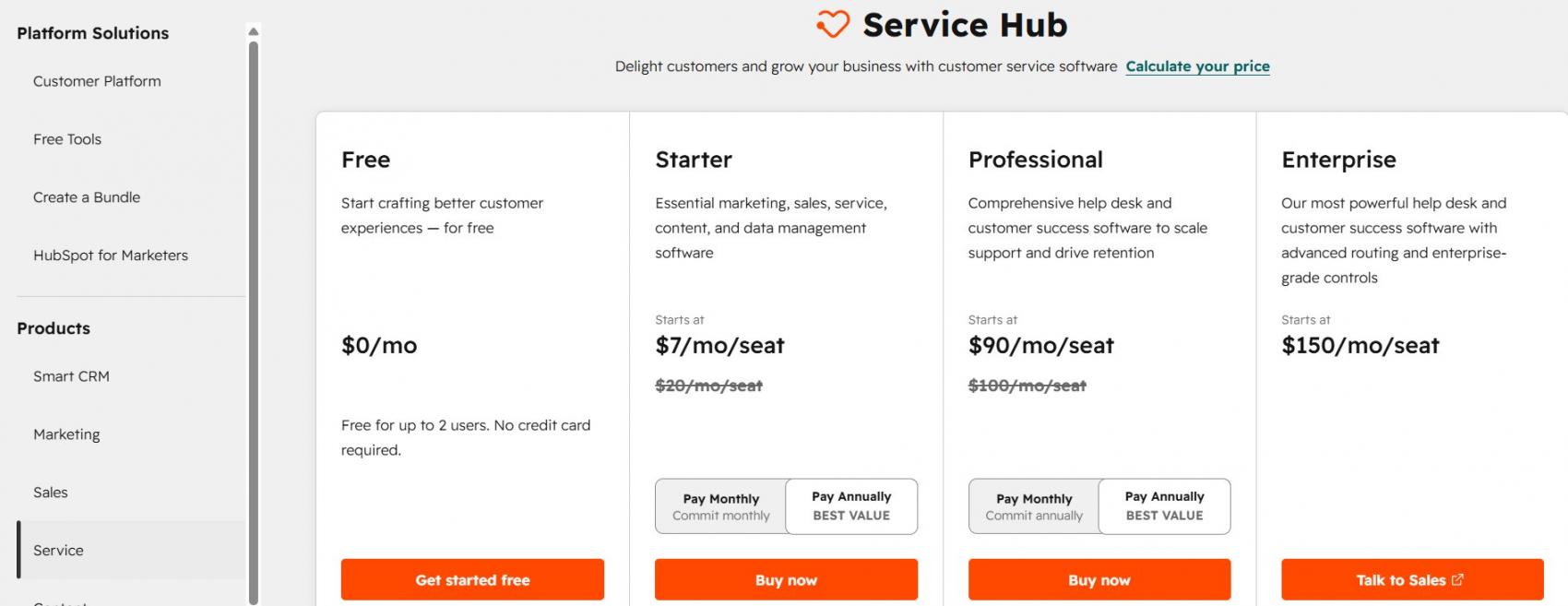
Image via HubSpot
Tool Level
- It works for everyone from single-person businesses to massive corporations. The free and Starter plans are great for small teams. The Professional and Enterprise plans are built for growing, mid-sized, and large companies that want one single software platform instead of juggling five different tools.
Usability
- It is relatively easy to learn and comes with great setup guides, so most teams can start using it right away. However, setting up the advanced automation and deep data reports may require additional training. For a software platform that does this much, admin costs stay reasonable.
Pro Tip: Set up your Service Hub customer health scores and an automatic churn risk workflow before you pay to add more team members. This way, you automatically track and save at-risk customers from day one, rather than trying to fix it later.
2. Salesforce Service Cloud
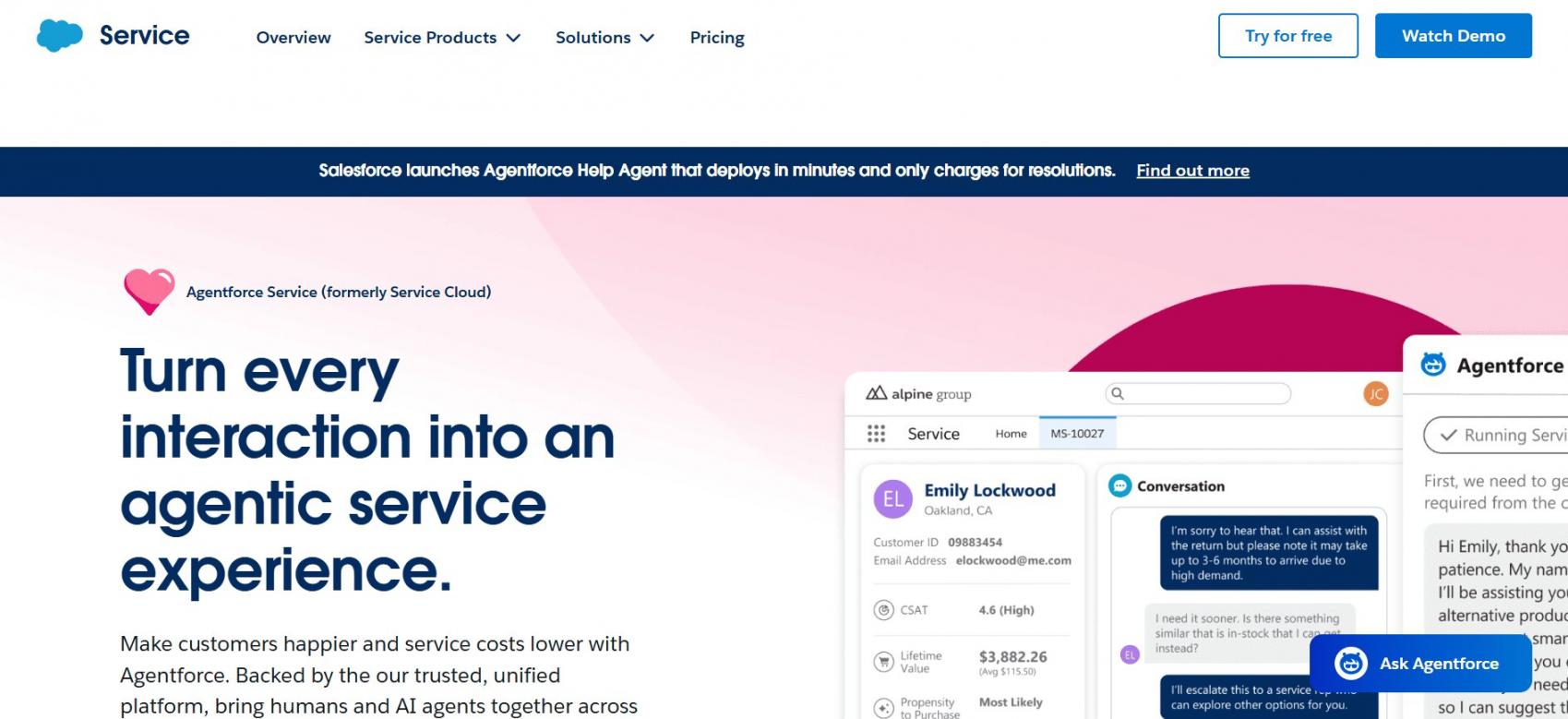
Image via Salesforce
Salesforce Service Cloud is the best customer retention software for enterprises that take deep customization and a unified view of all customer touchpoints seriously. It unifies cases, telephony, and self-service, then layers AI on top to bring to your attention the accounts that are most in need of attention. For large teams, that depth is the main attraction.
Key Features
- Omnichannel case management: Unify email, phone, chat, and social in one console
- AI and automation: Surface at-risk cases and automate routine resolutions
- Self-service portals: Deflect tickets and help customers solve issues fast
- Analytics: Track service quality and retention signals across the business
Pros
- Unmatched customization for complex enterprise workflows
- A vast ecosystem of apps and integrations
- Scales to the largest, most demanding teams
Cons
- Pricing climbs fast once you add editions and AI features
- Implementation often needs admin or partner support
- Overkill for small teams that want speed over depth
Pricing
- Starter Suite: $25/user/month
- Pro: $100/user/month
- Enterprise: $175/user/month
- Unlimited: $350/user/month
- Agentforce 1 Service: $550/user/month
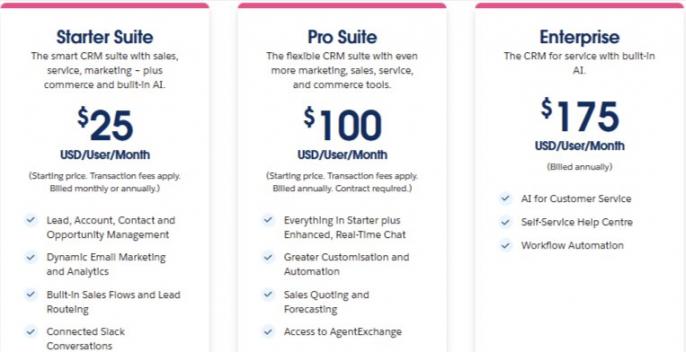
Image via Salesforce
Tool Level
- Salesforce suits mid-market and enterprise teams with the budget and admin capacity to run it. Smaller teams usually find it heavier than they need.
Usability
- The platform is powerful but harder to master than most. You may also need to invest in setup and admin support before adding custom objects and AI features. If you are comparing the two platforms, my HubSpot vs Salesforce comparison breaks down the pros and cons of each.
Pro Tip: Start with the Starter Suite and add the Einstein AI tier only when your case volume justifies predictive routing. This way, you avoid paying for capacity you cannot yet use.
3. Zoho CRM Plus
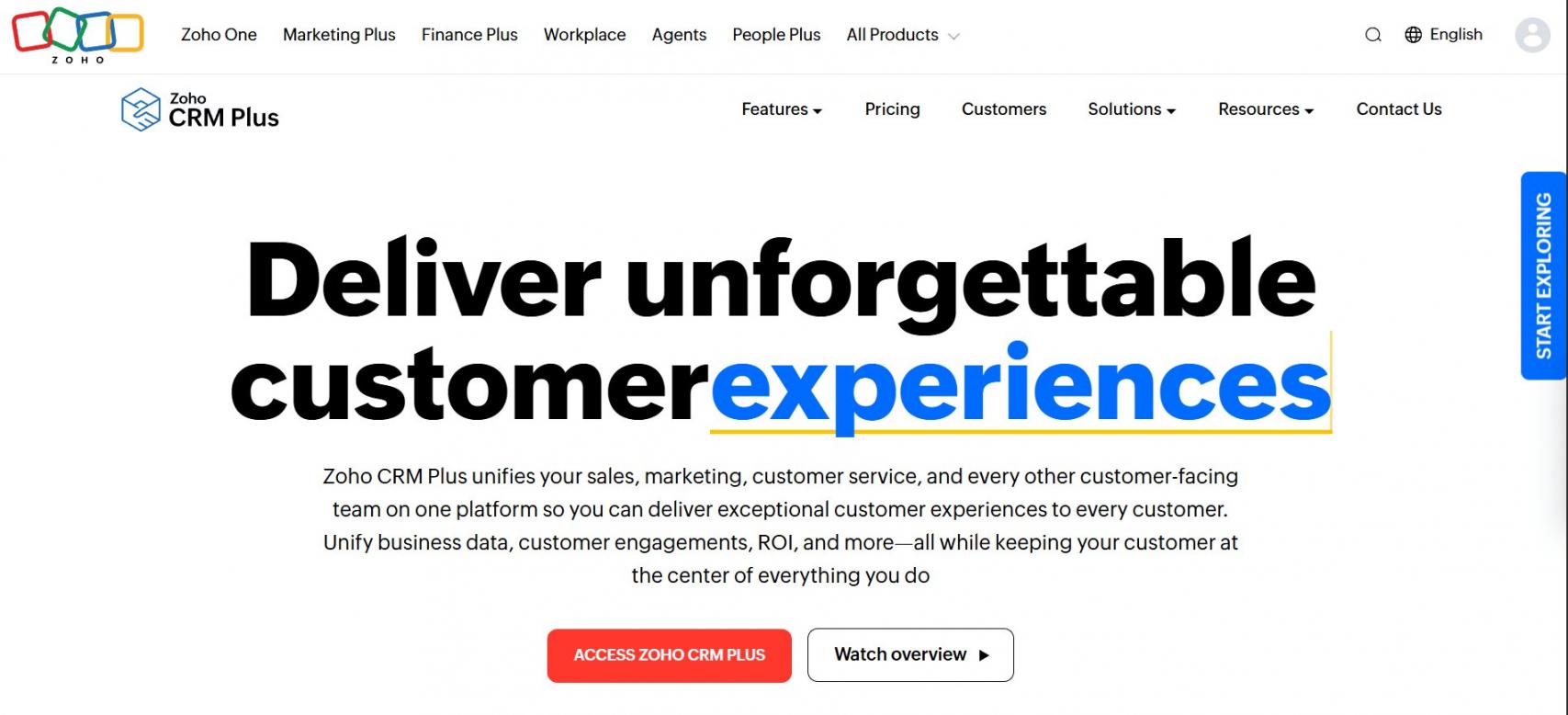
Image via Zoho CRM
Zoho CRM Plus is the best-value customer retention software for SMBs seeking a unified suite without enterprise pricing. With Zoho CRM Plus, smaller teams can access broad coverage at a predictable cost, thanks to the inclusion of sales, support, surveys, social, and analytics in one subscription. The range of features for the price is difficult to match.
Key Features
- Unified suite: CRM, help desk, surveys, social, and analytics in one place
- Customer satisfaction surveys: Capture feedback and act on sentiment
- Visitor and behavior tracking: Spot disengagement before it becomes churn
- Automation: Workflows and alerts keep outreach timely
Pros
- Strong value for the bundled feature set
- One vendor and one login across nine integrated tools
- Flexible enough for SMB and mid-market teams
Cons
- Per-user costs add up as headcount grows
- Individual modules can trail best-of-breed point tools
- The interface takes some getting used to
Pricing
- 30-day Free Trial
- Starter: $25/user/month
- Enterprise: $69/user/month
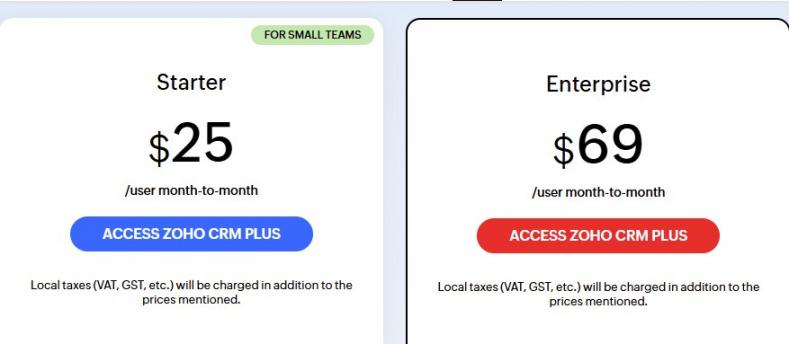
Image via Zoho CRM
Tool Level
- Zoho is perfect for small- and mid-market businesses that want a single integrated suite rather than multiple subscriptions.
Usability
- Setup is easy enough, and the unified design means you learn one system rather than many. Some advanced configurations may require time to master, but non-technical teams will find regular use of the platform pretty accessible.
Pro Tip: Turn on Zoho's satisfaction surveys and route low scores to an automated follow-up, so unhappy customers reach a human before they churn. If you are comparing suites, my roundup of CRM tools for small businesses digs deeper.
4. Gainsight
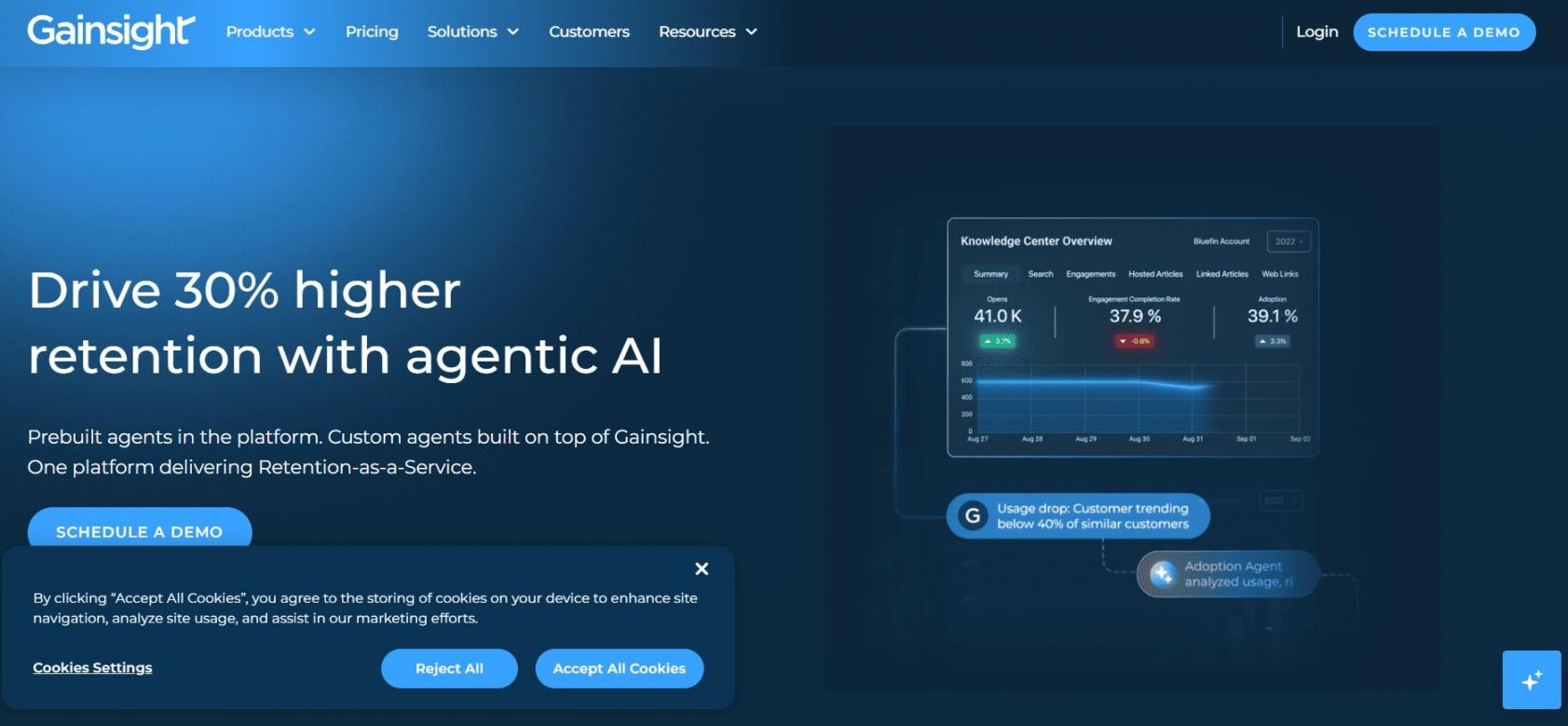
Image via Gainsight
Gainsight is the best customer retention software for large enterprise companies whose teams have outgrown manual customer account management. It puts health scoring, renewal tracking, and step-by-step team playbooks all in one central place. For large companies with subscription models, this software is the industry standard for saving at-risk revenue at scale.
Key Features
- Customer health scoring: Gives you a completely customizable, data-driven view of how likely each account is to cancel
- Renewal and churn management: Forecast renewals and flag at-risk revenue early
- Automated playbooks: Guide success managers through consistent retention plays
- Product and usage analytics: Shows you how your customers are using your product so you can connect usage to long-term loyalty
Pros
- The most powerful and scalable customer success platform available
- Deep configurability for complex enterprise processes
- Strong analytics that tie customer success activity to revenue
Cons
- Enterprise pricing puts it out of reach for many SMBs
- It needs a dedicated success-ops resource to run well
- Implementation is a project, not a quick switch
Pricing
Contact Sales
Tool Level
- Gainsight fits enterprise and upper-mid-market SaaS companies with a formal customer success function and the budget to support it.
Usability
- This platform is quite comprehensive. Teams with success-ops backing will reap huge benefits. However, those without may initially be overwhelmed by all the features.
Pro Tip: Define your health-score inputs pre-launch and go over them every three months. A score derived from outdated assumptions will slowly lead your entire team astray without you even realizing it.
5. ChurnZero
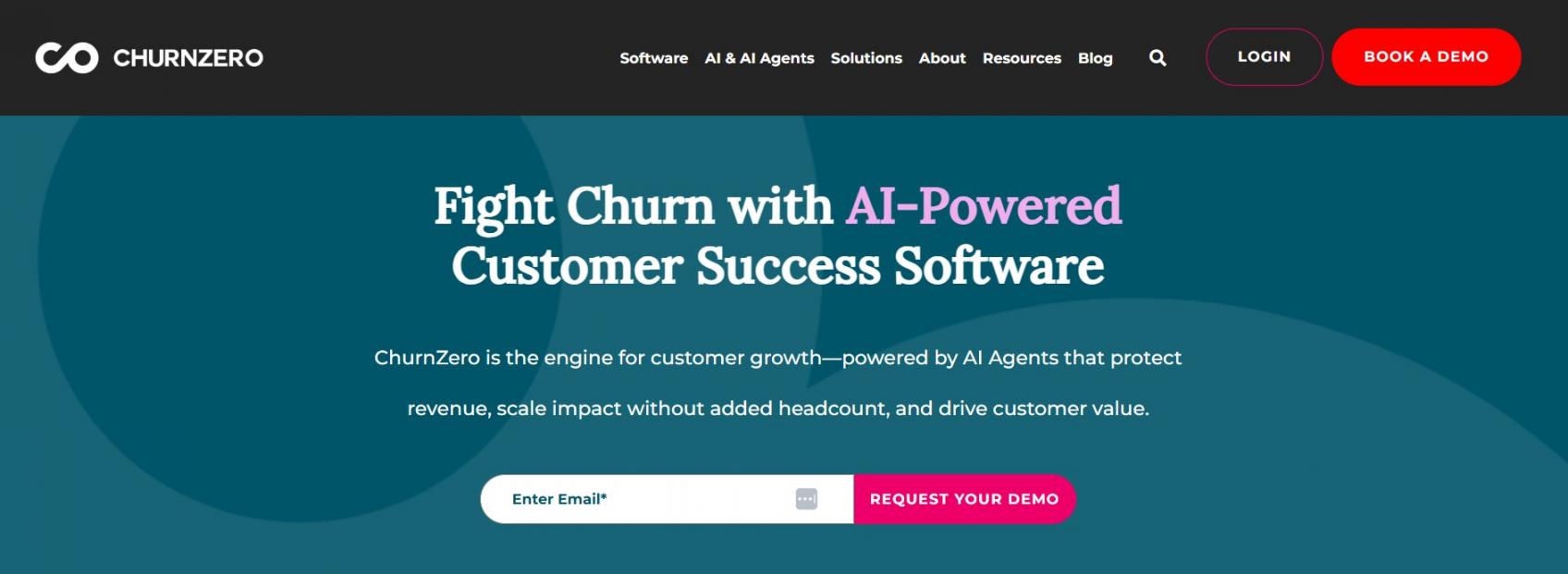
Image via ChurnZero
ChurnZero is an excellent customer retention software solution for mid-market SaaS success teams seeking enterprise-level insights without the complexity of an enterprise-level system. It combines real-time health scoring and in-app messaging, enabling teams to respond to risks immediately. Buyers consistently praise how quickly it gets up and running.
Key Features
- Real-time health scores: See account risk update as usage changes
- In-app messaging: Reach users inside your product, where it counts
- Automated playbooks: Standardize retention and onboarding motions
- Renewal and forecasting: Track upcoming renewals and at-risk revenue
Pros
- Faster to deploy and easier to use than heavier rivals
- Strong in-app engagement tools for product-led teams
- Excellent user reviews for support and value
Cons
- Less enterprise depth than the largest platforms
- Quote-based pricing reduces upfront transparency
- Very large books of business may outgrow it
Pricing
Contact Sales
Tool Level
- ChurnZero fits mid-market B2B SaaS companies with a growing customer success team that needs structure without a long rollout.
Usability
- This is one of ChurnZero's strengths. Teams report a quick setup and an intuitive interface, which means success managers spend time on customers rather than admin.
Pro Tip: Use in-app messages to nudge customers toward the features that correlate with renewal, so your retention play improves adoption at the same time.
6. Userpilot
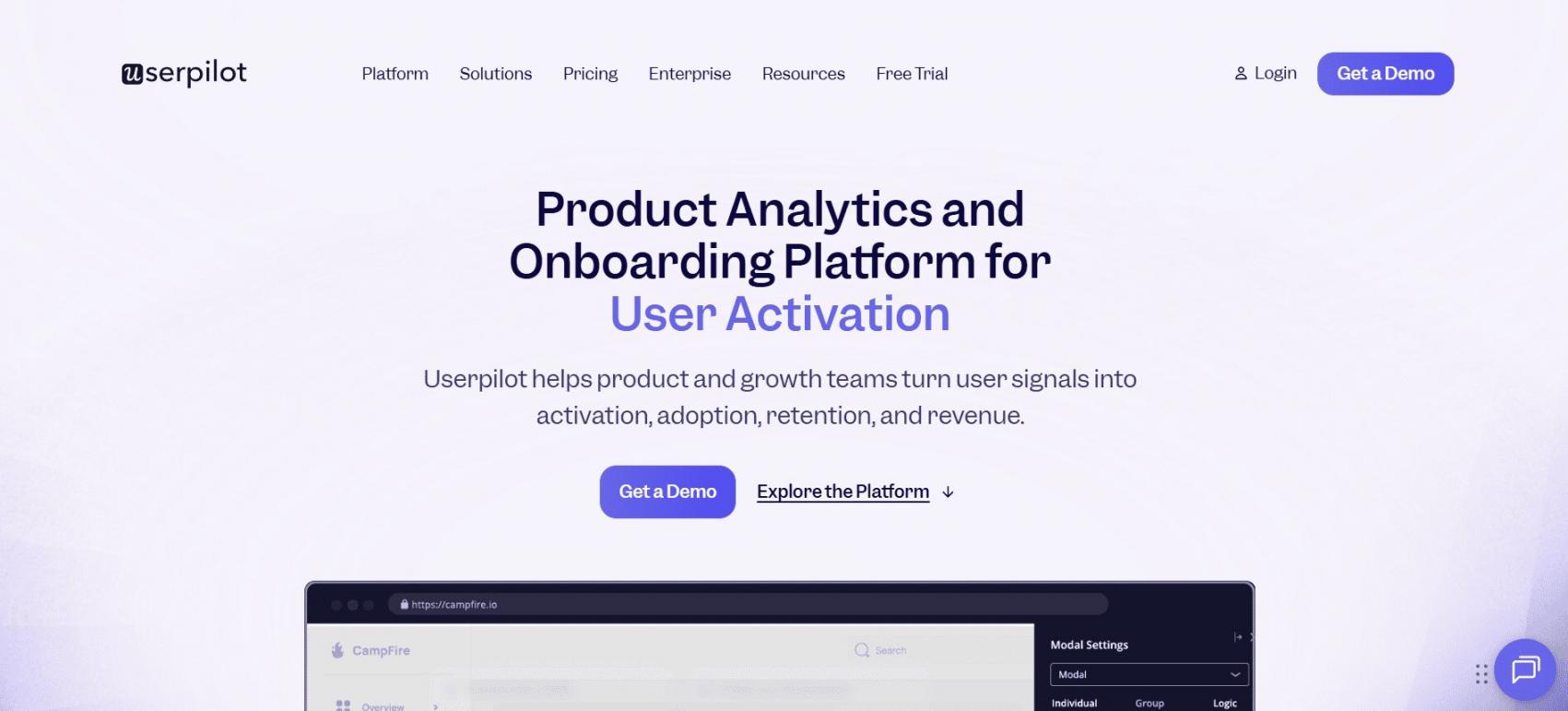
Image via Userpilot
Userpilot is the best customer retention software for product-led teams focused on driving in-app retention. It offers in-app onboarding, feature prompts, and behavior analysis, which help to keep users engaged at moments when they are most likely to drop off. For SaaS products, adoption is retention, and Userpilot addresses that connection directly.
Key Features
- In-app onboarding: Guide new users to value without engineering work
- Feature adoption flows: Surface underused features that drive retention
- Behavior analytics: See where users drop off and act on it
- In-app surveys: Capture customer feedback and NPS in context
Pros
- No-code builder ships flows fast
- Strong analytics tie engagement to retention
- Excellent fit for product-led growth motions
Cons
- Not a full CRM or customer success suite
- Usage-based pricing scales with active users
- Best results need a clear adoption strategy behind them
Pricing
- Starter: $299/month
- Growth: $849/month
- Enterprise: Contact Sales
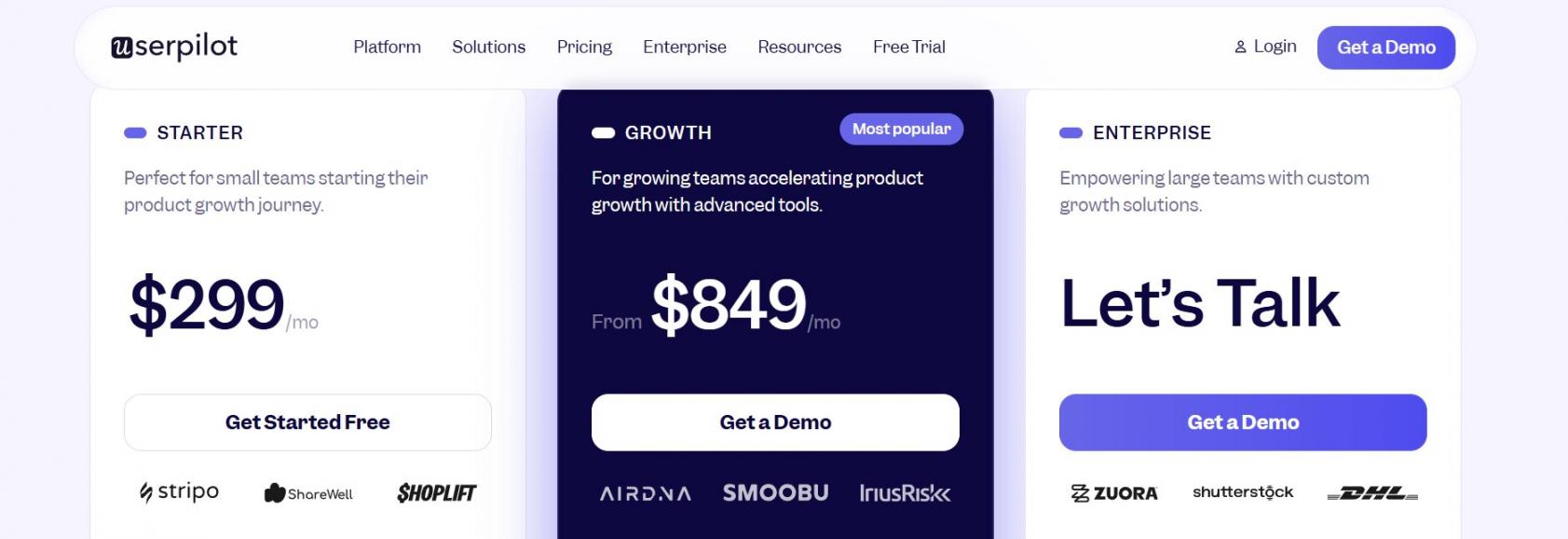
Image via Userpilot
Tool Level
- Userpilot fits B2B SaaS and product-led teams that want to improve onboarding and adoption without building flows in-house.
Usability
- The no-code editor is user-friendly, and most teams can launch their first flow almost immediately. Although extracting full value requires a carefully crafted adoption plan, the tool itself rarely gets in the way.
Pro Tip: Figure out the exact actions your customers take when they decide to stay with your product long-term. Then, build a welcome process (onboarding) that guides new users to take those exact actions during their very first week. Getting customers hooked early is the most powerful way to keep them forever.
7. Smile.io
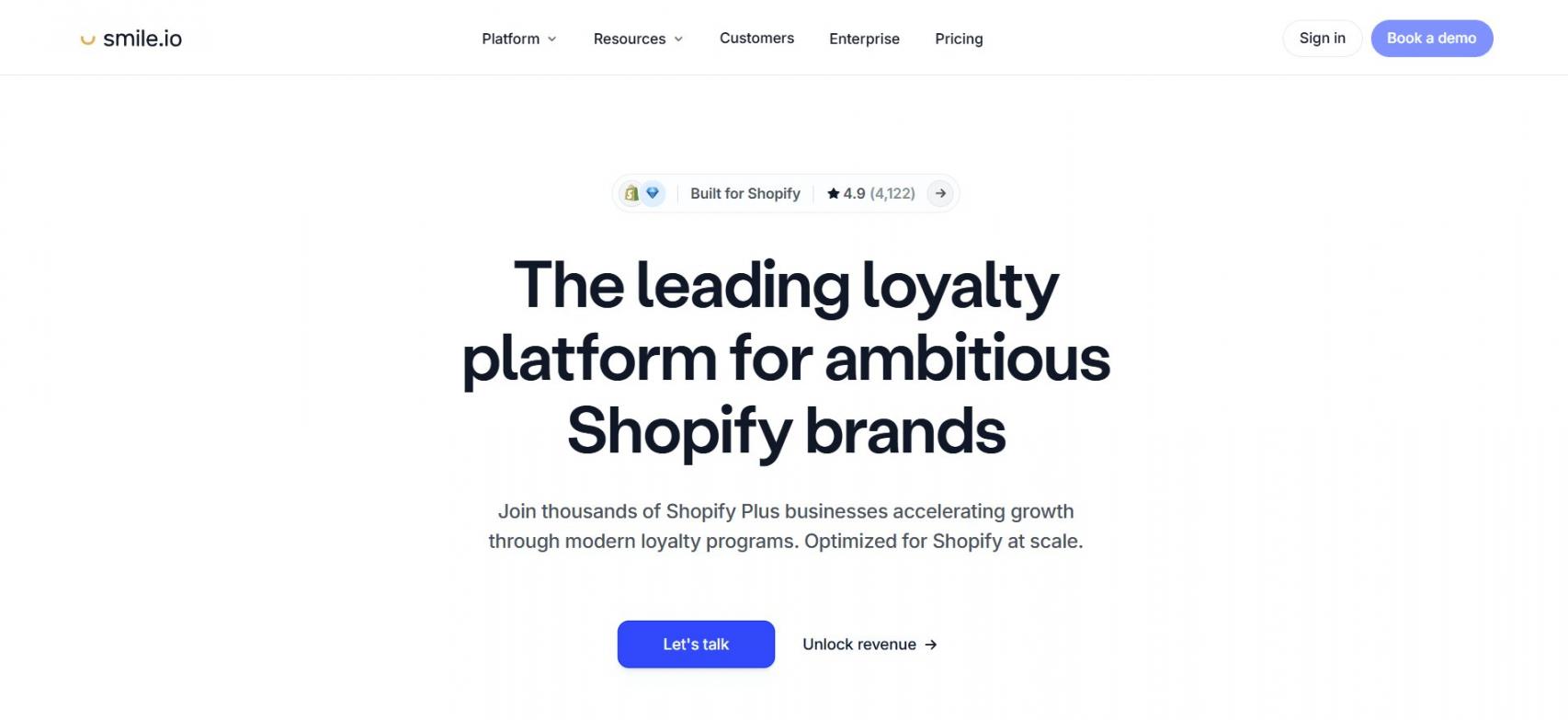
Image via Smile.io
Smile.io is the best customer retention software for ecommerce brands that use loyalty and rewards to keep their customers. It offers points, VIP tiers, and referral programs on Shopify and other platforms, making it easy to convert one-time buyers into regular customers. This is the easiest way for DTC stores to get repeat purchases.
Key Features
- Points programs: Reward purchases and actions to drive repeat orders
- VIP tiers: Give your best customers status and perks
- Referral programs: Turn happy buyers into a low-cost acquisition channel
- Integrations: Connect with major ecommerce and email tools
Pros
- Quick to launch on Shopify with little setup
- Proven lift in repeat purchases and customer lifetime value
- Clean, approachable interface for small teams
Cons
- Focused on ecommerce, so it is not a fit for B2B SaaS
- Advanced features sit in higher-priced tiers
- Deep customization can require a higher plan or apps
Pricing
Smile.io offers a two-tiered pricing model.
For Startups:
- Free
- Essential: $15/month
- Standard: $79/month
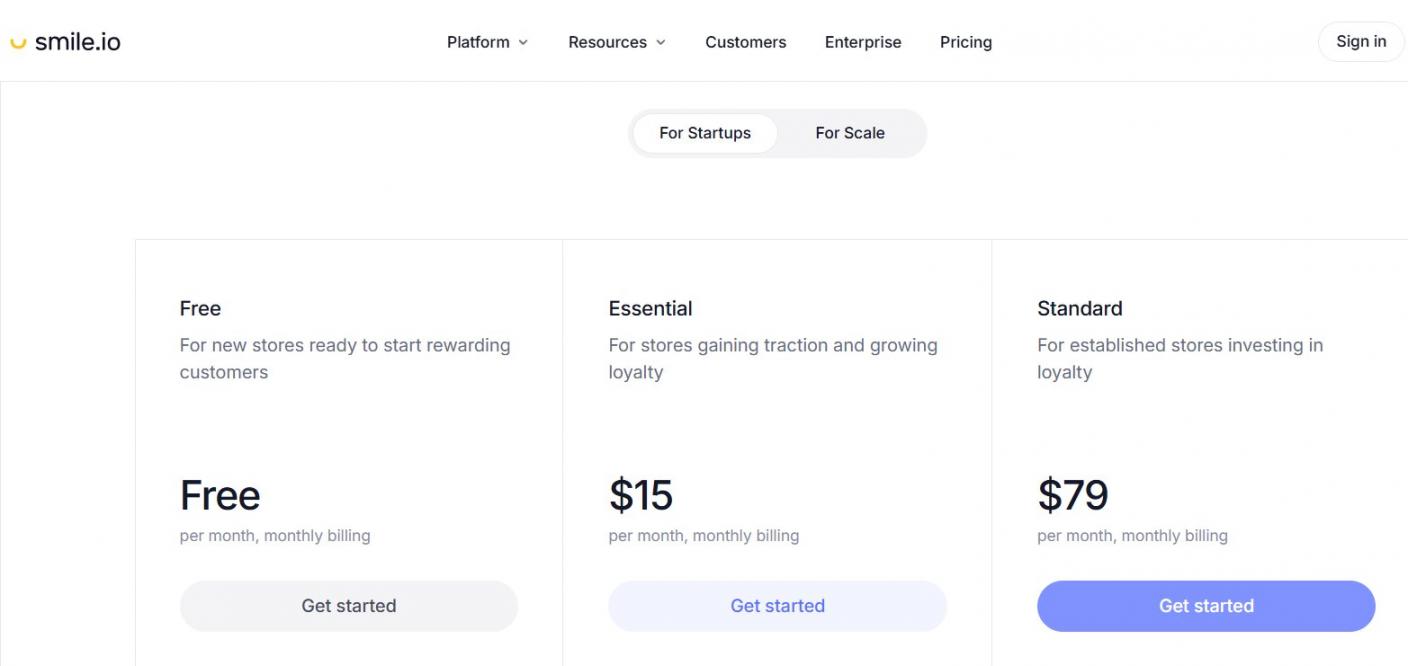
Image via Smile.io
For Scale:
- Growth: $199/month
- Plus: $999/month
- Enterprise: Contact Sales
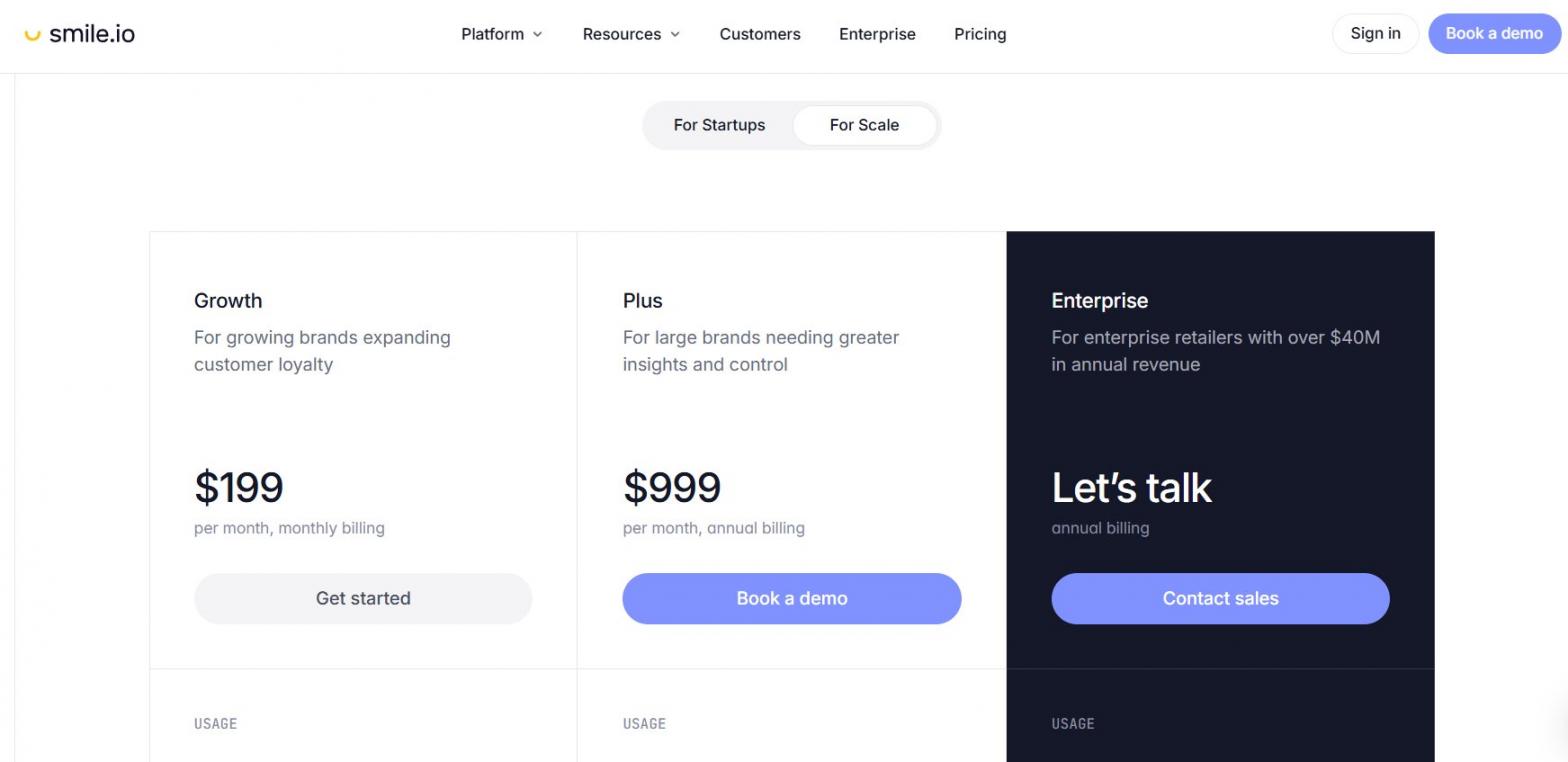
Image via Smile.io
Tool Level
- Smile.io is designed for ecommerce and DTC brands, from small Shopify stores on the free plan to established retailers on the Pro plan.
Usability
- Smile.io is one of the easiest tools on this list to get running. Most online shops can set up a rewards points program almost instantly, and the widget your customers see on your website requires very little upkeep.
Pro Tip: Pair your points program with a referral reward. That way, every time a customer redeems a reward, they bring in a new customer. To round out the stack, see my guide to referral marketing software.
Which Customer Retention Metrics Matter Most?
The metrics that matter are the ones that tell you whether retention is improving and where it leaks. Good customer retention software tracks these for you, but you should know what each one means. Watch the leading indicators, not just the lagging ones.
| Metric | What it measures |
|---|---|
| Customer retention rate | The share of customers you keep over a period |
| Churn rate | The share of customers who leave over a period |
| Net revenue retention (NRR) | Revenue kept and expanded from existing customers |
| Gross revenue retention (GRR) | Revenue kept before any expansion |
| Customer lifetime value (CLV) | Total revenue a customer generates over time |
| Repeat purchase rate | How often customers buy again |
Health and usage signals are leading indicators, since they move before a customer cancels. Churn is a lagging indicator because by the time it shows up, the customer is already gone. The point of retention software is to act on the leading signals while you still can.
For context on the broader numbers, the SaaS benchmarks above are a useful yardstick. If you sell online, my breakdown of ecommerce KPIs covers the retention metrics that matter for stores. My guide to email marketing metrics helps you track engagement, too.
Start with net revenue retention if you sell subscriptions, and repeat purchase rate if you sell products. Both tell you whether customers are staying and spending more.
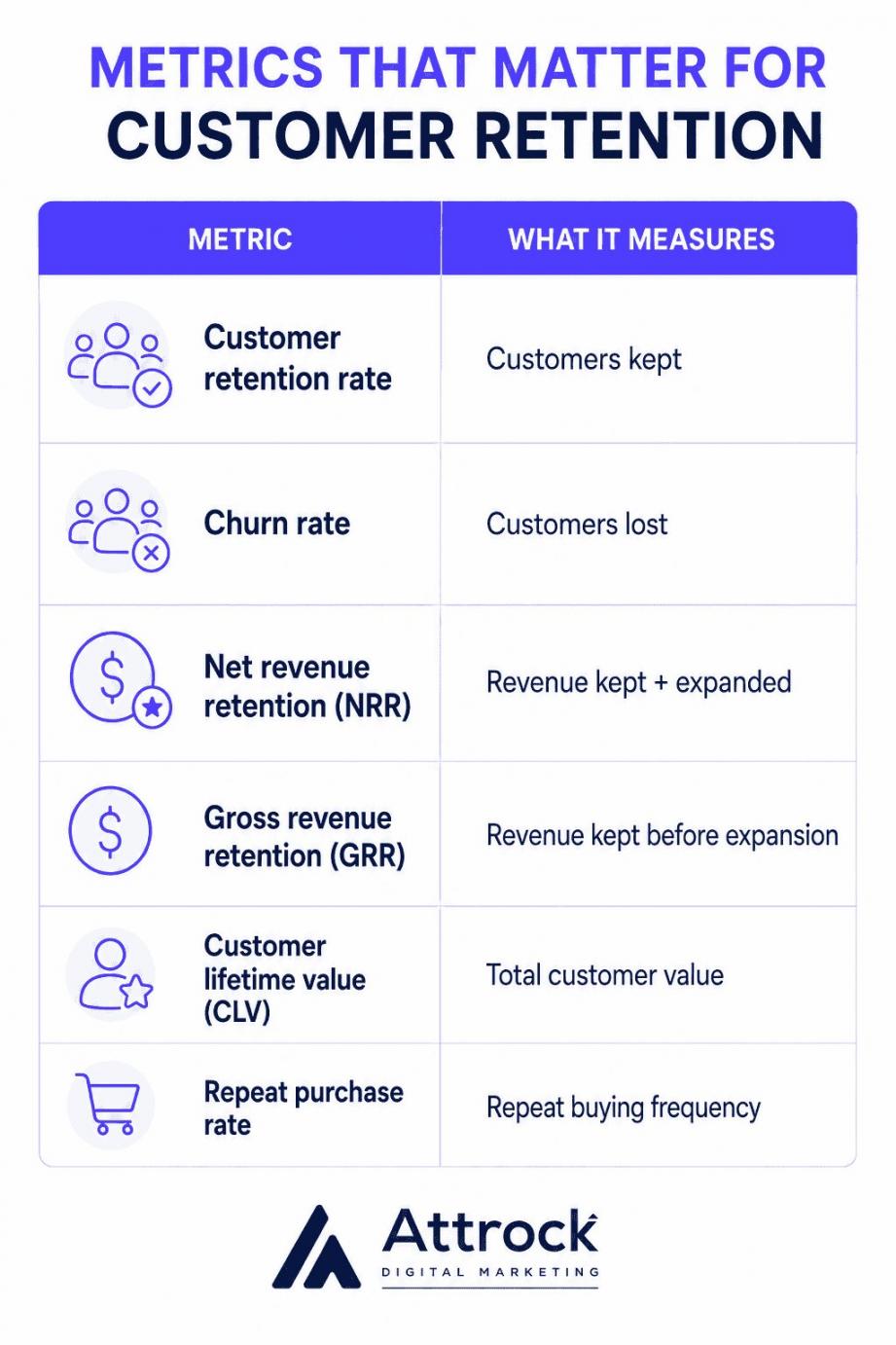
Image via Attrock
Which Customer Retention Software Trends Will Shape 2026?
The biggest shift in 2026 is that retention software is getting predictive and proactive by default. Three trends stand out, and each one favors tools that act before a customer leaves rather than after.
First, AI churn prediction is moving from an add-on to the core of the product. Now, new software platforms are built entirely around using AI to spot unhappy or inactive customers early, forcing older tools to catch up.
Second, the unified customer view is becoming the entry ticket. When data is split across different systems, it is easy to miss the warning signs that a customer is getting frustrated. Businesses now expect a single profile that combines a customer's product usage with their support history.
Third, retention is moving inside the product. To get customers hooked, you have to help them at the exact moment they are using your product. Because of this, software tools that build onboarding prompts, helpful hints, and quick surveys directly inside the app are growing the fastest. To see how this connects to acquisition, my guide to the benefits of retargeting is a useful companion.
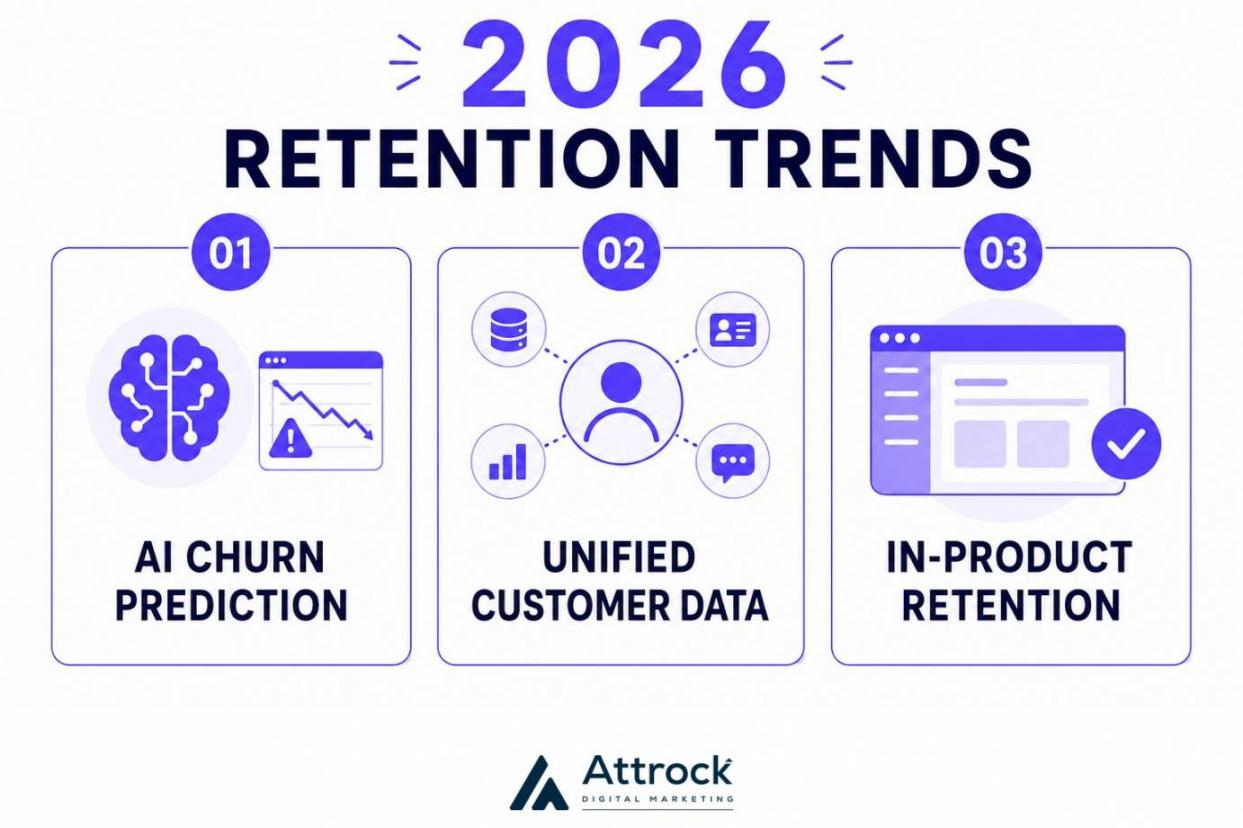
Image via Attrock
AI is making churn prediction standard, unified data is becoming the baseline, and retention is shifting into the product itself.
FAQ
Q1. What is customer retention software?
A. A customer retention software solution is a tool that helps you keep existing customers engaged and loyal. It tracks customer data, scores account health, predicts churn, and automates re-engagement. That helps you reduce cancellations and grow repeat revenue from the customers you already have.
Q2. What are customer retention tools?
A. Customer retention tools come in several forms. They cover everything from multifunctional Customer Relationship Management (CRM) software such as HubSpot to customer success tools like Gainsight and ChurnZero, product-adoption tools like Userpilot, and loyalty platforms like Smile. io. Each of them retains customers differently: through service success, adoption, or rewards.
Q3. Is a CRM the same as customer retention software?
A. They are not quite the same. A CRM is a database of customer relationships and history. Retention software, on the other hand, focuses on activity around the customer, keeping them by scoring health and forecasting churn. It's pretty common for CRMs, such as HubSpot, to now have retention features, so these categories overlap more and more each year.
Q4. What are the 8 C's of customer retention?
A. The 8 Cs can be summed up as consistency, customization, convenience, communication, competency, contact, community, and care. Think of them as the checklist for keeping your customers happy. Together, they create an experience that makes people want to stick around. Good retention software helps you handle several of them automatically as your business grows.
Q5. How much does customer retention software cost?
A. The price varies a lot depending on your business size. You can get started for free with basic tools from HubSpot or Smile.io. For small- to medium-sized businesses, complete software suites like Zoho cost around $57 per user per month. Large corporations using advanced customer platforms like Gainsight get custom pricing that can easily run into tens of thousands of dollars a year.
Q6. Is there free customer retention software?
A. Yes. Tools like HubSpot offer a free CRM with basic customer service tools, and Smile.io has a free loyalty program for new online stores. These free options are great for small teams, but you will probably need to upgrade to a paid plan as your business and customer list grow.
Q7. What is the best customer retention software for small businesses?
A. For most small businesses, HubSpot is the best choice. Its free plan combines customer service, marketing, and a CRM (customer tracker) all in one place. If you run an online shop, Smile.io is usually better for building customer loyalty. If you want a complete set of business tools for a lower price, Zoho CRM Plus is a great value option.
Q8. Does HubSpot help with customer retention?
A. Yes. HubSpot's Service Hub includes options such as customer health scores, retention insights, and real-time data tracking that integrate directly with its free Smart CRM. This setup makes it easy to spot accounts at risk of leaving, so you can automatically reach out to them.
Q9. How do you measure customer retention?
A. You track a few key metrics like retention rate, churn rate, total customer value, and net revenue. Subscription-based businesses usually focus on net revenue retention to see if their current users are spending more money over time. Online shops prefer to look at repeat purchase rates to see how many people come back for a second purchase. Most customer retention software calculates all of these numbers for you automatically.
Q10. Can customer retention software predict churn?
A. Yes. Modern tools use AI to rate your customers' account health and flag people who are at risk of leaving before they actually cancel. The software looks for warning signs, such as customers using the tool less often, submitting lots of support tickets, or ignoring your emails, so your team can step in and help while there is still time to save the account.
Final Thoughts
The best customer retention software is the one that fits your model. For most teams, HubSpot offers a comprehensive starting point. If you’re considering your options, a good rule of thumb is to base your decision on how you actually keep customers. Let your business model, not a feature list, lead the decision.
Retention is the cheapest growth you will ever buy, so the tool you choose should pay for itself in saved revenue. Want help turning more of your traffic and customers into lasting revenue? Explore Attrock's conversion rate optimization services to put the strategy into motion.
You may also check out HubSpot’s comprehensive customer retention solutions for free to see if it’s the perfect fit for your team.
Disclaimer: This content contains some affiliate links for which we will earn a commission (at no additional cost to you). This is to ensure that we can keep creating free content for you.